Entering into a marriage is often a joyful and exciting time, but it can also bring about important financial considerations. In Connecticut, couples can utilize a prenuptial agreement to clearly outline their financial rights and responsibilities before tying the knot. This legal document serves as a proactive measure, allowing partners to discuss and agree upon the division of assets, debts, and other financial matters in the event of a divorce or separation. A well-crafted prenuptial agreement can address various aspects, such as property ownership, spousal support, and the management of future earnings. It also provides a framework for resolving potential disputes, fostering open communication about finances. By understanding the key components of the Connecticut Prenuptial Agreement form, couples can better prepare for their future together while safeguarding their individual interests.
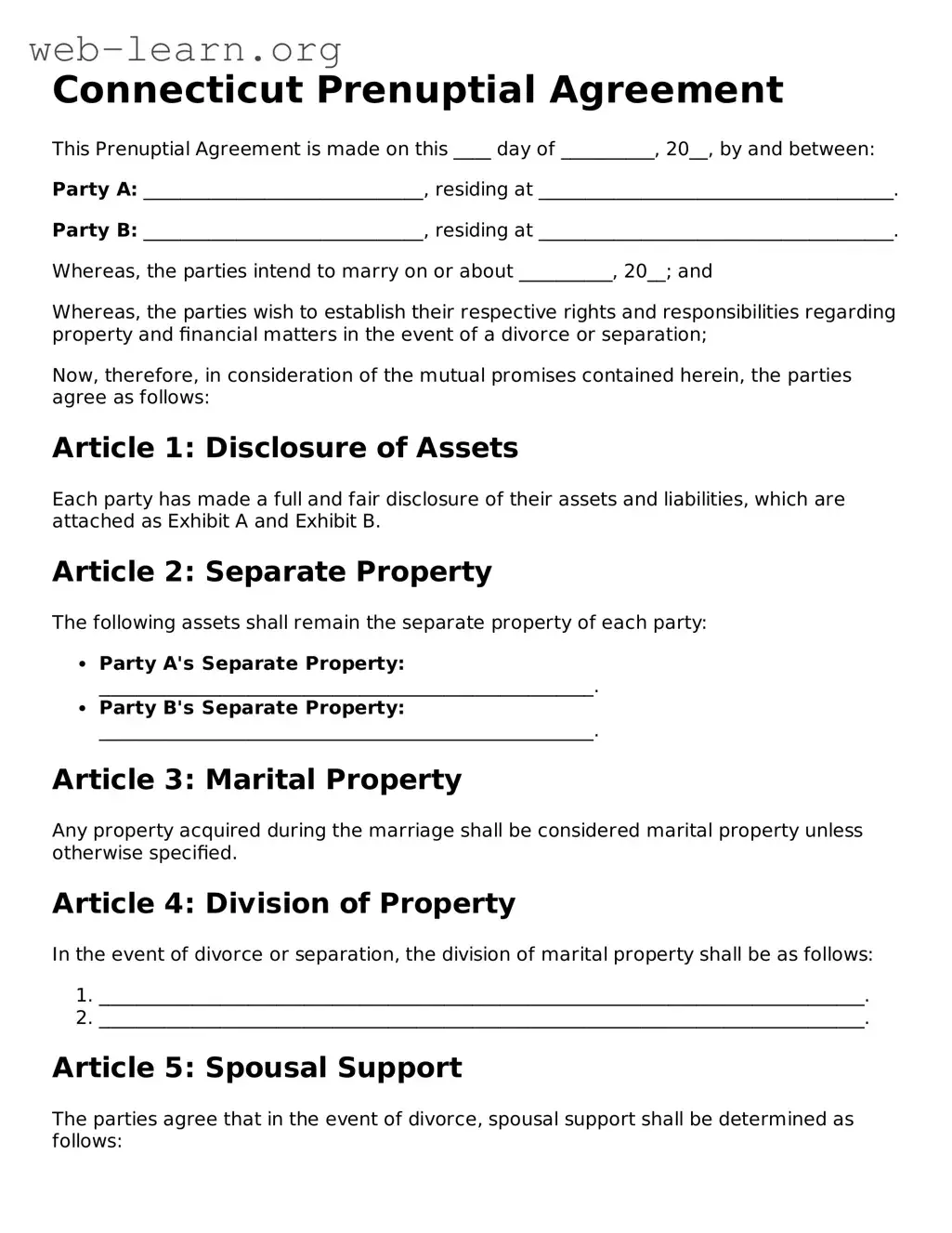
Connecticut Prenuptial Agreement
This Prenuptial Agreement is made on this ____ day of __________, 20__, by and between:
Party A: ______________________________, residing at ______________________________________.
Party B: ______________________________, residing at ______________________________________.
Whereas, the parties intend to marry on or about __________, 20__; and
Whereas, the parties wish to establish their respective rights and responsibilities regarding property and financial matters in the event of a divorce or separation;
Now, therefore, in consideration of the mutual promises contained herein, the parties agree as follows:
Article 1: Disclosure of Assets
Each party has made a full and fair disclosure of their assets and liabilities, which are attached as Exhibit A and Exhibit B.
Article 2: Separate Property
The following assets shall remain the separate property of each party:
Article 3: Marital Property
Any property acquired during the marriage shall be considered marital property unless otherwise specified.
Article 4: Division of Property
In the event of divorce or separation, the division of marital property shall be as follows:
Article 5: Spousal Support
The parties agree that in the event of divorce, spousal support shall be determined as follows:
Article 6: Governing Law
This agreement shall be governed by the laws of the State of Connecticut.
Article 7: Amendments
This agreement may be amended only by a written document signed by both parties.
Article 8: Severability
If any provision of this agreement is found to be invalid or unenforceable, the remaining provisions shall continue in full force and effect.
IN WITNESS WHEREOF, the parties have executed this Prenuptial Agreement as of the date first above written.
Party A Signature: ________________________________ Date: ____________
Party B Signature: ________________________________ Date: ____________
Witness Signature: ________________________________ Date: ____________
Witness Signature: ________________________________ Date: ____________
| Fact Name | Details |
|---|---|
| Governing Law | Connecticut General Statutes § 46b-36 |
| Purpose | To outline the division of assets and debts in the event of divorce or separation. |
| Enforceability | A prenuptial agreement must be in writing and signed by both parties to be enforceable. |
| Disclosure Requirement | Both parties must fully disclose their financial situations before signing the agreement. |
| Modification | The agreement can be modified or revoked at any time by mutual consent of both parties. |
Filling out the Connecticut Prenuptial Agreement form requires careful attention to detail. This process ensures that both parties clearly understand their rights and obligations before entering into marriage.
After completing these steps, each party should keep a copy of the signed agreement for their records. It is advisable to consult with a legal professional to ensure that the agreement meets all legal requirements and adequately protects both parties' interests.
A prenuptial agreement, often called a prenup, is a legal document created by two individuals before they marry. This agreement outlines how assets and debts will be divided in the event of divorce or separation. It can also address issues such as spousal support and property rights.
Having a prenuptial agreement can provide several advantages:
For a prenuptial agreement to be considered valid in Connecticut, it must meet certain criteria:
Yes, a prenuptial agreement can be modified or revoked after marriage. Both parties must agree to the changes, and any modifications should be made in writing. It is advisable to consult with legal counsel to ensure that the revised agreement complies with Connecticut law and is enforceable.
When individuals approach the process of completing a Connecticut Prenuptial Agreement form, they often overlook critical details that can significantly impact the validity and enforceability of the agreement. One common mistake is failing to disclose all assets and liabilities fully. Transparency is essential in these agreements. If one party conceals significant financial information, it can lead to disputes later on, undermining the very purpose of the prenuptial arrangement.
Another frequent error involves inadequate understanding of the legal implications of the agreement. Many individuals assume that simply signing the document will protect their interests. However, without a clear understanding of the terms and conditions, parties may inadvertently agree to unfavorable provisions. This lack of comprehension can result in unintended consequences during divorce proceedings, where the prenuptial agreement is challenged in court.
Additionally, the timing of when the prenuptial agreement is presented can pose challenges. It is crucial that both parties have ample time to review the agreement before the wedding. If one party presents the agreement just days before the ceremony, it may lead to claims of coercion or duress. Such claims can jeopardize the agreement's enforceability, making it essential to approach the process with consideration and respect for both parties' needs.
Lastly, neglecting to seek legal advice is a significant misstep. While some may believe they can navigate the process independently, consulting with a qualified attorney can provide invaluable insights. Legal professionals can help clarify complex terms, ensure compliance with state laws, and tailor the agreement to fit the specific needs of both parties. Skipping this step can lead to poorly constructed agreements that fail to protect the interests of either individual.
When preparing for a marriage, couples often consider various legal documents to ensure their interests are protected. Along with a Connecticut Prenuptial Agreement, several other forms and documents may be relevant. Each serves a unique purpose and can help clarify expectations and responsibilities within the marriage.
Understanding these documents can help couples navigate their financial and legal responsibilities more effectively. By considering these forms alongside a prenuptial agreement, partners can foster a transparent and secure foundation for their marriage.
The Prenuptial Agreement form shares similarities with several other legal documents. Each of these documents serves a specific purpose and addresses various aspects of personal and financial relationships. Below is a list detailing these similarities:
When filling out the Connecticut Prenuptial Agreement form, it is important to follow certain guidelines to ensure the document is valid and effective. Here are six things to consider:
When considering a prenuptial agreement in Connecticut, it’s easy to encounter various misconceptions. Understanding these myths can help couples navigate their options more effectively. Here’s a look at seven common misunderstandings regarding the Connecticut Prenuptial Agreement form:
This is a widespread belief, but prenuptial agreements can benefit couples of all financial backgrounds. They provide clarity and protection for both parties, regardless of their financial status.
While it’s true that prenuptial agreements are binding, they can be modified. Both parties must agree to any changes, and it’s best to put those changes in writing.
On the contrary, having a prenuptial agreement can actually strengthen a marriage. It encourages open communication about finances and expectations, which can lead to a healthier relationship.
Many people assume that only those who have been married before need a prenuptial agreement. In reality, any couple can benefit from discussing their financial future and protecting their assets.
Prenuptial agreements can cover much more than just asset division. They can address debt responsibilities, spousal support, and even future financial goals.
While it’s highly recommended for both individuals to seek legal advice, it is not a strict requirement for the agreement to be valid. However, having independent legal counsel can help ensure fairness and clarity.
This misconception ignores the fact that prenuptial agreements are available to all couples, regardless of sexual orientation. The law recognizes the rights of same-sex couples in the same way it does for heterosexual couples.
By debunking these myths, couples can approach the idea of a prenuptial agreement with a clearer understanding, leading to informed decisions that align with their values and circumstances.
Here are some key takeaways about filling out and using the Connecticut Prenuptial Agreement form:
By keeping these points in mind, individuals can create a prenuptial agreement that is clear and beneficial for both parties.
California Prenup - This document can help couples navigate the complexities of merging finances.
Alabama Prenup - A prenuptial agreement can be revised or updated as circumstances change.
Arizona Prenup - This document can clarify how retirement accounts will be handled.
Oregon Prenup - A prenuptial agreement can specify how to handle financial support for children from previous relationships.