In Connecticut, the Power of Attorney form serves as a crucial legal document that allows individuals to appoint someone else to make decisions on their behalf. This form can cover a wide range of responsibilities, including financial matters, healthcare decisions, and real estate transactions. It is important to understand that the person you designate, known as the agent or attorney-in-fact, will have the authority to act in your best interest, but they must also adhere to the guidelines you establish. The form can be tailored to be either general or specific, depending on your needs. Additionally, it can be effective immediately or set to activate only under certain conditions, such as incapacitation. Understanding these aspects can help ensure that your wishes are honored and that the right person is entrusted with your affairs when you are unable to manage them yourself.
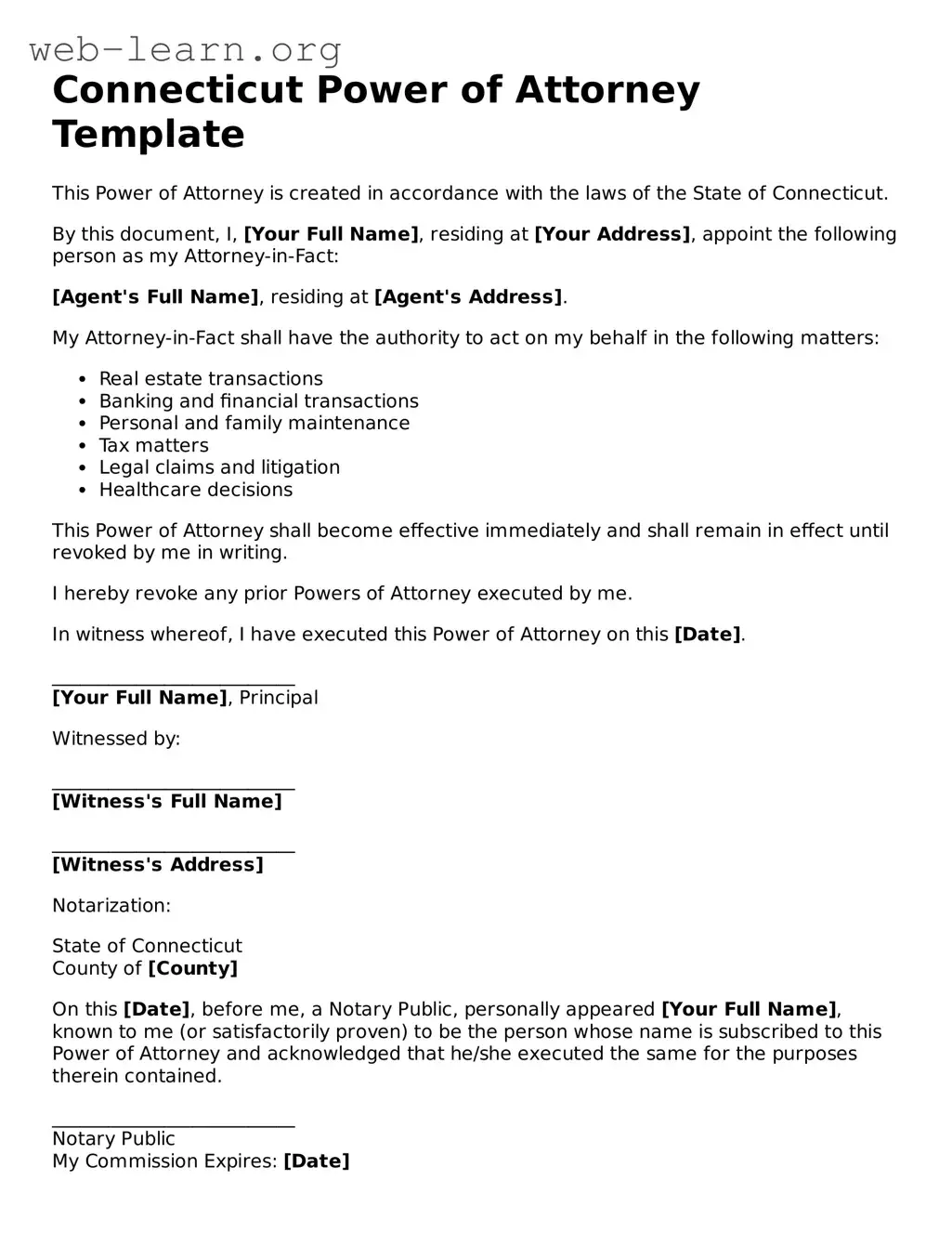
Connecticut Power of Attorney Template
This Power of Attorney is created in accordance with the laws of the State of Connecticut.
By this document, I, [Your Full Name], residing at [Your Address], appoint the following person as my Attorney-in-Fact:
[Agent's Full Name], residing at [Agent's Address].
My Attorney-in-Fact shall have the authority to act on my behalf in the following matters:
This Power of Attorney shall become effective immediately and shall remain in effect until revoked by me in writing.
I hereby revoke any prior Powers of Attorney executed by me.
In witness whereof, I have executed this Power of Attorney on this [Date].
__________________________
[Your Full Name], Principal
Witnessed by:
__________________________
[Witness's Full Name]
__________________________
[Witness's Address]
Notarization:
State of Connecticut
County of [County]
On this [Date], before me, a Notary Public, personally appeared [Your Full Name], known to me (or satisfactorily proven) to be the person whose name is subscribed to this Power of Attorney and acknowledged that he/she executed the same for the purposes therein contained.
__________________________
Notary Public
My Commission Expires: [Date]
| Fact Name | Description |
|---|---|
| Definition | A Power of Attorney (POA) in Connecticut is a legal document that allows one person to authorize another to act on their behalf in legal or financial matters. |
| Governing Law | The Connecticut Power of Attorney is governed by Connecticut General Statutes, Title 1, Chapter 13, specifically sections 1-42 to 1-56. |
| Types of POA | Connecticut recognizes several types of POA, including Durable, Springing, and Limited Powers of Attorney, each serving different purposes. |
| Durable POA | A Durable Power of Attorney remains effective even if the principal becomes incapacitated, ensuring that the agent can continue to make decisions. |
| Springing POA | A Springing Power of Attorney only becomes effective upon the occurrence of a specified event, such as the principal's incapacitation. |
| Agent's Authority | The agent's authority can be broad or limited based on the principal's preferences outlined in the document. |
| Signing Requirements | The Power of Attorney must be signed by the principal and acknowledged before a notary public to be valid in Connecticut. |
| Revocation | The principal can revoke a Power of Attorney at any time as long as they are mentally competent, which must be done in writing. |
| Agent's Duties | The agent has a fiduciary duty to act in the best interests of the principal, ensuring transparency and accountability in all actions taken. |
| Limitations | Some actions, such as making a will or altering a trust, cannot be granted through a Power of Attorney, as they require specific legal formalities. |
Once you have the Connecticut Power of Attorney form, you can begin filling it out. Follow these steps carefully to ensure the document is completed correctly.
After completing the form, make copies for your records and provide a copy to your agent. It’s also wise to share copies with any relevant institutions, such as banks or healthcare providers, where your agent may need to act on your behalf.
A Power of Attorney is a legal document that allows one person, known as the principal, to grant another person, called the agent or attorney-in-fact, the authority to act on their behalf. This can include making financial decisions, managing property, or handling legal matters. The principal can specify the extent of the agent's powers, which can be broad or limited to specific tasks.
There are several reasons a person may choose to establish a Power of Attorney. It can be particularly useful in situations where the principal may become incapacitated or unable to manage their affairs due to illness, injury, or other reasons. Additionally, a POA can facilitate smoother financial transactions, such as managing bank accounts or selling property, especially when the principal is unavailable.
Connecticut recognizes several types of Power of Attorney, including:
To create a Power of Attorney in Connecticut, follow these steps:
While it is not legally required to have a lawyer when creating a Power of Attorney, consulting with one can be beneficial. A legal professional can help ensure that the document meets all legal requirements, reflects your wishes accurately, and addresses any specific concerns you may have.
Yes, you can revoke a Power of Attorney at any time, as long as you are mentally competent. To do so, you must create a written revocation document, sign it, and notify your agent and any institutions that may have relied on the original Power of Attorney. It's advisable to keep a copy of the revocation for your records.
If you become incapacitated without a Power of Attorney in place, your loved ones may need to go through a court process to obtain guardianship or conservatorship over your affairs. This process can be time-consuming, costly, and may not reflect your personal wishes. Having a Power of Attorney can help avoid this situation.
A Power of Attorney created in Connecticut is generally valid in other states, but it is important to check the specific laws of the state where it will be used. Some states may have different requirements or may require additional documentation. It is wise to consult with a legal professional if you plan to use your Connecticut POA in another state.
Filling out the Connecticut Power of Attorney form can be a straightforward process, yet many individuals encounter pitfalls that can lead to complications down the line. One common mistake is failing to specify the powers granted. The form allows for a range of authorities, from managing finances to making healthcare decisions. When a person simply checks off general powers without clear definitions, it can create confusion about what the agent is truly authorized to do.
Another frequent error is neglecting to date the document. A Power of Attorney must be dated to establish when the authority begins. Without a date, the validity of the form may be questioned, potentially leading to delays or disputes. This simple oversight can have significant implications, especially in urgent situations where decisions need to be made quickly.
People often overlook the importance of notarization and witness signatures. In Connecticut, the Power of Attorney form requires the signature of the principal to be notarized. Additionally, having a witness present can further validate the document. Skipping this step can render the form ineffective, leaving the agent without the legal authority to act on behalf of the principal.
Another mistake involves not discussing the choice of agent with the selected individual beforehand. It’s essential to choose someone trustworthy and capable of handling the responsibilities that come with the role. Failing to communicate with the agent can lead to misunderstandings about their willingness to serve, potentially resulting in a situation where the agent is unprepared or unwilling to take on the responsibilities.
Additionally, individuals sometimes forget to review the form after completing it. Even minor errors, such as incorrect names or addresses, can invalidate the document. Taking the time to double-check all information ensures that the Power of Attorney accurately reflects the principal's intentions and is legally sound.
Finally, many people do not consider the implications of revoking a Power of Attorney. If circumstances change and a principal wishes to revoke the authority granted to an agent, they must follow the proper procedures. Failing to formally revoke a Power of Attorney can lead to confusion and potential misuse of authority by the agent. Understanding how to properly manage and update the document is crucial for maintaining control over personal affairs.
When preparing a Power of Attorney in Connecticut, several other forms and documents may also be necessary to ensure comprehensive management of your affairs. Each of these documents serves a specific purpose, complementing the Power of Attorney and providing clarity in various situations.
Understanding these documents and their roles can significantly ease the process of managing your legal and financial affairs. Ensuring all necessary forms are in place provides peace of mind and clarity for you and your loved ones.
The Power of Attorney (POA) form is a vital legal document that allows one person to act on behalf of another in various matters. However, there are several other documents that share similarities with the Power of Attorney. Here’s a list of ten such documents, along with a brief explanation of how they relate to a POA.
Each of these documents serves a unique purpose but shares the common theme of empowering one person to act on behalf of another. Understanding these similarities can help individuals make informed decisions about their legal and financial planning.
When preparing to fill out the Connecticut Power of Attorney form, it's essential to approach the task with care. This document grants someone else the authority to make decisions on your behalf. Here are some important dos and don’ts to keep in mind:
By following these guidelines, you can help ensure that your Power of Attorney form is completed correctly and serves your intended purpose effectively.
Understanding the Connecticut Power of Attorney form is crucial for making informed decisions. However, several misconceptions can lead to confusion. Here are four common misunderstandings:
This is not true. While many people associate a Power of Attorney primarily with financial decisions, it can also cover healthcare decisions. You can designate someone to make medical choices on your behalf if you become unable to do so.
This misconception can cause unnecessary worry. In reality, you can revoke a Power of Attorney at any time, as long as you are mentally competent. It’s essential to inform your agent and any relevant institutions about the revocation.
This belief is misleading. People of all ages can benefit from having a Power of Attorney. Unexpected events, such as accidents or sudden illnesses, can occur at any time, making it important for everyone to consider this legal document.
This is incorrect. A Power of Attorney can specify the extent of the authority granted. You can limit the powers to specific tasks or decisions, ensuring that your wishes are respected and that your agent acts within the defined boundaries.
By addressing these misconceptions, individuals can better understand the importance and functionality of the Connecticut Power of Attorney form. It is a valuable tool for planning and ensuring that your preferences are honored, regardless of your circumstances.
Filling out and using the Connecticut Power of Attorney form is an important step in managing your financial and legal affairs. Here are some key takeaways to keep in mind:
By keeping these points in mind, you can ensure that your Power of Attorney serves its intended purpose effectively.
Printable Power of Attorney Form Louisiana - It can be a temporary measure during recovery from illness or surgery.
Power of Attorney Document - A Power of Attorney can ease the burden on family members during difficult times.