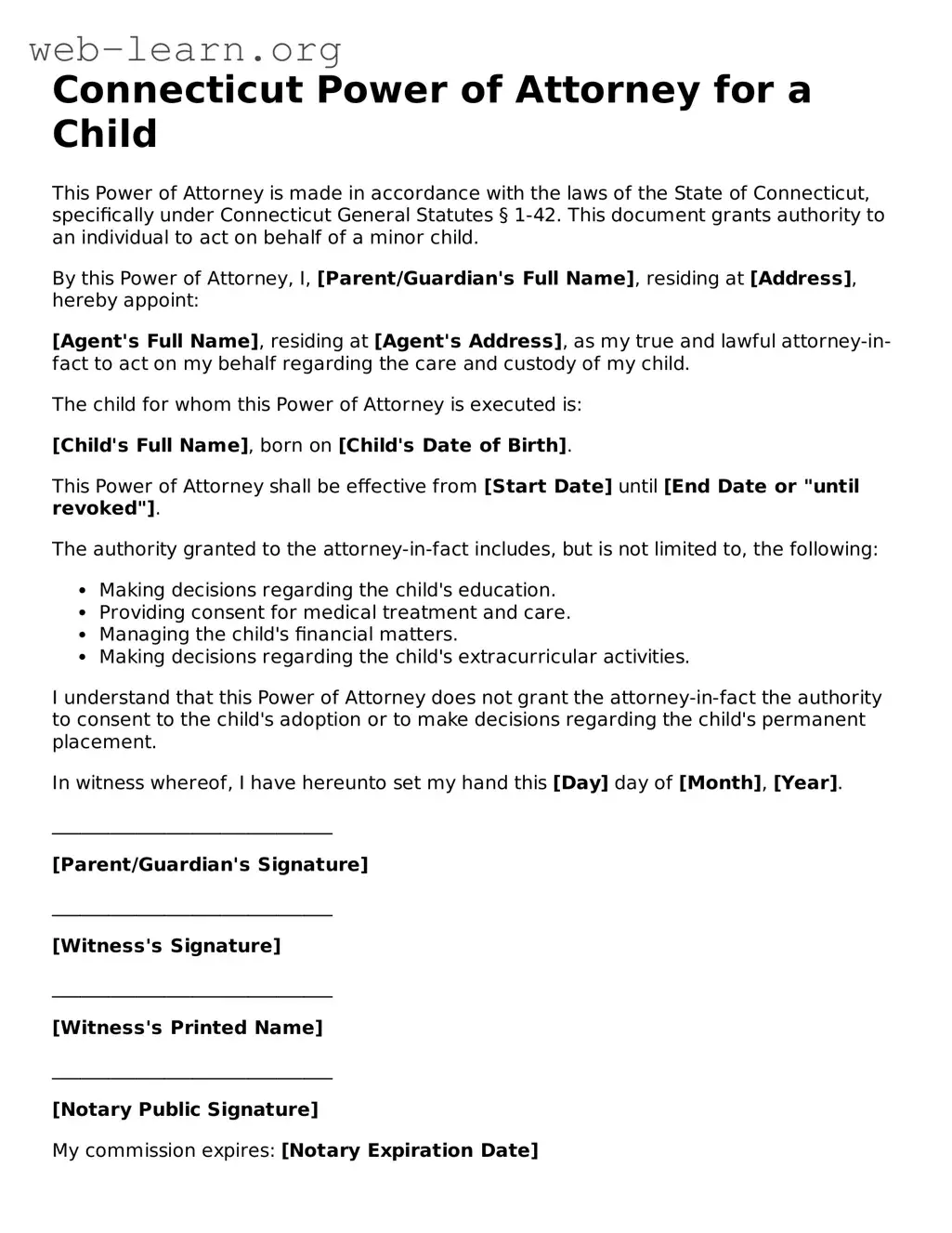
In Connecticut, the Power of Attorney for a Child form serves as a vital legal instrument that empowers a designated adult to make decisions on behalf of a minor child. This form is particularly useful for parents or guardians who may be temporarily unable to care for their child due to various circumstances, such as travel, illness, or other commitments. By completing this document, parents can grant authority to a trusted individual, often a relative or family friend, to handle essential matters related to the child's welfare. These responsibilities may include making medical decisions, enrolling the child in school, and managing day-to-day activities. Importantly, the Power of Attorney for a Child form is limited in scope and duration, ensuring that parental rights are preserved while providing necessary support for the child. The form must be signed and notarized, affirming its legitimacy and the intent behind its creation. Understanding the nuances of this form is crucial for parents seeking to ensure their child's well-being during times of absence.
Connecticut Power of Attorney for a Child
This Power of Attorney is made in accordance with the laws of the State of Connecticut, specifically under Connecticut General Statutes § 1-42. This document grants authority to an individual to act on behalf of a minor child.
By this Power of Attorney, I, [Parent/Guardian's Full Name], residing at [Address], hereby appoint:
[Agent's Full Name], residing at [Agent's Address], as my true and lawful attorney-in-fact to act on my behalf regarding the care and custody of my child.
The child for whom this Power of Attorney is executed is:
[Child's Full Name], born on [Child's Date of Birth].
This Power of Attorney shall be effective from [Start Date] until [End Date or "until revoked"].
The authority granted to the attorney-in-fact includes, but is not limited to, the following:
I understand that this Power of Attorney does not grant the attorney-in-fact the authority to consent to the child's adoption or to make decisions regarding the child's permanent placement.
In witness whereof, I have hereunto set my hand this [Day] day of [Month], [Year].
______________________________
[Parent/Guardian's Signature]
______________________________
[Witness's Signature]
______________________________
[Witness's Printed Name]
______________________________
[Notary Public Signature]
My commission expires: [Notary Expiration Date]
| Fact Name | Description |
|---|---|
| Definition | The Connecticut Power of Attorney for a Child form allows a parent or guardian to delegate authority to another adult for the care of their child. |
| Governing Law | This form is governed by Connecticut General Statutes, specifically Section 1-42a. |
| Duration | The authority granted can be limited to a specific time frame or can remain in effect until revoked. |
| Eligibility | Any parent or legal guardian of a child can create this Power of Attorney. |
| Revocation | The Power of Attorney can be revoked at any time by the parent or guardian, provided they notify the designated adult. |
| Scope of Authority | The form allows for various responsibilities, including medical decisions, educational choices, and general care. |
| Signature Requirement | The form must be signed by the parent or guardian in the presence of a notary public. |
| Notarization | Notarization is crucial to validate the Power of Attorney, ensuring its acceptance by third parties. |
| Limitations | This form does not grant authority to make financial decisions for the child. |
| Use Cases | Common scenarios for use include travel, medical emergencies, or temporary guardianship arrangements. |
Completing the Connecticut Power of Attorney for a Child form requires careful attention to detail. This document allows a parent or guardian to designate another adult to make decisions on behalf of their child. Follow these steps to fill out the form accurately.
Once you have completed the form, keep a copy for your records. Provide the original to the attorney-in-fact so they can act on your behalf when necessary. It’s wise to inform your child about who will be making decisions for them and to ensure that the designated individual is prepared for this responsibility.
A Power of Attorney for a Child is a legal document that allows a parent or legal guardian to grant another person the authority to make decisions on behalf of their child. This can include decisions related to education, healthcare, and other important matters.
The parent or legal guardian can designate any trusted adult as the agent. This can be a relative, family friend, or anyone who is willing to take on the responsibility of caring for the child.
The agent is responsible for making decisions that are in the best interest of the child. This includes managing healthcare needs, making educational choices, and ensuring the child's overall well-being. The agent must act according to the wishes of the parent or guardian as outlined in the document.
The Power of Attorney can be set for a specific duration or until revoked by the parent or guardian. It is important to specify the time frame in the document if a limited duration is intended.
Yes, in Connecticut, the Power of Attorney for a Child must be signed in the presence of a notary public. This adds an extra layer of validation to the document and ensures its legal standing.
Yes, the parent or legal guardian can revoke the Power of Attorney at any time. This can be done by providing written notice to the agent and any relevant parties. It is advisable to keep a copy of the revocation for personal records.
No, a Power of Attorney for a Child is not the same as guardianship. Guardianship involves a court process and grants more permanent authority over a child. A Power of Attorney is typically temporary and can be revoked more easily.
The form can often be obtained from legal websites, local government offices, or family law attorneys in Connecticut. It is important to ensure that the form complies with state laws and requirements.
When filling out the Connecticut Power of Attorney for a Child form, many individuals make critical mistakes that can lead to complications down the line. One common error is failing to specify the duration of the power of attorney. Without a clear timeframe, the authority granted may be misunderstood or misused, causing confusion for both the child and the appointed agent.
Another frequent mistake is neglecting to include the necessary personal information of both the child and the agent. Incomplete details, such as missing addresses or contact numbers, can hinder the effectiveness of the document. It's essential to ensure that all information is accurate and up-to-date to avoid issues later.
People often overlook the importance of notarization. In Connecticut, a Power of Attorney for a Child must be signed in front of a notary public. Failing to do so can render the document invalid. Always check that the signature is notarized to ensure it holds legal weight.
Additionally, some individuals do not discuss the responsibilities with the agent before signing the form. This lack of communication can lead to misunderstandings about what the agent is authorized to do. Open dialogue ensures that everyone is on the same page and that the child's best interests are prioritized.
Another mistake is not considering the child’s needs. The form should reflect the specific circumstances and requirements of the child. Generic language may not adequately cover unique situations, leading to potential gaps in care or decision-making.
Many also forget to review the form thoroughly before submission. Typos and errors can create significant problems. A simple review can catch mistakes that might otherwise complicate the authority granted.
Some people assume that once the form is signed, it cannot be changed. This is not true. If circumstances change, such as a new agent being needed or a different duration required, the form can be updated. Keeping the document flexible is crucial for adapting to life’s changes.
Finally, individuals sometimes fail to provide copies of the signed document to relevant parties. It’s essential that the agent, the child’s school, and healthcare providers have access to the Power of Attorney. Without copies, the authority may not be recognized when needed.
By avoiding these mistakes, individuals can ensure that the Connecticut Power of Attorney for a Child form serves its intended purpose effectively. Proper attention to detail and communication can make a significant difference in the welfare of the child.
When creating a Power of Attorney for a Child in Connecticut, you may also need several other forms and documents to ensure comprehensive legal coverage. Each of these documents serves a specific purpose and can help clarify responsibilities and rights. Below is a list of commonly used forms that complement the Power of Attorney for a Child.
These documents work together to provide a clear legal framework for the care and decision-making regarding the child. Having them in place ensures that all parties understand their roles and responsibilities, minimizing potential conflicts and confusion.
The Power of Attorney for a Child form allows a designated adult to make decisions on behalf of a child. This document is similar to several other legal forms that grant authority or rights in various situations. Here are four documents that share similarities:
When filling out the Connecticut Power of Attorney for a Child form, it is important to be careful and thorough. Here are some guidelines to help you navigate the process.
Following these steps will help ensure that the Power of Attorney for a Child form is filled out correctly. It is crucial to take your time and ensure all details are accurate.
Understanding the Connecticut Power of Attorney for a Child form can be challenging. Many people hold misconceptions that can lead to confusion. Here are eight common misconceptions:
Clearing up these misconceptions can help ensure that parents and guardians make informed decisions about their children's care and legal representation.
Filling out and using the Connecticut Power of Attorney for a Child form can be an important step for parents or guardians. Here are some key takeaways to consider:
Understanding these key points can help ensure that the Power of Attorney for a Child form is filled out correctly and used effectively.
How to Get Power of Attorney in Arkansas - This form is essential for temporary guardianship arrangements, especially during travel or emergencies.
How to Get Power of Attorney in Oregon - It can help ensure that the child receives timely medical treatment when needed.