In the realm of business formation, particularly for limited liability companies (LLCs) in Connecticut, the Operating Agreement serves as a foundational document that outlines the internal workings of the company. This agreement is crucial, as it establishes the rights, responsibilities, and obligations of the members involved. It details the management structure, specifies how profits and losses will be distributed, and provides guidelines for decision-making processes. Additionally, the Operating Agreement addresses the procedures for adding or removing members, as well as the steps to take in the event of dissolution. While Connecticut law does not mandate the creation of an Operating Agreement, having one in place can significantly enhance clarity and prevent disputes among members. By clearly articulating expectations and responsibilities, this document not only protects individual interests but also fosters a collaborative environment, which is essential for the success of any business venture. Understanding the nuances of the Connecticut Operating Agreement form is vital for anyone looking to establish a solid foundation for their LLC.
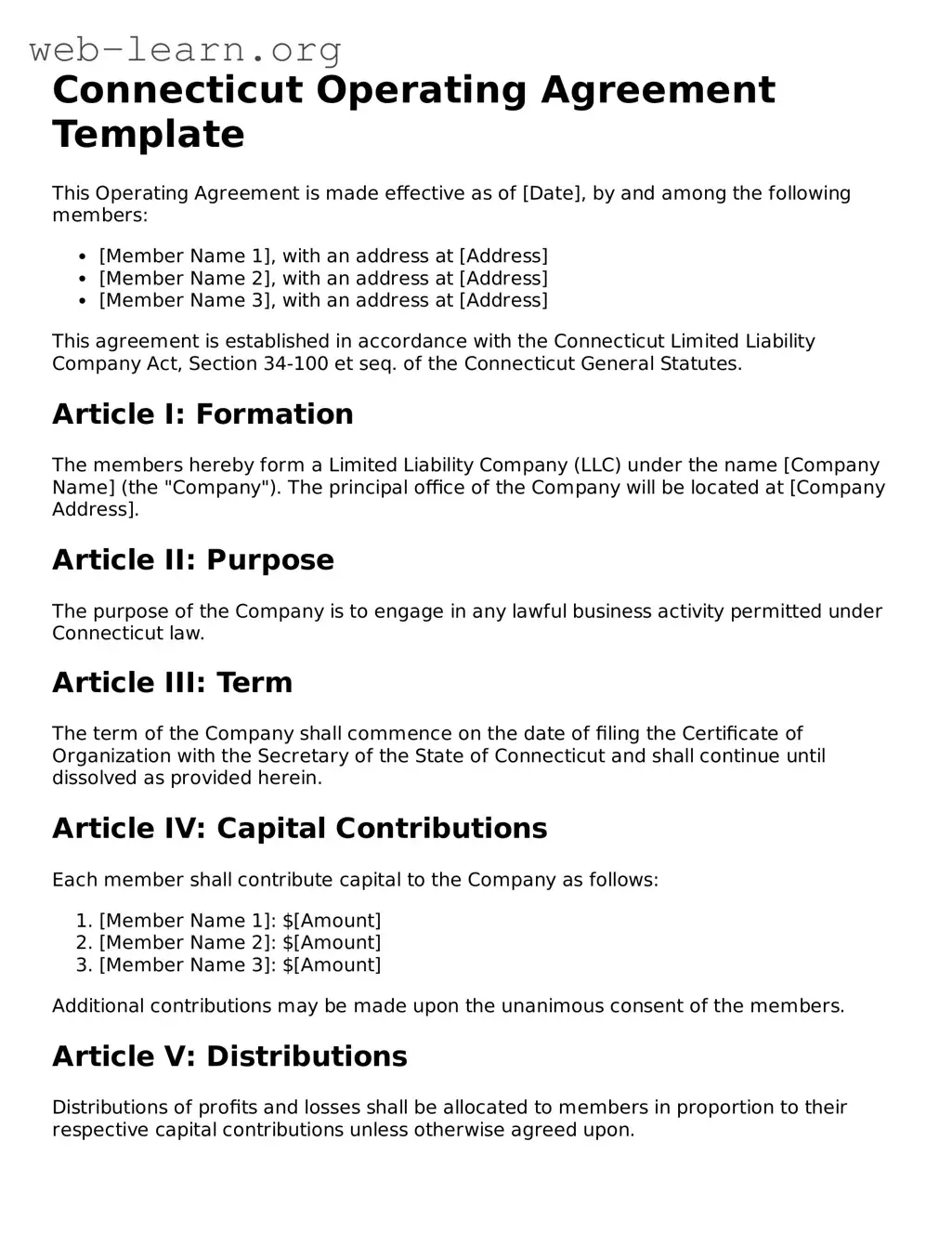
Connecticut Operating Agreement Template
This Operating Agreement is made effective as of [Date], by and among the following members:
This agreement is established in accordance with the Connecticut Limited Liability Company Act, Section 34-100 et seq. of the Connecticut General Statutes.
Article I: Formation
The members hereby form a Limited Liability Company (LLC) under the name [Company Name] (the "Company"). The principal office of the Company will be located at [Company Address].
Article II: Purpose
The purpose of the Company is to engage in any lawful business activity permitted under Connecticut law.
Article III: Term
The term of the Company shall commence on the date of filing the Certificate of Organization with the Secretary of the State of Connecticut and shall continue until dissolved as provided herein.
Article IV: Capital Contributions
Each member shall contribute capital to the Company as follows:
Additional contributions may be made upon the unanimous consent of the members.
Article V: Distributions
Distributions of profits and losses shall be allocated to members in proportion to their respective capital contributions unless otherwise agreed upon.
Article VI: Management
The management of the Company shall be vested in its members. Decisions shall be made by a majority vote of the members.
Article VII: Indemnification
The Company shall indemnify its members to the fullest extent permitted by law against any losses or liabilities incurred in connection with the Company.
Article VIII: Amendment
This Operating Agreement may be amended only by a written agreement signed by all members.
Article IX: Governing Law
This Agreement shall be governed by and construed in accordance with the laws of the State of Connecticut.
IN WITNESS WHEREOF, the undersigned have executed this Operating Agreement as of the date first above written.
__________________________
[Member Name 1]
__________________________
[Member Name 2]
__________________________
[Member Name 3]
| Fact Name | Description |
|---|---|
| Purpose | The Connecticut Operating Agreement outlines the management structure and operational procedures of a limited liability company (LLC). |
| Governing Law | This agreement is governed by the Connecticut General Statutes, specifically Chapter 613 on Limited Liability Companies. |
| Members | All members of the LLC are typically required to sign the Operating Agreement to ensure mutual understanding and agreement. |
| Flexibility | The Operating Agreement allows for flexibility in management and distribution of profits, tailored to the specific needs of the members. |
| Internal Governance | It provides guidelines on how the LLC will be managed, including voting rights and decision-making processes. |
| Dispute Resolution | The agreement may include provisions for resolving disputes among members, which can help prevent conflicts. |
| Amendments | Members can amend the Operating Agreement as needed, allowing for changes in management or membership structure. |
| Compliance | Having an Operating Agreement helps ensure compliance with state laws and regulations governing LLCs. |
| Confidentiality | The agreement can include confidentiality clauses to protect sensitive business information from being disclosed. |
| Not Mandatory | While not required by law, having an Operating Agreement is highly recommended for LLCs in Connecticut. |
Filling out the Connecticut Operating Agreement form is an important step for any business entity looking to outline its structure and operational guidelines. After completing the form, you will be well on your way to establishing a clear framework for your business. Below are the steps to guide you through the process.
Once you have completed these steps, your Operating Agreement will be ready for use. This document will serve as a vital reference for your business operations and member responsibilities.
What is a Connecticut Operating Agreement?
A Connecticut Operating Agreement is a legal document that outlines the management structure and operating procedures of a limited liability company (LLC) in Connecticut. It serves as an internal guideline for the members of the LLC, detailing their rights, responsibilities, and obligations.
Is an Operating Agreement required in Connecticut?
No, an Operating Agreement is not legally required in Connecticut. However, having one is highly recommended. It helps prevent misunderstandings among members and provides a clear framework for operations and decision-making.
What should be included in the Operating Agreement?
The Operating Agreement should include:
How do I create an Operating Agreement?
To create an Operating Agreement, start by drafting the document based on your LLC's specific needs. You can use templates available online or consult with a legal professional. Once completed, all members should review and sign the agreement to ensure mutual understanding and acceptance.
Can I change the Operating Agreement later?
Yes, you can modify the Operating Agreement at any time. Changes typically require the consent of all members, unless the agreement specifies a different process. Document any amendments in writing and have all members sign the revised agreement to maintain clarity and legality.
What happens if I don’t have an Operating Agreement?
Without an Operating Agreement, your LLC will be governed by Connecticut's default laws regarding LLCs. This may not align with your specific intentions for the business. Disputes among members could arise, and the lack of clarity may lead to complications in management and profit distribution.
Where should I keep the Operating Agreement?
It is advisable to keep the Operating Agreement in a safe place, such as a secure file or a safe deposit box. All members should have access to it, and it’s a good idea to keep a digital copy as well. Regularly review it to ensure it remains up to date with any changes in the LLC.
Filling out the Connecticut Operating Agreement form can be a straightforward process, but many individuals still make common mistakes. One frequent error is failing to include all necessary member names. Each member's full legal name should be clearly listed. Omitting a member can lead to disputes down the line.
Another mistake is neglecting to specify the ownership percentages. This detail is crucial as it determines how profits and losses are distributed among members. Without clear percentages, misunderstandings may arise, causing friction within the group.
Some individuals forget to outline the management structure of the LLC. Whether it’s member-managed or manager-managed, this decision should be explicitly stated. Clarity in management roles helps prevent confusion about who is responsible for day-to-day operations.
Additionally, many people overlook the importance of including a provision for resolving disputes. A well-defined process for handling disagreements can save time and money in the future. Without this, conflicts may escalate, leading to costly legal battles.
Another common error is not addressing how new members can join the LLC. This section should include the process for admitting new members and any necessary approvals. Without this information, the organization may struggle to adapt as it grows.
Some individuals fail to update the Operating Agreement after changes occur. Life events, such as a member leaving or new members joining, necessitate revisions to the agreement. Keeping the document current is vital for maintaining clarity and legal protection.
Another mistake is using vague language throughout the document. Clear, precise language is essential to avoid misinterpretations. Ambiguity can lead to confusion and disputes among members.
Finally, many people neglect to have the agreement reviewed by a legal professional. While it may seem like an unnecessary expense, a lawyer can catch errors and provide valuable insights. Investing in this step can prevent significant issues in the future.
When forming a limited liability company (LLC) in Connecticut, an Operating Agreement is a crucial document that outlines the management structure and operating procedures of the business. However, several other forms and documents complement the Operating Agreement, ensuring that your LLC operates smoothly and complies with state regulations. Here’s a list of essential documents you might consider alongside your Connecticut Operating Agreement:
Each of these documents plays a vital role in the overall functioning and legal standing of your LLC. By ensuring you have all the necessary paperwork in place, you can focus on growing your business with confidence.
The Operating Agreement is a crucial document for LLCs, outlining the management structure and operational procedures. It shares similarities with several other legal documents. Below is a list of nine documents that are comparable to the Operating Agreement, along with explanations of their similarities.
When filling out the Connecticut Operating Agreement form, it is important to follow specific guidelines to ensure accuracy and compliance. Here is a list of things you should and shouldn't do:
Following these guidelines will help you complete the Operating Agreement form accurately and effectively.
When it comes to the Connecticut Operating Agreement form, many people hold misconceptions that can lead to confusion or mistakes. Here’s a closer look at nine common misunderstandings:
While it is highly recommended for LLCs in Connecticut to have an Operating Agreement, it is not legally required. However, having one can help clarify the roles and responsibilities of members.
In Connecticut, the Operating Agreement is considered a private document. It is not filed with the state, meaning the details remain confidential among the members.
Even single-member LLCs can benefit from having an Operating Agreement. It helps establish credibility and outlines how the business will be managed.
This is not true. The Operating Agreement can be amended as needed, allowing members to adapt to changing circumstances or preferences.
The state does not review or approve the provisions of the Operating Agreement. Members have the freedom to set their own rules, as long as they comply with state laws.
While financial aspects are important, the Operating Agreement also covers management structure, decision-making processes, and procedures for adding new members.
While templates can be helpful, it’s crucial to tailor the document to fit your specific business needs. A one-size-fits-all approach may not address unique situations.
Verbal agreements can lead to misunderstandings and disputes. A written Operating Agreement provides clarity and serves as a reference point for all members.
Ignoring the Operating Agreement can lead to chaos. It’s essential to refer to it regularly to ensure that all members are on the same page regarding operations and responsibilities.
Understanding these misconceptions can help you navigate the complexities of forming and managing an LLC in Connecticut more effectively. A well-crafted Operating Agreement can be a valuable asset to your business.
Filling out and using the Connecticut Operating Agreement form is an important step for any business entity. Here are some key takeaways to keep in mind:
By keeping these points in mind, you can create a comprehensive Operating Agreement that serves your business well.
Kansas Operating Agreement - This document can help streamline operations and improve efficiency.
How to Create an Operating Agreement - This form is essential for ensuring that all members understand their rights and obligations.
Operating Agreement Llc California Template - An Operating Agreement can help in tax planning for the LLC.
Colorado Llc Operating Agreement - This form can help secure funding by showing potential investors a clear plan.