Homepage Blank Connecticut Op 300 Form
Outline

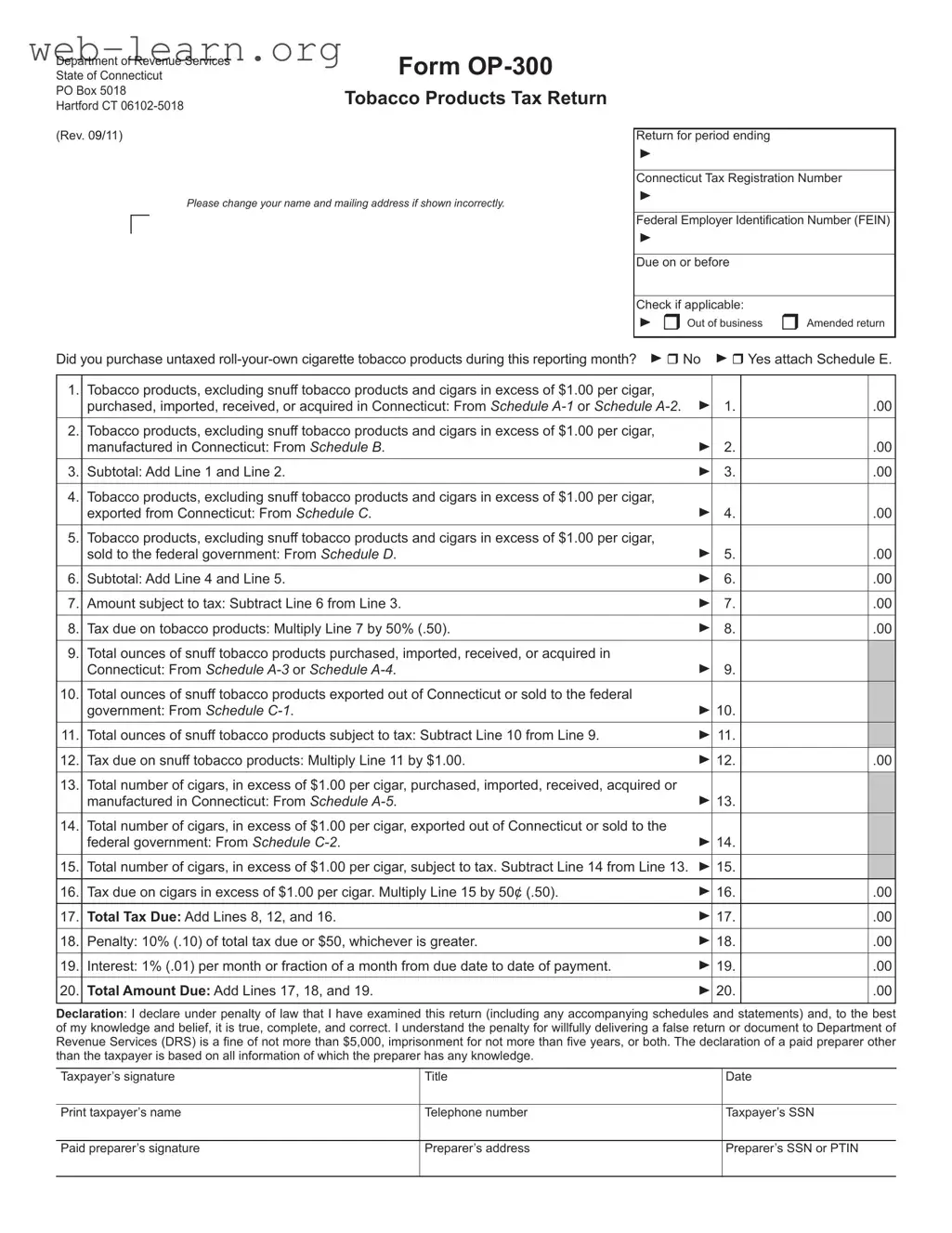
The Connecticut Op 300 form is a crucial document for businesses involved in the sale and distribution of tobacco products within the state. This form serves as the Tobacco Products Tax Return, requiring detailed reporting of various tobacco items, including cigars, snuff, and roll-your-own cigarette tobacco. Businesses must provide their Connecticut Tax Registration Number and Federal Employer Identification Number (FEIN) on the form. It is essential to indicate whether the business is out of operation or if the return is amended. The form requires taxpayers to report the total amount of tobacco products purchased, manufactured, and exported, along with the corresponding tax calculations. Each section of the form guides users through the necessary calculations, ensuring that all taxable amounts are accurately recorded. Additionally, it outlines the penalties and interest that may apply if payments are not made on time. By completing the Op 300 form accurately and submitting it by the due date, businesses can comply with state regulations and avoid potential penalties.


Sample - Connecticut Op 300 Form

Form OP-300
Tobacco Products Tax Return
Please change your name and mailing address if shown incorrectly.
Department of Revenue Services
State of Connecticut
PO Box 5018
Hartford CT 06102-5018
(Rev. 09/11)
Declaration: I declare under penalty of law that I have examined this return (including any accompanying schedules and statements) and, to the best
of my knowledge and belief, it is true, complete, and correct. I understand the penalty for willfully delivering a false return or document to Department of

than the taxpayer is based on all information of which the preparer has any knowledge.
Taxpayer’s signature Title Date
Print taxpayer’s name Telephone number Taxpayer’s SSN
Paid preparer’s signature Preparer’s address Preparer’s SSN or PTIN
Return for period ending
Connecticut Tax Registration Number

Due on or before
Check if applicable:
Out of business
Amended return
Did you purchase untaxed roll-your-own cigarette tobacco products during this reporting month?
No
Yes attach Schedule E.
 
purchased, imported, received, or acquired in Connecticut: From Schedule A-1 or Schedule A-2.
1. .00
 
manufactured in Connecticut: From Schedule B.
2. .00
3. Subtotal: Add Line 1 and Line 2.
3. .00
 
exported from Connecticut: From Schedule C.
4. .00
 
sold to the federal government: From Schedule D.
5. .00
6. Subtotal: Add Line 4 and Line 5.
6. .00
7. Amount subject to tax: Subtract Line 6 from Line 3.
7. .00
8. Tax due on tobacco products: Multiply Line 7 by 50% (.50).
8. .00
9. Total ounces of snuff tobacco products purchased, imported, received, or acquired in
Connecticut: From Schedule A-3 or Schedule A-4.
9.
10. Total ounces of snuff tobacco products exported out of Connecticut or sold to the federal
government: From Schedule C-1.
10.
11. Total ounces of snuff tobacco products subject to tax: Subtract Line 10 from Line 9.
11.
 
12. .00
 
manufactured in Connecticut: From Schedule A-5.
13.
 
federal government: From Schedule C-2.
14.
 
15.
 
16. .00
17. Total Tax Due: Add Lines 8, 12, and 16.
17. .00
 
18. .00
19. Interest: 1% (.01) per month or fraction of a month from due date to date of payment.
19. .00
20. Total Amount Due: Add Lines 17, 18, and 19.
20. .00
OP-300 Back (Rev. 09/11)
General Instructions
Complete the return in blue or black ink only.


Example: The tobacco products tax return for January 1 through

    All
supporting schedules can be found on the Department of
Revenue Services (DRS) website at 
   
return.
Pay Electronically: Visit to use the
 TSC) to make a direct tax
payment. After logging onto the TSC, select the Make
Payment Only option and choose a tax type from the
drop down box. Using this option authorizes the DRS to
electronically withdraw from your bank account (checking or
savings) a payment on a date you select up to the due date.
As a reminder, even if you pay electronically you must still

due date will be subject to penalty and interest.
If you do not pay electronically, make check payable to
   . DRS may submit
your check to your bank electronically.
Mail to: Department of Revenue Services
State of Connecticut
PO Box 5018
Hartford CT 06102-5018

Tobacco Products means: Cigars, cheroots, stogies,
periques, granulated, plug cut, crimp cut, ready rubbed and
other smoking tobacco, cavendish, plug and twist tobacco,

clippings, cuttings and sweepings of tobacco, and all other
kinds and forms of tobacco prepared in a manner as to be
suitable for chewing or smoking in a pipe or otherwise for both
chewing and smoking, but does not include any cigarettes

Snuff Tobacco Products means: Tobacco products that
have imprinted on the packages the designation “snuff” or

both.
Wholesale Sales Price means:
In the case of a distributor that is the manufacturer of the
tobacco products, the price set for these products or, if no
price has been set, the wholesale value of these products.
In the case of a distributor that is not the manufacturer of
the tobacco products, the price at which the distributor
purchased the products.

You must check the appropriate box concerning
the purchase of untaxed roll-your-own cigarette tobacco
products. If Yes, a completed Schedule E must be attached.
Line 1
Resident Distributor: Enter from Schedule A-1 the
wholesale sales price of tobacco products (excluding snuff

purchased, imported, received, or acquired in Connecticut
by the distributor.
Nonresident Distributor: Enter from Schedule A-2 the
wholesale sales price of tobacco products (excluding snuff

imported into Connecticut by the distributor.
Line 2 - Enter from Schedule B the wholesale sales price
of tobacco products (excluding snuff tobacco products
        
Connecticut by the distributor.
Line 4 - Enter from Schedule C the wholesale sales price
of tobacco products (excluding snuff tobacco products and

that were imported, received, purchased, acquired, or
manufactured in Connecticut by the distributor. Prepare a
separate Schedule C for each state of destination. (Use
Line 9 and Line 10 to report snuff products and Line 13 and

Line 5 - Enter from Schedule D the wholesale sales price
of tobacco products (excluding snuff tobacco products

government that were imported, received, purchased,
acquired, or manufactured in Connecticut by the distributor.
Line 9 - Enter from Schedule A-3 or Schedule A-4 the total
ounces of snuff tobacco products manufactured, purchased,
imported, received, or acquired in Connecticut by the
distributor.
Line 10 - Enter from Schedule C-1 the total ounces of snuff
tobacco products exported out of Connecticut or sold to the
federal government.
Line 13 - Enter from Schedule A-5 the total number of cigars,

acquired, or manufactured in Connecticut.
Line 14 - Enter from Schedule C-2 the total number of cigars,

sold to the federal government.

If you need additional information or assistance, please call the
Excise Taxes Unit at 860-541-3224, Monday through Friday,
8:30 a.m. to 4:30 p.m.
Forms and Publications: Visit the DRS website at
 to download and print Connecticut tax
forms and publications.
may transmit
inquiries anytime by calling 860-297-4911.

Form Information

Fact Name Details
Governing Law The Connecticut Op 300 form is governed by the Connecticut General Statutes, specifically §12-285, which pertains to the taxation of tobacco products.
Purpose This form serves as the Tobacco Products Tax Return, allowing businesses to report and pay taxes on tobacco products sold or manufactured in Connecticut.
Filing Frequency Taxpayers must file the Op 300 form monthly, with returns due by the 25th day of the following month.
Penalties for Late Filing Failure to file by the due date may result in a penalty of 10% of the total tax due or a minimum of $50, whichever is greater.
Signature Requirement The form must be signed by the taxpayer, who can be the owner, a partner, or a principal officer of the business.
Electronic Payment Option Taxpayers can make electronic payments through the Taxpayer Service Center, facilitating easier and timely tax payments.
Supporting Schedules Additional schedules, such as Schedule A-1 and Schedule B, must be attached to report specific details about tobacco products purchased or manufactured.

Detailed Guide for Filling Out Connecticut Op 300

Once you have gathered the necessary information, you can begin filling out the Connecticut Op 300 form. This form must be completed accurately and submitted on time to avoid any penalties or interest charges. Below are the steps to guide you through the process.

  1. Obtain the Connecticut Op 300 form from the Department of Revenue Services website or your local office.
  2. Fill in your Connecticut Tax Registration Number and Federal Employer Identification Number (FEIN) in the designated spaces.
  3. Indicate the period ending date for the report.
  4. Check the appropriate box if you are out of business or filing an amended return.
  5. Answer the question regarding the purchase of untaxed roll-your-own cigarette tobacco products. If "Yes," attach Schedule E.
  6. For Line 1, enter the total value of tobacco products purchased or acquired in Connecticut from Schedule A-1 or Schedule A-2.
  7. For Line 2, enter the total value of tobacco products manufactured in Connecticut from Schedule B.
  8. Add the amounts from Line 1 and Line 2 to get the subtotal for Line 3.
  9. For Line 4, enter the total value of tobacco products exported from Connecticut from Schedule C.
  10. For Line 5, enter the total value of tobacco products sold to the federal government from Schedule D.
  11. Add the amounts from Line 4 and Line 5 for Line 6.
  12. Subtract Line 6 from Line 3 to determine the amount subject to tax for Line 7.
  13. Multiply the amount from Line 7 by 50% to calculate the tax due on tobacco products for Line 8.
  14. For Line 9, enter the total ounces of snuff tobacco products from Schedule A-3 or Schedule A-4.
  15. For Line 10, enter the total ounces of snuff tobacco products exported or sold to the federal government from Schedule C-1.
  16. Subtract Line 10 from Line 9 for Line 11 to find the total ounces of snuff tobacco products subject to tax.
  17. Multiply the amount from Line 11 by $1.00 for Line 12 to calculate the tax due on snuff tobacco products.
  18. For Line 13, enter the total number of cigars purchased or manufactured in Connecticut from Schedule A-5.
  19. For Line 14, enter the total number of cigars exported or sold to the federal government from Schedule C-2.
  20. Subtract Line 14 from Line 13 for Line 15 to find the total number of cigars subject to tax.
  21. Multiply the amount from Line 15 by 50¢ for Line 16 to calculate the tax due on cigars.
  22. Add Lines 8, 12, and 16 to determine the total tax due for Line 17.
  23. Calculate the penalty for Line 18, which is 10% of the total tax due or $50, whichever is greater.
  24. Calculate the interest for Line 19, which is 1% per month from the due date to the date of payment.
  25. Add Lines 17, 18, and 19 for Line 20 to find the total amount due.
  26. Sign and date the declaration section at the bottom of the form.
  27. Ensure the form is completed in blue or black ink only.
  28. Mail the completed form to the Department of Revenue Services at the address provided.

Obtain Answers on Connecticut Op 300

  1. What is the purpose of the Connecticut OP-300 form?

    The Connecticut OP-300 form is used to report and pay the tobacco products tax in the state of Connecticut. This form is required for distributors who purchase, import, or manufacture tobacco products within the state. It ensures compliance with state tax regulations and provides a means for calculating the tax due on these products.

  2. Who needs to file the OP-300 form?

    Any individual or business that acts as a distributor of tobacco products in Connecticut must file the OP-300 form. This includes those who purchase, import, or manufacture tobacco products, as well as those who sell to the federal government. Even if no tax is due, filing is still required.

  3. When is the OP-300 form due?

    The OP-300 form must be filed by the twenty-fifth day of the month following the reporting period. For example, the return for January must be submitted by February 25. Timely filing is essential to avoid penalties and interest.

  4. What should I do if I am out of business?

    If you are no longer in business, you should check the "Out of business" box on the OP-300 form. This indicates to the Department of Revenue Services that you will not be filing future returns. It is important to ensure that all prior obligations are settled before marking this box.

  5. What if I need to amend my return?

    If you need to correct information on a previously filed OP-300 form, check the "Amended return" box. This will allow you to submit the corrected information and ensure that your tax records are accurate. Be sure to include all necessary schedules and documentation with your amended return.

  6. What information is required on the OP-300 form?

    The form requires various details, including your Connecticut Tax Registration Number, Federal Employer Identification Number (FEIN), and specific figures related to tobacco products purchased, manufactured, exported, or sold. Additionally, you must provide a declaration affirming the accuracy of the information submitted.

  7. How can I pay the tax due?

    You can pay the tax electronically through the Taxpayer Service Center (TSC) by visiting www.ct.gov/TSC. Alternatively, if you prefer to pay by check, make it payable to the Commissioner of Revenue Services and mail it to the address specified on the form. Ensure that payment is made by the due date to avoid penalties.

  8. What happens if I miss the filing deadline?

    Failure to file the OP-300 form by the due date may result in penalties and interest. The penalty is 10% of the total tax due or $50, whichever is greater. Additionally, interest accrues at a rate of 1% per month until the tax is paid. Timely filing and payment are crucial to avoid these additional costs.

  9. Where can I find additional resources or assistance?

    If you need further assistance, you can contact the Excise Taxes Unit at 860-541-3224 during business hours. For forms and publications, visit the Department of Revenue Services website at www.ct.gov/DRS. There, you can download and print necessary documents and find additional information regarding tobacco tax regulations.

Common mistakes

Completing the Connecticut OP-300 form can be a straightforward process, but many individuals make common mistakes that can lead to delays or complications. Understanding these pitfalls can help ensure that your submission is accurate and timely.

One frequent error is neglecting to check the appropriate box regarding the purchase of untaxed roll-your-own cigarette tobacco products. If you select "Yes," it is essential to attach Schedule E. Failing to do so may result in your form being returned or processed incorrectly. Always double-check this section to ensure compliance.

Another common mistake occurs when individuals forget to include their Connecticut Tax Registration Number and Federal Employer Identification Number (FEIN). These numbers are crucial for identifying your business and ensuring that your tax return is processed correctly. Leaving these fields blank can delay your filing and potentially incur penalties.

Many people also overlook the requirement to sign the form. The owner, partner, or principal officer must sign the return. A missing signature can lead to the return being considered incomplete, which may result in additional fines or complications.

Additionally, some taxpayers mistakenly assume that they do not need to file if no tax is due. This is not the case. All taxpayers are required to submit a return for each calendar month, regardless of whether any tax is owed. Ignoring this requirement can lead to penalties.

Another area where errors often occur is in the calculations of the tax due. It is vital to ensure that all figures are added and subtracted correctly. A simple miscalculation can result in underpayment or overpayment, both of which can create issues down the line. Taking the time to review your math can save you from future headaches.

Finally, many individuals fail to use blue or black ink when completing the form. This may seem trivial, but it is a requirement that helps ensure clarity and legibility. Using other colors can result in processing delays or misinterpretations of your information.

By being aware of these common mistakes, you can approach the Connecticut OP-300 form with confidence. Careful attention to detail will help ensure that your submission is accurate and complete, allowing you to fulfill your tax obligations smoothly.

Documents used along the form

The Connecticut OP-300 form is a crucial document for reporting tobacco products tax. However, several other forms and documents are often used alongside it to ensure compliance with state regulations. Below is a list of these related forms and documents.

  • Schedule A-1: This schedule details the wholesale sales price of tobacco products purchased, imported, or received in Connecticut by resident distributors.
  • Schedule A-2: Nonresident distributors use this schedule to report the wholesale sales price of tobacco products imported into Connecticut.
  • Schedule B: This schedule is for reporting the wholesale sales price of tobacco products manufactured in Connecticut.
  • Schedule C: Distributors must use this schedule to report the wholesale sales price of tobacco products exported from Connecticut.
  • Schedule D: This schedule is specifically for reporting tobacco products sold to the federal government by distributors.
  • Schedule E: If a distributor purchases untaxed roll-your-own cigarette tobacco products, this schedule must be attached to the OP-300 form.
  • Schedule A-3 and A-4: These schedules report the total ounces of snuff tobacco products purchased or received in Connecticut.

Using these forms in conjunction with the OP-300 ensures accurate reporting and compliance with Connecticut tax laws. Proper documentation is essential for avoiding penalties and ensuring a smooth tax filing process.

Similar forms

The Connecticut Op 300 form is an important document for reporting tobacco product taxes. It shares similarities with several other forms used in tax reporting and compliance. Below is a list of six documents that are comparable to the Op 300 form, highlighting their key similarities.

  • IRS Form 720: This form is used to report and pay the federal excise tax on certain goods, including tobacco products. Like the Op 300, it requires detailed reporting of purchases and sales, as well as calculations for tax due.
  • Connecticut Sales and Use Tax Return (Form ST-1): This form is utilized for reporting sales and use taxes in Connecticut. Both forms require a breakdown of taxable items and the total tax owed, ensuring compliance with state tax regulations.
  • IRS Form 2290: This form is for reporting heavy highway vehicle use tax. Similar to the Op 300, it includes a declaration section where taxpayers affirm the accuracy of their information under penalty of law.
  • Connecticut Income Tax Return (Form CT-1040): This document is for individual income tax reporting in Connecticut. Both forms necessitate accurate reporting of financial data and may include penalties for incorrect information.
  • IRS Form 941: Used for reporting payroll taxes, this form requires employers to detail wages paid and taxes withheld. Like the Op 300, it involves regular filing and may incur penalties for late submissions.
  • Connecticut Corporation Business Tax Return (Form CT-1120): This form is for corporations to report their business income. Both the Op 300 and this form require comprehensive reporting and adherence to specific tax regulations.

Dos and Don'ts

When filling out the Connecticut Op 300 form, it is essential to follow specific guidelines to ensure accuracy and compliance. Below is a list of things you should and shouldn't do:

  • Do complete the return in blue or black ink only to ensure clarity.
  • Do file the return by the twenty-fifth day of the month following the reporting period, even if no tax is due.
  • Do attach any required schedules, such as Schedule E, if applicable.
  • Do ensure that the form is signed by the owner, partner, or principal officer.
  • Don't leave any required fields blank; provide all necessary information.
  • Don't forget to check the appropriate box regarding the purchase of untaxed roll-your-own cigarette tobacco products.
  • Don't submit the form without verifying all calculations for accuracy.
  • Don't ignore the penalties for filing a false return or failing to file on time.

Misconceptions

Misconceptions about the Connecticut OP-300 form can lead to confusion and errors in tax reporting. Here are six common misunderstandings:

  • Only businesses need to file the OP-300 form. Many individuals who purchase tobacco products may also need to file this form. If you buy untaxed tobacco, you are responsible for reporting it.
  • The OP-300 form is only for Connecticut residents. Non-residents who import tobacco products into Connecticut must also complete this form. Tax obligations apply regardless of residency.
  • Filing is optional if no tax is due. This is incorrect. Taxpayers must file a return every month, even if no tax is owed. Failure to do so can result in penalties.
  • All tobacco products are taxed the same way. Different types of tobacco products, such as snuff and cigars, have specific tax rates and reporting requirements. It is essential to understand these distinctions.
  • Penalties only apply for late payments. Penalties can also arise from filing an incorrect form or failing to file altogether. Accuracy is crucial to avoid additional costs.
  • Electronic payments eliminate the need to file a form. Paying electronically does not replace the requirement to file the OP-300 form. Both steps must be completed to remain compliant.

Understanding these misconceptions can help ensure that taxpayers fulfill their obligations accurately and on time.

Key takeaways

Here are key takeaways about filling out and using the Connecticut OP-300 form:

  • The OP-300 form is used to report tobacco products tax in Connecticut.
  • Complete the form using blue or black ink only.
  • File the return by the twenty-fifth day of the month following the reporting period.
  • Even if no tax is due, a return must still be filed.
  • Include the Connecticut Tax Registration Number and Federal Employer Identification Number (FEIN).
  • If you purchased untaxed roll-your-own cigarette tobacco, check the appropriate box and attach Schedule E.
  • The form requires detailed reporting of tobacco products purchased, manufactured, exported, and sold.
  • Pay the tax electronically through the Taxpayer Service Center or by mailing a check.
  • Sign the form; the owner or principal officer must provide their signature.

Ensure accuracy to avoid penalties, which can include fines or imprisonment for false reporting.