In the competitive landscape of today’s job market, many employers in Connecticut utilize Non-compete Agreements to protect their business interests and intellectual property. This legal document serves as a mutual understanding between an employer and an employee, outlining specific restrictions on the employee's ability to work in similar roles or industries after leaving the company. Key elements of the Connecticut Non-compete Agreement form typically include the duration of the restriction, the geographic area it covers, and the types of activities that are prohibited. Employers must ensure that the terms are reasonable and tailored to their business needs, while employees should be aware of their rights and the implications of signing such an agreement. Understanding the nuances of this form can help both parties navigate potential conflicts and foster a more transparent working relationship.
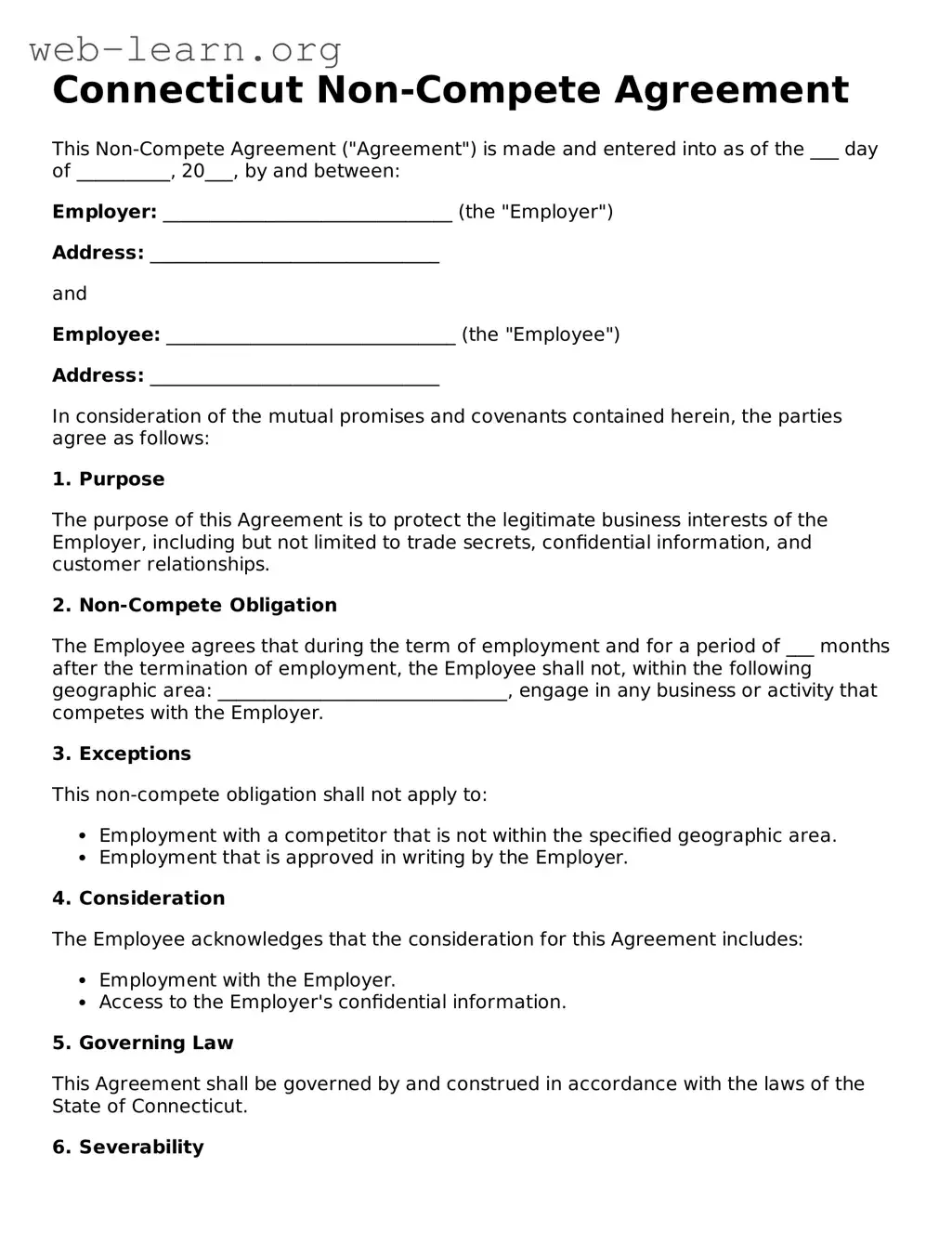
Connecticut Non-Compete Agreement
This Non-Compete Agreement ("Agreement") is made and entered into as of the ___ day of __________, 20___, by and between:
Employer: _______________________________ (the "Employer")
Address: _______________________________
and
Employee: _______________________________ (the "Employee")
Address: _______________________________
In consideration of the mutual promises and covenants contained herein, the parties agree as follows:
1. Purpose
The purpose of this Agreement is to protect the legitimate business interests of the Employer, including but not limited to trade secrets, confidential information, and customer relationships.
2. Non-Compete Obligation
The Employee agrees that during the term of employment and for a period of ___ months after the termination of employment, the Employee shall not, within the following geographic area: _______________________________, engage in any business or activity that competes with the Employer.
3. Exceptions
This non-compete obligation shall not apply to:
4. Consideration
The Employee acknowledges that the consideration for this Agreement includes:
5. Governing Law
This Agreement shall be governed by and construed in accordance with the laws of the State of Connecticut.
6. Severability
If any provision of this Agreement is found to be unenforceable, the remaining provisions shall remain in full force and effect.
7. Entire Agreement
This Agreement constitutes the entire agreement between the parties regarding the subject matter hereof and supersedes all prior agreements and understandings.
IN WITNESS WHEREOF, the parties have executed this Non-Compete Agreement as of the date first above written.
Employer Signature: _______________________________
Date: _______________________________
Employee Signature: _______________________________
Date: _______________________________
| Fact Name | Description |
|---|---|
| Definition | A non-compete agreement is a contract that restricts an employee from working for competitors after leaving a job. |
| Governing Law | Connecticut General Statutes, Section 34-1 et seq. governs non-compete agreements in Connecticut. |
| Reasonableness | Connecticut courts require that non-compete agreements be reasonable in scope, duration, and geographic area. |
| Enforceability | Non-compete agreements are enforceable in Connecticut if they protect legitimate business interests. |
| Duration | Typically, non-compete agreements in Connecticut should not exceed one to two years. |
| Geographic Limitations | The agreement must specify a reasonable geographic area where the restrictions apply. |
| Consideration | For a non-compete agreement to be valid, there must be adequate consideration, such as a job offer or promotion. |
| Employee Rights | Employees have the right to negotiate the terms of a non-compete agreement before signing. |
| Trade Secrets | Non-compete agreements can help protect trade secrets and confidential information of a business. |
| Legal Challenges | Employees may challenge non-compete agreements in court if they find them overly restrictive or unfair. |
After obtaining the Connecticut Non-compete Agreement form, you will need to complete it accurately to ensure that all necessary information is provided. Follow these steps to fill out the form correctly.
What is a Non-compete Agreement?
A Non-compete Agreement is a legal contract between an employer and an employee. It restricts the employee from working for competitors or starting a competing business for a certain period after leaving the company. The goal is to protect the employer’s business interests, trade secrets, and sensitive information.
Are Non-compete Agreements enforceable in Connecticut?
Yes, Non-compete Agreements can be enforceable in Connecticut, but they must meet specific criteria. The agreement should be reasonable in scope, duration, and geographic area. Courts will assess whether the agreement protects legitimate business interests without imposing undue hardship on the employee.
How long can a Non-compete Agreement last?
The duration of a Non-compete Agreement in Connecticut typically ranges from six months to two years. However, the length should be justifiable based on the nature of the business and the role of the employee. Courts will evaluate whether the duration is necessary to protect the employer's interests.
What should be included in a Non-compete Agreement?
A well-drafted Non-compete Agreement should include:
Can an employee negotiate a Non-compete Agreement?
Absolutely! Employees can and should negotiate the terms of a Non-compete Agreement. It’s important to ensure that the terms are fair and reasonable. Discussing concerns with the employer can lead to modifications that better protect both parties’ interests.
What happens if I violate a Non-compete Agreement?
If you violate a Non-compete Agreement, your former employer may take legal action against you. This could result in a court ordering you to stop working for a competitor or even seeking damages. It’s wise to consult with a legal professional if you find yourself in this situation.
Can a Non-compete Agreement be terminated?
Yes, a Non-compete Agreement can be terminated under certain conditions. This may happen if both parties agree to end the agreement or if the employer no longer has a legitimate business interest to protect. Always review the specific terms of your agreement to understand the conditions for termination.
Filling out a Connecticut Non-compete Agreement form can be tricky. Many people make common mistakes that can undermine the effectiveness of the agreement. One major error is failing to clearly define the scope of the non-compete. It’s crucial to specify what types of activities are restricted. Vague language can lead to confusion and possible legal challenges later on.
Another frequent mistake is not considering the duration of the non-compete. Connecticut law requires that the duration be reasonable. If the time frame is too long, a court may deem it unenforceable. Striking a balance is essential. A non-compete that lasts for six months may be acceptable, while one that extends for several years may not be.
Many individuals also overlook the geographical limitations of the agreement. The non-compete should specify the areas where the restrictions apply. A broad geographical scope can make the agreement harder to enforce. It’s wise to limit the area to where the employee actually worked or where the employer conducts business.
Inadequate consideration of the employee’s role is another mistake. The agreement should reflect the employee's position and responsibilities. A high-level executive may warrant a stricter non-compete than an entry-level employee. Tailoring the agreement to the individual’s role helps ensure it is fair and enforceable.
People often forget to include consideration, which is a critical element of any contract. In this context, consideration means something of value exchanged between the parties. If an employee is asked to sign a non-compete after starting their job without any additional benefits, the agreement may not hold up in court.
Failing to consult with legal counsel can also be a costly oversight. Many individuals attempt to draft the agreement on their own, only to find that they have missed key legal requirements. Seeking advice from a lawyer experienced in employment law can save time and trouble in the long run.
Another common pitfall is neglecting to update the agreement as circumstances change. If the business grows or the employee’s role shifts, the non-compete should be revised accordingly. An outdated agreement may not reflect current realities and could be challenged in court.
People sometimes misunderstand the enforceability of the agreement. Just because a non-compete is signed doesn’t mean it will automatically be upheld. Courts in Connecticut look at various factors, including reasonableness and fairness. Understanding these factors can guide how the agreement is structured.
Finally, individuals may not realize the importance of clear language. Legal documents should be straightforward and easy to understand. Ambiguities can lead to disputes and weaken the agreement's enforceability. Clear, concise language helps both parties know their rights and obligations.
In the context of employment agreements in Connecticut, a Non-compete Agreement serves as a critical document to protect business interests. Alongside this agreement, several other forms and documents are commonly utilized to ensure clarity and legal compliance. Below is a list of these documents, each serving a specific purpose in the employment relationship.
These documents play an essential role in establishing a clear framework for the employment relationship, protecting both the employer's and employee's rights and responsibilities. Properly drafting and executing these forms can help prevent disputes and ensure compliance with applicable laws.
A Non-compete Agreement is a legal document that restricts an individual from engaging in business activities that compete with their employer after leaving the company. While it serves a specific purpose, there are other documents that share similarities in their intent to protect business interests and confidential information. Here are four such documents:
Each of these documents plays a crucial role in the business landscape, helping to safeguard valuable assets and relationships. Understanding their similarities can help individuals navigate their rights and obligations in a professional setting.
When filling out the Connecticut Non-compete Agreement form, there are several important considerations to keep in mind. Below is a list of things you should and shouldn't do.
Non-compete agreements are often misunderstood. Here are nine common misconceptions about the Connecticut Non-compete Agreement form, along with clarifications for each.
In Connecticut, non-compete agreements are not automatically enforceable. Their validity depends on several factors, including reasonableness in scope, duration, and geographic area.
Many employees are unaware that they can negotiate the terms of a non-compete agreement. It is advisable to discuss any concerns with an employer before signing.
Non-compete agreements can vary significantly from one employer to another. Each agreement should be reviewed individually, as terms can differ widely.
While they are often associated with executives or high-level employees, non-compete agreements can be applied to any employee, regardless of position.
This is not entirely accurate. A non-compete may restrict certain activities, but it does not prevent all employment in the field. The specifics of the agreement determine what is prohibited.
Most non-compete agreements have a specific duration. Once this period expires, employees are typically free to pursue opportunities in their field.
For a non-compete to be enforceable, the employer must demonstrate a legitimate business interest that the agreement protects, such as trade secrets or client relationships.
Each state has its own laws and regulations governing non-compete agreements. Connecticut has specific criteria that differ from those in other states.
Non-compete agreements can be challenged in court. If an employee believes an agreement is unreasonable, they may seek legal counsel to review the situation.
Understanding these misconceptions can help individuals make informed decisions regarding non-compete agreements in Connecticut.
When considering a Non-compete Agreement in Connecticut, it is important to understand the implications and requirements of the form. Here are some key takeaways:
By keeping these points in mind, both employers and employees can navigate the complexities of Non-compete Agreements more effectively.
Do Non Competes Hold Up in Colorado - This form can help businesses plan for the future by protecting their intellectual property and client relationships.
Nys Non Compete - They can also specify the types of businesses that are considered competitors.