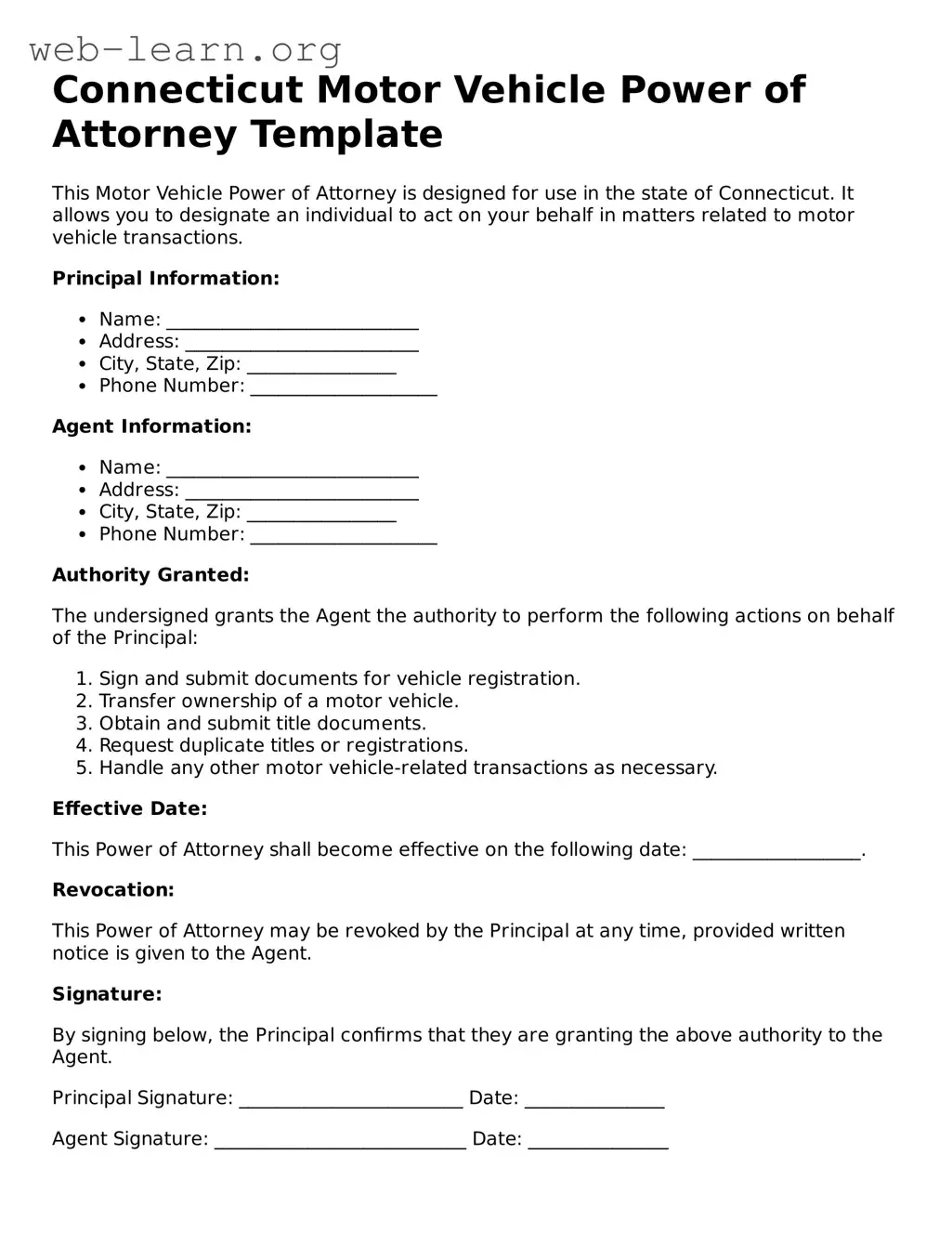
The Connecticut Motor Vehicle Power of Attorney form serves as a crucial legal document that empowers an individual, known as the agent, to act on behalf of another person, referred to as the principal, specifically concerning matters related to motor vehicle transactions. This form is particularly significant for those who may be unable to handle their vehicle-related affairs due to various reasons, such as illness, absence, or other constraints. By completing this form, the principal grants the agent the authority to perform tasks such as signing titles, registering vehicles, and transferring ownership. It is essential to ensure that the form is filled out accurately and includes all necessary details, such as the names and addresses of both the principal and the agent, as well as a clear description of the powers being granted. Additionally, the document requires the principal's signature and may need to be notarized to enhance its validity. Understanding the implications and requirements of the Motor Vehicle Power of Attorney can help individuals navigate the complexities of vehicle ownership and transactions in Connecticut.
Connecticut Motor Vehicle Power of Attorney Template
This Motor Vehicle Power of Attorney is designed for use in the state of Connecticut. It allows you to designate an individual to act on your behalf in matters related to motor vehicle transactions.
Principal Information:
Agent Information:
Authority Granted:
The undersigned grants the Agent the authority to perform the following actions on behalf of the Principal:
Effective Date:
This Power of Attorney shall become effective on the following date: __________________.
Revocation:
This Power of Attorney may be revoked by the Principal at any time, provided written notice is given to the Agent.
Signature:
By signing below, the Principal confirms that they are granting the above authority to the Agent.
Principal Signature: ________________________ Date: _______________
Agent Signature: ___________________________ Date: _______________
Witness Information:
Witness Signature: ________________________ Date: _______________
This document is governed by the laws of the State of Connecticut.
| Fact Name | Details |
|---|---|
| Purpose | The Connecticut Motor Vehicle Power of Attorney form allows an individual to designate another person to act on their behalf regarding motor vehicle transactions. |
| Governing Law | This form is governed by Connecticut General Statutes, specifically Section 14-50. |
| Signatory Requirements | The form must be signed by the principal (the person granting authority) in the presence of a notary public. |
| Agent Authority | The appointed agent can perform various tasks, such as transferring title, registering vehicles, and obtaining license plates. |
| Duration | The authority granted by this form remains effective until revoked or until the specific transaction is completed. |
| Revocation | The principal can revoke the power of attorney at any time, provided they notify the agent and any relevant parties. |
| Notarization | A notary public must witness the signing of the form to ensure its validity. |
| Use Cases | This form is commonly used when the principal cannot be present for a vehicle transaction, such as when out of state. |
| Additional Documentation | Depending on the transaction, additional documents may be required, such as proof of identity or ownership of the vehicle. |
Completing the Connecticut Motor Vehicle Power of Attorney form is a straightforward process. This document allows you to designate someone to act on your behalf regarding motor vehicle matters. Once filled out, it can be submitted to the appropriate authorities or shared with the designated agent.
What is a Motor Vehicle Power of Attorney in Connecticut?
A Motor Vehicle Power of Attorney (POA) is a legal document that allows one person (the principal) to authorize another person (the agent) to act on their behalf in matters related to motor vehicles. This can include tasks such as transferring ownership, registering a vehicle, or obtaining title documents.
Who can be appointed as an agent?
In Connecticut, the agent can be any competent adult. This means they should be at least 18 years old and capable of understanding the responsibilities involved. Many people choose a trusted family member, friend, or legal representative to serve in this role.
What powers does the agent have?
The agent can perform a variety of tasks related to motor vehicles, including:
How do I create a Motor Vehicle Power of Attorney?
To create a Motor Vehicle Power of Attorney in Connecticut, you need to complete the appropriate form, which can often be found online or at local Department of Motor Vehicles (DMV) offices. The form must be signed by the principal and may require notarization to ensure its validity.
Is notarization required for the form?
While notarization is not always mandatory, it is highly recommended. Having the document notarized adds an extra layer of authenticity and may be required by some institutions or agencies when the agent presents the POA.
Can I revoke a Motor Vehicle Power of Attorney?
Yes, you can revoke a Motor Vehicle Power of Attorney at any time as long as you are mentally competent. To do so, you should create a written revocation document and provide copies to the agent and any relevant institutions, such as the DMV.
What happens if the principal becomes incapacitated?
If the principal becomes incapacitated, the Motor Vehicle Power of Attorney may become ineffective unless it is a durable power of attorney. A durable power of attorney remains valid even if the principal loses their ability to make decisions. It is crucial to specify this when creating the document.
Where can I find the Motor Vehicle Power of Attorney form?
You can typically find the Motor Vehicle Power of Attorney form on the Connecticut DMV website or at your local DMV office. Ensure that you are using the most current version of the form to avoid any issues during the process.
Filling out the Connecticut Motor Vehicle Power of Attorney form can seem straightforward, but many people make mistakes that can lead to complications. One common error is failing to provide complete and accurate information. When individuals leave out essential details, such as the full name or address of the person granting power, it can create confusion and delay the process.
Another frequent mistake is not signing the form in the appropriate places. Signatures are crucial for validating the document. If a signature is missing or placed incorrectly, the form may be deemed invalid. Similarly, not having the document notarized can also lead to issues. In Connecticut, a notary's presence is often required to ensure that the form is legally binding.
People sometimes overlook the importance of specifying the powers being granted. A vague description can lead to misunderstandings about what the attorney-in-fact is authorized to do. Clarity is essential; therefore, it is vital to outline specific actions the representative can take on behalf of the vehicle owner.
Another common oversight is neglecting to include the vehicle identification number (VIN). This number uniquely identifies the vehicle and is crucial for any transactions related to it. Omitting the VIN can result in delays or even prevent the attorney-in-fact from acting on behalf of the vehicle owner.
In addition, individuals may not consider the timing of their Power of Attorney. If the form is filled out but not submitted promptly, it could lead to complications if an urgent situation arises. It’s important to keep the document updated and ensure it is filed when needed.
Some people also fail to keep copies of the completed form. Having a record is essential for both the vehicle owner and the attorney-in-fact. Without copies, it can be challenging to prove authority or reference the specific powers granted.
Additionally, individuals might not verify the identity of the attorney-in-fact. It’s crucial to choose someone trustworthy and responsible, as this person will have significant control over the vehicle and its transactions. Trusting the wrong person can lead to serious consequences.
Another mistake is not understanding the revocation process. If the vehicle owner decides to revoke the Power of Attorney, they must do so in writing. Failing to follow this process can leave room for confusion and potential misuse of authority.
Finally, many overlook the legal implications of the Power of Attorney. Understanding that this document grants significant authority is essential. It’s not just a formality; it’s a legal instrument that can affect ownership and rights. Being aware of this can help individuals make more informed decisions.
The Connecticut Motor Vehicle Power of Attorney form allows an individual to designate someone else to act on their behalf regarding motor vehicle transactions. This document is often accompanied by other forms and documents to facilitate various aspects of vehicle ownership and transfer. Below is a list of commonly used forms that may accompany the Power of Attorney in Connecticut.
These documents play a critical role in ensuring a smooth process for vehicle transactions in Connecticut. Having the necessary forms ready can help prevent delays and complications during the registration or transfer process.
When filling out the Connecticut Motor Vehicle Power of Attorney form, it's crucial to pay attention to detail. Here are ten important dos and don'ts to keep in mind:
By following these guidelines, you can help ensure that your Motor Vehicle Power of Attorney form is filled out correctly and efficiently. Taking the time to do it right now can save you from complications later on.
Many people have misunderstandings about the Connecticut Motor Vehicle Power of Attorney form. Here are some common misconceptions:
Understanding these misconceptions can help individuals navigate the process more effectively. It is essential to have accurate information when dealing with motor vehicle transactions.
Filling out and using the Connecticut Motor Vehicle Power of Attorney form can be straightforward if you keep a few key points in mind. Here are some essential takeaways to help guide you through the process:
By keeping these points in mind, you can confidently navigate the process of using the Motor Vehicle Power of Attorney form in Connecticut.
Idaho Dmv Power of Attorney - The principal should clearly outline the powers being granted to avoid confusion.
Ky Dmv Forms - Ensure your vehicle matters are handled efficiently by granting someone power of attorney.