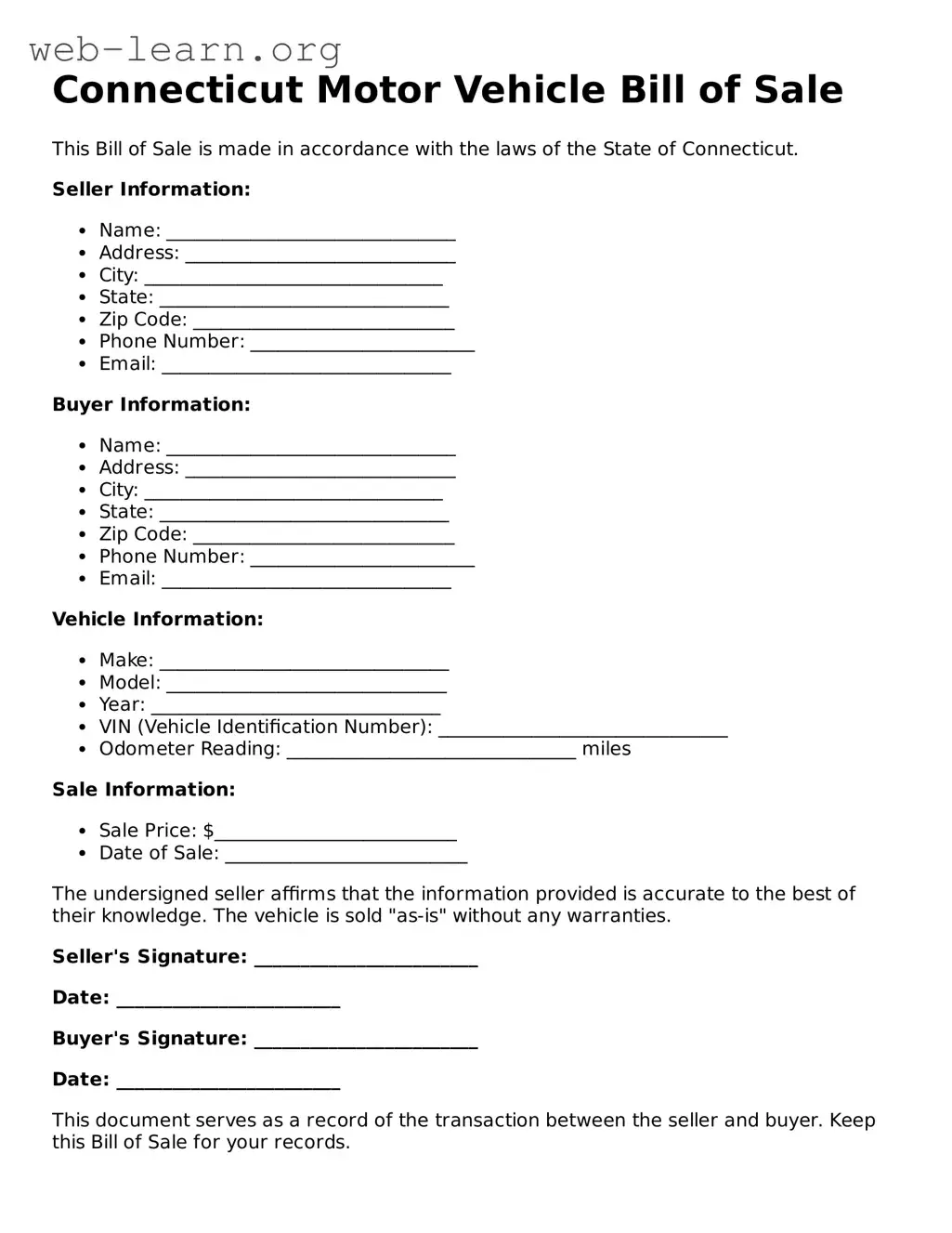
The Connecticut Motor Vehicle Bill of Sale form is an essential document for anyone involved in the buying or selling of a vehicle in the state. This form serves as a legal record of the transaction, providing important details such as the names and addresses of both the buyer and seller, the vehicle's make, model, year, and Vehicle Identification Number (VIN). Additionally, it outlines the purchase price and the date of the sale, ensuring that both parties have a clear understanding of the agreement. Completing this form not only protects the interests of both the buyer and seller but also facilitates the transfer of ownership with the Connecticut Department of Motor Vehicles (DMV). It is crucial to accurately fill out all sections of the form to avoid any future disputes or complications. Furthermore, having a Bill of Sale can be beneficial when registering the vehicle or when proof of ownership is required. Understanding the significance of this document can help streamline the vehicle transfer process and provide peace of mind for both parties involved.
Connecticut Motor Vehicle Bill of Sale
This Bill of Sale is made in accordance with the laws of the State of Connecticut.
Seller Information:
Buyer Information:
Vehicle Information:
Sale Information:
The undersigned seller affirms that the information provided is accurate to the best of their knowledge. The vehicle is sold "as-is" without any warranties.
Seller's Signature: ________________________
Date: ________________________
Buyer's Signature: ________________________
Date: ________________________
This document serves as a record of the transaction between the seller and buyer. Keep this Bill of Sale for your records.
| Fact Name | Details |
|---|---|
| Purpose | The Connecticut Motor Vehicle Bill of Sale form is used to document the sale of a motor vehicle between a buyer and a seller. |
| Required Information | The form requires details such as the vehicle identification number (VIN), make, model, year, and odometer reading at the time of sale. |
| Governing Law | This form is governed by Connecticut General Statutes, specifically Section 14-186a regarding the transfer of ownership of motor vehicles. |
| Signatures | Both the seller and the buyer must sign the form to validate the transaction and transfer of ownership. |
| Record Keeping | It is recommended that both parties retain a copy of the Bill of Sale for their records, as it serves as proof of the transaction. |
Once you have the Connecticut Motor Vehicle Bill of Sale form in front of you, it’s time to fill it out carefully. This document will serve as proof of the transaction between the buyer and the seller. Ensure that all information is accurate to avoid any potential issues in the future.
After completing the form, keep a copy for your records. The buyer should also retain a copy as proof of the purchase. This document may be needed for registration and title transfer purposes in the future.
What is a Connecticut Motor Vehicle Bill of Sale?
A Connecticut Motor Vehicle Bill of Sale is a legal document that records the transfer of ownership of a vehicle from one party to another. It includes essential details such as the vehicle's make, model, year, Vehicle Identification Number (VIN), and the sale price. This document serves as proof of the transaction and can be used for registration purposes with the Connecticut Department of Motor Vehicles (DMV).
Is a Bill of Sale required in Connecticut when selling a vehicle?
While a Bill of Sale is not legally required in Connecticut, it is highly recommended. Having this document protects both the buyer and seller by providing a written record of the transaction. It can help resolve any disputes that may arise regarding the sale and is often required when registering the vehicle in the new owner's name.
What information should be included in the Bill of Sale?
When creating a Bill of Sale in Connecticut, ensure that it includes the following information:
Including this information helps to ensure clarity and legality in the transaction.
How do I obtain a Bill of Sale form in Connecticut?
There is no official state form for a Bill of Sale in Connecticut, but you can easily create one. Many templates are available online, or you can draft your own document using the information mentioned earlier. Be sure to have both parties sign the document. Having a notary public witness the signatures can add an extra layer of authenticity, though it is not required.
When filling out the Connecticut Motor Vehicle Bill of Sale form, many individuals make common mistakes that can lead to complications. One of the most frequent errors is failing to include all required information. Essential details such as the vehicle's make, model, year, and VIN (Vehicle Identification Number) must be accurately recorded. Omitting any of these can create issues during the registration process.
Another mistake is not providing the correct date of the sale. The date is crucial for establishing the transfer of ownership and for tax purposes. If the date is incorrect or left blank, it can lead to confusion and delays in processing the transaction.
People often overlook the importance of signatures. Both the seller and the buyer must sign the form for it to be valid. A missing signature can invalidate the sale, leaving both parties in a difficult position. It's essential to double-check that all necessary signatures are present before submitting the form.
Inaccurate pricing is another common error. The sale price should reflect the actual transaction amount. If the price is misrepresented, it can lead to tax complications. Sellers should ensure that the price listed matches what was agreed upon to avoid any potential legal issues.
Failing to provide a copy of the bill of sale to the buyer is also a mistake that can create problems. Both parties should retain a copy for their records. This document serves as proof of the transaction and can be important for future reference, especially if disputes arise.
Lastly, many individuals forget to check the form for completeness before submission. A thorough review can catch errors and omissions. Taking the time to ensure that all information is correct can save both parties from future headaches.
When you are involved in buying or selling a vehicle in Connecticut, the Motor Vehicle Bill of Sale is an essential document. However, there are several other forms and documents that often accompany this bill of sale to ensure a smooth transaction. Here’s a list of important documents you may need to consider.
Having these documents prepared and organized can greatly simplify the vehicle buying or selling process in Connecticut. Being proactive ensures that both parties are protected and that the transaction goes smoothly. Always consider consulting with a professional if you have questions about any specific forms or requirements.
The Motor Vehicle Bill of Sale form serves as a crucial document in the transfer of vehicle ownership. However, it shares similarities with several other important documents. Here’s a look at nine documents that are comparable to the Motor Vehicle Bill of Sale:
Each of these documents plays a vital role in their respective transactions, ensuring clarity and legal protection for all parties involved.
When filling out the Connecticut Motor Vehicle Bill of Sale form, it is important to follow certain guidelines to ensure the process goes smoothly. Here are nine things you should and shouldn't do:
By following these guidelines, you can help ensure that your Bill of Sale is completed correctly and that the transaction proceeds without complications.
Understanding the Connecticut Motor Vehicle Bill of Sale form can be tricky. Here are seven common misconceptions that people often have about this important document:
Many people believe that a bill of sale is only required for dealership transactions. However, in Connecticut, a bill of sale is essential for private sales to establish proof of ownership and the sale price.
While notarization can add an extra layer of security, it is not a requirement for the Connecticut Motor Vehicle Bill of Sale. Simply filling out the form correctly and having both parties sign it is sufficient.
Some people think that only the seller's signature is needed. In reality, both the buyer and the seller should sign the bill of sale to validate the transaction.
This form is often associated with used vehicle sales, but it can also be used for new vehicles. Any transfer of ownership requires a bill of sale.
Some individuals overlook the importance of the VIN. Including the VIN is crucial as it uniquely identifies the vehicle and prevents any confusion during the transfer process.
While it is best to ensure all information is accurate before signing, if a mistake is made, the parties can create a new bill of sale to correct any errors.
Some people think that the bill of sale is optional when registering a vehicle. In Connecticut, the Department of Motor Vehicles requires it as part of the registration process for both new and used vehicles.
By clearing up these misconceptions, individuals can better navigate the process of buying or selling a vehicle in Connecticut. A bill of sale is not just a formality; it is an important document that protects both parties involved in the transaction.
When engaging in the sale or purchase of a motor vehicle in Connecticut, it is essential to properly complete the Motor Vehicle Bill of Sale form. Here are key takeaways to consider:
Free Printable Bill of Sale for Car Georgia - A Motor Vehicle Bill of Sale is often required for insurance purposes.
Bill of Sale for Car Alabama Pdf - Can include a section for disclosures about the vehicle's condition or history.