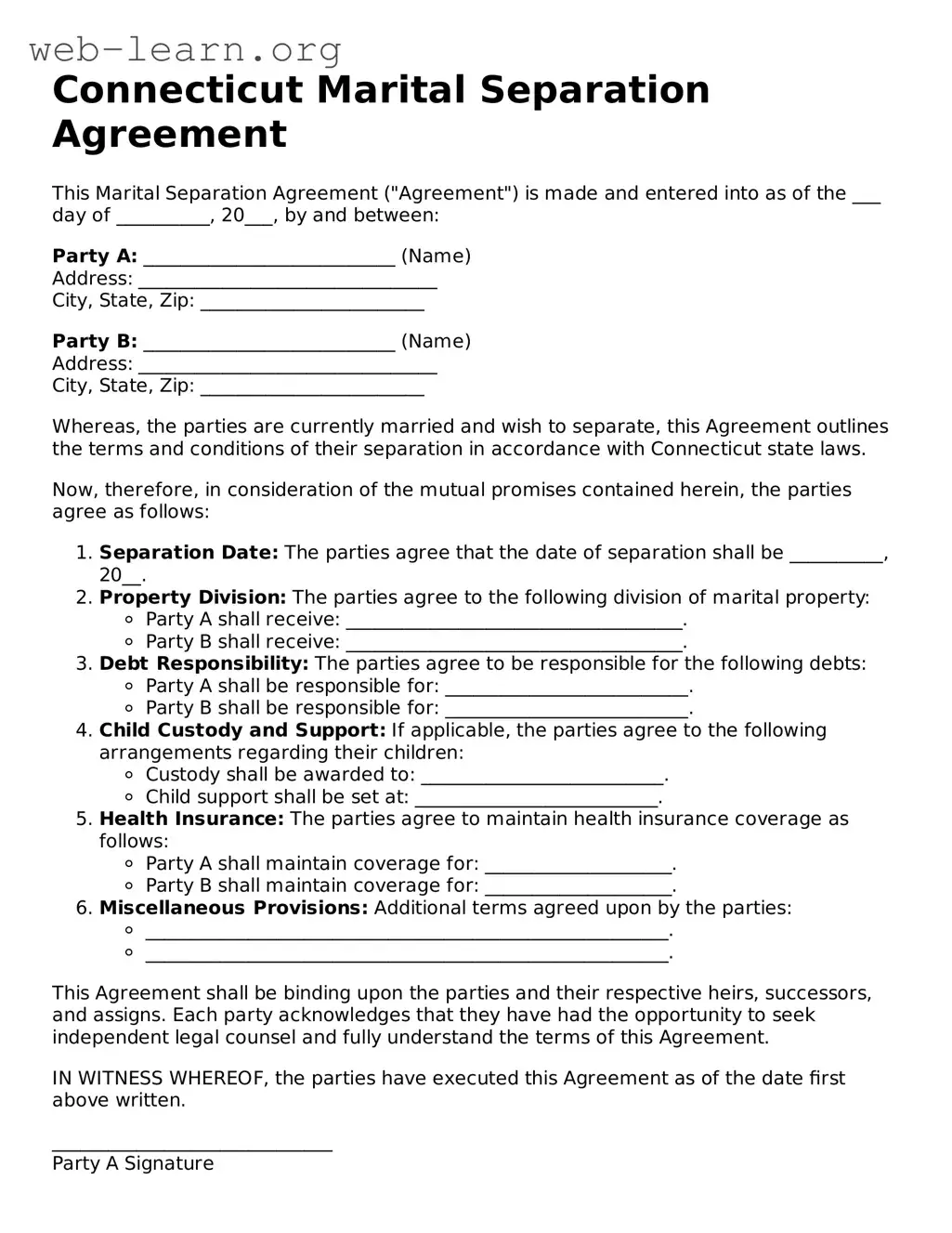
In the landscape of family law, the Connecticut Marital Separation Agreement form serves as a crucial tool for couples navigating the complexities of separation. This legal document outlines the terms and conditions agreed upon by both parties, addressing key aspects such as the division of assets and debts, child custody arrangements, and spousal support obligations. By formalizing these agreements, the form provides clarity and reduces the potential for future disputes. It also emphasizes the importance of mutual consent, as both parties must willingly sign the document to ensure its enforceability. Understanding the nuances of this agreement is essential for anyone considering separation in Connecticut, as it lays the groundwork for a fair and structured transition into post-marital life.
Connecticut Marital Separation Agreement
This Marital Separation Agreement ("Agreement") is made and entered into as of the ___ day of __________, 20___, by and between:
Party A: ___________________________ (Name)
Address: ________________________________
City, State, Zip: ________________________
Party B: ___________________________ (Name)
Address: ________________________________
City, State, Zip: ________________________
Whereas, the parties are currently married and wish to separate, this Agreement outlines the terms and conditions of their separation in accordance with Connecticut state laws.
Now, therefore, in consideration of the mutual promises contained herein, the parties agree as follows:
This Agreement shall be binding upon the parties and their respective heirs, successors, and assigns. Each party acknowledges that they have had the opportunity to seek independent legal counsel and fully understand the terms of this Agreement.
IN WITNESS WHEREOF, the parties have executed this Agreement as of the date first above written.
______________________________
Party A Signature
______________________________
Party B Signature
______________________________
Date
| Fact Name | Description |
|---|---|
| Definition | A Connecticut Marital Separation Agreement is a legal document that outlines the terms of separation between spouses. |
| Governing Law | The agreement is governed by Connecticut General Statutes, particularly Sections 46b-66 to 46b-71. |
| Purpose | This form is used to clarify issues such as property division, alimony, and child custody during separation. |
| Voluntary Agreement | Both parties must voluntarily agree to the terms outlined in the document. |
| Legal Effect | Once signed, the agreement can be enforced in court, making it a binding contract. |
| Modification | The agreement can be modified if both parties consent to the changes in writing. |
| Child Support | If children are involved, the agreement must include provisions for child support, adhering to state guidelines. |
| Filing Requirement | While the agreement itself does not need to be filed with the court, it may be incorporated into divorce proceedings. |
| Legal Advice | It is advisable for both parties to seek independent legal counsel before signing the agreement to ensure fair terms. |
Filling out the Connecticut Marital Separation Agreement form is an important step in the process of formalizing a separation. After completing the form, you will need to review it carefully and ensure that both parties agree to the terms outlined. Once finalized, the agreement should be signed and dated by both spouses.
A Connecticut Marital Separation Agreement is a legal document that outlines the terms of a couple's separation. It details how assets and debts will be divided, as well as arrangements for child custody, visitation, and support. This agreement helps both parties understand their rights and responsibilities during the separation period.
Creating a Marital Separation Agreement can provide clarity and peace of mind. It helps prevent misunderstandings and disputes by clearly outlining each person's obligations. This agreement can also serve as a reference point if the couple decides to divorce in the future. Having everything documented can make the process smoother and more organized.
Key elements to include in a Marital Separation Agreement are:
Each section should be as detailed as possible to avoid future conflicts.
While it is not legally required to have a lawyer, it is highly recommended. A lawyer can help ensure that the agreement complies with state laws and adequately protects your interests. If both parties agree on the terms, a lawyer can also help draft the document to make sure it is clear and enforceable.
When filling out the Connecticut Marital Separation Agreement form, many people make common mistakes that can lead to complications down the road. One frequent error is not providing complete information. Each section of the form must be filled out accurately. Leaving blanks can cause delays in processing or even rejection of the agreement.
Another mistake is failing to specify the terms clearly. For instance, vague language about asset division or child custody can create confusion later. It’s essential to be precise and detailed. This ensures both parties understand their rights and obligations.
People often overlook the importance of signatures. Both parties must sign the agreement for it to be valid. Without these signatures, the document may not hold up in court. Additionally, forgetting to date the signatures can also lead to issues.
Some individuals neglect to consider tax implications. The separation agreement can affect taxes, particularly concerning alimony and property division. Consulting a tax professional before finalizing the agreement is wise.
Another common oversight is not including a plan for future changes. Life circumstances can change, and it’s important to have a clause that addresses how modifications will be handled. This can prevent future disputes.
People sometimes fail to communicate effectively. Discussing the terms openly with the other party can help ensure that both sides are on the same page. Misunderstandings can lead to conflicts that could have been avoided.
Not seeking legal advice is a mistake many make. While it’s possible to fill out the form without an attorney, having legal guidance can help navigate complex issues. An attorney can ensure that the agreement complies with state laws.
Another error involves not considering the children's best interests. When children are involved, their needs should be prioritized. Agreements should reflect a commitment to co-parenting and their well-being.
Some individuals forget to keep copies of the signed agreement. After the form is completed, it’s important to retain a copy for personal records. This can be crucial for future reference and enforcement of the agreement.
Finally, many people rush through the process. Taking the time to review each section carefully can prevent mistakes. A thorough review ensures that all terms are understood and agreed upon, leading to a smoother separation process.
When navigating a marital separation in Connecticut, several key documents often accompany the Marital Separation Agreement. These forms help clarify responsibilities, rights, and arrangements between the parties involved. Understanding each of these documents can make the process smoother and ensure that all necessary aspects of the separation are addressed.
By familiarizing yourself with these documents, you can approach the separation process with greater confidence. Each form plays a vital role in ensuring that both parties are clear about their rights and responsibilities, helping to pave the way for a smoother transition.
When filling out the Connecticut Marital Separation Agreement form, it's important to approach the process thoughtfully. Here are some key dos and don'ts to keep in mind:
When dealing with a Connecticut Marital Separation Agreement, it is essential to clarify some common misconceptions. Understanding these points can help individuals navigate their separation more effectively.
While a separation agreement outlines the terms of living apart, it does not legally end the marriage. A divorce is a separate legal process that terminates the marriage entirely.
This is not true. Parties can agree to modify the terms of the agreement later, provided both individuals consent to the changes and document them properly.
Even without children, a separation agreement can clarify financial responsibilities, property division, and other important matters. It is beneficial for any couple separating.
While individuals can draft their own agreements, it is highly advisable to seek legal guidance. An attorney can ensure that the agreement is fair and complies with state laws.
Many couples use separation agreements as a tool to gain clarity and space. Reconciliation is still possible, and the agreement can be set aside if both parties choose to reunite.
In Connecticut, a separation agreement does not need court approval to be valid. However, if the agreement is later incorporated into a divorce decree, the court will review it for fairness.
When filling out and using the Connecticut Marital Separation Agreement form, keep these key points in mind:
Separation Agreement California Template - The agreement can specify how to manage shared debts during separation.
Arizona Legal Separation - A Marital Separation Agreement can help couples take control of their situation and make informed decisions.
Legal Separation in Alabama - Having a written agreement can provide peace of mind, knowing that both parties have agreed to the terms of their separation.
How Long Do You Have to Be Separated Before Divorce in Arkansas - A Marital Separation Agreement can help ensure fair treatment of children.