In the state of Connecticut, the Living Will form serves as a crucial document that empowers individuals to articulate their healthcare preferences in the event that they become unable to communicate their wishes. This legal instrument primarily addresses end-of-life decisions, allowing individuals to specify their desires regarding medical treatments and interventions. By outlining choices related to life-sustaining measures, such as resuscitation and artificial nutrition, the form provides clarity to healthcare providers and loved ones during emotionally charged moments. Additionally, the Living Will can be integrated with other advance directives, such as a healthcare proxy, which designates a trusted person to make decisions on behalf of the individual. Understanding the nuances of this form is essential for ensuring that one's values and preferences are respected, thus alleviating potential conflicts among family members and healthcare professionals when critical decisions must be made. With a clear and concise approach, the Connecticut Living Will form aims to safeguard personal autonomy and promote dignity in healthcare choices, reflecting the individual's wishes even when they can no longer voice them.
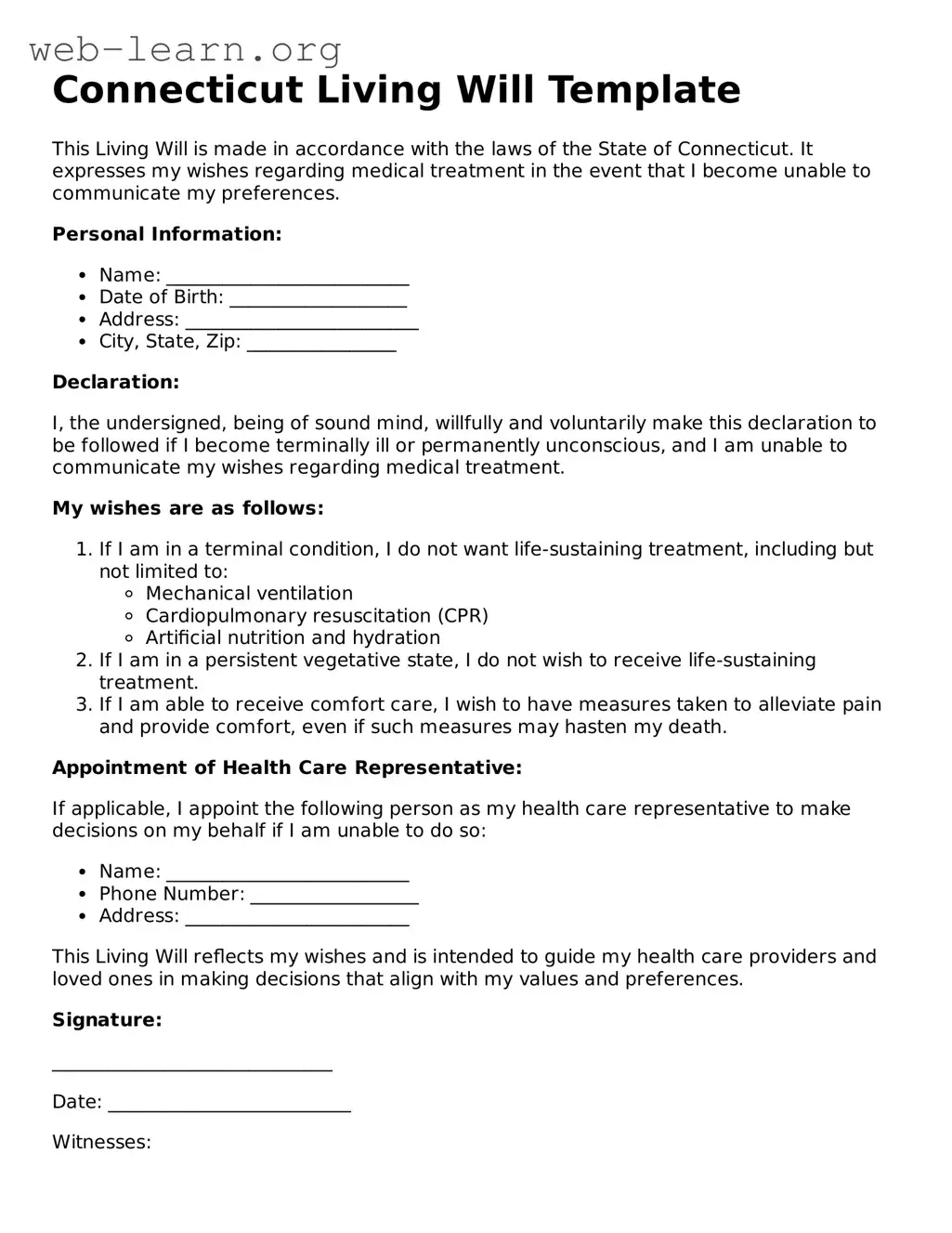
Connecticut Living Will Template
This Living Will is made in accordance with the laws of the State of Connecticut. It expresses my wishes regarding medical treatment in the event that I become unable to communicate my preferences.
Personal Information:
Declaration:
I, the undersigned, being of sound mind, willfully and voluntarily make this declaration to be followed if I become terminally ill or permanently unconscious, and I am unable to communicate my wishes regarding medical treatment.
My wishes are as follows:
Appointment of Health Care Representative:
If applicable, I appoint the following person as my health care representative to make decisions on my behalf if I am unable to do so:
This Living Will reflects my wishes and is intended to guide my health care providers and loved ones in making decisions that align with my values and preferences.
Signature:
______________________________
Date: __________________________
Witnesses:
| Fact Name | Description |
|---|---|
| Definition | A Connecticut Living Will is a legal document that outlines a person's wishes regarding medical treatment in situations where they are unable to communicate their preferences. |
| Governing Law | The Connecticut Living Will is governed by Connecticut General Statutes § 19a-570 to § 19a-580. |
| Eligibility | Any adult who is at least 18 years old can create a Living Will in Connecticut. |
| Requirements | The document must be signed by the individual and witnessed by two people who are not related to the individual or entitled to any portion of their estate. |
| Revocation | A Living Will can be revoked at any time by the individual, either verbally or in writing. |
| Healthcare Proxy | While a Living Will specifies treatment preferences, individuals can also appoint a healthcare proxy to make decisions on their behalf if they become incapacitated. |
Filling out the Connecticut Living Will form is an important step in expressing your healthcare preferences. Once you complete the form, you will be better prepared to communicate your wishes regarding medical treatment in situations where you may not be able to speak for yourself.
What is a Living Will in Connecticut?
A Living Will is a legal document that allows you to express your wishes regarding medical treatment in case you become unable to communicate those wishes yourself. It specifically addresses situations where you may be facing terminal illness or are in a persistent vegetative state. By outlining your preferences, you can guide your healthcare providers and loved ones in making decisions that align with your values.
Who should consider creating a Living Will?
Anyone over the age of 18 should consider creating a Living Will, especially if you have specific wishes about end-of-life care. This document is essential for individuals with serious health conditions, those approaching advanced age, or anyone who simply wants to ensure their healthcare preferences are known. It provides peace of mind for both you and your loved ones.
How do I create a Living Will in Connecticut?
Creating a Living Will in Connecticut involves a few straightforward steps:
Once completed, share copies with your healthcare provider, family members, and anyone else involved in your care.
Can I change or revoke my Living Will?
Yes, you can change or revoke your Living Will at any time as long as you are mentally competent. To make changes, simply create a new Living Will, ensuring that you follow the proper procedures for signing and witnessing. If you wish to revoke your existing document, you can do so by destroying it or by explicitly stating your intention to revoke it in writing.
What happens if I don’t have a Living Will?
If you do not have a Living Will, healthcare decisions may be made by your family members or legal representatives, which could lead to disagreements or decisions that do not reflect your wishes. Without a clear directive, loved ones may face significant emotional stress during an already challenging time. Having a Living Will helps to alleviate this burden and ensures that your preferences are honored.
Is a Living Will the same as a Power of Attorney?
No, a Living Will and a Power of Attorney serve different purposes. A Living Will focuses on your medical treatment preferences, while a Power of Attorney allows you to designate someone to make healthcare decisions on your behalf if you are unable to do so. You can have both documents in place to provide comprehensive guidance regarding your healthcare and financial matters.
Where should I keep my Living Will?
Store your Living Will in a safe yet accessible location. Consider keeping it with other important documents, such as your health records or estate planning materials. Additionally, provide copies to your healthcare provider, family members, and anyone else who may need to reference it. This ensures that your wishes can be easily accessed when needed.
When filling out the Connecticut Living Will form, individuals often overlook crucial details that can impact their healthcare decisions. One common mistake is failing to specify the types of medical treatments they wish to receive or refuse. While it may seem straightforward, the lack of clarity can lead to confusion among healthcare providers during critical moments.
Another frequent error is neglecting to sign and date the document properly. A Living Will is only valid if it is signed by the individual creating it. Without a signature, the form may be rendered useless, leaving loved ones and medical staff without guidance regarding the individual’s wishes.
Many people also forget to include witnesses when required. In Connecticut, the presence of two witnesses is necessary for the Living Will to be legally binding. If this step is skipped, the document may not hold up in a medical emergency, undermining the purpose of having a Living Will in the first place.
In addition, individuals sometimes fail to communicate their wishes with family members or healthcare proxies. It is essential that those who may be involved in decision-making are aware of the contents of the Living Will. Without this communication, there may be disputes or misunderstandings at a time when clarity is most needed.
Another mistake involves not reviewing the document regularly. As life circumstances change, so might one’s preferences regarding medical treatment. Failing to update the Living Will can lead to outdated instructions that no longer reflect the individual’s current desires.
Some individuals may also misinterpret the legal language or intent of the form. It’s important to understand the implications of the choices being made. Misunderstanding can lead to unintended consequences, such as refusing treatments that one might actually want in a different context.
Additionally, people sometimes overlook the importance of specifying a healthcare proxy. While a Living Will outlines one’s medical wishes, appointing a trusted individual to make decisions on one’s behalf can provide an extra layer of assurance. Without a designated proxy, there may be confusion about who should advocate for the individual’s wishes.
Lastly, individuals often fail to store the document in an accessible location. A Living Will should be easily retrievable in case of an emergency. Placing it in a safe deposit box or a location that is not readily available can hinder timely access when it is needed most.
A Connecticut Living Will is an important document that outlines your wishes regarding medical treatment in situations where you cannot communicate your preferences. However, there are several other forms and documents that often accompany a Living Will to ensure comprehensive planning for healthcare decisions. Below is a list of related documents that can enhance your advance care planning.
Having a well-rounded set of documents can provide clarity and support for your loved ones during challenging times. It ensures that your wishes are honored and that your healthcare and financial matters are managed according to your preferences.
The Living Will form is similar to several other important documents that address healthcare decisions and end-of-life preferences. Here are four documents that share similarities with a Living Will:
When filling out the Connecticut Living Will form, it is essential to approach the task with care and attention. Here is a list of things you should and shouldn't do to ensure your wishes are clearly expressed and legally recognized.
Understanding the Connecticut Living Will form is essential for making informed decisions about your healthcare preferences. However, several misconceptions can cloud people's understanding. Below are ten common misconceptions about the Connecticut Living Will form, along with clarifications.
By understanding these misconceptions, you can make better-informed decisions regarding your healthcare preferences and ensure that your wishes are honored when it matters most.
Filling out a Connecticut Living Will form is an important step in planning for your healthcare preferences. Here are some key takeaways to consider:
Living Will Free Forms - A Living Will can help protect your rights as a patient in critical care scenarios.
Arkansas Medical Power of Attorney - A Living Will can include instructions about artificial nutrition and hydration.
Alabama Living Will - This form allows you to articulate your wishes without ambiguity.