Creating a Last Will and Testament is an essential step in ensuring that your wishes are honored after your passing. In Connecticut, this legal document outlines how your assets will be distributed, who will serve as your executor, and can even designate guardians for minor children. The form typically includes sections for naming beneficiaries, specifying the distribution of property, and detailing any specific bequests. Additionally, it requires signatures from witnesses to validate the document, ensuring that it meets state requirements. Understanding the nuances of the Connecticut Last Will and Testament form can help individuals navigate the complexities of estate planning, providing peace of mind that their intentions will be clearly communicated and legally upheld.
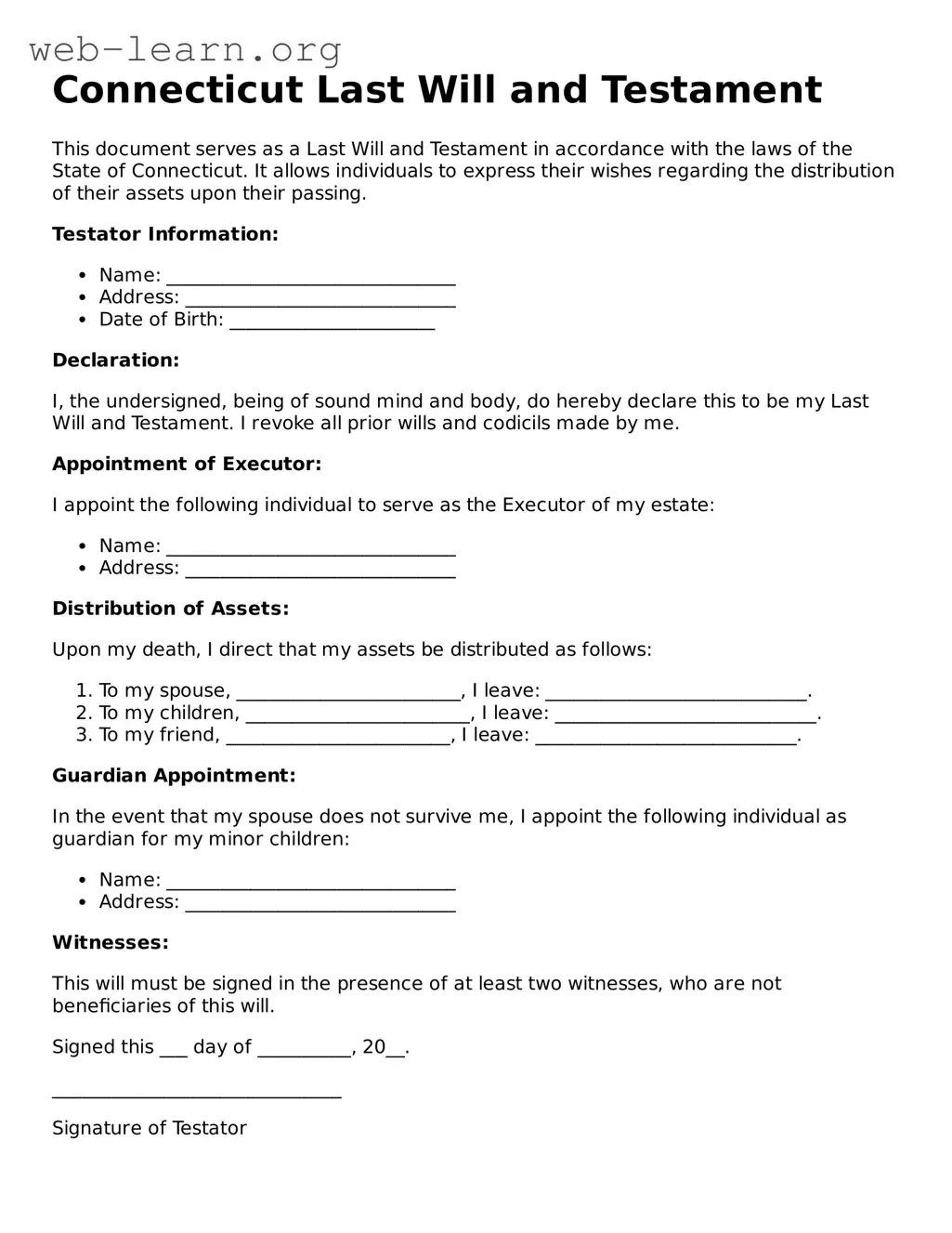
Connecticut Last Will and Testament
This document serves as a Last Will and Testament in accordance with the laws of the State of Connecticut. It allows individuals to express their wishes regarding the distribution of their assets upon their passing.
Testator Information:
Declaration:
I, the undersigned, being of sound mind and body, do hereby declare this to be my Last Will and Testament. I revoke all prior wills and codicils made by me.
Appointment of Executor:
I appoint the following individual to serve as the Executor of my estate:
Distribution of Assets:
Upon my death, I direct that my assets be distributed as follows:
Guardian Appointment:
In the event that my spouse does not survive me, I appoint the following individual as guardian for my minor children:
Witnesses:
This will must be signed in the presence of at least two witnesses, who are not beneficiaries of this will.
Signed this ___ day of __________, 20__.
_______________________________
Signature of Testator
We, the undersigned witnesses, hereby declare that we witnessed the signing of this Last Will and Testament by the Testator, who appeared to be of sound mind and not under duress.
_______________________________
Signature of Witness 1
Name: _______________________________
Address: _____________________________
_______________________________
Signature of Witness 2
Name: _______________________________
Address: _____________________________
| Fact Name | Details |
|---|---|
| Governing Law | The Connecticut Last Will and Testament is governed by Connecticut General Statutes, Title 45a. |
| Requirements | The testator must be at least 18 years old and of sound mind to create a valid will. |
| Witnesses | Two witnesses are required to sign the will in the presence of the testator. |
| Revocation | A will can be revoked by a subsequent will or by physically destroying the original document. |
| Self-Proving Will | Connecticut allows for a self-proving will, which can simplify the probate process. |
Completing a Last Will and Testament is an important step in ensuring your wishes are honored after your passing. Once you have filled out the form, it will need to be signed and witnessed according to Connecticut law to ensure its validity.
What is a Last Will and Testament in Connecticut?
A Last Will and Testament is a legal document that outlines how an individual's assets and property should be distributed after their death. In Connecticut, this document can also specify guardianship for minor children and appoint an executor to manage the estate. The will serves as a clear expression of the individual's wishes and can help avoid disputes among family members.
Who can create a Last Will and Testament in Connecticut?
Any person who is at least 18 years old and of sound mind can create a Last Will and Testament in Connecticut. This means the individual must understand the nature of their assets and the implications of the decisions they are making. There are no residency requirements; however, the will must comply with Connecticut laws to be valid.
What are the requirements for a valid will in Connecticut?
For a will to be valid in Connecticut, it must meet several criteria:
Additionally, the will should clearly express the testator's intentions to avoid ambiguity.
Can I change or revoke my Last Will and Testament?
Yes, individuals in Connecticut can change or revoke their Last Will and Testament at any time while they are alive and of sound mind. Changes can be made by creating a new will or by drafting a codicil, which is an amendment to the existing will. To revoke a will, the testator can destroy it or create a new will that explicitly states the previous will is revoked.
What happens if I die without a will in Connecticut?
If an individual dies without a will, they are considered to have died "intestate." In this case, Connecticut law determines how the deceased's assets will be distributed. Typically, the estate will be divided among the closest relatives, such as a spouse, children, or parents. This process can lead to outcomes that may not align with the deceased's wishes, highlighting the importance of having a will.
Do I need a lawyer to create a Last Will and Testament in Connecticut?
While it is not legally required to have a lawyer to create a Last Will and Testament in Connecticut, seeking legal advice is often advisable. An attorney can ensure that the will complies with state laws, accurately reflects the testator's intentions, and addresses any complex issues, such as tax implications or unique family situations. For many individuals, the peace of mind that comes from professional guidance is invaluable.
Creating a Last Will and Testament is a crucial step in ensuring that your wishes are honored after you pass away. However, many individuals make mistakes when filling out the Connecticut Last Will and Testament form, which can lead to complications and disputes later on. Understanding these common pitfalls can help you avoid them and create a clear, effective will.
One common mistake is failing to specify beneficiaries clearly. It is essential to name individuals or organizations explicitly and to avoid vague terms. For example, instead of saying “my children,” list their full names. This clarity prevents confusion and ensures that your intentions are understood.
Another frequent error is neglecting to sign the will properly. In Connecticut, a will must be signed by the testator, the person creating the will. If this signature is missing, the will may be considered invalid. Additionally, having witnesses present during the signing is crucial. Failing to have the required witnesses can also render the will unenforceable.
People often overlook the importance of updating their will. Life changes, such as marriage, divorce, or the birth of a child, can significantly affect your estate planning. If you don’t revise your will accordingly, it may not reflect your current wishes or circumstances, leading to potential disputes among heirs.
Another mistake is not considering the tax implications of your estate. While many people focus solely on who gets what, they may forget about the potential tax burdens that could affect their beneficiaries. Understanding these implications can help you structure your estate in a way that minimizes tax liabilities for your heirs.
Some individuals also fail to provide for the care of minor children. If you have children under 18, it’s crucial to name a guardian in your will. Without this designation, the court will decide who will take care of your children, which may not align with your wishes.
In addition, many people neglect to include a residuary clause. This clause addresses any assets not specifically mentioned in the will. Without it, any property not explicitly outlined may be left out of the distribution process, leading to confusion and potential legal battles.
Finally, a common oversight is not keeping the will in a safe yet accessible location. After completing your will, it should be stored securely but also made known to trusted family members or friends. If your loved ones cannot find the document when needed, your wishes may not be honored, and your estate could be subjected to unnecessary complications.
By being aware of these common mistakes, individuals can take the necessary steps to create a clear and effective Last Will and Testament in Connecticut. Proper planning ensures that your intentions are honored and that your loved ones are taken care of according to your wishes.
When creating a Last Will and Testament in Connecticut, there are several other important documents that can complement your will. Each of these documents serves a specific purpose, ensuring that your wishes are carried out effectively and that your loved ones are protected. Here’s a list of commonly used forms and documents:
Having these documents in place can make a significant difference in how your estate is managed and how your loved ones are cared for. It’s essential to consider each of these forms to ensure your wishes are honored and to provide clarity for those you leave behind.
The Last Will and Testament is an important legal document that outlines how a person's assets and affairs should be handled after their passing. Several other documents serve similar purposes in estate planning and asset distribution. Here are four documents that share similarities with a Last Will and Testament:
When filling out the Connecticut Last Will and Testament form, it is important to approach the process with care. Below are some essential dos and don'ts to keep in mind.
By following these guidelines, you can help ensure that your Last Will and Testament accurately reflects your wishes and is legally valid.
Understanding the Connecticut Last Will and Testament form is essential for anyone looking to plan their estate. However, there are several misconceptions that can lead to confusion. Here are ten common misconceptions:
Many people believe that a will has no significance until the person passes away. In reality, having a will in place can help guide decisions regarding your healthcare and financial matters while you are still alive.
It is a common misconception that only those with significant assets need a will. Regardless of your financial situation, a will can ensure that your wishes are respected and can help avoid disputes among family members.
Some people think that only typed and formally executed wills are valid. In Connecticut, handwritten wills, also known as holographic wills, can be valid if they meet specific requirements.
While debts are typically settled during the probate process, this does not mean that a will cannot be executed until all debts are cleared. The estate will handle debts before distributing assets according to the will.
Many believe that wills only serve to distribute physical property. However, a will can also designate guardians for minor children, name executors, and outline funeral arrangements.
This is a misconception. A will can be updated or revoked at any time, as long as the individual is of sound mind. It is advisable to review your will regularly, especially after major life changes.
Not all assets are subject to the terms of a will. Certain assets, like those held in a trust or those with designated beneficiaries, may bypass the will and go directly to the named individuals.
Many young adults believe they do not need a will. However, unexpected events can occur at any age, and having a will ensures that your wishes are known and respected.
While a signed will is legally binding, it can be contested in court under certain circumstances. Factors such as undue influence or lack of capacity can lead to disputes.
Although it is possible to create a will without legal help, consulting with an attorney or a legal document preparer can ensure that the will meets all legal requirements and accurately reflects your wishes.
Being aware of these misconceptions can help you navigate the process of creating a Last Will and Testament in Connecticut. It is important to take the necessary steps to protect your wishes and your loved ones.
When filling out and using the Connecticut Last Will and Testament form, it is important to consider several key aspects to ensure that the document is valid and serves its intended purpose.
Following these guidelines can help ensure that your wishes are honored and reduce potential disputes among heirs.
How to Make a Will in Arkansas - Offers a way to express personal sentiments or messages to loved ones.
Kansas Will - Leave a lasting impact by supporting causes you care about in your will.
How to Make a Will in Florida - Offers a way to express personal values and beliefs through asset distribution.
Making a Will in Kentucky - This document can be a way to express gratitude to those who have supported you throughout your life.