Homepage Blank Connecticut K 158 Form
Outline

The Connecticut K 158 form serves as a critical document for motor vehicle dealers, repairers, and leasing or renting companies operating within the state. This surety bond, required by the Department of Motor Vehicles, ensures that these businesses comply with state and federal laws governing their operations. Depending on the type of business, the bond amount varies: $50,000 for motor vehicle dealers, $5,000 for motor vehicle repairers or limited repairers, and $10,000 for leasing or renting companies. The bond acts as a safeguard, providing indemnity for any losses incurred by individuals due to the actions of the licensee that may warrant suspension or revocation of their license. It’s important to note that the bond's penalty can only be invoked following a hearing led by the Commissioner of Motor Vehicles, ensuring that all parties are treated fairly. To validate the bond, signatures from both the principal and the surety must be witnessed, and a Power of Attorney for the surety's attorney-in-fact must accompany the document. Understanding the nuances of the K 158 form is essential for any business in this sector, as it not only protects consumers but also helps maintain the integrity of the automotive industry in Connecticut.
Sample - Connecticut K 158 Form

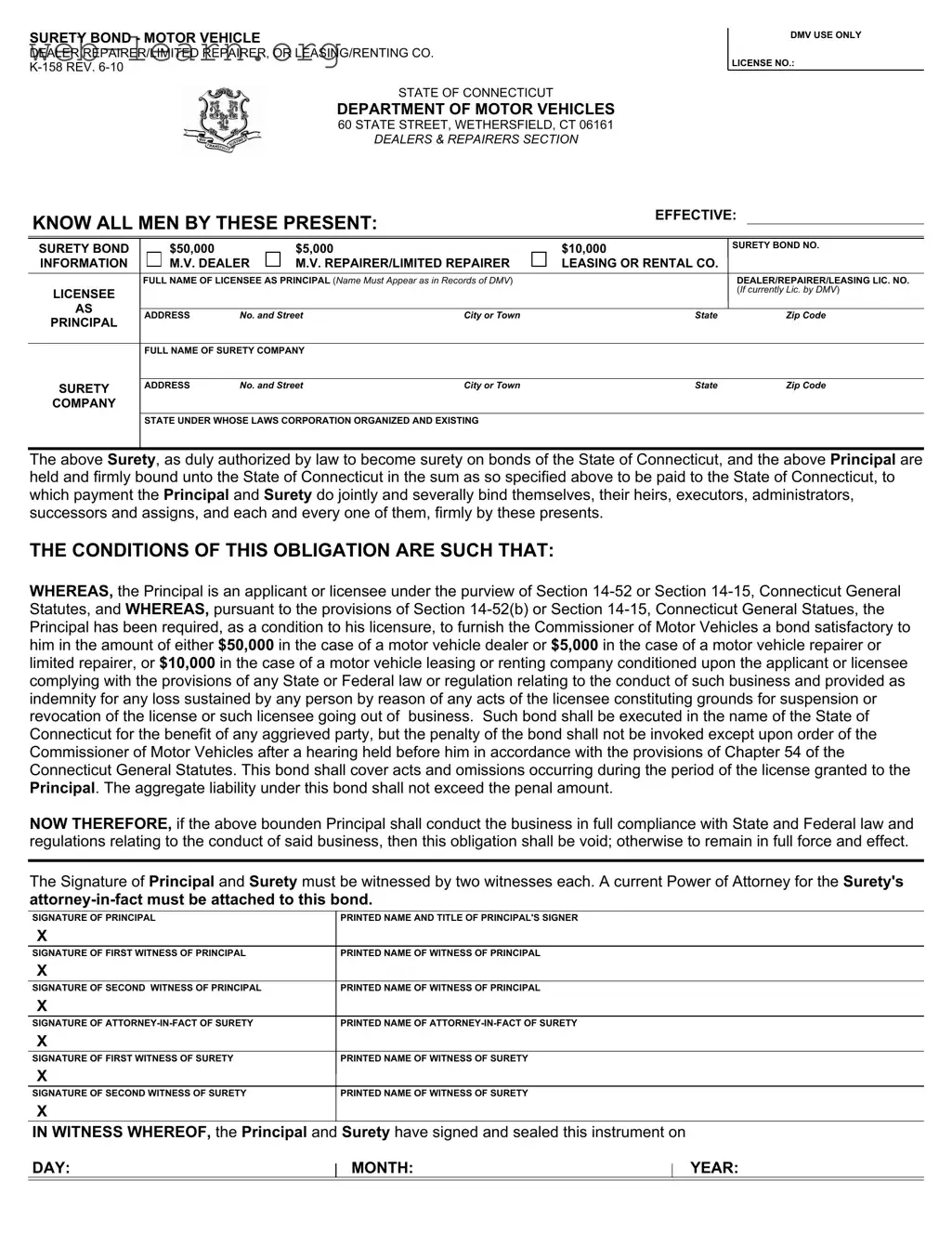
STATE OF CONNECTICUT
DEPARTMENT OF MOTOR VEHICLES
60 STATE STREET, WETHERSFIELD, CT 06161
DEALERS & REPAIRERS SECTION
SURETY BOND - MOTOR VEHICLE
DEALER REPAIRER/LIMITED REPAIRER, OR LEASING/RENTING CO.
K-158 REV. 6-10
KNOW ALL MEN BY THESE PRESENT:
SURETY BOND
INFORMATION
$50,000
M.V. DEALER
$5,000
M.V. REPAIRER/LIMITED REPAIRER
$10,000
LEASING OR RENTAL CO.
SURETY BOND NO.
LICENSEE
AS
PRINCIPAL
FULL NAME OF LICENSEE AS PRINCIPAL (Name Must Appear as in Records of DMV) DEALER/REPAIRER/LEASING LIC. NO.
(If currently Lic. by DMV)
ADDRESS No. and Street City or Town State Zip Code
FULL NAME OF SURETY COMPANY
ADDRESS No. and Street City or Town State Zip Code
STATE UNDER WHOSE LAWS CORPORATION ORGANIZED AND EXISTING
SURETY
COMPANY
The above Surety, as duly authorized by law to become surety on bonds of the State of Connecticut, and the above Principal are
held and firmly bound unto the State of Connecticut in the sum as so specified above to be paid to the State of Connecticut, to
which payment the Principal and Surety do jointly and severally bind themselves, their heirs, executors, administrators,
successors and assigns, and each and every one of them, firmly by these presents.
THE CONDITIONS OF THIS OBLIGATION ARE SUCH THAT:
WHEREAS, the Principal is an applicant or licensee under the purview of Section 14-52 or Section 14-15, Connecticut General
Statutes, and WHEREAS, pursuant to the provisions of Section 14-52(b) or Section 14-15, Connecticut General Statues, the
Principal has been required, as a condition to his licensure, to furnish the Commissioner of Motor Vehicles a bond satisfactory to
him in the amount of either $50,000 in the case of a motor vehicle dealer or $5,000 in the case of a motor vehicle repairer or
limited repairer, or $10,000 in the case of a motor vehicle leasing or renting company conditioned upon the applicant or licensee
complying with the provisions of any State or Federal law or regulation relating to the conduct of such business and provided as
indemnity for any loss sustained by any person by reason of any acts of the licensee constituting grounds for suspension or
revocation of the license or such licensee going out of business. Such bond shall be executed in the name of the State of
Connecticut for the benefit of any aggrieved party, but the penalty of the bond shall not be invoked except upon order of the
Commissioner of Motor Vehicles after a hearing held before him in accordance with the provisions of Chapter 54 of the
Connecticut General Statutes. This bond shall cover acts and omissions occurring during the period of the license granted to the
Principal. The aggregate liability under this bond shall not exceed the penal amount.
NOW THEREFORE, if the above bounden Principal shall conduct the business in full compliance with State and Federal law and
regulations relating to the conduct of said business, then this obligation shall be void; otherwise to remain in full force and effect.
The Signature of Principal and Surety must be witnessed by two witnesses each. A current Power of Attorney for the Surety's
attorney-in-fact must be attached to this bond.
SIGNATURE OF PRINCIPAL PRINTED NAME AND TITLE OF PRINCIPAL'S SIGNER
SIGNATURE OF FIRST WITNESS OF PRINCIPAL PRINTED NAME OF WITNESS OF PRINCIPAL
SIGNATURE OF SECOND WITNESS OF PRINCIPAL PRINTED NAME OF WITNESS OF PRINCIPAL
SIGNATURE OF ATTORNEY-IN-FACT OF SURETY PRINTED NAME OF ATTORNEY-IN-FACT OF SURETY
SIGNATURE OF FIRST WITNESS OF SURETY PRINTED NAME OF WITNESS OF SURETY
SIGNATURE OF SECOND WITNESS OF SURETY PRINTED NAME OF WITNESS OF SURETY
IN WITNESS WHEREOF, the Principal and Surety have signed and sealed this instrument on
DAY: MONTH: YEAR:
DMV USE ONLY
LICENSE NO.:
X
X
X
X
X
X
EFFECTIVE:

Form Information

Fact Name Details
Form Purpose This form is used to establish a surety bond for motor vehicle dealers, repairers, and leasing companies in Connecticut.
Bond Amounts The bond amounts are $50,000 for motor vehicle dealers, $5,000 for repairers or limited repairers, and $10,000 for leasing or rental companies.
Governing Laws The form is governed by Section 14-52 and Section 14-15 of the Connecticut General Statutes.
License Requirement Applicants must provide this bond as a condition for obtaining a license from the Connecticut Department of Motor Vehicles.
Indemnity Provision The bond serves as indemnity for losses caused by the licensee's actions that could lead to license suspension or revocation.
Hearing Requirement The bond penalty can only be invoked following a hearing conducted by the Commissioner of Motor Vehicles.
Witness Requirement Signatures of both the Principal and Surety must be witnessed by two individuals each.
Power of Attorney A current Power of Attorney for the Surety's attorney-in-fact must be attached to the bond.
Effective Date The bond becomes effective upon the date specified by the Principal and Surety at the time of signing.
Aggregate Liability The total liability under the bond cannot exceed the specified penal amount.

Detailed Guide for Filling Out Connecticut K 158

After obtaining the Connecticut K 158 form, you will need to fill it out accurately. This form serves as a surety bond for motor vehicle dealers, repairers, limited repairers, or leasing/renting companies. Follow the steps below to ensure proper completion of the form.

  1. Begin by entering the effective date of the bond in the designated space.
  2. Indicate the amount of the surety bond. Select from $50,000 for a motor vehicle dealer, $5,000 for a motor vehicle repairer or limited repairer, or $10,000 for a leasing or rental company.
  3. Fill in the surety bond number in the appropriate field.
  4. Provide the full name of the licensee as principal. Ensure it matches the records of the DMV.
  5. Enter the dealer/repairer/leasing license number, if currently licensed by the DMV.
  6. Complete the address section with the street number, city or town, state, and zip code of the principal.
  7. Write the full name of the surety company.
  8. Fill in the surety company's address, including street number, city or town, state, and zip code.
  9. Specify the state under whose laws the surety company is organized and existing.
  10. Ensure that the principal signs the form. The printed name and title of the principal’s signer should also be included.
  11. Two witnesses must sign the form next to the principal's signature. Include the printed names of both witnesses.
  12. The attorney-in-fact of the surety must sign the form. Include their printed name as well.
  13. Two additional witnesses must sign next to the attorney-in-fact’s signature. Their printed names should also be provided.
  14. Finally, complete the date section by writing the day, month, and year when the bond is signed and sealed.

Obtain Answers on Connecticut K 158

  1. What is the purpose of the Connecticut K 158 form?

    The Connecticut K 158 form serves as a surety bond for motor vehicle dealers, repairers, limited repairers, and leasing or renting companies. It ensures compliance with state and federal laws related to these businesses. By filing this bond, the principal (the business owner) agrees to adhere to regulations and provides a financial guarantee to protect consumers from potential losses due to misconduct.

  2. What are the bond amounts required for different types of businesses?

    The bond amounts vary depending on the type of business:

    • $50,000 for motor vehicle dealers
    • $5,000 for motor vehicle repairers or limited repairers
    • $10,000 for motor vehicle leasing or renting companies

    These amounts are set to ensure adequate protection for consumers and compliance with the law.

  3. What happens if the principal does not comply with the law?

    If the principal fails to comply with state or federal laws, the bond remains in effect. The surety company may be required to pay out claims made by aggrieved parties. However, the bond can only be invoked after a hearing conducted by the Commissioner of Motor Vehicles.

  4. Who needs to sign the K 158 form?

    The K 158 form must be signed by the principal and the surety. Each signature must be witnessed by two individuals. Additionally, a current Power of Attorney for the surety's attorney-in-fact must be attached to the bond.

  5. How long does the bond cover the principal's business activities?

    The bond covers acts and omissions that occur during the period the principal holds a valid license. It is essential for businesses to maintain compliance throughout their licensing period to ensure the bond remains effective.

Common mistakes

When filling out the Connecticut K 158 form, many individuals make mistakes that can lead to delays or complications in processing. One common error is not providing the full name of the licensee as it appears in the DMV records. This name must match exactly; otherwise, the form may be rejected. Ensuring accuracy in this section is crucial.

Another frequent mistake is failing to include the correct license number. The license number should correspond to the specific type of license held, whether it is for a dealer, repairer, or leasing company. Omitting or miswriting this number can cause significant issues down the line.

People often overlook the requirement for a complete address. The form asks for the full street address, city or town, state, and zip code. Missing any part of this information can lead to confusion and delays in processing the bond.

Many applicants forget to provide the full name of the surety company. This detail is essential, as the bond must be executed by a valid surety company authorized to operate in Connecticut. Not including this information can invalidate the bond.

Additionally, individuals sometimes neglect to attach a current Power of Attorney for the surety's attorney-in-fact. This document is necessary for the surety to legally bind itself to the bond. Without it, the bond may not be considered valid.

Another mistake involves the signatures. The form requires the signatures of both the principal and surety to be witnessed by two individuals each. Failing to have the appropriate witnesses can render the bond ineffective.

People also tend to skip the date section, which requires the day, month, and year when the bond is signed. Omitting this information can lead to questions about the bond's validity and timing.

Furthermore, applicants sometimes miscalculate the bond amount. The required amounts differ based on the type of license. It is essential to ensure that the correct amount is filled in to avoid issues with compliance.

Finally, not reviewing the completed form for any typographical errors can lead to significant problems. Simple mistakes can cause delays or even result in the need to resubmit the entire form, wasting time and resources.

Documents used along the form

The Connecticut K 158 form serves as a surety bond for motor vehicle dealers, repairers, and leasing companies. It is a crucial document for ensuring compliance with state regulations and protecting consumers. In addition to the K 158 form, several other documents are often required in conjunction with it. Below is a list of these forms, each playing a vital role in the licensing and regulatory process.

  • Power of Attorney: This document authorizes a representative to act on behalf of the surety company. It is essential for the surety to designate an attorney-in-fact to execute the bond.
  • License Application: This form is submitted by the dealer or repairer to apply for their business license. It includes details about the business and its owners, ensuring that the state has all necessary information for approval.
  • Financial Statements: Often required to demonstrate the financial stability of the applicant, these statements provide insight into the business’s operations and ability to meet obligations.
  • Proof of Insurance: This document shows that the dealer or repairer has the necessary insurance coverage, which is typically mandated by state law to protect consumers and the business.
  • Business Entity Registration: If the applicant is a corporation or LLC, this document proves that the business is registered with the state. It confirms the legal existence of the business entity.
  • Background Check Authorization: This form allows the state to conduct a background check on the applicant, ensuring that they meet the moral and ethical standards required for licensing.
  • Sales Tax Permit: This permit shows that the business is registered to collect sales tax, a requirement for most retail operations, including vehicle sales and repairs.
  • Continuing Education Certificates: Some states require dealers and repairers to complete ongoing training. These certificates prove compliance with educational requirements necessary for maintaining a license.

Each of these documents contributes to a comprehensive understanding of the applicant's qualifications and readiness to operate within the state. Properly completing and submitting these forms alongside the Connecticut K 158 ensures a smoother licensing process and helps protect both the business and its customers.

Similar forms

  • Surety Bond for Contractors: Similar to the K 158 form, this document ensures that contractors fulfill their contractual obligations. It protects clients from financial loss if the contractor fails to meet the terms of the agreement.
  • Performance Bond: This bond guarantees that a contractor will complete a project according to the contract's specifications. Like the K 158, it provides financial security to the project owner.
  • License Bond: Required for various professions, this bond protects the public from unethical practices. Similar to the K 158, it ensures compliance with state regulations.
  • Fidelity Bond: This type of bond protects businesses from employee dishonesty. It shares the K 158's purpose of providing financial protection, though it focuses on employee actions rather than business compliance.
  • Bid Bond: Used in the bidding process for contracts, this bond ensures that the winning bidder will undertake the contract. It is similar to the K 158 in that it secures obligations related to business operations.
  • Notary Bond: This bond protects the public from mistakes or misconduct by a notary public. It serves a similar protective function as the K 158, ensuring trust in professional conduct.
  • Mortgage Broker Bond: Required for mortgage brokers, this bond protects clients from fraud or misrepresentation. Like the K 158, it ensures compliance with legal standards in a specific industry.

Dos and Don'ts

When filling out the Connecticut K 158 form, it is important to follow specific guidelines to ensure accuracy and compliance. Below is a list of things you should and shouldn't do.

  • Do ensure that the full name of the licensee appears exactly as it is recorded with the DMV.
  • Do provide accurate and complete addresses for both the principal and surety company.
  • Do include the correct surety bond amount based on your business type: $50,000 for motor vehicle dealers, $5,000 for repairers, and $10,000 for leasing companies.
  • Do have the signatures of the principal and surety witnessed by two individuals each.
  • Do attach a current Power of Attorney for the surety's attorney-in-fact to the bond.
  • Don't leave any sections of the form blank; every field must be completed.
  • Don't use abbreviations or nicknames for names or addresses; use full legal names and complete addresses.
  • Don't forget to include the date of signing, as it is essential for the validity of the bond.
  • Don't submit the form without reviewing it for errors or omissions, as this may delay processing.

Misconceptions

Understanding the Connecticut K 158 form can be challenging, especially with the various myths surrounding it. Here are eight common misconceptions:

  1. It is only for motor vehicle dealers.

    Many believe that the K 158 form is exclusively for motor vehicle dealers. In reality, it applies to motor vehicle repairers, limited repairers, and leasing or renting companies as well.

  2. Only new businesses need to file this form.

    This form is often thought to be necessary only for new businesses. However, existing businesses must also submit it when renewing their licenses or if there are changes in their operations.

  3. Filing the form guarantees a license approval.

    Some assume that submitting the K 158 form will automatically lead to license approval. Approval is contingent on meeting all licensing requirements and regulations set by the state.

  4. The bond amount is the same for all businesses.

    There's a misconception that all businesses pay the same bond amount. In fact, the bond amount varies: $50,000 for dealers, $5,000 for repairers, and $10,000 for leasing or renting companies.

  5. The bond protects only the business owner.

    Many people think the bond is solely for the business owner’s protection. In truth, it is designed to protect consumers and the state from any potential losses caused by the business's actions.

  6. Once filed, the bond remains effective indefinitely.

    It is a common belief that the bond remains in effect forever. However, the bond is valid only during the period of the license and must be renewed accordingly.

  7. Witness signatures are optional.

    Some individuals think that having witnesses sign the form is not necessary. In fact, the signatures of two witnesses are required for both the principal and the surety.

  8. The K 158 form is a simple document.

    While the form may seem straightforward, it contains important legal obligations and requirements. Understanding its implications is crucial for compliance and protection.

By debunking these misconceptions, individuals can better navigate the requirements and responsibilities associated with the Connecticut K 158 form.

Key takeaways

Filling out the Connecticut K 158 form is essential for motor vehicle dealers, repairers, and leasing companies. Here are some key takeaways to keep in mind:

  • Understand the Bond Amount: The required bond amount varies based on your business type. For a motor vehicle dealer, it's $50,000. Repairers or limited repairers need $5,000, while leasing or renting companies must provide $10,000.
  • Principal and Surety Information: Ensure that the full name of the licensee appears exactly as recorded with the DMV. This includes providing accurate addresses for both the principal and the surety company.
  • Witness Signatures: The signatures of both the principal and the surety must be witnessed by two individuals each. This is a crucial step to validate the bond.
  • Compliance with Laws: The bond serves as a guarantee that the principal will comply with all applicable state and federal laws. If the principal fails to do so, the bond remains in effect until resolved.