For families considering homeschooling in Connecticut, understanding the process can feel overwhelming, but it doesn’t have to be. One crucial step in this journey is the completion of the Homeschool Letter of Intent form. This document serves as a formal notification to the local school district that a parent or guardian intends to educate their child at home. It typically requires basic information, such as the names and ages of the children being homeschooled, along with the address of the family. While the form is relatively straightforward, it marks the beginning of a significant commitment to providing a tailored educational experience. Parents should also be aware that submitting this letter is not just a formality; it sets the stage for compliance with state regulations regarding homeschooling. By taking this important step, families can embark on an enriching educational adventure that aligns with their values and goals.
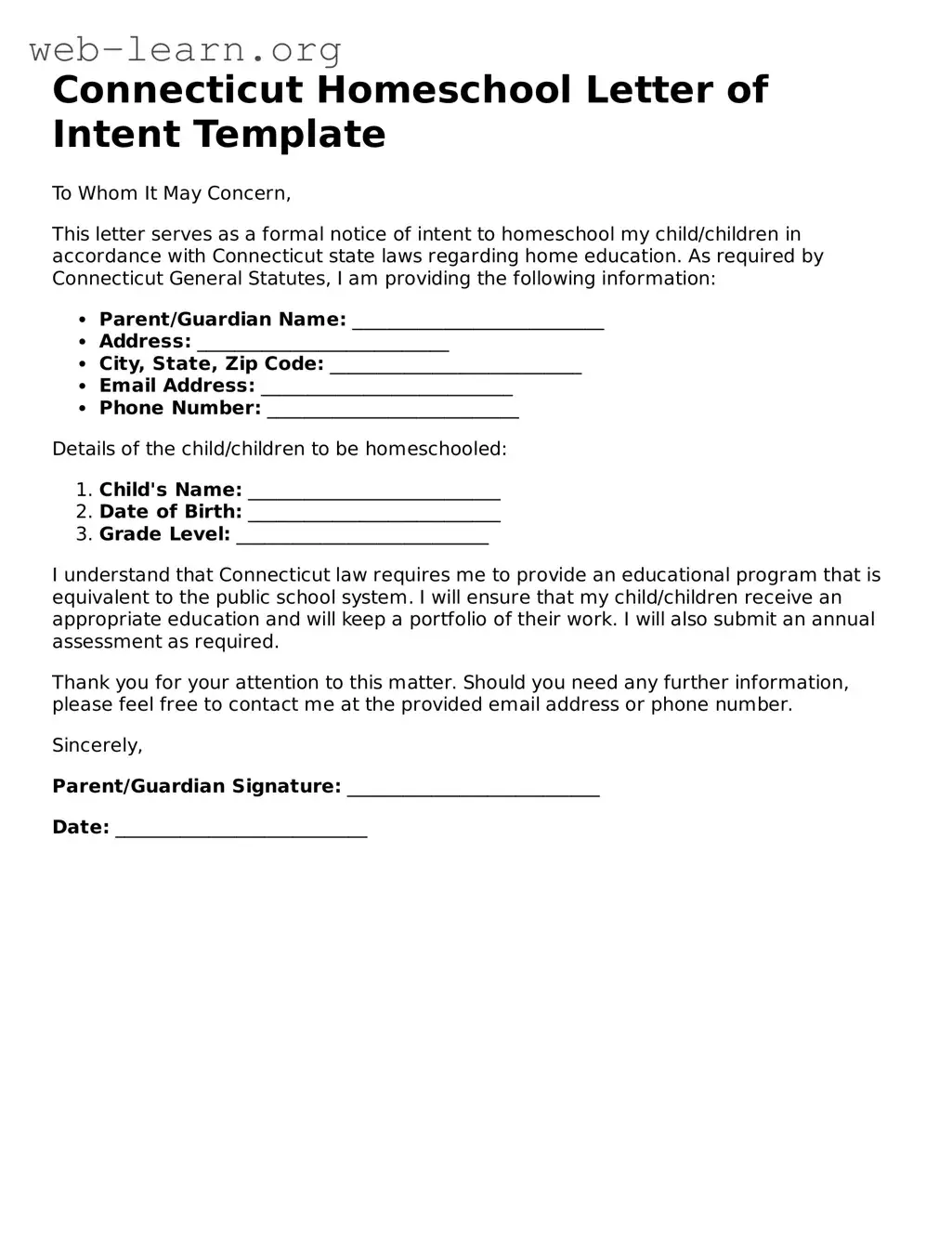
Connecticut Homeschool Letter of Intent Template
To Whom It May Concern,
This letter serves as a formal notice of intent to homeschool my child/children in accordance with Connecticut state laws regarding home education. As required by Connecticut General Statutes, I am providing the following information:
Details of the child/children to be homeschooled:
I understand that Connecticut law requires me to provide an educational program that is equivalent to the public school system. I will ensure that my child/children receive an appropriate education and will keep a portfolio of their work. I will also submit an annual assessment as required.
Thank you for your attention to this matter. Should you need any further information, please feel free to contact me at the provided email address or phone number.
Sincerely,
Parent/Guardian Signature: ___________________________
Date: ___________________________
| Fact Name | Description |
|---|---|
| Purpose | The Connecticut Homeschool Letter of Intent form is used to notify the local school district of a family's intent to homeschool their child. |
| Governing Law | This form is governed by Connecticut General Statutes Section 10-184 and Section 10-220. |
| Who Must File | Parents or guardians of children who will be homeschooled must complete and submit this form. |
| Filing Deadline | The letter must be submitted to the local school district at least five days before the start of the homeschool program. |
| Content Requirements | The form must include the child's name, age, and the address of the homeschooling location. |
| Submission Method | Parents can submit the form via mail, email, or in person, depending on the local district's preferences. |
| Record Keeping | It is advisable for parents to keep a copy of the submitted form for their records. |
| Annual Updates | Families may need to submit an updated Letter of Intent each year to continue homeschooling. |
| Support Resources | Various homeschooling organizations in Connecticut provide resources and guidance for families navigating the process. |
After completing the Connecticut Homeschool Letter of Intent form, you will need to submit it to your local school district. This step is crucial for ensuring that your homeschooling plans are recognized and that you comply with state regulations.
The Connecticut Homeschool Letter of Intent is a formal notification that parents or guardians must submit to their local school district when they choose to homeschool their child. This letter serves as an official declaration of the intent to provide home-based education and ensures that the school district is aware of the educational arrangement.
It is recommended that the Letter of Intent be submitted at least 30 days before the start of the homeschooling program. This allows the school district adequate time to process the request and ensures compliance with state regulations. If you are withdrawing your child from public school to homeschool, submit the letter as soon as possible to avoid any potential issues.
The Letter of Intent must include several key pieces of information:
Providing complete and accurate information helps ensure a smooth process with your local school district.
While there is no mandated format for the Letter of Intent, it should be clear and concise. A simple, written letter that includes all required information is typically sufficient. Some families choose to use templates available online, but ensure that all necessary details are included.
Once the Letter of Intent is submitted, the local school district will review the information provided. They may contact you for clarification or additional information. After processing, you should receive confirmation that your homeschooling plan is acknowledged. Keep this confirmation for your records, as it may be important for future reference.
Connecticut law requires that parents or guardians maintain an educational program that meets certain standards. While there are no formal reporting requirements after the Letter of Intent is submitted, it is advisable to keep records of educational progress and materials used. This documentation may be helpful if you are ever asked to demonstrate compliance with state homeschooling laws.
Filling out the Connecticut Homeschool Letter of Intent form can be a straightforward process, but many make common mistakes that can lead to complications. One frequent error is failing to provide the required information. Each section of the form must be completed accurately. Omitting details can result in delays or even rejection of the application.
Another mistake involves incorrect personal information. Parents sometimes miswrite their names or addresses. This may seem minor, but it can cause significant issues in communication with local education authorities. Always double-check this information before submission.
Many individuals overlook the importance of submitting the form on time. Connecticut law requires that the Letter of Intent be filed within a specific timeframe. Missing this deadline can lead to problems, including the potential need to re-enroll children in public school.
Some parents also fail to include the necessary documentation. Alongside the Letter of Intent, supplementary materials may be required, such as proof of residency. Neglecting to attach these documents can slow down the approval process.
Inaccurate educational plans are another common error. The form asks for a brief description of the intended curriculum. Parents sometimes provide vague or overly general information. Clear and specific details about the educational approach can enhance the chances of approval.
Another issue arises when parents do not keep a copy of the submitted form. Retaining a copy is crucial for future reference and can help resolve any disputes that may arise later. Without it, proving compliance with homeschooling regulations becomes challenging.
Some individuals may misunderstand the requirements regarding the child's age. The form must accurately reflect the age of the child being homeschooled. Incorrect age information can lead to complications in meeting state educational standards.
Additionally, parents sometimes forget to sign the form. A missing signature can render the entire submission invalid. Always ensure that the form is signed before sending it off.
Finally, failing to follow up after submission is a mistake that can lead to uncertainty. After sending the Letter of Intent, it is wise to confirm receipt with the local school district. This proactive approach can alleviate concerns and ensure that everything is on track.
By being mindful of these common pitfalls, parents can navigate the process of submitting the Connecticut Homeschool Letter of Intent with greater ease and confidence.
When families decide to homeschool in Connecticut, they often need to submit various forms and documents alongside the Homeschool Letter of Intent. These documents help ensure compliance with state regulations and support the educational journey of homeschooled children. Below is a list of commonly used forms and documents.
These documents not only help maintain transparency with educational authorities but also support the family's homeschooling experience. Keeping organized records can enhance the educational process and provide peace of mind throughout the homeschooling journey.
When filling out the Connecticut Homeschool Letter of Intent form, it is essential to follow specific guidelines to ensure your application is processed smoothly. Here are eight important dos and don'ts to keep in mind:
Following these guidelines can help ensure that your Homeschool Letter of Intent is processed efficiently, allowing you to focus on your child's education.
Many families considering homeschooling in Connecticut may have questions about the Letter of Intent form. Misconceptions can lead to confusion and unnecessary stress. Here are six common misconceptions, along with clarifications to help ease any concerns.
Understanding these misconceptions can empower families to make informed decisions about their homeschooling journey. By clarifying these points, it is hoped that parents feel more confident in navigating the process.
When filling out and using the Connecticut Homeschool Letter of Intent form, consider the following key takeaways:
Home Schooling in Idaho - Helps to establish a sense of accountability in the homeschooling process.
Oregon Home-schooling - It is an essential part of the process for families choosing to educate their children at home.
Do Homeschool Parents Get Paid - Notice that outlines your educational approach for your child at home.