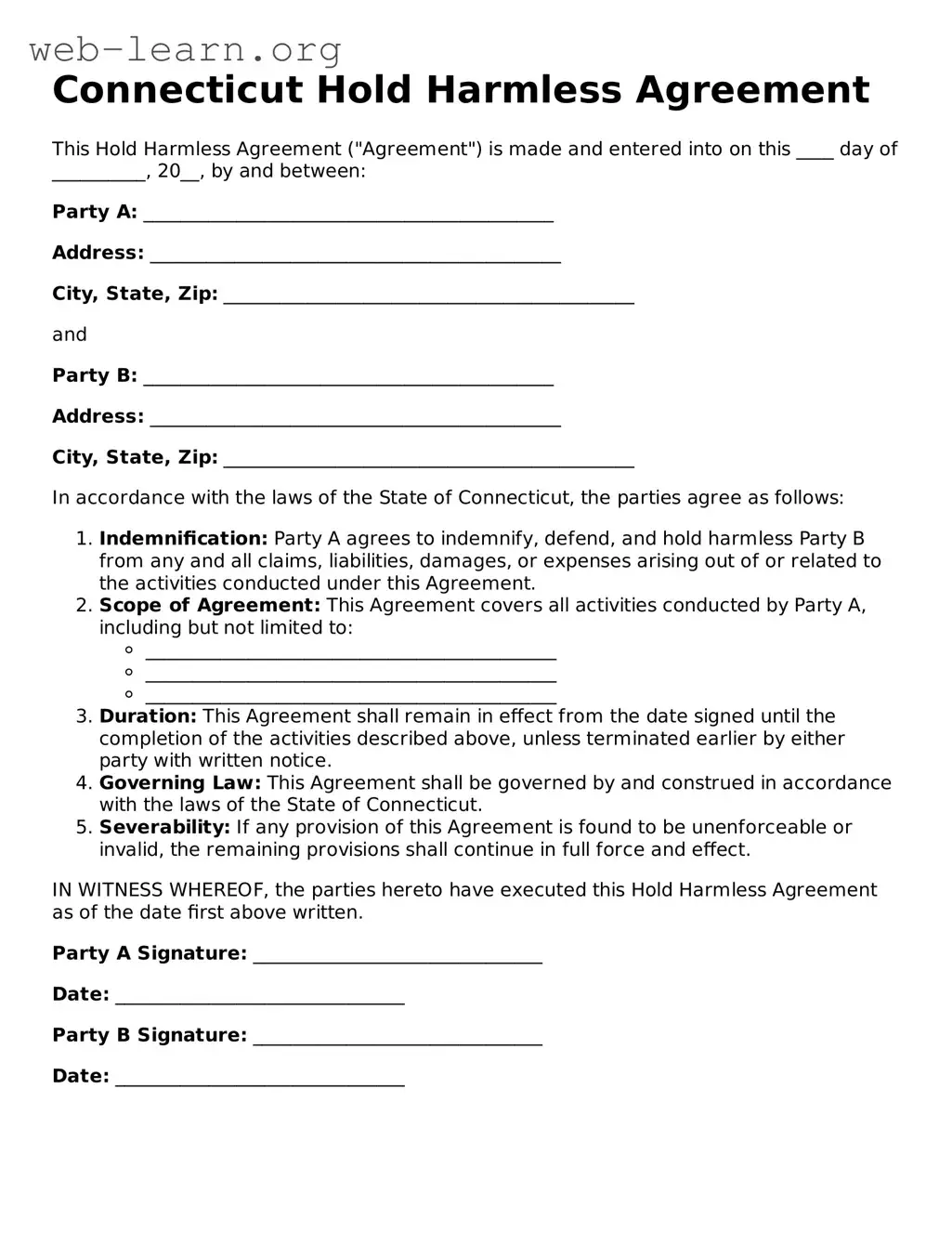
The Connecticut Hold Harmless Agreement form serves as a vital legal instrument designed to protect parties from liability in various situations. This form is commonly utilized in contracts where one party agrees to assume the risk of certain actions or events, thereby shielding the other party from legal repercussions. By signing this agreement, individuals or organizations acknowledge their understanding of the risks involved and agree not to hold the other party responsible for any resulting damages or injuries. The agreement typically outlines specific circumstances under which the hold harmless provision applies, ensuring clarity and mutual understanding between the involved parties. It is important to note that while this form can provide significant protection, it must be crafted carefully to ensure enforceability and compliance with state laws. As such, individuals considering the use of this form should approach it with a clear understanding of its implications and seek legal guidance if necessary.
Connecticut Hold Harmless Agreement
This Hold Harmless Agreement ("Agreement") is made and entered into on this ____ day of __________, 20__, by and between:
Party A: ____________________________________________
Address: ____________________________________________
City, State, Zip: ____________________________________________
and
Party B: ____________________________________________
Address: ____________________________________________
City, State, Zip: ____________________________________________
In accordance with the laws of the State of Connecticut, the parties agree as follows:
IN WITNESS WHEREOF, the parties hereto have executed this Hold Harmless Agreement as of the date first above written.
Party A Signature: _______________________________
Date: _______________________________
Party B Signature: _______________________________
Date: _______________________________
| Fact Name | Detail |
|---|---|
| Definition | A Hold Harmless Agreement is a legal document that protects one party from liability for certain actions or events. |
| Purpose | This agreement is commonly used to ensure that one party does not hold the other responsible for damages or injuries. |
| Governing Law | Connecticut state law governs the Hold Harmless Agreement. |
| Common Uses | These agreements are often used in construction contracts, event planning, and rental agreements. |
| Parties Involved | Typically, there are two parties: the indemnitor (who agrees to hold harmless) and the indemnitee (who is protected). |
| Enforceability | For the agreement to be enforceable, it must be clear, specific, and voluntarily signed by both parties. |
| Limitations | Hold Harmless Agreements cannot waive liability for gross negligence or willful misconduct. |
| Written vs. Oral | While written agreements are preferred, oral agreements may also be recognized under certain circumstances. |
| Legal Advice | It is advisable to consult with a legal professional when drafting or signing a Hold Harmless Agreement. |
After obtaining the Connecticut Hold Harmless Agreement form, you will need to complete it accurately. This process ensures that all necessary information is provided for proper processing.
Once you have filled out the form, review it for accuracy. Make sure all information is correct before submitting it to the relevant party or authority.
What is a Hold Harmless Agreement?
A Hold Harmless Agreement is a legal document that protects one party from liability or claims that may arise from the actions or negligence of another party. Essentially, it ensures that if something goes wrong, one party agrees not to hold the other party responsible.
Why is a Hold Harmless Agreement important in Connecticut?
In Connecticut, these agreements are particularly important because they can help mitigate risks associated with various activities, such as events, construction projects, or rental agreements. By clearly outlining responsibilities, these agreements can prevent disputes and provide peace of mind for all parties involved.
Who typically uses a Hold Harmless Agreement?
Various individuals and organizations utilize Hold Harmless Agreements. Common users include:
Each of these parties may seek protection from potential claims arising from their activities or the activities of others.
What should be included in a Hold Harmless Agreement?
A comprehensive Hold Harmless Agreement typically includes:
Including these elements helps to ensure clarity and enforceability.
Can a Hold Harmless Agreement be enforced in court?
Yes, a Hold Harmless Agreement can be enforced in court, provided it is properly drafted and meets legal standards. Courts generally uphold these agreements unless they are found to be unconscionable or violate public policy. It’s essential to ensure that the language is clear and unambiguous.
Are there any limitations to a Hold Harmless Agreement?
While Hold Harmless Agreements offer protection, they do have limitations. For instance, they may not protect against gross negligence or willful misconduct. Additionally, certain statutory limitations may apply, particularly in specific industries or activities.
How can I create a Hold Harmless Agreement?
Creating a Hold Harmless Agreement can be straightforward. Start by outlining the key elements mentioned earlier. It’s advisable to consult with a legal professional to ensure that the agreement is tailored to your specific needs and complies with Connecticut laws.
Is a Hold Harmless Agreement the same as liability insurance?
No, a Hold Harmless Agreement is not a substitute for liability insurance. While it can provide some level of protection, liability insurance offers financial coverage in the event of a claim. It is wise to have both in place to ensure comprehensive protection.
Can I revoke a Hold Harmless Agreement?
Revoking a Hold Harmless Agreement can be complex. Generally, once signed, the agreement is binding unless both parties agree to modify or terminate it. It’s best to consult with a legal advisor if you wish to make changes or revoke the agreement.
When individuals fill out the Connecticut Hold Harmless Agreement form, several common mistakes can lead to complications. Understanding these pitfalls can help ensure that the form is completed accurately and effectively. One frequent error is failing to read the entire document before signing. The Hold Harmless Agreement contains important terms and conditions that must be understood to avoid unintended consequences.
Another mistake often made is neglecting to provide complete and accurate information. This includes not filling in all required fields or providing incorrect details about the parties involved. Incomplete or inaccurate information can render the agreement unenforceable, which defeats its purpose.
Additionally, some individuals overlook the importance of having the agreement signed by all necessary parties. An agreement that lacks signatures from all involved may not hold up legally. It is crucial to ensure that everyone who is required to sign does so, as this demonstrates mutual consent and understanding of the terms.
People sometimes forget to date the agreement. A missing date can create confusion about when the agreement was made and can affect its validity. Including the date is essential for clarity and for establishing a timeline of the agreement's terms.
Another common oversight is failing to understand the implications of the terms within the agreement. Individuals may not fully grasp what they are agreeing to, which can lead to unforeseen liabilities. It is advisable to take the time to comprehend the responsibilities and risks involved before signing.
Moreover, some individuals may not seek legal advice when necessary. While the Hold Harmless Agreement is a straightforward document, consulting with a legal professional can provide valuable insights and ensure that all aspects of the agreement are properly addressed. This step can prevent future disputes and misunderstandings.
Lastly, individuals often neglect to keep a copy of the signed agreement for their records. Without a copy, it can be challenging to refer back to the terms agreed upon if questions or issues arise later. Retaining a copy is a simple yet crucial step in safeguarding one’s interests.
A Hold Harmless Agreement in Connecticut is often used in various situations to protect one party from liability. When utilizing this agreement, several other documents may also be relevant. Here’s a brief overview of four commonly associated forms and documents.
Understanding these documents can enhance the effectiveness of a Hold Harmless Agreement. By ensuring all parties are aware of their rights and responsibilities, potential disputes can be minimized.
When filling out the Connecticut Hold Harmless Agreement form, it is essential to approach the process with care and attention. Here are some important guidelines to consider:
Understanding the Connecticut Hold Harmless Agreement form is crucial for anyone involved in contracts or agreements. However, several misconceptions surround this document that can lead to confusion. Below are some common misunderstandings:
Being aware of these misconceptions can help individuals and businesses navigate their agreements more effectively. Understanding the nuances of the Hold Harmless Agreement is essential for making informed decisions.
When dealing with the Connecticut Hold Harmless Agreement, it's essential to understand its purpose and implications. Here are some key takeaways to consider:
Understanding these aspects of the Hold Harmless Agreement can help you navigate potential risks effectively.
What Is a Hold Harmless Agreement - A Hold Harmless Agreement protects one party from legal liability for certain actions or events.
Indemnity Hold Harmless Agreement - This agreement can be a valuable tool for non-profit organizations.
What Is Hold Harmless Agreement - It serves as a reminder for all parties to act responsibly and acknowledge inherent risks.
Hold Harmless Agreement Illinois - The Hold Harmless Agreement is a proactive measure for risk management.