Homepage Blank Connecticut H 110 Form
Outline

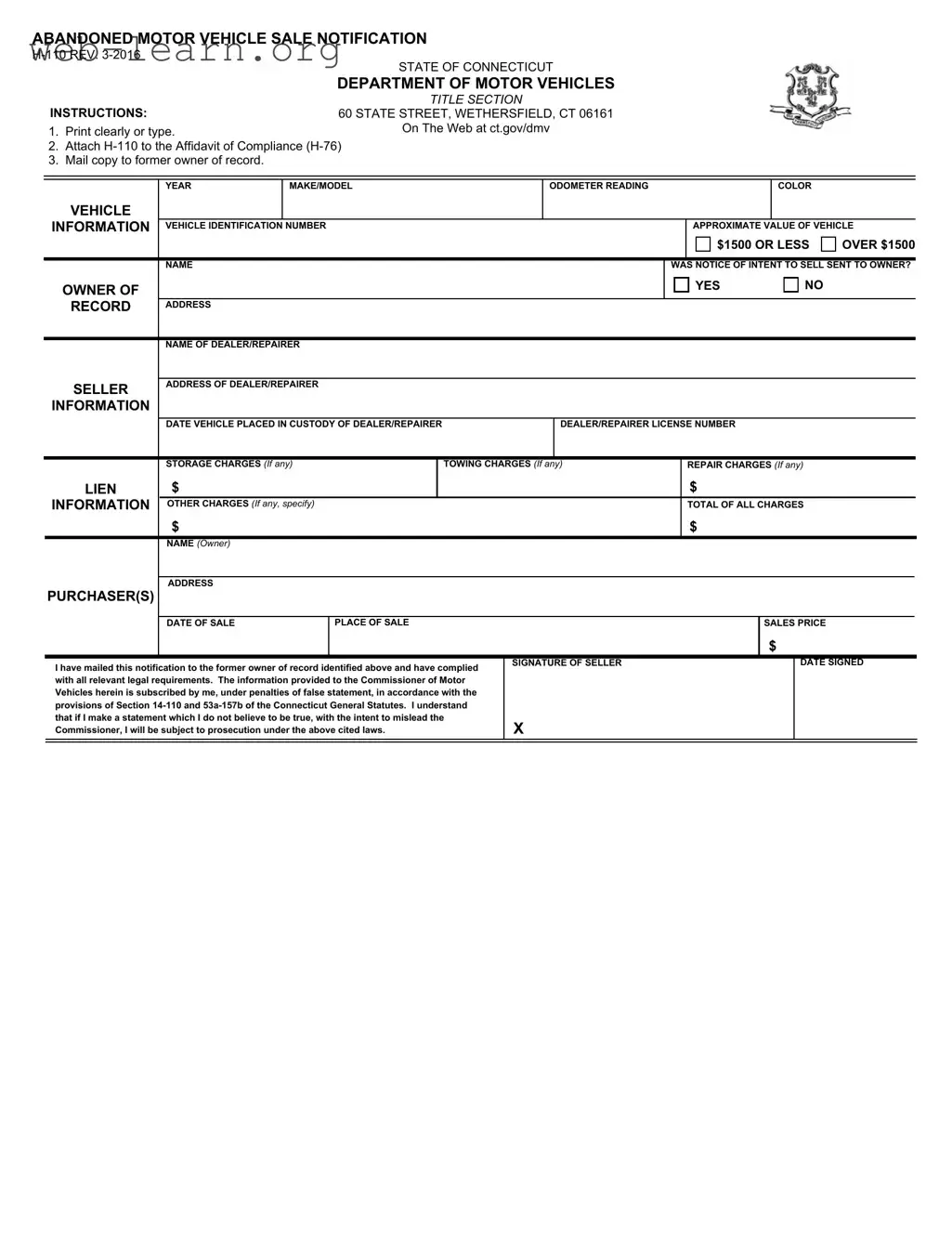
The Connecticut H 110 form serves a crucial role in the process of notifying former vehicle owners about the sale of abandoned motor vehicles. This form is used by dealers and repairers to document the necessary information regarding the vehicle, including its make, model, and identification number. It also captures the vehicle's condition through the odometer reading and color. Additionally, the form requires details about any storage, towing, or repair charges associated with the vehicle. Importantly, it includes a section to confirm whether a notice of intent to sell was sent to the previous owner. Once completed, the H 110 form must be attached to the Affidavit of Compliance (H-76) and sent to the former owner. The seller must also certify that all legal requirements have been met, ensuring transparency and compliance with state regulations. This process helps protect both the seller and the previous owner while facilitating the sale of abandoned vehicles in Connecticut.
Sample - Connecticut H 110 Form

SELLER
INFORMATION
OWNER OF
RECORD
VEHICLE
INFORMATION
ABANDONED MOTOR VEHICLE SALE NOTIFICATION
H-110 REV. 3-2016
STATE OF CONNECTICUT
DEPARTMENT OF MOTOR VEHICLES
TITLE SECTION
60 STATE STREET, WETHERSFIELD, CT 06161
On The Web at ct.gov/dmv
INSTRUCTIONS:
1.
2.
3.
Print clearly or type.
Attach H-110 to the Affidavit of Compliance (H-76)
Mail copy to former owner of record.
YEAR MAKE/MODEL
ODOMETER READING COLOR
VEHICLE IDENTIFICATION NUMBER APPROXIMATE VALUE OF VEHICLE
$1500 OR LESS
OVER $1500
NAME WAS NOTICE OF INTENT TO SELL SENT TO OWNER?
YES
NO
ADDRESS
NAME OF DEALER/REPAIRER
ADDRESS OF DEALER/REPAIRER
DATE VEHICLE PLACED IN CUSTODY OF DEALER/REPAIRER
DEALER/REPAIRER LICENSE NUMBER
STORAGE CHARGES (If any)
TOWING CHARGES (If any)
REPAIR CHARGES (If any)
$
$
OTHER CHARGES (If any, specify)
$
TOTAL OF ALL CHARGES
$
LIEN
INFORMATION
NAME (Owner)
ADDRESS
DATE OF SALE
PLACE OF SALE
SALES PRICE
$
PURCHASER(S)
SIGNATURE OF SELLER
X
DATE SIGNED
I have mailed this notification to the former owner of record identified above and have complied
with all relevant legal requirements. The information provided to the Commissioner of Motor
Vehicles herein is subscribed by me, under penalties of false statement, in accordance with the
provisions of Section 14-110 and 53a-157b of the Connecticut General Statutes. I understand
that if I make a statement which I do not believe to be true, with the intent to mislead the
Commissioner, I will be subject to prosecution under the above cited laws.

Form Information

Fact Name Details
Form Title Abandoned Motor Vehicle Sale Notification H-110
Governing Law Connecticut General Statutes Sections 14-110 and 53a-157b
Revision Date March 2016
Submission Requirements Must be printed clearly or typed
Affidavit Attachment Attach H-110 to the Affidavit of Compliance (H-76)
Mailing Requirement A copy must be mailed to the former owner of record
Vehicle Information Includes year, make/model, odometer reading, color, VIN, and value
Charges Breakdown Storage, towing, repair, and other charges must be listed
Seller's Declaration The seller must sign and date the form, affirming compliance with legal requirements

Detailed Guide for Filling Out Connecticut H 110

Completing the Connecticut H 110 form is a straightforward process. This form is essential for notifying the relevant parties about the sale of an abandoned motor vehicle. Follow the steps below to ensure all necessary information is accurately filled out.

  1. Begin by printing the form clearly or typing the required information.
  2. Provide the vehicle information, including the year, make/model, odometer reading, color, and vehicle identification number (VIN).
  3. Indicate the approximate value of the vehicle by checking either "$1500 or less" or "over $1500."
  4. Answer whether a notice of intent to sell was sent to the owner by checking "yes" or "no."
  5. Fill in the owner of record's name and address.
  6. Provide the name of the dealer/repairer and their address.
  7. Enter the date the vehicle was placed in the custody of the dealer/repairer.
  8. Include the dealer/repairer license number.
  9. List any storage charges, towing charges, repair charges, and any other charges that may apply.
  10. Calculate the total of all charges and write it in the designated space.
  11. Provide the name and address of the purchaser(s).
  12. Fill in the date of sale and place of sale.
  13. State the sales price of the vehicle.
  14. Sign the form to certify that you have mailed the notification to the former owner and complied with all legal requirements.
  15. Date your signature.

Once you have completed the form, attach it to the Affidavit of Compliance (H-76). Make sure to mail a copy of the completed H 110 form to the former owner of record. This will ensure that all parties are informed and that you are in compliance with the necessary legal requirements.

Obtain Answers on Connecticut H 110

  1. What is the Connecticut H 110 form?

    The Connecticut H 110 form is a notification used for the sale of abandoned motor vehicles. It serves as a formal record that the vehicle has been placed in the custody of a dealer or repairer, and it outlines the necessary steps to notify the previous owner of the vehicle's impending sale.

  2. Who needs to fill out the H 110 form?

    The form must be completed by the dealer or repairer who has taken custody of the abandoned vehicle. This ensures that all legal requirements are met when selling a vehicle that was previously abandoned.

  3. What information is required on the H 110 form?

    Key details that must be included on the form are:

    • Year, make, and model of the vehicle
    • Odometer reading
    • Color of the vehicle
    • Vehicle Identification Number (VIN)
    • Approximate value of the vehicle
    • Owner's information, including name and address
    • Details about the dealer or repairer
    • Storage, towing, and repair charges, if applicable
    • Date of sale and purchaser information
  4. What is the purpose of notifying the former owner?

    Notifying the former owner is a legal requirement. It ensures that the previous owner is aware of the sale and has the opportunity to reclaim the vehicle before it is sold. This step protects the rights of the owner and helps to avoid potential disputes.

  5. How should the H 110 form be submitted?

    The completed H 110 form should be attached to the Affidavit of Compliance (H-76). After this, a copy must be mailed to the former owner of record. This ensures that all parties are informed and that the process is documented properly.

  6. What are the consequences of providing false information on the H 110 form?

    Providing false information can lead to serious legal repercussions. The individual completing the form is subject to prosecution under Connecticut law if it is determined that they made a statement they did not believe to be true with the intent to mislead.

  7. Where can I find more information about the H 110 form?

    For additional details, you can visit the Connecticut Department of Motor Vehicles website at ct.gov/dmv. This site provides resources and guidance on various DMV forms and procedures.

Common mistakes

Completing the Connecticut H-110 form can seem straightforward, but many individuals encounter common pitfalls that can lead to delays or complications. One frequent mistake is failing to print clearly or type the information. Handwriting that is difficult to read can result in errors or misinterpretations, ultimately causing issues with processing the form.

Another common error is neglecting to attach the required Affidavit of Compliance (H-76). This attachment is crucial as it provides additional verification of compliance with the necessary legal requirements. Without it, the H-110 form may be deemed incomplete.

Individuals sometimes forget to mail a copy of the form to the former owner of record. This step is not merely a formality; it ensures that the previous owner is informed about the sale of the vehicle. Failing to do so can lead to disputes or claims later on.

When filling out the vehicle information, some people mistakenly leave out critical details such as the Vehicle Identification Number (VIN). The VIN is essential for accurately identifying the vehicle in question. Omitting it can create confusion and hinder the processing of the form.

Moreover, miscalculating the approximate value of the vehicle is another frequent mistake. The form requires a clear indication of whether the value is $1,500 or less or over $1,500. An incorrect valuation can affect various legal and financial implications associated with the vehicle sale.

Many individuals also overlook the question regarding whether a notice of intent to sell was sent to the owner. This question requires a definitive "yes" or "no" answer. Providing an unclear response can lead to complications down the line.

Inaccuracies in the dealer or repairer information are also common. This includes failing to provide the correct dealer/repairer license number. Such errors can result in the form being rejected or delayed, as the authorities need accurate information to verify the legitimacy of the sale.

Storage, towing, and repair charges often lead to confusion. Individuals may either fail to list these charges or miscalculate the total. It is essential to provide accurate figures to avoid discrepancies that could complicate the sale.

Another area where mistakes occur is in the section regarding the purchaser(s) and the sales price. Omitting names or providing incorrect information can lead to significant issues. The purchaser's information must be accurate to ensure proper transfer of ownership.

Finally, a critical mistake is failing to sign and date the form. Without a signature, the form lacks authenticity and cannot be processed. Always double-check that all required fields are completed and that the form is signed before submission.

Documents used along the form

The Connecticut H 110 form is used to notify the former owner of an abandoned vehicle about its impending sale. This form is often accompanied by several other documents to ensure compliance with state regulations and to facilitate the sale process. Below is a list of other forms and documents commonly used in conjunction with the H 110 form.

  • Affidavit of Compliance (H-76): This document certifies that all necessary steps have been taken to comply with state laws regarding the sale of an abandoned vehicle. It must be attached to the H 110 form when submitted.
  • Notice of Intent to Sell: This notice is sent to the former owner of record, informing them of the dealer's intention to sell the abandoned vehicle. It serves as a formal communication and is required before proceeding with the sale.
  • Vehicle Title Application (Form H-6): If the vehicle is to be sold and a new title issued, this application must be completed. It provides necessary information for the transfer of ownership.
  • Bill of Sale: This document serves as proof of the sale transaction between the seller and the buyer. It includes details such as the sale price, vehicle identification number, and the names of both parties.
  • Storage Lien Form: If storage fees have accrued, this form allows the dealer or repairer to claim a lien on the vehicle for unpaid charges. It is important for recovering costs associated with the vehicle's storage.
  • Towing Invoice: This document details the charges incurred for towing the abandoned vehicle. It is essential for transparency and can be included in the total charges when selling the vehicle.
  • Repair Invoice: If any repairs were made to the vehicle before the sale, this invoice outlines the costs and services provided. It helps establish the overall value of the vehicle.
  • Proof of Notification: This document provides evidence that the former owner was notified of the sale. It may include copies of letters or other communications sent to the owner.
  • Sales Tax Form: Depending on the sale price, a sales tax form may need to be completed to ensure compliance with state tax regulations during the sale process.

These documents work together with the Connecticut H 110 form to ensure that the sale of an abandoned vehicle is conducted legally and transparently. Proper documentation helps protect all parties involved and facilitates a smoother transaction process.

Similar forms

  • Affidavit of Compliance (H-76): This document is often used in conjunction with the H-110 form. It serves to confirm that all legal requirements for the sale of an abandoned vehicle have been met. Just like the H-110, it requires clear information about the vehicle and the seller's compliance with state laws.
  • Vehicle Bill of Sale: A Vehicle Bill of Sale is a record of the transaction between the seller and the buyer. Similar to the H-110, it includes details about the vehicle, such as the make, model, and VIN, along with the sale price. Both documents serve to establish ownership transfer.
  • Notice of Intent to Sell: This document is used to inform the previous owner that their abandoned vehicle will be sold. Like the H-110, it requires clear communication about the vehicle's status and provides a record of notification to the owner.
  • Title Application: When a vehicle is sold, a Title Application is often submitted to transfer ownership officially. This document, like the H-110, includes essential vehicle details and ensures that the new owner is recognized legally.
  • Storage Lien Notice: A Storage Lien Notice is issued when a vehicle is towed and stored. This document shares similarities with the H-110 as it outlines the charges incurred and notifies the owner of the potential sale of the vehicle to recover those costs.
  • Towing Authorization Form: This form is used to authorize a towing company to remove a vehicle. Similar to the H-110, it provides necessary details about the vehicle and the circumstances surrounding its removal, establishing a legal basis for the towing.
  • Mechanic’s Lien: A Mechanic’s Lien is filed when a vehicle owner fails to pay for repairs. Like the H-110, it documents the charges and can lead to the sale of the vehicle if the debt remains unpaid, protecting the repairer's interests.
  • Sales Tax Form: When a vehicle is sold, a Sales Tax Form may be required for tax purposes. This document, similar to the H-110, includes details about the sale and ensures compliance with tax regulations related to the transaction.

Dos and Don'ts

When filling out the Connecticut H-110 form, it's important to ensure accuracy and compliance. Here are some guidelines to help you navigate the process effectively:

  • Do print clearly or type your information to avoid any confusion.
  • Don't forget to attach the H-110 form to the Affidavit of Compliance (H-76).
  • Do mail a copy of the completed form to the former owner of record.
  • Don't leave any required fields blank; ensure all necessary information is filled out.
  • Do double-check the vehicle identification number (VIN) for accuracy.
  • Don't submit the form without signing and dating it; your signature is essential.
  • Do keep a copy of the completed form for your records after mailing it.

Following these steps will help ensure that your submission is processed smoothly and in accordance with Connecticut regulations.

Misconceptions

Understanding the Connecticut H 110 form is essential for anyone involved in the sale of abandoned motor vehicles. However, several misconceptions can lead to confusion. Below is a list of common misunderstandings about this form.

  • The H 110 form is only for dealers. Many believe that only licensed dealers can use the H 110 form. In reality, both dealers and individuals who have custody of abandoned vehicles can utilize this form to notify former owners.
  • Filing the H 110 form is optional. Some people think that completing the H 110 form is not necessary. However, it is a legal requirement to notify the former owner of record when selling an abandoned vehicle.
  • All abandoned vehicles must be sold immediately. There is a misconception that abandoned vehicles must be sold as soon as they are found. In fact, the law allows for a specific process that must be followed, including the completion of the H 110 form.
  • The H 110 form can be filled out incorrectly without consequences. Some individuals believe that mistakes on the form do not matter. However, inaccuracies can lead to legal issues, including penalties for false statements.
  • There is no need to notify the former owner if the vehicle is valued under $1500. Many assume that if the vehicle's value is low, they do not need to inform the previous owner. This is incorrect; notification is required regardless of the vehicle's value.
  • Payment of storage and towing charges is not necessary. Some people think they can sell the vehicle without paying any associated fees. However, all charges must be accounted for on the H 110 form.
  • Once the H 110 form is submitted, the sale is final. There is a belief that submitting the form completes the sale process. In reality, the sale is only finalized after all legal requirements are met, including proper notification.
  • There are no penalties for failing to send a copy of the H 110 to the former owner. Some believe that neglecting to notify the previous owner is inconsequential. However, this can lead to legal repercussions, including fines or other penalties.

By clarifying these misconceptions, individuals can better navigate the requirements associated with the Connecticut H 110 form and ensure compliance with state laws.

Key takeaways

Filling out and using the Connecticut H 110 form requires attention to detail and compliance with specific guidelines. Here are some key takeaways:

  • Print Clearly or Type: Ensure that all information is legible. This helps avoid confusion and potential delays in processing.
  • Attach Required Documents: The H-110 form must be attached to the Affidavit of Compliance (H-76). This is crucial for the form to be valid.
  • Notify the Former Owner: A copy of the completed form must be mailed to the former owner of record. This step is essential to meet legal requirements.
  • Provide Accurate Vehicle Information: Include details like the year, make, model, and vehicle identification number. Accurate information is necessary for proper identification.
  • Understand the Legal Implications: By signing the form, you affirm that the information is true. Misleading information can lead to legal consequences.