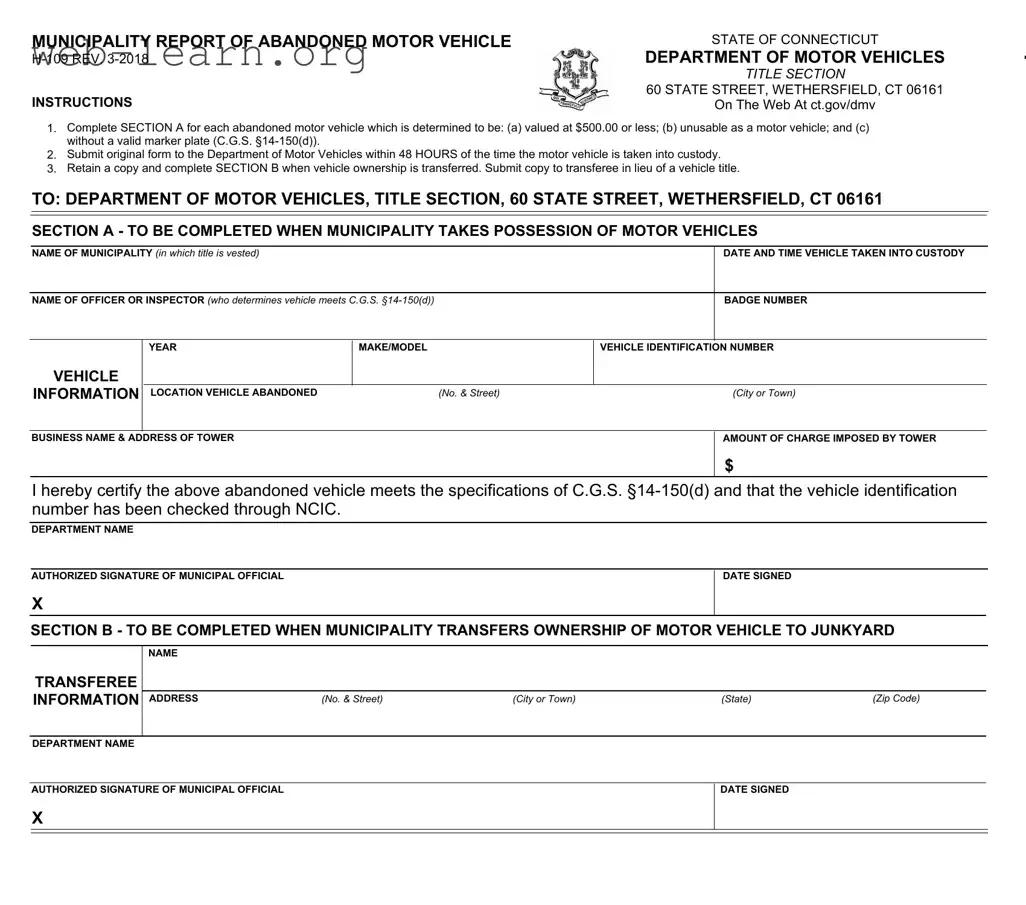
Homepage Blank Connecticut H 109 Form
Outline

Understanding the Connecticut H 109 form is essential for municipalities managing abandoned motor vehicles. This form serves a critical function in reporting vehicles that have been deemed abandoned, specifically those valued at $500 or less, deemed unusable, and lacking a valid marker plate. When a vehicle is taken into custody, municipalities must act quickly, submitting the original form to the Department of Motor Vehicles within 48 hours. This urgency ensures that the proper protocols are followed, allowing for an efficient transfer of ownership if the vehicle is later sent to a junkyard. The form is divided into two sections: Section A captures the details of the abandoned vehicle and the circumstances of its custody, while Section B is reserved for when ownership is transferred. Each section requires specific information, including the vehicle's identification number, the municipality's name, and the authorized signatures of municipal officials. By adhering to these guidelines, municipalities not only comply with state regulations but also contribute to the overall management of abandoned vehicles in Connecticut.
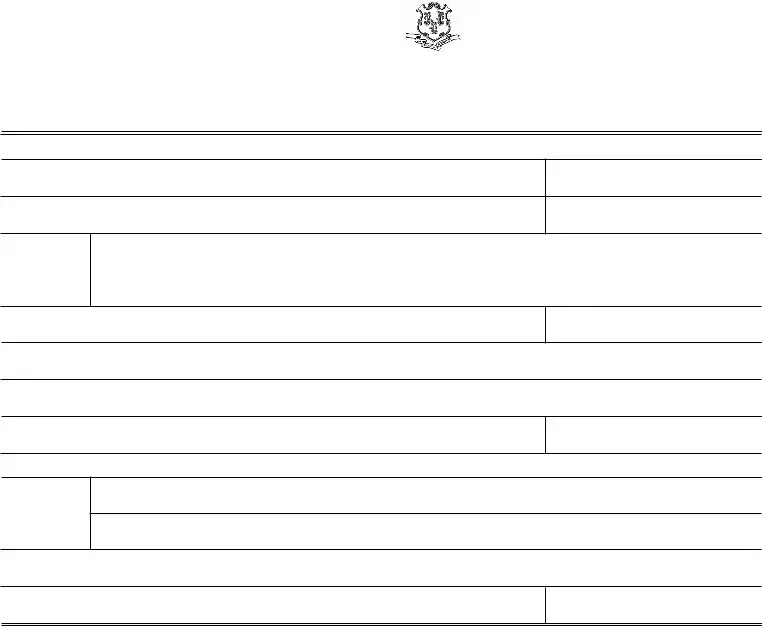
Sample - Connecticut H 109 Form

NAME
AMOUNT OF CHARGE IMPOSED BY TOWER
(City or Town)
(No. & Street)
LOCATION VEHICLE ABANDONED
VEHICLE IDENTIFICATION NUMBER
MAKE/MODEL
YEAR
INSTRUCTIONS
-
-
-
-
-
I
MUNICIPALITY REPORT OF ABANDONED MOTOR VEHICLE
H-109 REV. 3-2018
STATE OF CONNECTICUT
DEPARTMENT OF MOTOR VEHICLES
TITLE SECTION
60 STATE STREET, WETHERSFIELD, CT 06161
On The Web At ct.gov/dmv
Complete SECTION A for each abandoned motor vehicle which is determined to be: (a) valued at $500.00 or less; (b) unusable as a motor vehicle; and (c)
without a valid marker plate (C.G.S. §14-150(d)).
Submit original form to the Department of Motor Vehicles within 48 HOURS of the time the motor vehicle is taken into custody.
Retain a copy and complete SECTION B when vehicle ownership is transferred. Submit copy to transferee in lieu of a vehicle title.
1.
2.
3.
TO: DEPARTMENT OF MOTOR VEHICLES, TITLE SECTION, 60 STATE STREET, WETHERSFIELD, CT 06161
SECTION A - TO BE COMPLETED WHEN MUNICIPALITY TAKES POSSESSION OF MOTOR VEHICLES
NAME OF MUNICIPALITY (in which title is vested)
DATE AND TIME VEHICLE TAKEN INTO CUSTODY
NAME OF OFFICER OR INSPECTOR (who determines vehicle meets C.G.S. §14-150(d))
BADGE NUMBER
VEHICLE
INFORMATION
BUSINESS NAME & ADDRESS OF TOWER
$
I hereby certify the above abandoned vehicle meets the specifications of C.G.S. §14-150(d) and that the vehicle identification
number has been checked through NCIC.
DEPARTMENT NAME
AUTHORIZED SIGNATURE OF MUNICIPAL OFFICIAL
DATE SIGNED
X
SECTION B - TO BE COMPLETED WHEN MUNICIPALITY TRANSFERS OWNERSHIP OF MOTOR VEHICLE TO JUNKYARD
ADDRESS
(No. & Street)
(City or Town)
(State)
(Zip Code)
TRANSFEREE
INFORMATION
DEPARTMENT NAME
AUTHORIZED SIGNATURE OF MUNICIPAL OFFICIAL
X
DATE SIGNED

Form Information

Fact Name Fact Description
Purpose The Connecticut H-109 form is used to report abandoned motor vehicles by municipalities.
Valuation Criteria It applies to vehicles valued at $500.00 or less, deemed unusable, and lacking a valid marker plate.
Submission Timeline Municipalities must submit the original form to the Department of Motor Vehicles within 48 hours of taking custody of the vehicle.
Section B Requirement When transferring ownership to a junkyard, municipalities must complete Section B and provide a copy to the transferee.
Governing Law The form is governed by Connecticut General Statutes §14-150(d), which outlines the criteria for abandoned vehicles.

Detailed Guide for Filling Out Connecticut H 109

Filling out the Connecticut H 109 form is an essential step for municipalities handling abandoned motor vehicles. After completing the form, it should be submitted promptly to the Department of Motor Vehicles. Retaining a copy for your records is also necessary, especially when transferring ownership.

  1. Complete SECTION A for each abandoned motor vehicle that meets the following criteria:
    • Valued at $500.00 or less
    • Unusable as a motor vehicle
    • Without a valid marker plate
  2. Fill in the NAME OF MUNICIPALITY where the vehicle title is vested.
  3. Record the DATE AND TIME the vehicle was taken into custody.
  4. Provide the NAME OF OFFICER OR INSPECTOR who determined the vehicle meets the criteria.
  5. Enter the BADGE NUMBER of the officer or inspector.
  6. Input the VEHICLE INFORMATION including:
    • YEAR
    • MAKE/MODEL
    • VEHICLE IDENTIFICATION NUMBER
  7. Specify the LOCATION where the vehicle was abandoned, including the street number and name, and city or town.
  8. Fill in the BUSINESS NAME & ADDRESS OF TOWER.
  9. Indicate the AMOUNT OF CHARGE IMPOSED BY TOWER.
  10. Certify that the vehicle meets the specifications by signing the form and providing the DEPARTMENT NAME.
  11. Date the signature.
  12. Submit the original form to the Department of Motor Vehicles within 48 hours of taking the vehicle into custody.
  13. Retain a copy of the form and complete SECTION B when transferring ownership of the vehicle.
  14. Submit the copy to the transferee in lieu of a vehicle title.

Obtain Answers on Connecticut H 109

  1. What is the purpose of the Connecticut H 109 form?

    The Connecticut H 109 form serves as a Municipal Report of Abandoned Motor Vehicle. It is used by municipalities to report vehicles that have been abandoned and meet specific criteria set forth in Connecticut General Statutes. The form helps facilitate the process of documenting and transferring ownership of these vehicles, ensuring that proper procedures are followed.

  2. When should I complete Section A of the form?

    Section A must be completed when a municipality takes possession of a motor vehicle that is determined to be:

    • Valued at $500.00 or less;
    • Unusable as a motor vehicle;
    • Without a valid marker plate.

    This section captures essential details about the vehicle and the circumstances of its abandonment.

  3. How quickly must the form be submitted to the Department of Motor Vehicles?

    The original form should be submitted to the Department of Motor Vehicles within 48 hours of the time the motor vehicle is taken into custody. Timely submission is crucial for compliance with state regulations.

  4. What should I do with the form after submitting it?

    After submitting the original form, it is important to retain a copy for your records. Additionally, when the vehicle's ownership is transferred, you will need to complete Section B of the form and provide the copy to the new owner in lieu of a vehicle title.

  5. What information is required in Section A?

    Section A requires several key pieces of information, including:

    • Name of the municipality;
    • Date and time the vehicle was taken into custody;
    • Name and badge number of the officer or inspector;
    • Vehicle details such as year, make/model, and identification number;
    • Location where the vehicle was abandoned;
    • Business name and address of the towing company;
    • Amount charged by the tower.

    This information ensures that all relevant details are documented accurately.

  6. What happens after the municipality takes possession of the abandoned vehicle?

    Once the municipality takes possession of the vehicle, they must certify that it meets the specifications outlined in Connecticut General Statutes. An authorized municipal official must sign the form, indicating that the vehicle's identification number has been checked through the National Crime Information Center (NCIC).

  7. What is Section B used for?

    Section B is completed when the municipality transfers ownership of the abandoned vehicle to a junkyard. This section captures the details of the transferee, including their name and address, and requires the signature of an authorized municipal official.

  8. Is there a fee associated with the towing of abandoned vehicles?

    Yes, there is typically a charge imposed by the towing company for the removal of the abandoned vehicle. This amount must be documented on the form. It is important to ensure that all fees are clearly stated to avoid any misunderstandings.

Common mistakes

Filling out the Connecticut H 109 form can be straightforward, but mistakes can lead to delays and complications. One common error is failing to complete SECTION A for each abandoned vehicle. Each vehicle must be reported individually, and omitting one can result in processing issues.

Another mistake is not submitting the original form within the required 48 hours of taking the vehicle into custody. Timeliness is crucial. If the form is late, the municipality may face penalties or complications in the vehicle's disposal process.

People often overlook the importance of providing accurate information about the vehicle. This includes the year, make, model, and vehicle identification number (VIN). Incorrect details can lead to confusion and may delay the processing of the form.

Additionally, some individuals forget to include the location where the vehicle was abandoned. This information is essential for record-keeping and for any future inquiries related to the vehicle.

Another frequent mistake is not certifying that the vehicle meets the specifications of C.G.S. §14-150(d). This certification is a critical part of the process, and failing to sign or provide the required information can render the form invalid.

When transferring ownership to a junkyard, it’s important to complete SECTION B accurately. Many people neglect to fill this out or provide incomplete transferee information, which can complicate the transfer process.

Lastly, individuals sometimes forget to retain a copy of the form for their records. Keeping a copy is essential for tracking the vehicle's status and for any future reference, especially if questions arise regarding the vehicle's disposal.

Documents used along the form

The Connecticut H 109 form is an essential document used by municipalities to report abandoned motor vehicles. However, several other forms and documents are often utilized in conjunction with this form to ensure compliance with state regulations and facilitate the proper handling of abandoned vehicles. Below is a list of these documents, each described briefly to provide clarity on their purpose.

  • Connecticut H 100 Form: This form is used for reporting the removal of abandoned vehicles. It serves as an official notification to the Department of Motor Vehicles (DMV) regarding vehicles that have been towed or otherwise removed from public or private property.
  • Connecticut H 101 Form: This document is required when a municipality needs to request a title for a vehicle that has been abandoned. It helps facilitate the transfer of ownership to a junkyard or other entity, ensuring that all legal requirements are met.
  • Connecticut DMV Title Application: When a vehicle is transferred to a new owner, this application must be completed to obtain a new title. It includes information about the vehicle and the new owner, ensuring that the DMV has accurate records.
  • Connecticut Bill of Sale: This document serves as proof of the sale of a vehicle. It is often required when transferring ownership, providing essential details such as the sale price, vehicle identification number, and signatures of both the seller and buyer.
  • Connecticut Junkyard License Application: This application is necessary for businesses that wish to operate as junkyards. It ensures that the junkyard complies with state regulations and is properly licensed to handle abandoned vehicles.
  • Vehicle Identification Number (VIN) Verification Form: This form is used to verify the VIN of a vehicle. It is important for confirming the vehicle's identity and ensuring that it matches the records held by the DMV.
  • Connecticut Abandoned Vehicle Notice: This notice must be posted on an abandoned vehicle before it can be towed. It informs the owner of the vehicle about the impending removal and provides them an opportunity to reclaim it.
  • Connecticut DMV Release of Liability: This document releases the previous owner from any responsibility for the vehicle once it has been sold or transferred. It protects the seller from future liabilities associated with the vehicle.

Utilizing these forms and documents alongside the Connecticut H 109 form ensures that municipalities adhere to state laws and manage abandoned vehicles effectively. Each document plays a vital role in the process, contributing to a streamlined approach to vehicle abandonment and ownership transfer.

Similar forms

The Connecticut H 109 form is related to various other documents used in the management of abandoned vehicles. Below is a list of similar documents, highlighting their connections to the H 109 form.

  • Vehicle Title Application: This document is used to apply for a title for a motor vehicle. Like the H 109, it involves the identification of the vehicle and requires submission to the Department of Motor Vehicles.
  • Notice of Abandoned Vehicle: This form notifies the owner of an abandoned vehicle. Similar to the H 109, it addresses vehicles that are deemed unusable and outlines the steps for resolution.
  • Vehicle Registration Renewal: This document is used to renew the registration of a vehicle. Both forms involve vehicle identification and are processed through the DMV.
  • Bill of Sale: This document transfers ownership of a vehicle from one party to another. It shares similarities with Section B of the H 109, which also deals with ownership transfer.
  • Junk Vehicle Declaration: This form declares a vehicle as junk. Like the H 109, it is used when a vehicle is no longer operable and must be documented for legal purposes.
  • Vehicle Inspection Report: This document assesses the condition of a vehicle. Similar to the H 109, it may involve an official inspection to determine the vehicle's status.
  • DMV Release of Liability: This form releases the previous owner from liability after a vehicle has been sold or abandoned. It is related to the ownership transfer aspect of the H 109.
  • Salvage Title Application: This document is used to apply for a salvage title for a vehicle that has been declared a total loss. Like the H 109, it involves specific criteria for vehicle classification.

Dos and Don'ts

Filling out the Connecticut H 109 form can be straightforward if you keep a few key points in mind. Here’s a list of things to do and things to avoid to ensure your submission goes smoothly.

  • Do complete SECTION A for each abandoned motor vehicle that meets the specified criteria.
  • Do submit the original form to the Department of Motor Vehicles within 48 hours of taking custody of the vehicle.
  • Do retain a copy of the form and complete SECTION B when transferring ownership to a junkyard.
  • Do ensure all vehicle information is accurate, including the year, make/model, and vehicle identification number.
  • Don't forget to include the name of the municipality where the vehicle is located.
  • Don't submit the form without the authorized signature of a municipal official.

By following these guidelines, you can help ensure that your form is processed without unnecessary delays. Stay organized and double-check your entries for a smoother experience!

Misconceptions

Understanding the Connecticut H 109 form is crucial for municipalities dealing with abandoned motor vehicles. However, several misconceptions surround this form. Here are nine common misunderstandings, clarified for better comprehension:

  1. Only vehicles worth more than $500 can be reported. Many believe that only vehicles valued above $500 can be reported as abandoned. In reality, the form applies specifically to vehicles valued at $500 or less, which are deemed unusable.
  2. The form must be submitted immediately. Some think that there is no time frame for submitting the form. However, it is essential to submit the original H 109 form to the Department of Motor Vehicles within 48 hours of taking the vehicle into custody.
  3. Municipalities can ignore the form if they plan to junk the vehicle. It is a common belief that municipalities can bypass the form if they intend to junk the vehicle. This is not true; the H 109 form must still be completed and submitted to comply with state regulations.
  4. Only police officers can complete the form. Some assume that only law enforcement officials can determine if a vehicle is abandoned. In fact, any designated municipal inspector can make this determination and complete the necessary sections of the form.
  5. The form is not needed if the vehicle has a valid registration. There is a misconception that if a vehicle has a valid registration, it cannot be considered abandoned. However, the absence of a valid marker plate is one of the criteria for abandonment, regardless of registration status.
  6. Section B is optional. Many people think that completing Section B is optional. In truth, it is mandatory to complete this section when the municipality transfers ownership of the vehicle to a junkyard.
  7. The form can be submitted online. Some believe that the H 109 form can be submitted electronically. Currently, the form must be submitted as a physical document to the Department of Motor Vehicles.
  8. All abandoned vehicles must be towed by a police officer. A common myth is that only police officers can tow abandoned vehicles. In reality, municipalities can contract with towing companies to handle the removal of these vehicles.
  9. Filling out the form is straightforward and requires no training. While the form may seem simple, municipalities often benefit from training on how to properly complete it to ensure compliance with state laws and regulations.

By understanding these misconceptions, municipalities can navigate the process of reporting abandoned vehicles more effectively and ensure compliance with Connecticut's regulations.

Key takeaways

Filling out the Connecticut H 109 form is an important process for municipalities dealing with abandoned motor vehicles. Here are key takeaways to ensure compliance and smooth handling of the form:

  • Eligibility Criteria: Only vehicles valued at $500 or less, deemed unusable, and without a valid marker plate can be reported using this form.
  • Timely Submission: The original form must be submitted to the Department of Motor Vehicles within 48 hours of taking the vehicle into custody.
  • Documentation: Retain a copy of the form for your records. This is crucial for future reference, especially when transferring ownership.
  • Ownership Transfer: When transferring the vehicle to a junkyard, complete Section B of the form and provide a copy to the new owner in place of a vehicle title.
  • Verification Requirement: Ensure that the vehicle identification number has been checked through NCIC to confirm its status.
  • Authorized Signatures: The form must be signed by an authorized municipal official to validate the submission and transfer process.

Understanding these points can help streamline the process and ensure compliance with state regulations. Act promptly to avoid any potential complications.