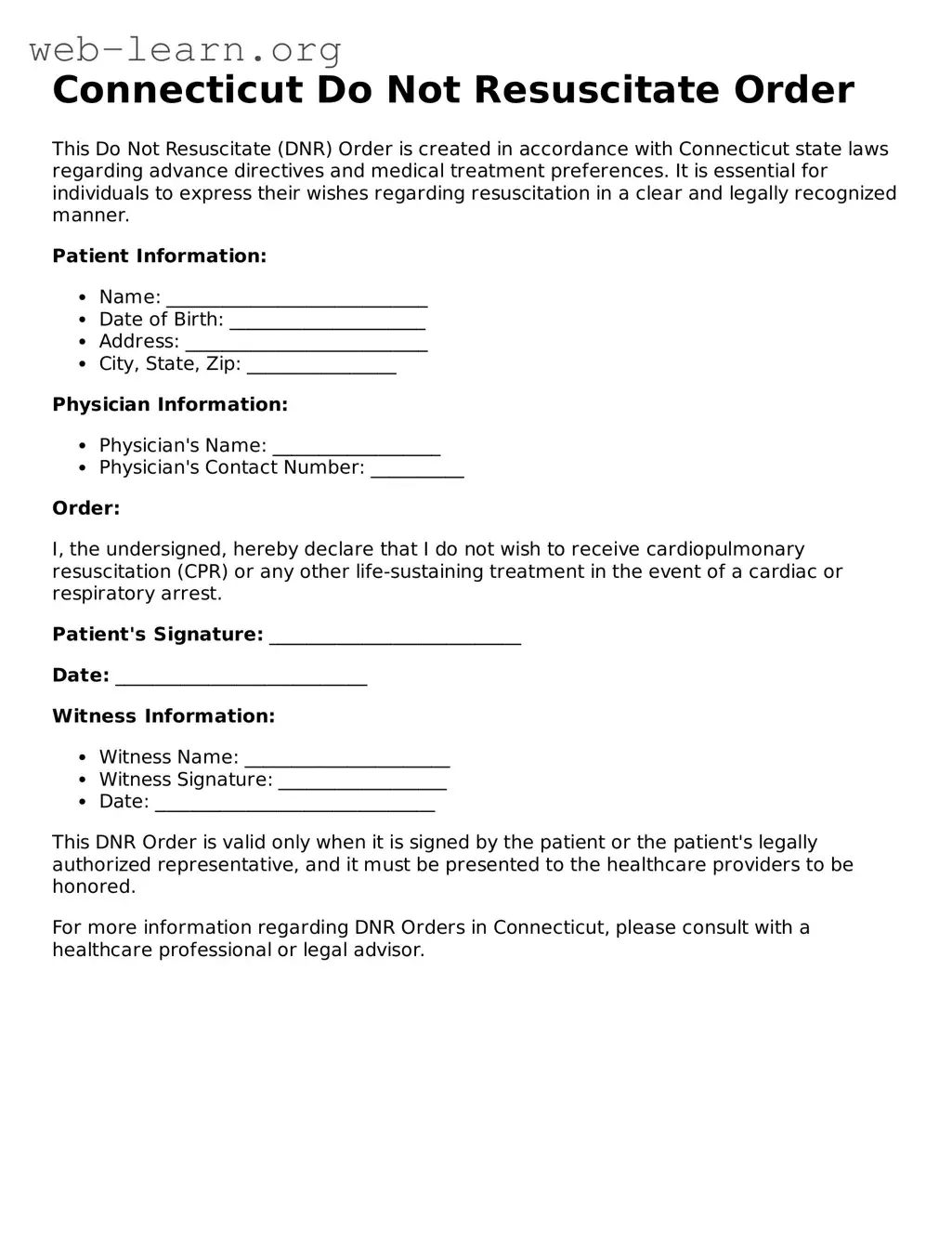
The Connecticut Do Not Resuscitate (DNR) Order form is a crucial document for individuals who wish to express their preferences regarding life-sustaining treatment in emergency medical situations. This form allows patients to communicate their desire not to receive cardiopulmonary resuscitation (CPR) if their heart stops beating or if they stop breathing. It is essential for ensuring that medical personnel respect a person's wishes during critical moments. The DNR Order must be completed and signed by a licensed physician, and it requires the patient’s consent or the consent of a legally authorized representative. Once executed, the form should be readily available to emergency responders and healthcare providers to ensure compliance. Understanding the implications of this document is vital for individuals and families, as it plays a significant role in end-of-life care planning and helps to alleviate potential confusion during medical emergencies.
Connecticut Do Not Resuscitate Order
This Do Not Resuscitate (DNR) Order is created in accordance with Connecticut state laws regarding advance directives and medical treatment preferences. It is essential for individuals to express their wishes regarding resuscitation in a clear and legally recognized manner.
Patient Information:
Physician Information:
Order:
I, the undersigned, hereby declare that I do not wish to receive cardiopulmonary resuscitation (CPR) or any other life-sustaining treatment in the event of a cardiac or respiratory arrest.
Patient's Signature: ___________________________
Date: ___________________________
Witness Information:
This DNR Order is valid only when it is signed by the patient or the patient's legally authorized representative, and it must be presented to the healthcare providers to be honored.
For more information regarding DNR Orders in Connecticut, please consult with a healthcare professional or legal advisor.
| Fact Name | Description |
|---|---|
| Definition | A Do Not Resuscitate (DNR) order is a legal document that instructs medical personnel not to perform cardiopulmonary resuscitation (CPR) if a patient's heart stops or they stop breathing. |
| Governing Law | The Connecticut DNR order is governed by Connecticut General Statutes § 19a-575. |
| Eligibility | Any adult who is capable of making their own medical decisions can complete a DNR order. |
| Form Requirements | The DNR order must be signed by the patient and a physician to be valid. |
| Emergency Services | Emergency medical services (EMS) personnel are required to honor a valid DNR order when they arrive at the scene. |
| Placement | The completed DNR form should be kept in a visible location, such as on the refrigerator or with other important medical documents. |
| Revocation | A patient can revoke a DNR order at any time, either verbally or by destroying the document. |
| State Registry | Connecticut has a DNR registry where individuals can voluntarily register their DNR orders for easier access by medical personnel. |
| Patient Rights | Patients have the right to make decisions about their medical care, including the choice to refuse resuscitation. |
| Legal Protection | Healthcare providers are legally protected when they follow a valid DNR order, shielding them from liability for not performing CPR. |
Filling out the Connecticut Do Not Resuscitate Order form is an important step in ensuring your healthcare preferences are respected. This document allows you to communicate your wishes regarding resuscitation in a clear and legally recognized manner. It is essential to complete the form accurately to avoid any confusion in critical situations.
After you have completed the form, ensure that it is stored in a safe yet accessible location. Sharing copies with your healthcare provider and loved ones will help facilitate discussions about your preferences. It is always advisable to revisit and update your wishes periodically, especially if your health status changes.
What is a Do Not Resuscitate (DNR) Order?
A Do Not Resuscitate Order is a medical order that tells healthcare providers not to perform cardiopulmonary resuscitation (CPR) if a person's heart stops beating or they stop breathing. It is a way for individuals to express their wishes about end-of-life care.
Who can request a DNR Order in Connecticut?
In Connecticut, a DNR Order can be requested by a patient or their legally authorized representative. This includes family members or someone designated to make medical decisions on behalf of the patient.
How do I obtain a DNR Order form?
You can obtain a DNR Order form from your healthcare provider, hospital, or online through the Connecticut Department of Public Health website. It is important to ensure that the form is completed correctly and signed by the appropriate parties.
What information is needed to complete the DNR Order form?
The form typically requires the patient's name, date of birth, and signature. It also needs to be signed by a physician who agrees with the decision. Some forms may ask for additional medical information or the signature of a witness.
Where should I keep the DNR Order once it is completed?
After completing the DNR Order, it is essential to keep it in a place where it can be easily accessed by healthcare providers. Many people choose to keep it in their medical records, at home, or with a family member who can present it in an emergency.
Can I change or revoke my DNR Order?
Yes, you can change or revoke your DNR Order at any time. To do this, you may need to fill out a new form or write a statement indicating your wish to revoke the previous order. It is important to inform your healthcare providers of any changes.
What should I discuss with my doctor before completing a DNR Order?
Before completing a DNR Order, it is important to have an open discussion with your doctor about your health condition, prognosis, and treatment options. Understanding the implications of a DNR Order can help you make an informed decision that aligns with your values and preferences.
Filling out the Connecticut Do Not Resuscitate (DNR) Order form is a crucial step for individuals who wish to express their medical preferences. However, mistakes can occur during this process, potentially leading to unintended consequences. One common error is not discussing the decision with family members or healthcare providers. Open communication is essential, as it ensures that everyone involved understands the individual's wishes.
Another frequent mistake is failing to complete the form in its entirety. Omitting any required sections can lead to confusion or invalidate the order. It is important to carefully review the entire document before submission. Additionally, individuals sometimes forget to sign and date the form. A signature is necessary to confirm that the decision is valid and reflects the individual's wishes.
Some people mistakenly assume that a verbal agreement suffices. A written DNR order is legally binding and must be documented properly to be effective. Relying solely on verbal communication can lead to misunderstandings in critical situations. Furthermore, individuals may neglect to provide copies of the completed form to their healthcare providers or family members. Sharing the document ensures that everyone involved is aware of the individual's preferences.
In some cases, individuals may choose not to update their DNR order as their health status changes. It is vital to review and revise the form periodically to ensure it accurately reflects current wishes. Lastly, misunderstanding the implications of a DNR order can lead to confusion. It is essential to fully grasp what a DNR order entails and how it affects medical care.
By avoiding these common mistakes, individuals can better ensure that their DNR orders are respected and upheld in accordance with their wishes. Taking the time to carefully complete the form and communicate preferences can provide peace of mind for both the individual and their loved ones.
When considering end-of-life care preferences, individuals often utilize various forms and documents in conjunction with the Connecticut Do Not Resuscitate (DNR) Order. These documents help ensure that a person’s wishes regarding medical treatment are clearly communicated and respected. Below is a list of commonly used forms alongside the DNR Order.
Utilizing these documents in conjunction with the Connecticut Do Not Resuscitate Order helps create a comprehensive plan for healthcare preferences. It is essential for individuals to discuss their wishes with family members and healthcare providers to ensure that their choices are understood and respected.
A Do Not Resuscitate (DNR) Order is an important document that outlines a person's wishes regarding medical treatment in the event of a cardiac arrest or respiratory failure. Several other documents serve similar purposes in healthcare settings. Here are eight documents that share similarities with a DNR Order:
When filling out the Connecticut Do Not Resuscitate Order form, it's important to follow specific guidelines. Here’s a list of things you should and shouldn't do:
Understanding the Connecticut Do Not Resuscitate (DNR) Order form is important for both patients and their families. However, several misconceptions can lead to confusion. Here are six common misconceptions:
By clarifying these misconceptions, individuals can make informed decisions about their healthcare preferences and communicate their wishes effectively with family and healthcare providers.
When considering the Connecticut Do Not Resuscitate (DNR) Order form, it's essential to understand its purpose and how to properly complete it. Here are some key takeaways to keep in mind:
By understanding these key points, you can make informed decisions about your healthcare preferences and ensure that your wishes are respected in critical situations.
Do Not Resuscitate Form - Having a DNR in place can help ensure that patients receive the type of care they truly want at the end of their lives.
How Old Do You Have to Be to Sign a Dnr - A DNR order can be a compassionate choice for patients who prioritize quality of life over aggressive interventions.
Georgia Dnr Form - A DNR order can be part of discussions about end-of-life care and treatment options.