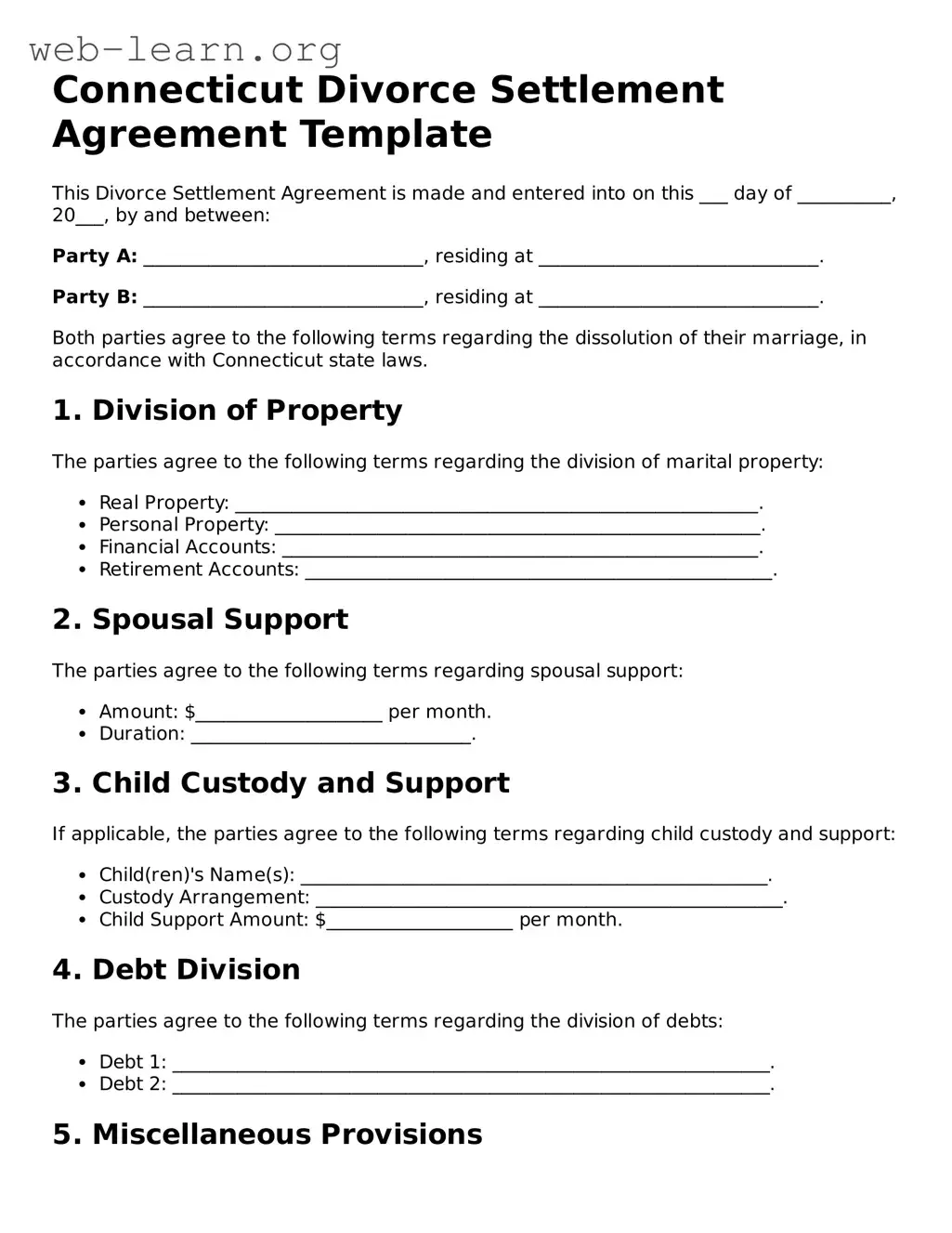
In the process of navigating a divorce, individuals in Connecticut must confront various legal requirements, one of which is the Divorce Settlement Agreement form. This essential document serves as a comprehensive outline of the terms agreed upon by both parties regarding the division of assets, child custody arrangements, and support obligations. It encompasses critical aspects such as the distribution of marital property, spousal support, and any arrangements for child visitation and support. By detailing these elements, the form aims to ensure clarity and mutual understanding, reducing the potential for future disputes. Furthermore, it is important to recognize that this agreement must be signed by both spouses and submitted to the court for approval, thereby formalizing the terms of the divorce. Understanding the nuances of this form can significantly influence the outcome of the divorce proceedings and provide a foundation for a more amicable post-divorce relationship.
Connecticut Divorce Settlement Agreement Template
This Divorce Settlement Agreement is made and entered into on this ___ day of __________, 20___, by and between:
Party A: ______________________________, residing at ______________________________.
Party B: ______________________________, residing at ______________________________.
Both parties agree to the following terms regarding the dissolution of their marriage, in accordance with Connecticut state laws.
1. Division of Property
The parties agree to the following terms regarding the division of marital property:
2. Spousal Support
The parties agree to the following terms regarding spousal support:
3. Child Custody and Support
If applicable, the parties agree to the following terms regarding child custody and support:
4. Debt Division
The parties agree to the following terms regarding the division of debts:
5. Miscellaneous Provisions
Both parties agree to the following additional terms:
IN WITNESS WHEREOF, the parties have executed this Divorce Settlement Agreement as of the date first above written.
Party A Signature: ______________________________ Date: ____________
Party B Signature: ______________________________ Date: ____________
Witness Signature: ______________________________ Date: ____________
| Fact Name | Description |
|---|---|
| Purpose | The Connecticut Divorce Settlement Agreement form outlines the terms of the divorce settlement between spouses. |
| Governing Law | This form is governed by the Connecticut General Statutes, particularly Title 46b, which deals with family law. |
| Filing Requirement | Both parties must sign the agreement for it to be valid and enforceable in court. |
| Property Division | The form includes provisions for the equitable division of marital property and debts. |
| Child Custody | If children are involved, the agreement must address child custody and visitation arrangements. |
| Child Support | The agreement should specify child support obligations, including amounts and payment schedules. |
| Spousal Support | Provisions for alimony or spousal support can be included, detailing duration and amount. |
| Modification | Terms in the agreement can be modified later if both parties agree and it is approved by the court. |
| Legal Advice | It is advisable for both parties to seek legal counsel before signing the agreement to ensure fairness and understanding. |
Once you have gathered the necessary information and documents, you can begin filling out the Connecticut Divorce Settlement Agreement form. This form is essential for outlining the terms of your divorce, including property division, alimony, and child custody arrangements. Follow these steps to complete the form accurately.
After completing the form, it will need to be submitted to the court along with any required documents. Ensure that you keep copies for your records. If you have any questions or need further assistance, consider reaching out to a legal professional.
What is a Connecticut Divorce Settlement Agreement?
A Connecticut Divorce Settlement Agreement is a legal document that outlines the terms of a divorce between two parties. It details how assets, debts, child custody, and support will be divided. This agreement is crucial for ensuring both parties understand their rights and responsibilities after the divorce.
Who needs to complete this form?
Both spouses involved in the divorce must complete the Divorce Settlement Agreement. It is important for both parties to agree on the terms outlined in the document. This agreement becomes part of the divorce decree, making it enforceable by the court.
What should be included in the agreement?
The agreement should cover several key areas, including:
It is essential to be thorough and clear in each section to prevent misunderstandings in the future.
How do I file the Divorce Settlement Agreement?
After both parties have signed the agreement, it must be filed with the court as part of the divorce proceedings. Typically, this is done at the same time as the divorce petition or response. Check with your local court for specific filing procedures and any required fees.
Can the agreement be modified after it is signed?
Yes, the Divorce Settlement Agreement can be modified after it is signed, but both parties must agree to the changes. If circumstances change significantly, such as a job loss or relocation, a court may also allow modifications. It is advisable to document any changes formally.
What happens if one party does not comply with the agreement?
If one party fails to comply with the terms of the Divorce Settlement Agreement, the other party can seek enforcement through the court. The court may impose penalties or require compliance with the agreement. It is crucial to keep records of any violations.
Do I need a lawyer to complete this form?
While it is not legally required to have a lawyer, it is highly recommended. A legal professional can help ensure that the agreement is fair, comprehensive, and compliant with state laws. They can also provide valuable advice tailored to your specific situation.
Filling out the Connecticut Divorce Settlement Agreement form can be a daunting task. Many individuals find themselves making common mistakes that can complicate the divorce process. One frequent error is failing to provide complete information. Each section of the form requires detailed responses, and omitting any part can lead to delays or even the rejection of the agreement.
Another mistake is not understanding the implications of the agreements made. For instance, individuals may agree to terms regarding property division or child custody without fully grasping how these decisions will affect their future. It is crucial to consider both immediate and long-term consequences before signing.
People often overlook the importance of accurate financial disclosures. Incomplete or inaccurate financial information can lead to disputes later on. Parties should ensure that they disclose all assets, debts, and income sources. Transparency is key to a fair settlement.
Many individuals also underestimate the significance of legal terminology. Even though the form is designed to be user-friendly, misunderstandings can arise. Misinterpreting terms can lead to agreements that do not reflect the parties' true intentions. Seeking clarification or legal advice can help mitigate this issue.
Another common pitfall is neglecting to consider tax implications. Certain decisions made during the divorce process can have tax consequences. For example, the division of retirement accounts or alimony payments can impact tax liabilities. Consulting a financial advisor or tax professional is advisable to navigate these complexities.
Additionally, people sometimes fail to review the document thoroughly before submission. Rushing through the process can lead to overlooked errors or inconsistencies. Taking the time to carefully read and double-check the agreement can prevent future complications.
Some individuals also forget to include necessary supporting documentation. The form may require attachments, such as proof of income or property valuations. Missing these documents can delay the approval process and create unnecessary hurdles.
Moreover, parties may not fully understand their rights and responsibilities under Connecticut law. Each state has unique regulations regarding divorce, and failing to comply with these can lead to unfavorable outcomes. Familiarity with state laws is essential for ensuring that the agreement is valid and enforceable.
Lastly, individuals sometimes neglect to consider the emotional aspects of the divorce. A settlement agreement is not just a legal document; it represents the culmination of a significant life change. Taking the time to discuss feelings and expectations can lead to a more amicable resolution and a healthier transition for all involved.
When navigating the process of divorce in Connecticut, several important documents often accompany the Divorce Settlement Agreement. Each of these forms plays a crucial role in ensuring that the terms of the divorce are clear and enforceable. Below is a list of commonly used documents that may be required or beneficial during this process.
Understanding these documents can help individuals feel more prepared as they navigate the complexities of divorce. While the process can be emotionally challenging, having the right forms in place can lead to a smoother transition into the next chapter of life.
When filling out the Connecticut Divorce Settlement Agreement form, it's important to approach the task with care. Here are some essential dos and don’ts to keep in mind:
When it comes to the Connecticut Divorce Settlement Agreement form, many people hold misconceptions that can lead to confusion and mistakes. Here are eight common misunderstandings about this important document:
Understanding these misconceptions can help individuals navigate the divorce process more effectively. A well-prepared Divorce Settlement Agreement lays the foundation for a smoother transition into the next chapter of life.
Filling out the Connecticut Divorce Settlement Agreement form is a critical step in the divorce process. Understanding its components and implications can help streamline your divorce and protect your rights. Here are some key takeaways to consider:
These takeaways will help you navigate the Divorce Settlement Agreement process more effectively. Taking the time to understand and properly complete this form can save you from future complications.
Divorce Templates - The agreement can also outline how to handle disputes that may arise in the future.
Divorce Contract Template - This document details the division of assets and debts acquired during the marriage.