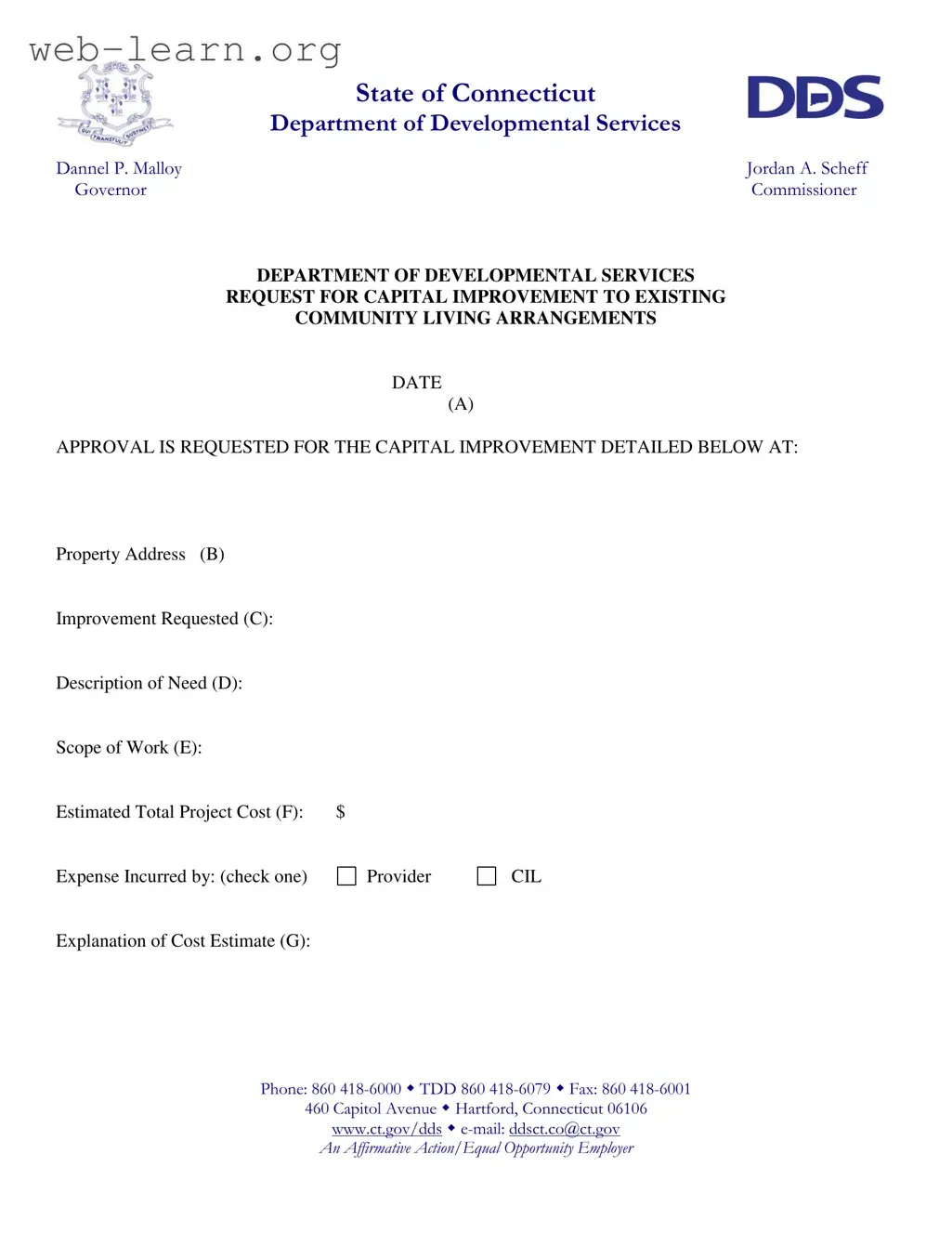
The Connecticut Capital Improvement form serves as a crucial tool for requesting enhancements to existing community living arrangements managed by the Department of Developmental Services. This form outlines key components necessary for the approval process, including the property address where improvements are sought and a detailed description of the requested enhancements. It emphasizes the importance of articulating the need for these changes, as well as providing a comprehensive scope of work that outlines the specific tasks involved. The estimated total project cost must also be clearly stated, along with an explanation of how these costs were determined. To ensure transparency, the form requires information about the provider and the contractor, including the type of contractor involved and a summary of bids received. Additionally, it addresses the possibility of exceptions to the bidding process, should they arise, and requires justification for the selection of bids. The form also includes sections for signatures from various stakeholders, ensuring that all parties acknowledge their roles in the process. Ultimately, this form is designed to facilitate necessary improvements while safeguarding the health and safety of residents within these community living arrangements.




| Fact Name | Description |
|---|---|
| Governing Laws | The Connecticut Capital Improvement form is governed by Sections 17b-244 and 17a-228 of the General Statutes. |
| Purpose | This form is used to request capital improvements for existing community living arrangements overseen by the Department of Developmental Services. |
| Approval Process | Approval for the capital improvement must be requested, detailing the specific improvements and their necessity. |
| Estimated Costs | The form requires an estimated total project cost, ensuring transparency in financial planning for improvements. |
| Bid Summary | A bid summary form is included, where providers must document contractor information, bid amounts, and justification for bid selection. |
| Signature Requirements | Multiple signatures are needed on the form, including those from the provider, regional director, and the commissioner. |
| Health and Safety Certification | By signing the form, the commissioner certifies that the project is essential for the health or safety of the residents, as mandated by law. |
Filling out the Connecticut Capital Improvement form is an important step in requesting funding for necessary improvements to community living arrangements. This form requires detailed information about the property, the proposed improvements, and the associated costs. Properly completing the form ensures that your request is clear and can be processed efficiently.
The Connecticut Capital Improvement form is designed to request funding for improvements to existing community living arrangements. It serves as a formal mechanism for providers to outline the necessary enhancements aimed at ensuring the health and safety of residents. The form captures essential details about the property, the nature of the requested improvements, and the estimated costs involved.
To complete the form, several key pieces of information must be provided:
The bidding process involves soliciting bids from contractors to ensure competitive pricing for the proposed work. Providers must submit a bid summary form that includes:
If there are exceptions to the bidding process, such as an inability to solicit three bids or urgency, these must be clearly stated.
Once the form is submitted, it undergoes a review process. The regional director and authorized designees from the Department of Developmental Services will evaluate the request. They will consider the necessity of the project for the health and safety of residents as outlined in Connecticut General Statutes 17b-244. Approval from the commissioner is required before any funds can be allocated.
No, submitting the Connecticut Capital Improvement form does not guarantee funding. The form serves as a request for consideration. Funding is contingent upon the approval of the project based on the outlined criteria and available budgetary resources.
For any inquiries related to the Connecticut Capital Improvement form, providers can reach out to the Department of Developmental Services. The main contact number is 860-418-6000. Additional resources, including email and TDD options, are also available for assistance.
Filling out the Connecticut Capital Improvement form can be a straightforward process, but there are common mistakes that people often make. Avoiding these pitfalls can save time and ensure that your request is processed smoothly.
One frequent error is not providing a complete property address. This information is essential for identifying the location of the proposed improvement. Omitting details or providing an incorrect address can lead to delays in approval.
Another mistake is failing to clearly articulate the improvement requested. Vague descriptions can confuse reviewers. Instead, be specific about what you are proposing. A clear and concise description helps the decision-makers understand the necessity of your request.
People often overlook the scope of work section as well. This part should outline all tasks involved in the project. A detailed scope allows reviewers to gauge the project’s complexity and budget requirements. If this section is too brief, it may raise questions about the project’s feasibility.
Many applicants also miscalculate the estimated total project cost. Providing an accurate estimate is crucial. If the cost is too low, it may raise doubts about the project’s viability. Conversely, an inflated estimate might discourage approval. Double-check your calculations and ensure they are realistic.
Another common oversight is neglecting to explain the cost estimate. Reviewers want to understand how you arrived at your figures. Providing a breakdown of costs can lend credibility to your request and demonstrate thorough planning.
Some individuals fail to check the appropriate box regarding expense incurred by. This choice is significant as it determines who will be financially responsible for the project. Not selecting an option can lead to confusion and unnecessary back-and-forth communication.
Additionally, applicants sometimes forget to include the justification for choosing a contractor if the lowest bid is not selected. If you opt for a different contractor, explain your reasoning clearly. This transparency can help justify your decision and facilitate the approval process.
Finally, many people neglect to obtain the necessary signatures on the form. Each signature represents a level of accountability and agreement on the project. Without these, the form may be deemed incomplete, leading to further delays.
The Connecticut Capital Improvement form is essential for requesting funds for improvements to community living arrangements. Along with this form, several other documents are often used to ensure a smooth process. Below is a list of these forms and a brief description of each.
These documents work together with the Connecticut Capital Improvement form to facilitate the planning and execution of community living improvements. Having all necessary paperwork in order helps ensure that projects run smoothly and meet all regulatory requirements.
When filling out the Connecticut Capital Improvement form, it is essential to follow certain guidelines to ensure a smooth process. Below is a list of things you should and shouldn't do:
By adhering to these guidelines, you can help ensure that your submission is complete and meets the necessary requirements for review. Properly completing the form will facilitate a more efficient approval process.
Misconceptions about the Connecticut Capital Improvement form can lead to confusion. Here are ten common misunderstandings along with clarifications:
Understanding these misconceptions can help ensure a smoother process when applying for capital improvements in Connecticut.
Filling out the Connecticut Capital Improvement form requires careful attention to detail. Here are some key takeaways to ensure the process runs smoothly:
By adhering to these takeaways, you can enhance your chances of a successful application for capital improvements in Connecticut.