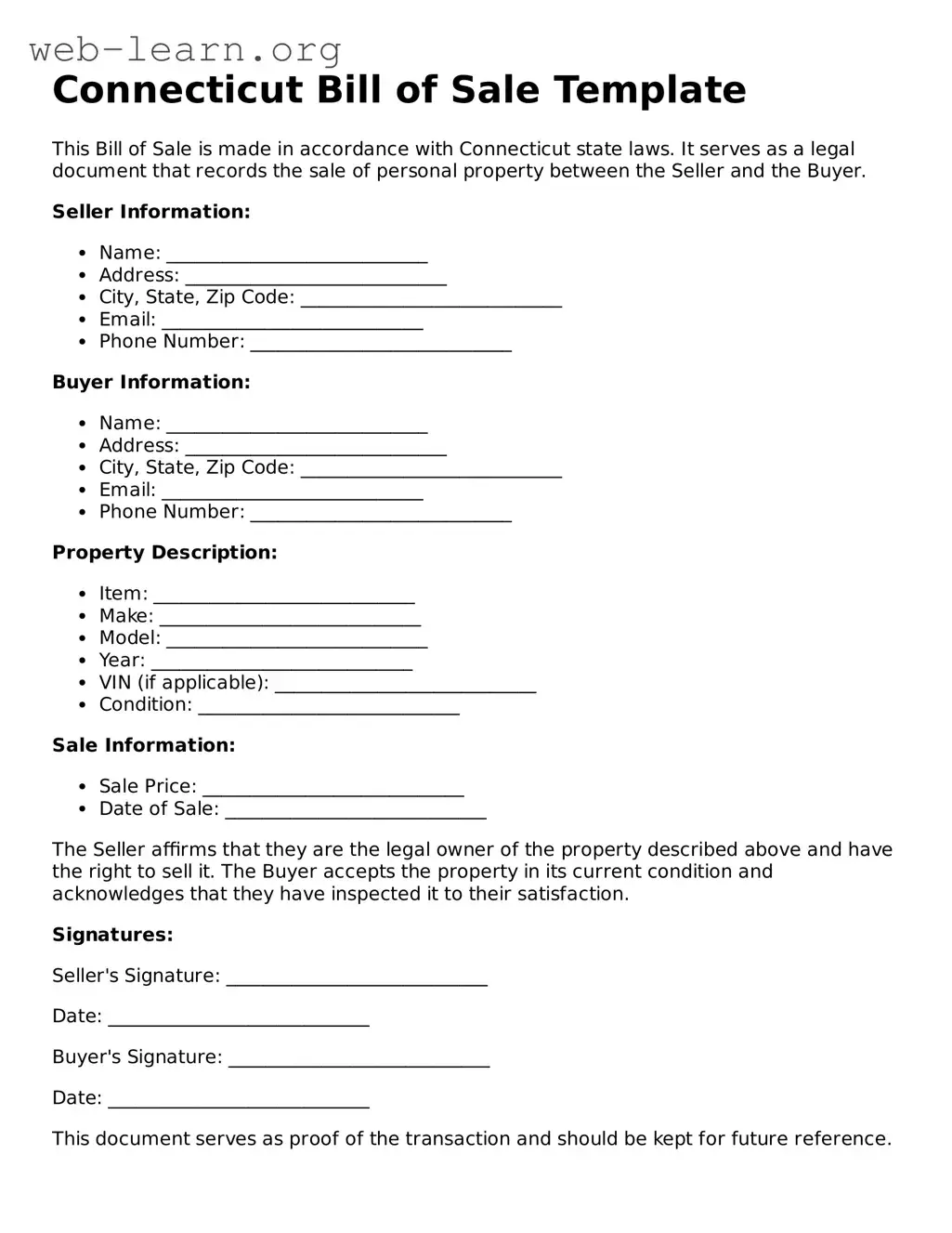
The Connecticut Bill of Sale form serves as a crucial document for individuals engaging in the sale or transfer of personal property within the state. This form outlines essential details such as the names and addresses of both the buyer and seller, a description of the item being sold, and the agreed-upon purchase price. It also includes the date of the transaction, which is vital for record-keeping and legal purposes. By providing a clear record of the exchange, the Bill of Sale helps protect both parties in case of disputes or misunderstandings in the future. Additionally, it may require signatures from both the buyer and seller, ensuring that both parties acknowledge and agree to the terms of the sale. Understanding how to properly fill out this form can simplify the process of transferring ownership and provide peace of mind for those involved.
Connecticut Bill of Sale Template
This Bill of Sale is made in accordance with Connecticut state laws. It serves as a legal document that records the sale of personal property between the Seller and the Buyer.
Seller Information:
Buyer Information:
Property Description:
Sale Information:
The Seller affirms that they are the legal owner of the property described above and have the right to sell it. The Buyer accepts the property in its current condition and acknowledges that they have inspected it to their satisfaction.
Signatures:
Seller's Signature: ____________________________
Date: ____________________________
Buyer's Signature: ____________________________
Date: ____________________________
This document serves as proof of the transaction and should be kept for future reference.
| Fact Name | Details |
|---|---|
| Definition | A Bill of Sale is a legal document that transfers ownership of personal property from one party to another. |
| Governing Law | The Connecticut Bill of Sale is governed by Connecticut General Statutes § 42-101 et seq. |
| Purpose | This document serves as proof of purchase and can help resolve disputes over ownership. |
| Types | Common types include vehicle, boat, and personal property Bill of Sale forms. |
| Requirements | It typically requires the names of both parties, a description of the item, and the sale price. |
| Signatures | Both the seller and buyer must sign the Bill of Sale for it to be valid. |
| Notarization | While notarization is not required, it can add an extra layer of protection and legitimacy. |
| Record Keeping | It is advisable for both parties to keep a copy of the Bill of Sale for their records. |
| Usage in Transactions | A Bill of Sale is often used in private sales, auctions, and transfers between family members. |
Once you have the Connecticut Bill of Sale form ready, it's time to fill it out accurately. This form will help document the transaction between the buyer and seller. Ensuring all details are correctly entered will make the process smoother for both parties involved.
A Bill of Sale is a legal document that records the transfer of ownership of personal property from one party to another. It serves as proof of the transaction and outlines the details of the sale, including the items sold, the purchase price, and the date of the transaction.
While a Bill of Sale is not legally required for all transactions in Connecticut, it is highly recommended for certain types of sales, particularly for vehicles, boats, and other high-value items. Having a Bill of Sale can help protect both the buyer and the seller by providing a clear record of the transaction.
A comprehensive Bill of Sale in Connecticut should include the following information:
In Connecticut, notarization of a Bill of Sale is not required for it to be valid. However, having the document notarized can add an extra layer of authenticity and may be beneficial if there are disputes in the future.
Yes, individuals can create their own Bill of Sale. There are many templates available online that can be customized to fit specific transactions. It is important to ensure that all necessary information is included to make the document legally binding.
After completing the Bill of Sale, both the buyer and the seller should keep a copy for their records. If the transaction involves a vehicle, the seller should also provide the buyer with the title and any other necessary documentation to complete the transfer of ownership.
If a dispute arises after the sale, the Bill of Sale can serve as important evidence in resolving the issue. It can clarify the terms of the sale and what was agreed upon by both parties. If necessary, parties may seek legal advice to address the dispute.
Connecticut does not have specific laws that govern Bills of Sale for all types of personal property. However, certain transactions, such as vehicle sales, are subject to state regulations. It is advisable to familiarize oneself with these regulations to ensure compliance.
When completing the Connecticut Bill of Sale form, individuals often encounter common pitfalls that can lead to complications. One frequent mistake is failing to provide accurate information about the buyer and seller. This includes not only names but also addresses and contact details. Inaccuracies in this information can create confusion and may complicate future transactions.
Another common error is neglecting to include a complete description of the item being sold. The Bill of Sale should detail not just the name of the item but also its condition, model number, and any identifying features. Omitting these details can result in disputes over what was actually sold, especially if the item is unique or has specific characteristics.
Additionally, many individuals forget to include the sale price. This figure is crucial, as it establishes the value of the transaction for both parties and for tax purposes. Leaving this section blank or providing an incorrect amount can lead to misunderstandings and potential legal issues down the line.
It is also important to ensure that both parties sign the document. Some individuals mistakenly think that a verbal agreement is sufficient. However, a signature provides proof of consent and can protect both the buyer and seller in case of future disagreements. Not obtaining a signature can render the Bill of Sale ineffective.
Lastly, people often overlook the importance of keeping a copy of the completed Bill of Sale. After signing, both parties should retain a copy for their records. This document serves as proof of the transaction and can be vital if questions arise later. Failing to keep a copy can leave one party vulnerable in the event of a dispute.
The Connecticut Bill of Sale is an important document used to transfer ownership of personal property. However, it often works in conjunction with several other forms and documents that help ensure a smooth transaction. Below is a list of additional forms that you may encounter when completing a sale in Connecticut.
Understanding these additional documents can help facilitate a successful sale. Each form serves a specific purpose and contributes to the overall legality and transparency of the transaction. Always ensure that you have the appropriate paperwork in order to protect your interests and comply with Connecticut laws.
The Bill of Sale is a crucial document in the transfer of ownership for various types of property. It shares similarities with several other documents that also facilitate transactions and ownership transfers. Here are six documents that resemble a Bill of Sale:
When filling out the Connecticut Bill of Sale form, it is important to be careful and thorough. Below are some guidelines to help you navigate this process effectively.
When it comes to the Connecticut Bill of Sale form, several misconceptions can lead to confusion. Here are five common misunderstandings:
This is not true. While many people associate a Bill of Sale with vehicle sales, it is also used for other items like boats, trailers, and personal property. Anytime you buy or sell something of value, a Bill of Sale can be beneficial.
In Connecticut, notarization is not a requirement for a Bill of Sale. However, having it notarized can provide an extra layer of protection and authenticity, especially for high-value transactions.
While a Bill of Sale serves as proof of the transaction, it is not a contract in the traditional sense. It does not necessarily cover warranties or guarantees unless explicitly stated.
This is a misconception. A Bill of Sale can also be used to document the transfer of ownership for gifts, providing a clear record of the transaction.
Not all Bills of Sale are created equal. Different types of transactions may require different information. It’s important to use a form that suits the specific item being sold and the details of the transaction.
Filling out and using the Connecticut Bill of Sale form is an important step in the process of transferring ownership of personal property. Here are some key takeaways to keep in mind:
Bill of Sale in Alabama - A Bill of Sale can help streamline the process of transferring ownership legally.
Bill of Sale Idaho Pdf - This document is commonly used for vehicles, equipment, and personal property sales.