Homepage Blank Connecticut B 276 Form
Outline

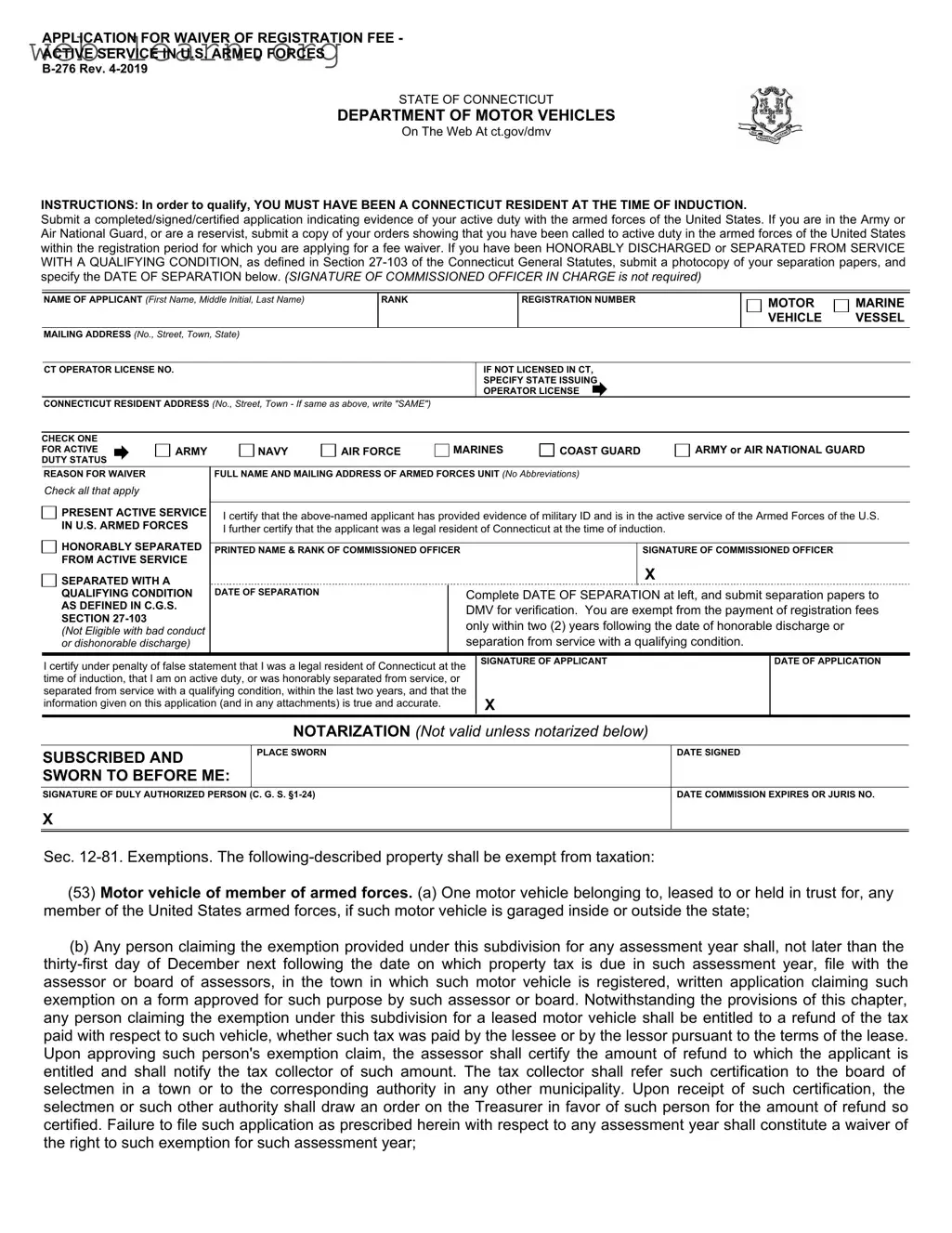
The Connecticut B 276 form serves a crucial role for those who have bravely served in the U.S. Armed Forces. Designed specifically for active service members and honorably discharged veterans, this form allows eligible individuals to apply for a waiver of vehicle registration fees. To qualify, applicants must demonstrate that they were Connecticut residents at the time of their induction into military service. The application requires documentation of active duty, including orders for reservists and National Guard members, and it emphasizes the importance of providing accurate information regarding military status and residency. Furthermore, those who have been honorably discharged or separated from service due to qualifying conditions must submit their separation papers to ensure eligibility. The process is straightforward, but it does require careful attention to detail, including notarization and verification from a commissioned officer. By completing this form, veterans and active-duty personnel can alleviate some of the financial burdens associated with vehicle registration, allowing them to focus on what truly matters: their service and their families.
Sample - Connecticut B 276 Form

NOTARIZATION (Not valid unless notarized below)
Complete DATE OF SEPARATION at left, and submit separation papers to
DMV for verification. You are exempt from the payment of registration fees
only within two (2) years following the date of honorable discharge or
separation from service with a qualifying condition.
STATE OF CONNECTICUT
DEPARTMENT OF MOTOR VEHICLES
On The Web At ct.gov/dmv
APPLICATION FOR WAIVER OF REGISTRATION FEE -
ACTIVE SERVICE IN U.S. ARMED FORCES
B-276 Rev. 4-2019
SIGNATURE OF APPLICANT
X
CT OPERATOR LICENSE NO.
REASON FOR WAIVER FULL NAME AND MAILING ADDRESS OF ARMED FORCES UNIT (No Abbreviations)
DATE OF SEPARATION
SIGNATURE OF COMMISSIONED OFFICER
REGISTRATION NUMBERNAME OF APPLICANT (First Name, Middle Initial, Last Name)
MOTOR
VEHICLE
MARINE
VESSEL
MAILING ADDRESS (No., Street, Town, State)
CONNECTICUT RESIDENT ADDRESS (No., Street, Town - If same as above, write "SAME")
SEPARATED WITH A
QUALIFYING CONDITION
AS DEFINED IN C.G.S.
SECTION 27-103
(Not Eligible with bad conduct
or dishonorable discharge)
PRESENT ACTIVE SERVICE
IN U.S. ARMED FORCES
X
PRINTED NAME & RANK OF COMMISSIONED OFFICER
RANK
IF NOT LICENSED IN CT,
SPECIFY STATE ISSUING
OPERATOR LICENSE
CHECK ONE
FOR ACTIVE
DUTY STATUS
ARMY NAVY
MARINES
AIR FORCE
ARMY or AIR NATIONAL GUARD
INSTRUCTIONS: In order to qualify, YOU MUST HAVE BEEN A CONNECTICUT RESIDENT AT THE TIME OF INDUCTION.
Submit a completed/signed/certified application indicating evidence of your active duty with the armed forces of the United States. If you are in the Army or
Air National Guard, or are a reservist, submit a copy of your orders showing that you have been called to active duty in the armed forces of the United States
within the registration period for which you are applying for a fee waiver. If you have been HONORABLY DISCHARGED or SEPARATED FROM SERVICE
WITH A QUALIFYING CONDITION, as defined in Section 27-103 of the Connecticut General Statutes, submit a photocopy of your separation papers, and
specify the DATE OF SEPARATION below. (SIGNATURE OF COMMISSIONED OFFICER IN CHARGE is not required)
I certify under penalty of false statement that I was a legal resident of Connecticut at the
time of induction, that I am on active duty, or was honorably separated from service, or
separated from service with a qualifying condition, within the last two years, and that the
information given on this application (and in any attachments) is true and accurate.
I certify that the above-named applicant has provided evidence of military ID and is in the active service of the Armed Forces of the U.S.
I further certify that the applicant was a legal resident of Connecticut at the time of induction.
DATE OF APPLICATION
COAST GUARD
Sec. 12-81. Exemptions. The following-described property shall be exempt from taxation:
(53) Motor vehicle of member of armed forces. (a) One motor vehicle belonging to, leased to or held in trust for, any
member of the United States armed forces, if such motor vehicle is garaged inside or outside the state;
(b) Any person claiming the exemption provided under this subdivision for any assessment year shall, not later than the
thirty-first day of December next following the date on which property tax is due in such assessment year, file with the
assessor or board of assessors, in the town in which such motor vehicle is registered, written application claiming such
exemption on a form approved for such purpose by such assessor or board. Notwithstanding the provisions of this chapter,
any person claiming the exemption under this subdivision for a leased motor vehicle shall be entitled to a refund of the tax
paid with respect to such vehicle, whether such tax was paid by the lessee or by the lessor pursuant to the terms of the lease.
Upon approving such person's exemption claim, the assessor shall certify the amount of refund to which the applicant is
entitled and shall notify the tax collector of such amount. The tax collector shall refer such certification to the board of
selectmen in a town or to the corresponding authority in any other municipality. Upon receipt of such certification, the
selectmen or such other authority shall draw an order on the Treasurer in favor of such person for the amount of refund so
certified. Failure to file such application as prescribed herein with respect to any assessment year shall constitute a waiver of
the right to such exemption for such assessment year;
SUBSCRIBED AND
SWORN TO BEFORE ME:
DATE SIGNED
X
PLACE SWORN
SIGNATURE OF DULY AUTHORIZED PERSON (C. G. S. §1-24) DATE COMMISSION EXPIRES OR JURIS NO.
HONORABLY SEPARATED
FROM ACTIVE SERVICE
Check all that apply

Form Information

Fact Name Description
Purpose The Connecticut B-276 form is used to apply for a waiver of registration fees for members of the U.S. Armed Forces.
Eligibility Applicants must have been Connecticut residents at the time of their induction into the armed forces.
Active Duty Verification Evidence of active duty is required, such as military orders or separation papers.
Honorable Discharge Applicants who have been honorably discharged or separated with a qualifying condition must submit their separation papers.
Governing Law This form is governed by Section 27-103 of the Connecticut General Statutes.
Notarization Requirement The application must be notarized to be considered valid.

Detailed Guide for Filling Out Connecticut B 276

Filling out the Connecticut B 276 form is a straightforward process that requires careful attention to detail. This form is essential for those seeking a waiver of registration fees due to active service in the U.S. Armed Forces. Before starting, ensure you have all necessary documents ready, including proof of military service and any separation papers if applicable.

  1. Begin by downloading the Connecticut B 276 form from the Connecticut Department of Motor Vehicles website.
  2. Fill in your full name (First Name, Middle Initial, Last Name) in the designated space.
  3. Indicate your rank in the military.
  4. Provide your registration number for the vehicle.
  5. Specify whether your application is for a motor vehicle or marine vessel.
  6. Enter your mailing address (No., Street, Town, State).
  7. If you have a Connecticut operator license, provide the license number. If not, specify the state that issued your operator license.
  8. Fill in your Connecticut resident address (No., Street, Town). If it is the same as your mailing address, simply write "SAME."
  9. Check the box that corresponds to your active duty status (Army, Navy, Air Force, Marines, Coast Guard, Army or Air National Guard).
  10. State the reason for the waiver in the provided space.
  11. Provide the full name and mailing address of your armed forces unit. Do not use abbreviations.
  12. Certify your current active service by having a commissioned officer sign in the appropriate section.
  13. If you have been honorably separated or separated with a qualifying condition, complete the date of separation and submit your separation papers.
  14. Sign the application, certifying that all information is true and accurate.
  15. Ensure the form is notarized by a duly authorized person.

After completing the form, submit it to the Connecticut Department of Motor Vehicles along with any required documents. This step is crucial to ensure your application is processed efficiently. Keep a copy of the submitted form for your records.

Obtain Answers on Connecticut B 276

  1. What is the Connecticut B 276 form?

    The Connecticut B 276 form is an application for a waiver of the registration fee for motor vehicles or vessels for individuals who are active members of the U.S. Armed Forces. It is specifically designed for Connecticut residents who have been inducted into military service.

  2. Who is eligible to apply for the fee waiver?

    To qualify for the fee waiver, you must have been a resident of Connecticut at the time of your induction into the Armed Forces. Additionally, you must currently be on active duty or have been honorably discharged or separated from service with a qualifying condition within the last two years.

  3. What documentation is required to complete the application?

    You need to provide several documents with your application:

    • A completed and signed B 276 form.
    • Evidence of your active duty status, such as military orders if you are in the Army or Air National Guard.
    • Separation papers if you are honorably discharged or separated with a qualifying condition.
  4. How do I submit the B 276 form?

    The completed form, along with all required documentation, should be submitted to the Connecticut Department of Motor Vehicles (DMV). Ensure that you have notarized the form before submission, as it will not be valid otherwise.

  5. What is the time frame for submitting the application?

    You must submit your application for the fee waiver within two years following your honorable discharge or separation from service with a qualifying condition. If you miss this window, you will not be eligible for the waiver.

  6. What happens if my application is approved?

    If your application is approved, you will be exempt from paying registration fees for your vehicle or vessel. The DMV will notify you of the approval and any further steps you need to take.

  7. Can I apply for a fee waiver if I have a bad conduct or dishonorable discharge?

    No, individuals who have received a bad conduct or dishonorable discharge are not eligible for the fee waiver. Only those who have been honorably discharged or separated with a qualifying condition may apply.

  8. Where can I find more information about the Connecticut B 276 form?

    For additional details, you can visit the Connecticut DMV website at ct.gov/dmv. This site provides comprehensive information regarding the form and the application process.

Common mistakes

Filling out the Connecticut B 276 form can be a straightforward process, but many people make common mistakes that can delay or even derail their application for a waiver of registration fees. One significant error is failing to provide adequate proof of active duty status. Applicants must submit documentation showing their current active service in the armed forces. Without this evidence, the application may be rejected.

Another frequent oversight is neglecting to confirm residency requirements. It is crucial to establish that the applicant was a legal resident of Connecticut at the time of induction. Many assume this information is understood, but failing to explicitly state it can lead to complications. Ensure that all residency claims are clearly documented and accurate.

Some applicants forget to include the date of separation when applying for a waiver after being honorably discharged. This date is essential for verifying eligibility. If you have been separated from service with a qualifying condition, the application must reflect this information accurately. Omitting this detail can cause unnecessary delays.

In addition, many people do not check the appropriate box for their active duty status. Whether you are in the Army, Navy, Air Force, Marines, or Coast Guard, it is vital to mark the correct option. This seemingly minor detail can lead to confusion and processing errors.

Another common mistake involves the mailing address. Applicants often provide an incomplete or incorrect mailing address, which can lead to important correspondence being lost. Double-check that the address is accurate and complete, including any necessary apartment or unit numbers.

Some individuals also overlook the requirement for notarization. The application is not valid unless it has been notarized. Without this step, the application will not be processed. Make sure to find a notary and complete this requirement before submitting the form.

Many applicants fail to sign the form correctly. A missing signature can render the application invalid. It is essential to sign in the designated area and ensure that the signature matches the name provided in the application.

Moreover, individuals sometimes forget to include their separation papers if they are applying based on an honorable discharge or qualifying condition. This documentation is vital for verification and must accompany the application to ensure it is processed efficiently.

Lastly, some applicants may not be aware of the two-year limit for fee waivers following honorable discharge. If you are applying after this period, your application will be denied. It is crucial to be aware of these timelines to avoid disappointment.

Documents used along the form

When applying for a waiver of registration fees in Connecticut due to active military service, several other forms and documents may be necessary to support your application. Here’s a list of commonly used documents that accompany the Connecticut B 276 form.

  • DD Form 214: This form is issued upon a service member's retirement, discharge, or separation from active duty. It provides essential information about the service member's military service and status.
  • Active Duty Orders: These documents confirm that a service member has been called to active duty. They are crucial for establishing eligibility for the fee waiver.
  • Military ID: A current military identification card verifies the service member's active status and identity, which is necessary for the application.
  • Application for Property Tax Exemption: This form is used to claim exemptions for military personnel regarding property taxes, often required alongside the B 276 form.
  • Proof of Connecticut Residency: Documents such as utility bills or lease agreements may be needed to prove that the applicant was a Connecticut resident at the time of induction.
  • Separation Papers: If the applicant has been honorably discharged, these papers provide proof of separation and any qualifying conditions that may apply.
  • Certification of Service: A letter or form from a commanding officer can certify the applicant's active service status and residency at the time of induction.
  • Notarized Statement: A notarized statement may be required to validate the information provided in the application, ensuring authenticity and compliance.
  • Tax Refund Application: If applicable, this form is used to request a refund of property taxes paid on a vehicle that qualifies for military exemptions.
  • Form for Exemption Claim: This document is necessary for filing a claim for exemption from taxes on motor vehicles owned by service members.

Gathering these documents will help streamline the process of applying for the waiver and ensure that all necessary information is submitted. Being prepared with the right paperwork can make a significant difference in successfully navigating the application process.

Similar forms

The Connecticut B 276 form, which is used to apply for a waiver of registration fees for active service members in the U.S. Armed Forces, shares similarities with several other documents. Here are four documents that are comparable:

  • DD Form 214: This form serves as a certificate of release or discharge from active duty. Like the B 276, it provides proof of military service and is essential for verifying eligibility for various benefits, including fee waivers.
  • VA Form 21-526EZ: This is an application for disability compensation and related compensation benefits. It requires proof of military service, similar to the B 276, and helps veterans access financial support based on their service-related conditions.
  • Form W-2 for Military Personnel: This tax document reports wages for military members. It can be used to verify income and residency status, much like the B 276, when applying for financial exemptions or benefits.
  • State Tax Exemption Application: This document is used by military members to claim tax exemptions on personal property. It parallels the B 276 in that both forms require proof of active duty status and residency to qualify for financial relief.

Dos and Don'ts

When filling out the Connecticut B 276 form, there are important dos and don'ts to keep in mind. Follow these guidelines to ensure your application is processed smoothly.

  • Do ensure you were a Connecticut resident at the time of induction.
  • Do submit a completed, signed, and certified application.
  • Do provide evidence of your active duty status with the armed forces.
  • Do include a photocopy of your separation papers if you have been honorably discharged.
  • Don't forget to specify your date of separation if applicable.
  • Don't submit the form without notarization; it will not be valid.
  • Don't provide incomplete information; ensure all sections are filled out.
  • Don't assume that a bad conduct or dishonorable discharge qualifies for the fee waiver.

Misconceptions

Understanding the Connecticut B 276 form can be challenging, and several misconceptions often arise. Here are four common misunderstandings about this application for a waiver of registration fees for active service members in the U.S. Armed Forces.

  • Misconception 1: Only active-duty members can apply.
  • While the form is primarily for those currently serving, it is also available for individuals who have been honorably discharged or separated from service with a qualifying condition within the last two years. Therefore, both active and recently separated service members can benefit from this waiver.

  • Misconception 2: You do not need to be a Connecticut resident to qualify.
  • One of the key requirements is that the applicant must have been a resident of Connecticut at the time of induction into the military. This residency requirement is essential for eligibility, so it's important to ensure you meet this criterion before applying.

  • Misconception 3: The application does not require any documentation.
  • This is not true. Applicants must submit a completed and signed application, along with evidence of their active duty status, such as military orders or separation papers. Failing to provide the necessary documentation can result in delays or denial of the waiver.

  • Misconception 4: The waiver applies to any vehicle, regardless of the situation.
  • The waiver specifically applies to one motor vehicle owned or leased by the service member. Additionally, the vehicle must be garaged in Connecticut. It’s important to understand these limitations to avoid confusion during the application process.

Key takeaways

When filling out and using the Connecticut B 276 form, keep the following key takeaways in mind:

  • Eligibility Requirements: You must have been a Connecticut resident at the time of induction into the U.S. Armed Forces.
  • Active Duty Proof: Provide evidence of your active duty status, such as military orders or a military ID.
  • Separation Papers: If you were honorably discharged, include a photocopy of your separation papers.
  • Timeframe for Waiver: The waiver is applicable only within two years of your honorable discharge or separation with a qualifying condition.
  • Signature Requirement: The signature of a commissioned officer is not required for the application.
  • Notarization: The application must be notarized to be considered valid.
  • Tax Exemption: The form may also relate to tax exemptions for motor vehicles owned by service members.
  • Deadline for Claims: File any claims for exemption by December 31 of the year following the tax due date.

By following these guidelines, you can ensure a smoother process when applying for a waiver of registration fees in Connecticut.