Homepage Blank Connecticut Au 463 Form
Outline

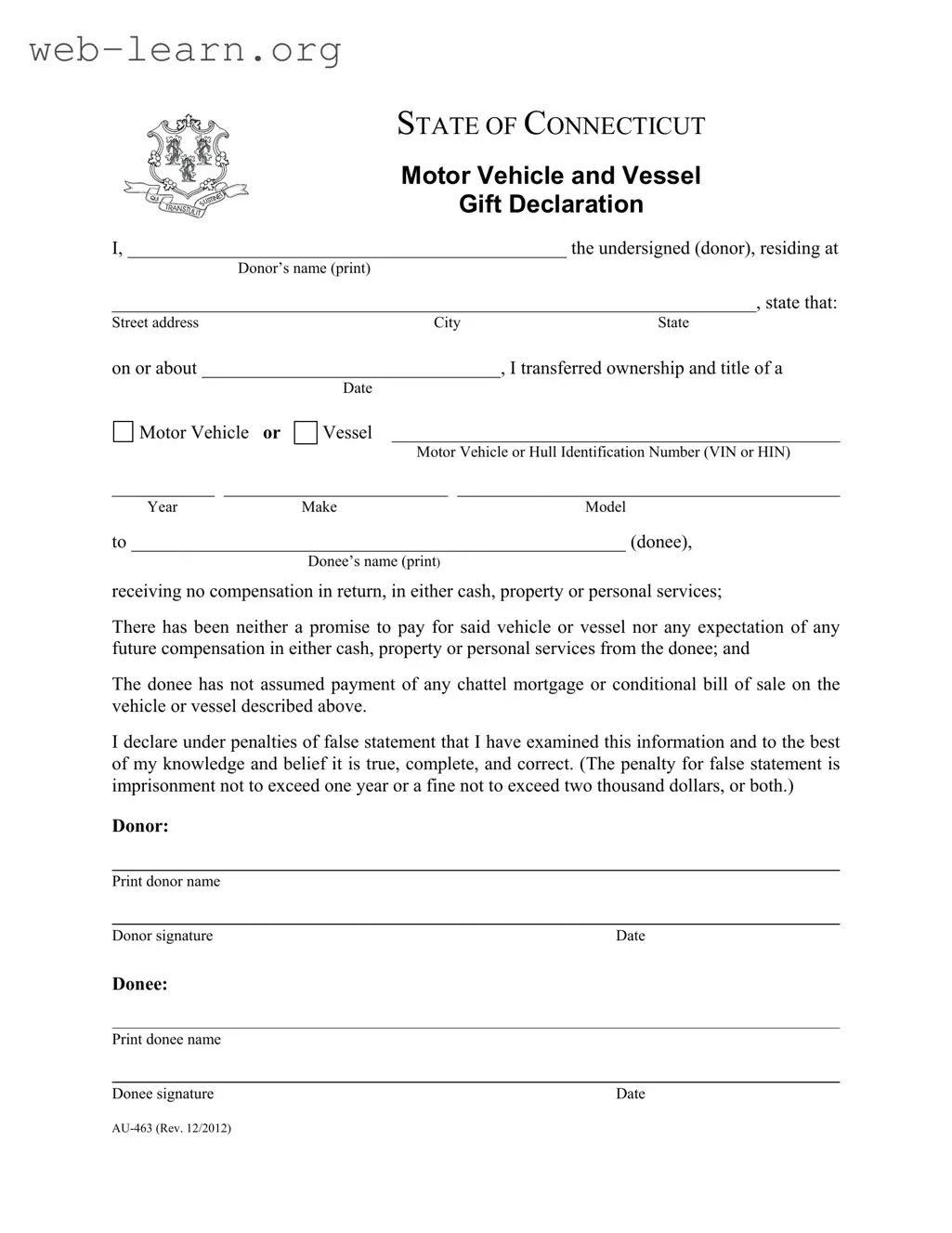
The Connecticut Au 463 form is an essential document for anyone involved in the transfer of ownership of a motor vehicle or vessel without any exchange of money or services. This form serves as a declaration from the donor, the person giving away the vehicle or vessel, affirming that the transfer is a gift. It includes critical details such as the donor's name, address, and the specifics of the vehicle or vessel being transferred, including the year, make, model, and identification numbers. The form also requires the donor to declare that there is no expectation of payment or compensation from the donee, the recipient of the gift. Additionally, it confirms that the donee has not taken on any existing debts related to the vehicle or vessel. By signing this form, both the donor and donee acknowledge the truthfulness of the information provided, with serious penalties for any false statements. Understanding the nuances of the Au 463 form is vital for ensuring a smooth and legally compliant transfer process.

Sample - Connecticut Au 463 Form

STATE OF CONNECTICUT
Motor Vehicle and Vessel
Gift Declaration
I, _______________________________________________ the undersigned (donor), residing at
Donor’s name (print)
_____________________________________________________________________, state that:
Street address City State
on or about ________________________________, I transferred ownership and title of a
Date
Motor Vehicle or Vessel ________________________________________________
Motor Vehicle or Hull Identification Number (VIN or HIN)
___________ ________________________ _________________________________________
Year Make Model
to _____________________________________________________ (donee),
Donee’s name (print)
receiving no compensation in return, in either cash, property or personal services;
There has been neither a promise to pay for said vehicle or vessel nor any expectation of any
future compensation in either cash, property or personal services from the donee; and
The donee has not assumed payment of any chattel mortgage or conditional bill of sale on the
vehicle or vessel described above.
I declare under penalties of false statement that I have examined this information and to the best
of my knowledge and belief it is true, complete, and correct. (The penalty for false statement is
imprisonment not to exceed one year or a fine not to exceed two thousand dollars, or both.)
Donor:
Print donor name
Donor signature Date
Donee:
Print donee name
Donee signature Date
AU-463 (Rev. 12/2012)

Form Information

Fact Name Details
Form Title Connecticut Motor Vehicle and Vessel Gift Declaration
Form Number AU-463
Purpose This form is used to declare the gift transfer of a motor vehicle or vessel.
Governing Law Connecticut General Statutes § 14-22
Donor Requirements The donor must provide their name, address, and signature.
Donee Requirements The donee must provide their name and signature.
Transfer Conditions No compensation can be received by the donor for the transfer.
Penalty for False Statement Imprisonment up to one year, a fine up to $2,000, or both.

Detailed Guide for Filling Out Connecticut Au 463

Filling out the Connecticut Au 463 form is a straightforward process. This form is used to declare the gift of a motor vehicle or vessel. After completing the form, you will need to submit it to the appropriate authorities as part of the ownership transfer process.

  1. Start by entering your name in the first blank space where it says "the undersigned (donor)." Make sure to print clearly.
  2. Next, fill in your street address, city, and state in the designated spaces.
  3. Write the date on which you transferred ownership of the vehicle or vessel in the specified format.
  4. In the next section, provide the details of the motor vehicle or vessel. This includes the Motor Vehicle or Hull Identification Number (VIN or HIN), year, make, and model.
  5. Now, enter the name of the person receiving the gift (the donee) in the space provided.
  6. Sign your name in the donor signature section. Include the date of your signature.
  7. In the donee section, print the name of the person receiving the gift again.
  8. The donee should then sign their name and include the date of their signature.

Obtain Answers on Connecticut Au 463

  1. What is the purpose of the Connecticut Au 463 form?

    The Connecticut Au 463 form is used to declare the gift of a motor vehicle or vessel. This document formalizes the transfer of ownership from the donor to the donee without any compensation. By completing this form, both parties acknowledge that the transaction is a gift, ensuring that there are no expectations of payment or future compensation involved.

  2. Who needs to fill out the Au 463 form?

    Both the donor and the donee must fill out the Connecticut Au 463 form. The donor is the individual giving the vehicle or vessel, while the donee is the individual receiving it. Each party must provide their name, address, and signatures, confirming their agreement to the terms of the gift. This helps to maintain clear records and avoid potential disputes in the future.

  3. What information is required on the form?

    To complete the Au 463 form, the following information is required:

    • The donor's name and address
    • The date of the transfer
    • Details of the vehicle or vessel, including:
      • Type (motor vehicle or vessel)
      • Identification number (VIN or HIN)
      • Year, make, and model
    • The donee's name

    Providing accurate information is crucial, as any discrepancies may lead to complications in the transfer process.

  4. What are the consequences of providing false information on the form?

    Providing false information on the Connecticut Au 463 form can lead to serious legal consequences. The form includes a declaration that the information provided is true and correct. If a donor is found to have made a false statement, they could face imprisonment for up to one year, a fine of up to two thousand dollars, or both. It is essential to ensure that all information is accurate to avoid these penalties.

Common mistakes

Filling out the Connecticut Au 463 form can seem straightforward, but many people make mistakes that can lead to complications. One common error is failing to provide complete information about the donor. The form requires the donor's full name, street address, city, and state. Omitting any of these details can result in delays or even rejection of the form.

Another frequent mistake involves the date of the transfer. It is crucial to accurately fill in the date when the vehicle or vessel was transferred. If this date is left blank or incorrectly stated, it may create confusion regarding the ownership timeline. This can affect both the donor and the donee, especially if there are any disputes later on.

Many individuals also overlook the section where they must specify the type of vehicle or vessel. Providing the correct Motor Vehicle or Hull Identification Number (VIN or HIN) is essential. Errors in this area can lead to difficulties in tracking the vehicle or vessel, potentially complicating the transfer process.

People often forget to sign the form. Both the donor and the donee must provide their signatures to validate the transfer. Without these signatures, the form is incomplete. This oversight can prevent the proper recording of the gift and may lead to legal issues down the line.

Another mistake is not understanding the implications of the statement regarding compensation. The donor must affirm that there has been no expectation of compensation in any form. Misunderstanding this requirement can lead to accusations of false statements, which carry serious penalties.

Finally, failing to review the entire form before submission is a common pitfall. A thorough review can catch mistakes or omissions that could cause problems later. Taking the time to double-check the information ensures that the form is accurate and complete, ultimately facilitating a smoother transfer process.

Documents used along the form

The Connecticut Au 463 form serves as a declaration for the transfer of ownership of a motor vehicle or vessel without compensation. When completing this process, several other forms and documents may be required to ensure compliance with state regulations and to facilitate the transfer. Below is a list of commonly used documents that accompany the Connecticut Au 463 form.

  • Connecticut DMV Form H-6: This form is used to request a vehicle history report. It provides information about the vehicle's title status, any accidents, and previous ownership, which can be essential for both the donor and donee.
  • Connecticut DMV Form T-1: This is the Application for a Certificate of Title. It is necessary for the donee to officially register the vehicle or vessel in their name after the transfer has occurred.
  • Connecticut DMV Form T-125: This form is used to apply for a duplicate title if the original title is lost or damaged. It ensures that the donee has a valid title to the vehicle or vessel.
  • Connecticut DMV Form O-1: This is the Bill of Sale form, which serves as proof of the transaction between the donor and donee. It details the sale price, if applicable, and the specifics of the vehicle or vessel.
  • Connecticut DMV Form V-888: This form is used to report a change of address for the vehicle or vessel registration. It is essential for keeping the registration records current after the transfer.
  • Connecticut DMV Form V-948: This is a form used for the declaration of a vehicle or vessel that has been donated. It may be required for tax purposes, particularly if the donee intends to claim a deduction.
  • Connecticut DMV Form R-1: This form is the application for registration. It must be completed by the donee to obtain a new registration for the vehicle or vessel.
  • Connecticut DMV Form V-70: This is the Affidavit of Ownership form. It may be used in cases where the title is not available, allowing the donee to claim ownership based on the donor's declaration.
  • Connecticut DMV Form V-5: This is the Application for a Certificate of Title for a vehicle that is not currently titled in Connecticut. It is necessary when the vehicle was previously registered in another state.

These documents play a critical role in the transfer process, ensuring that both the donor and donee are protected and that the transaction is properly recorded with the state. Proper completion and submission of these forms can help avoid potential legal issues in the future.

Similar forms

The Connecticut Au 463 form serves a specific purpose in documenting the gift of a motor vehicle or vessel. Several other documents share similar functions in terms of transferring ownership or declaring gifts. Here are five such documents:

  • Bill of Sale: This document records the transfer of ownership of a vehicle or vessel from one party to another. Like the Au 463, it includes details about the item being sold and the parties involved, but it typically involves a sale rather than a gift.
  • Title Transfer Form: Used when ownership of a vehicle is transferred, this form is essential for updating the official records with the Department of Motor Vehicles. It is similar to the Au 463 in that it formalizes the change of ownership, but it usually requires a payment or sale transaction.
  • Gift Deed: This document is often used for transferring real estate or personal property without compensation. Like the Au 463, it emphasizes that no payment is involved, focusing on the donor's intent to give the property freely.
  • Affidavit of Gift: This is a sworn statement declaring that a gift has been made. Similar to the Au 463, it serves to affirm the donor's intent and the lack of compensation, providing legal backing for the transfer.
  • Vehicle Donation Receipt: This document is provided when a vehicle is donated to a charity. It serves as proof of the donation and can be used for tax purposes, much like the Au 463, which documents the transfer of ownership without compensation.

Dos and Don'ts

When filling out the Connecticut Au 463 form, it's essential to follow specific guidelines to ensure accuracy and compliance. Here’s a list of things to do and avoid:

  • Do provide your full name clearly in the designated area.
  • Do include your complete address, including street, city, and state.
  • Do accurately state the date of the transfer.
  • Do specify the correct details of the vehicle or vessel, including the year, make, model, and identification number.
  • Do ensure that you are not expecting any compensation from the donee.
  • Don’t leave any sections blank; all fields must be filled out completely.
  • Don’t forget to sign and date the form as the donor.
  • Don’t assume the donee will fill out their information; they need to provide their details as well.
  • Don’t make false statements; ensure all information is accurate to avoid penalties.

By adhering to these guidelines, you can help ensure that your form is processed smoothly and without unnecessary delays.

Misconceptions

Misconceptions about the Connecticut Au 463 form can lead to confusion for both donors and donees. Here are four common misunderstandings:

  • The form is only for motor vehicles. Many people believe the Au 463 form applies solely to motor vehicles. However, it also covers vessels. This means that both types of transfers can be documented using the same form.
  • Compensation can be implied. Some individuals think that any form of compensation, even if not explicitly stated, is acceptable. In reality, the form requires that the donor receives no compensation at all, whether in cash, property, or services.
  • The form is optional for gift transfers. A common misconception is that completing the Au 463 form is optional. In fact, it is necessary for documenting the gift transfer to ensure proper title transfer and to avoid potential tax implications.
  • False statements have minor consequences. Some may underestimate the seriousness of providing false information on the form. The penalties for false statements can include imprisonment or substantial fines, highlighting the importance of accuracy when filling it out.

Key takeaways

The Connecticut Au 463 form is an important document for individuals transferring ownership of a motor vehicle or vessel as a gift. Here are some key takeaways to consider when filling out and using this form:

  • Accurate Information is Crucial: Ensure that all details, including the donor’s and donee’s names, addresses, and vehicle or vessel information, are filled out accurately. Mistakes can lead to complications in the transfer process.
  • No Compensation Allowed: The form explicitly states that the transfer must be a gift, meaning the donee cannot provide any form of compensation, whether cash, property, or services, in return for the vehicle or vessel.
  • Signature Requirement: Both the donor and donee must sign the form. This step is essential to validate the transfer and affirm that both parties agree to the terms outlined in the document.
  • Understand the Penalties: Be aware that providing false information on the form can lead to serious consequences, including potential imprisonment or fines. Honesty is paramount when declaring the details of the transfer.