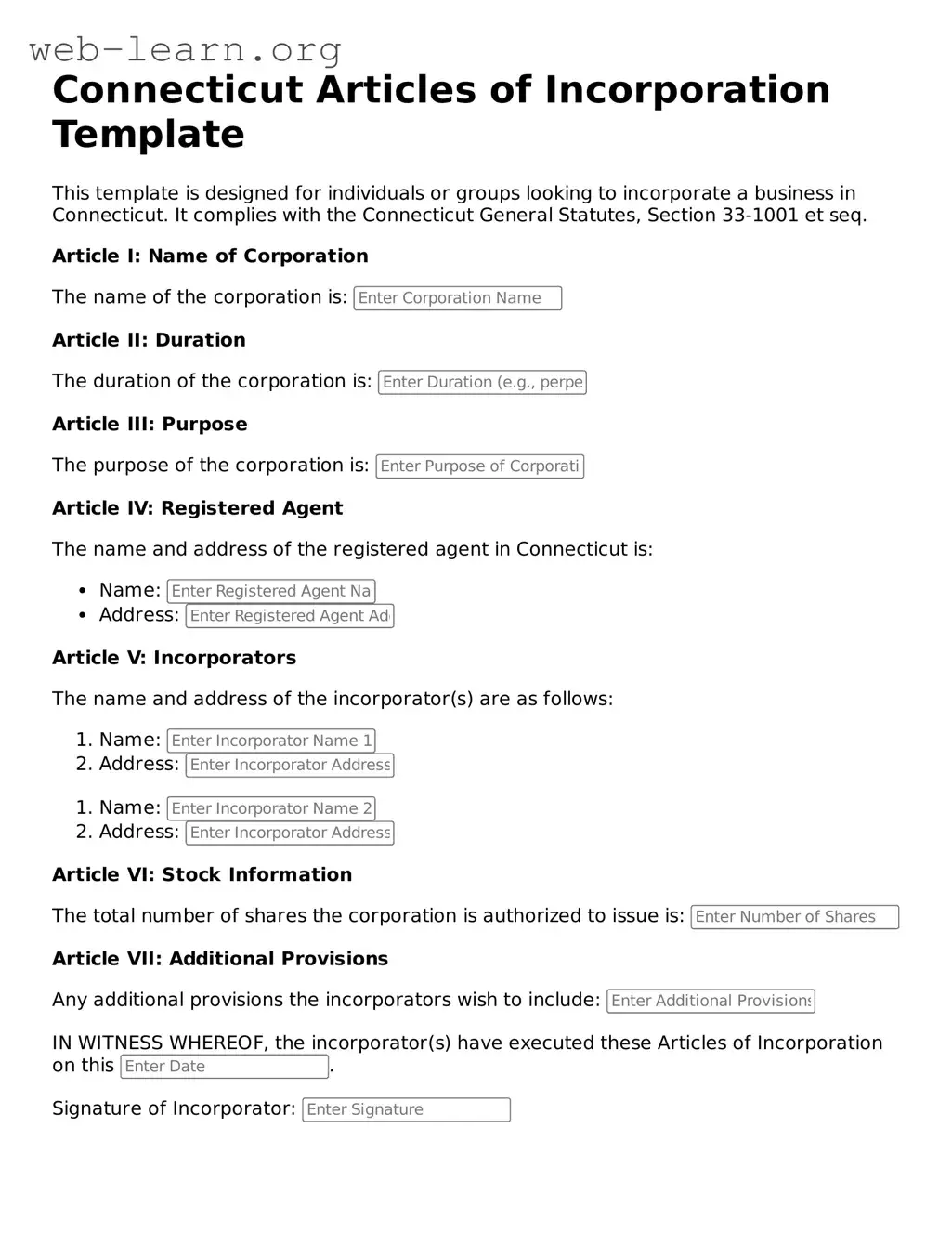
In Connecticut, the Articles of Incorporation form is a vital document for anyone looking to establish a corporation. This form serves as the foundation for your business, outlining essential details such as the corporation's name, purpose, and the address of its principal office. Additionally, it requires information about the registered agent, who will serve as the official point of contact for legal matters. The form also asks for the number of shares the corporation is authorized to issue, which is crucial for determining ownership and investment opportunities. Furthermore, it includes provisions regarding the management structure, allowing for flexibility in how the corporation will be run. Completing this form accurately is essential, as it ensures compliance with state laws and protects the interests of the corporation and its stakeholders. Understanding each section of the Articles of Incorporation will empower you to create a strong legal foundation for your business endeavors.
Connecticut Articles of Incorporation Template
This template is designed for individuals or groups looking to incorporate a business in Connecticut. It complies with the Connecticut General Statutes, Section 33-1001 et seq.
Article I: Name of Corporation
The name of the corporation is:
Article II: Duration
The duration of the corporation is:
Article III: Purpose
The purpose of the corporation is:
Article IV: Registered Agent
The name and address of the registered agent in Connecticut is:
Article V: Incorporators
The name and address of the incorporator(s) are as follows:
Article VI: Stock Information
The total number of shares the corporation is authorized to issue is:
Article VII: Additional Provisions
Any additional provisions the incorporators wish to include:
IN WITNESS WHEREOF, the incorporator(s) have executed these Articles of Incorporation on this .
Signature of Incorporator:
| Fact Name | Description |
|---|---|
| Purpose | The Articles of Incorporation form is used to legally create a corporation in Connecticut. |
| Governing Law | This form is governed by the Connecticut General Statutes, specifically Title 33, Chapter 601. |
| Filing Requirement | Filing the Articles of Incorporation with the Secretary of the State is mandatory for incorporation. |
| Information Needed | The form requires details such as the corporation's name, purpose, and registered agent. |
| Fees | A filing fee is required when submitting the Articles of Incorporation, which varies based on the type of corporation. |
| Effective Date | The corporation can specify an effective date for the Articles, which can be the filing date or a future date. |
| Amendments | Changes to the Articles of Incorporation can be made through an amendment process, requiring additional filings. |
| Public Record | Once filed, the Articles of Incorporation become part of the public record, accessible to the public. |
Once you have gathered all the necessary information, you are ready to fill out the Connecticut Articles of Incorporation form. This document is essential for establishing your corporation in Connecticut. After completing the form, you will need to submit it to the Secretary of State along with the required filing fee.
After filling out the form, make sure to submit it along with the required filing fee to the appropriate state office. Keep a copy of the submitted form for your records.
What is the purpose of the Connecticut Articles of Incorporation form?
The Connecticut Articles of Incorporation form is a legal document required to establish a corporation in the state of Connecticut. This form outlines essential information about the corporation, such as its name, purpose, registered agent, and the number of shares it is authorized to issue. Filing this document with the Secretary of the State officially creates the corporation as a legal entity.
Who needs to file the Articles of Incorporation?
Any individual or group looking to form a corporation in Connecticut must file the Articles of Incorporation. This includes businesses of all sizes, from small startups to large enterprises. Nonprofit organizations also need to file this form to gain legal status.
What information is required on the form?
The Articles of Incorporation form requires several key pieces of information, including:
Providing accurate and complete information is crucial for the successful filing of the form.
How do I file the Articles of Incorporation?
To file the Articles of Incorporation in Connecticut, you can submit the form online through the Secretary of the State's website or send a paper application via mail. Ensure that you include the appropriate filing fee, which varies based on the type of corporation you are forming. Online submissions typically offer faster processing times.
What is the filing fee for the Articles of Incorporation?
The filing fee for the Articles of Incorporation in Connecticut is generally $250 for most corporations. However, fees may vary for nonprofit organizations or other specific types of corporations. Always check the latest fee schedule on the Secretary of the State's website to confirm the current amount.
How long does it take to process the Articles of Incorporation?
Processing times can vary. Typically, online filings are processed within a few business days, while paper filings may take longer, sometimes up to several weeks. If you need expedited processing, inquire about available options when submitting your application.
What happens after I file the Articles of Incorporation?
Once the Articles of Incorporation are filed and approved, the corporation is officially created. You will receive a certificate of incorporation from the Secretary of the State. After incorporation, it is essential to comply with ongoing requirements, such as holding annual meetings and filing annual reports to maintain your corporation's good standing.
Can I amend the Articles of Incorporation after filing?
Yes, you can amend the Articles of Incorporation after they have been filed. If changes are necessary, such as a change in the corporation's name or purpose, you will need to file an amendment with the Secretary of the State. This process may involve additional fees and documentation, so it’s important to follow the correct procedures for amending your articles.
Filing the Articles of Incorporation in Connecticut is a crucial step for anyone looking to establish a corporation. However, many individuals make common mistakes that can delay the process or lead to complications down the line. Understanding these pitfalls can save time and resources.
One frequent error is providing incorrect or incomplete information. For instance, if the name of the corporation does not meet state requirements or is already in use, it can lead to rejection of the application. It’s essential to check the availability of the desired name through the Connecticut Secretary of State’s website before submission.
Another mistake is failing to include the registered agent’s information. A registered agent is a person or business designated to receive legal documents on behalf of the corporation. Omitting this information can result in the application being deemed incomplete. Ensure that the registered agent’s name and address are accurate and current.
Some people overlook the importance of specifying the purpose of the corporation. While a general statement may suffice, being too vague can cause confusion. It’s advisable to clearly outline the business activities to avoid any issues with state regulations.
Additionally, many applicants forget to sign and date the form. Without the proper signatures, the form cannot be processed. It’s a simple step, but one that can easily be overlooked in the rush to submit the paperwork.
Another common oversight is misunderstanding the filing fees. Each corporation type may have different fees associated with the filing. Failing to include the correct payment can lead to delays. It’s important to check the fee schedule and ensure that payment is made in the appropriate manner.
Lastly, some individuals neglect to keep copies of their submitted documents. Having a record of what was filed is essential for future reference. In case any issues arise, having a copy can help clarify any misunderstandings with the state.
By being aware of these mistakes, individuals can navigate the process of filling out the Connecticut Articles of Incorporation form more effectively. Taking the time to double-check information and ensure all requirements are met can lead to a smoother incorporation experience.
When forming a corporation in Connecticut, the Articles of Incorporation is just the first step. Several other important documents and forms are often required to ensure compliance with state regulations and to establish the corporation's operations. Below is a list of commonly used forms and documents that accompany the Articles of Incorporation.
Understanding these documents and their purposes can greatly assist in the smooth establishment and operation of a corporation in Connecticut. Each plays a vital role in ensuring that the corporation adheres to legal requirements and operates effectively within its framework.
Bylaws: These are the internal rules that govern the management of a corporation. While the Articles of Incorporation establish the corporation's existence, the bylaws outline how it will operate on a day-to-day basis.
Certificate of Formation: Similar to the Articles of Incorporation, this document is used in some states to officially create a corporation. It serves a similar purpose but may have different naming conventions depending on the jurisdiction.
Operating Agreement: For limited liability companies (LLCs), this document functions like bylaws for corporations. It details the management structure and operational guidelines of the LLC, paralleling the governance aspect of the Articles of Incorporation.
Partnership Agreement: This document outlines the terms and conditions of a partnership, detailing the roles, responsibilities, and profit-sharing arrangements among partners. It shares the foundational purpose of defining a business structure, much like the Articles do for corporations.
Business License: While not directly comparable in function, a business license is required to legally operate a business. Both documents signify compliance with legal requirements for establishing a business entity.
Employer Identification Number (EIN) Application: This form is essential for tax purposes and identifies a business entity. Like the Articles of Incorporation, it is a crucial step in formalizing a business.
Fictitious Business Name Registration: This document allows a business to operate under a name different from its legal name. It serves a similar purpose in establishing identity and legitimacy within the marketplace.
Shareholder Agreement: This agreement outlines the rights and responsibilities of shareholders in a corporation. It complements the Articles of Incorporation by addressing the governance and operational aspects of the corporation.
Annual Report: Corporations are often required to file annual reports to maintain their good standing. This document provides updates on the corporation's activities, similar to how the Articles initially establish its existence.
Statement of Information: In some jurisdictions, this document is required to provide updated information about the corporation's officers and directors. It serves a similar purpose to the Articles of Incorporation by keeping the public record current.
When filling out the Connecticut Articles of Incorporation form, it is important to follow specific guidelines to ensure accuracy and compliance. Here are nine things to keep in mind:
Many individuals and organizations encounter the Connecticut Articles of Incorporation form while seeking to establish a corporation. However, several misconceptions can lead to confusion. Below is a list of nine common misconceptions about this form, along with clarifications.
This is not true. While the Articles of Incorporation are essential, other steps such as obtaining necessary licenses and permits, and complying with state regulations are also required.
In some cases, additional documents may be required, such as a Certificate of Good Standing if the corporation is being formed by an existing entity.
This is incorrect. Connecticut allows for the submission of Articles of Incorporation online, by mail, or in person, providing flexibility for applicants.
A filing fee is required when submitting the Articles of Incorporation. This fee varies depending on the type of corporation being formed.
While many corporations choose to include "Corporation," "Inc.," or similar terms in their name, it is not a strict requirement as long as the name complies with state naming rules.
While it is possible to fill out the form without legal expertise, understanding the implications of the information provided is crucial. Legal advice can be beneficial.
This is misleading. Amendments can be made to the Articles of Incorporation if necessary, following the proper procedures outlined by the state.
Filing the Articles is just the first step. Success depends on many factors, including business planning, management, and market conditions.
This is not accurate. Certain information, such as the names of directors and officers, becomes part of the public record and can be accessed by anyone.
Understanding these misconceptions can help individuals navigate the process of incorporating a business in Connecticut more effectively.
When filling out and using the Connecticut Articles of Incorporation form, it is essential to be informed about several key aspects. The following takeaways will guide you through the process effectively.
By following these key points, you can navigate the process of incorporating in Connecticut with confidence.
Articles of Incorporation Kentucky - It can be filed online or via mail, depending on state requirements.
How Do I Get a Certificate of Good Standing - Details any limitations on the liability of shareholders.
California Articles of Incorporation - Some states mandate the inclusion of the corporation's duration, whether perpetual or limited.