Homepage Blank Connecticut A 62 Form
Outline

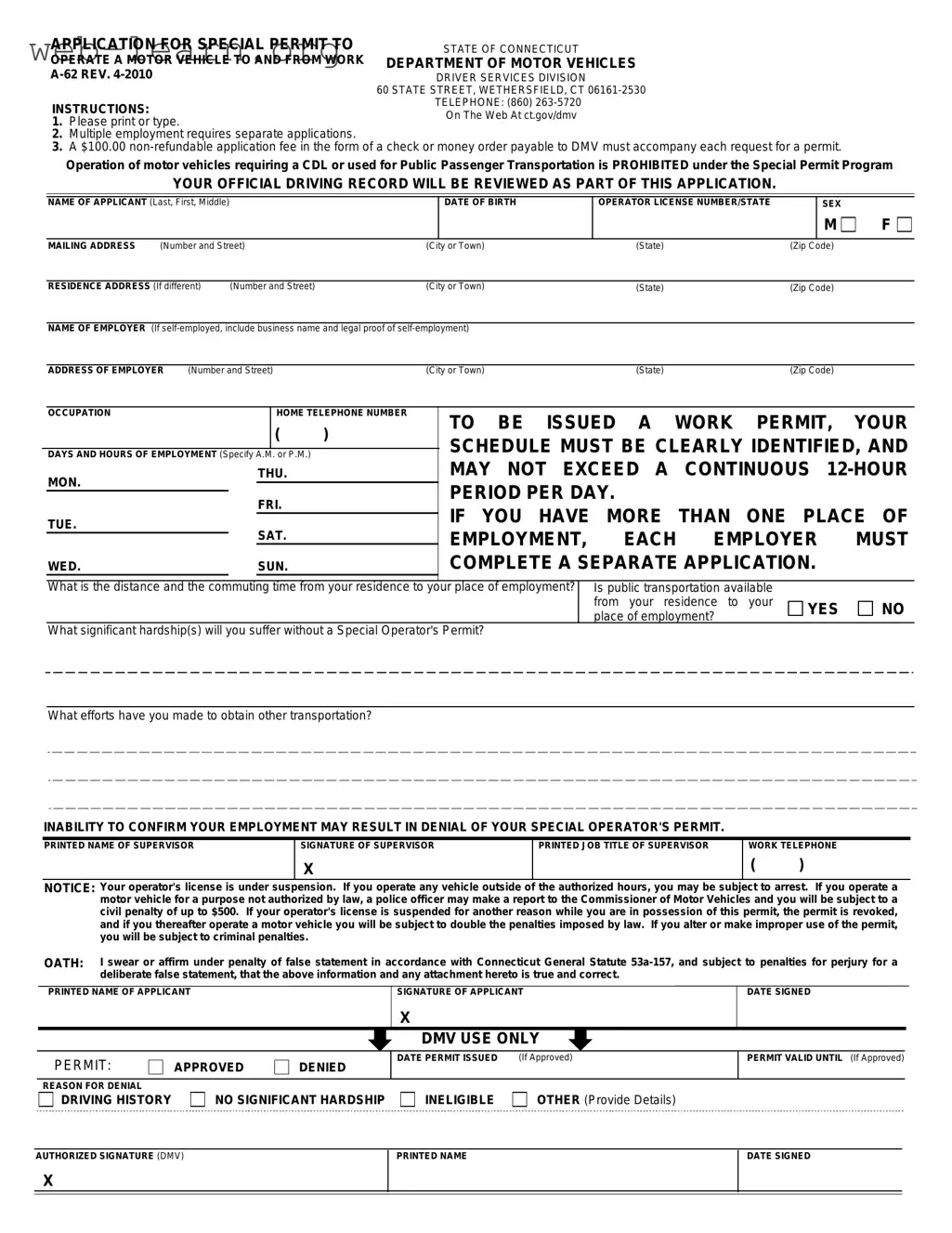
The Connecticut A 62 form serves as a vital tool for individuals whose driver’s licenses have been suspended but need to commute to work. This application for a special permit allows eligible applicants to operate a motor vehicle solely for the purpose of traveling to and from their place of employment. To initiate the process, applicants must provide personal details such as their name, date of birth, and license number, along with their employer's information. A significant aspect of the application is the requirement of a non-refundable fee of $100, which must accompany each request. It's important to note that if an applicant has multiple jobs, they will need to submit separate applications for each position. The form also emphasizes the need for clarity regarding work schedules, as permits will only be issued for specific hours and days. Additionally, applicants must address questions about commuting distances, public transportation availability, and hardships they may face without the permit. The review process includes an assessment of the applicant’s driving record, and any discrepancies or inability to confirm employment could lead to denial of the permit. Understanding these requirements is crucial for anyone seeking to navigate the complexities of this application process effectively.

Sample - Connecticut A 62 Form

APPLICATION FOR SPECIAL PERMIT TO
OPERATE A MOTOR VEHICLE TO AND FROM WORK
A-62 REV. 4-2010
STATE OF CONNECTICUT
DEPARTMENT OF MOTOR VEHICLES
DRIVER SERVICES DIVISION
60 STATE STREET, WETHERSFIELD, CT 06161-2530
TELEPHONE: (860) 263-5720
On The Web At ct.gov/dmv
INSTRUCTIONS:
1. Please print or type.
2. Multiple employment requires separate applications.
3. A $100.00 non-refundable application fee in the form of a check or money order payable to DMV must accompany each request for a permit.
Operation of motor vehicles requiring a CDL or used for Public Passenger Transportation is PROHIBITED under the Special Permit Program
NAME OF APPLICANT (Last, First, Middle) DATE OF BIRTH OPERATOR LICENSE NUMBER/STATE
SEX
M F
MAILING ADDRESS (Number and Street) (City or Town) (State) (Zip Code)
RESIDENCE ADDRESS (If different) (City or Town)
(State) (Zip Code)
NAME OF EMPLOYER (If self-employed, include business name and legal proof of self-employment)
ADDRESS OF EMPLOYER
OCCUPATION
HOME TELEPHONE NUMBER
DAYS AND HOURS OF EMPLOYMENT (Specify A.M. or P.M.)
(City or Town) (State) (Zip Code)
MON.
TUE.
WED.
THU.
FRI.
SAT.
SUN.
TO BE ISSUED A WORK PERMIT, YOUR
SCHEDULE MUST BE CLEARLY IDENTIFIED, AND
MAY NOT EXCEED A CONTINUOUS 12-HOUR
PERIOD PER DAY.
IF YOU HAVE MORE THAN ONE PLACE OF
EMPLOYMENT, EACH EMPLOYER MUST
COMPLETE A SEPARATE APPLICATION.
What is the distance and the commuting time from your residence to your place of employment?
Is public transportation available
from your residence to your
place of employment?
YES NO
What significant hardship(s) will you suffer without a Special Operator's Permit?
What efforts have you made to obtain other transportation?
Your operator's license is under suspension. If you operate any vehicle outside of the authorized hours, you may be subject to arrest. If you operate a
motor vehicle for a purpose not authorized by law, a police officer may make a report to the Commissioner of Motor Vehicles and you will be subject to a
civil penalty of up to $500. If your operator's license is suspended for another reason while you are in possession of this permit, the permit is revoked,
and if you thereafter operate a motor vehicle you will be subject to double the penalties imposed by law. If you alter or make improper use of the permit,
you will be subject to criminal penalties.
I swear or affirm under penalty of false statement in accordance with Connecticut General Statute 53a-157, and subject to penalties for perjury for a
deliberate false statement, that the above information and any attachment hereto is true and correct.
NOTICE:
OATH:
PRINTED NAME OF SUPERVISOR SIGNATURE OF SUPERVISOR
X
PRINTED JOB TITLE OF SUPERVISOR WORK TELEPHONE
PRINTED NAME OF APPLICANT SIGNATURE OF APPLICANT
X
DATE SIGNED
DMV USE ONLY
PERMIT:
APPROVED DENIED
DATE PERMIT ISSUED PERMIT VALID UNTIL
(If Approved)
(If Approved)
REASON FOR DENIAL
DRIVING HISTORY NO SIGNIFICANT HARDSHIP INELIGIBLE OTHER (Provide Details)
DATE SIGNEDAUTHORIZED SIGNATURE (DMV)
X
(Number and Street)
(Number and Street)
PRINTED NAME
( )
( )
YOUR OFFICIAL DRIVING RECORD WILL BE REVIEWED AS PART OF THIS APPLICATION.
INABILITY TO CONFIRM YOUR EMPLOYMENT MAY RESULT IN DENIAL OF YOUR SPECIAL OPERATOR'S PERMIT.

Form Information

Fact Name Details
Purpose The A-62 form is an application for a special permit allowing individuals to operate a motor vehicle to and from work.
Application Fee A non-refundable application fee of $100 must accompany each request for a permit.
Employment Verification Applicants must provide proof of employment. Inability to confirm employment may lead to denial of the permit.
Restrictions Operation of vehicles requiring a Commercial Driver's License (CDL) or used for public transportation is prohibited under this program.
Governing Law This form is governed by Connecticut General Statutes, specifically § 14-37a.
Validity If approved, the permit is valid until the specified expiration date noted on the form.

Detailed Guide for Filling Out Connecticut A 62

Filling out the Connecticut A 62 form is a straightforward process, but it requires careful attention to detail. This form is used to apply for a special permit that allows individuals to operate a motor vehicle to and from work, especially when their regular driving privileges are suspended. To ensure a smooth application process, follow the steps outlined below.

  1. Gather necessary information: Before starting, collect all relevant details such as your personal information, employer's details, and commuting information.
  2. Complete the applicant section: Write your name (last, first, middle), date of birth, operator license number/state, and sex. Make sure to print or type clearly.
  3. Provide your mailing address: Fill in your mailing address, including the number and street, city or town, state, and zip code. If your residence address is different, provide that as well.
  4. Enter employer information: Include the name of your employer. If self-employed, provide your business name and legal proof of self-employment. Also, fill in the employer's address.
  5. Specify your occupation: Write down your job title and home telephone number.
  6. Detail your work schedule: Clearly specify the days and hours of employment. Ensure your schedule does not exceed a continuous 12-hour period per day.
  7. Answer commuting questions: Indicate the distance and commuting time from your residence to your workplace. Also, state whether public transportation is available.
  8. Explain hardships: Describe any significant hardships you would face without the special operator's permit and outline your efforts to secure alternative transportation.
  9. Supervisor's endorsement: Have your supervisor print their name, sign the form, provide their job title, and include their work telephone number.
  10. Complete the oath: Read the oath carefully, then print your name, sign, and date the application.
  11. Prepare payment: Include a $100.00 non-refundable application fee in the form of a check or money order made payable to DMV.
  12. Submit the application: Send the completed form along with the payment to the address provided on the form.

After submitting the application, it will be reviewed by the DMV. You will receive notification regarding the approval or denial of your permit, along with any further instructions if needed. Keep an eye on your mail for updates!

Obtain Answers on Connecticut A 62

  1. What is the purpose of the Connecticut A 62 form?

    The Connecticut A 62 form is an application for a special permit that allows individuals to operate a motor vehicle to and from work while their regular operator's license is suspended. This permit is intended to help individuals who face significant hardships due to their inability to drive.

  2. What are the eligibility requirements for obtaining a special permit?

    To be eligible for a special permit, applicants must have a suspended operator's license and demonstrate a significant hardship if they cannot drive to work. Additionally, the applicant must provide proof of employment, including the name and address of the employer, and must clearly indicate their work schedule on the application.

  3. Is there a fee associated with the application?

    Yes, there is a non-refundable application fee of $100. This fee must be paid by check or money order made out to the Department of Motor Vehicles (DMV) and submitted along with the application.

  4. What happens if the application is denied?

    If the application is denied, the DMV will provide a reason for the denial. Common reasons include lack of significant hardship, ineligibility, or issues related to the applicant's driving history. The applicant will be informed of the decision and the specific grounds for denial.

  5. What are the restrictions associated with the special permit?

    Holders of the special permit are subject to specific restrictions. They may only operate a vehicle during the hours specified in their application, which cannot exceed a continuous 12-hour period per day. Operating a vehicle outside of these hours or for unauthorized purposes may result in penalties, including arrest and fines.

  6. What information must be provided about employment?

    Applicants must provide detailed information about their employer, including the employer's name, address, and the applicant's occupation. If self-employed, proof of self-employment must be included. The application also requires the applicant to specify their work schedule, including days and hours of employment.

Common mistakes

Filling out the Connecticut A 62 form can be straightforward, but many people make common mistakes that can lead to delays or denials. One frequent error is failing to provide complete and accurate personal information. Ensure that your name, date of birth, and operator license number are filled out correctly. Missing or incorrect information can result in the application being returned.

Another mistake is neglecting to include the required application fee. The form specifies a $100.00 non-refundable application fee that must be submitted with your application. Omitting this payment will lead to an automatic denial of your request.

People often overlook the requirement to clearly identify their work schedule. The form states that your days and hours of employment must be specified. If this information is vague or unclear, it can hinder the approval process. Make sure to indicate AM or PM for each day of the week you work.

Many applicants also fail to provide the correct employer information. If you are self-employed, you must include your business name and legal proof of self-employment. Incomplete employer details can lead to difficulties in confirming your employment status, which may result in denial.

Another common oversight is not addressing the commuting details adequately. The form asks for the distance and commuting time from your residence to your workplace. Providing vague or incomplete answers can raise questions about your need for the special permit.

Additionally, applicants sometimes forget to indicate whether public transportation is available from their residence to their place of employment. This is a crucial part of the application, as it helps determine your need for a special operator's permit.

Some individuals do not adequately explain the hardships they would face without the permit. The form requests information about significant hardships. Providing a clear and detailed explanation can strengthen your case for approval.

Another mistake is neglecting to have the supervisor's section completed properly. The printed name, signature, job title, and work telephone number of the supervisor must be included. Incomplete supervisor information can lead to delays in processing your application.

Lastly, be cautious about the oath section of the form. Ensure that you understand the penalties for false statements. Submitting inaccurate information, even unintentionally, can lead to serious consequences. Always double-check your answers before signing and submitting the form.

Documents used along the form

The Connecticut A 62 form serves as an application for a special permit that allows individuals to operate a motor vehicle to and from work during a period of license suspension. While this form is crucial for those seeking to maintain their employment, several other documents often accompany it to ensure a complete application process. Below is a list of these forms and documents.

  • Proof of Employment: This document verifies that the applicant is currently employed. It typically includes a letter from the employer or pay stubs that confirm the individual's job title, hours, and the necessity of transportation to work.
  • Driving Record: A copy of the applicant's driving history is often required. This document provides the DMV with an overview of any past violations or suspensions, which can influence the decision regarding the special permit.
  • Application Fee Payment: A check or money order for the non-refundable application fee of $100 must accompany the A 62 form. This payment proves that the applicant is serious about their request for a special permit.
  • Hardship Statement: This is a personal statement from the applicant detailing the significant hardships they would face without the ability to drive. It should clearly articulate why the special permit is essential for their daily life.
  • Public Transportation Availability Confirmation: If applicable, this document confirms whether public transportation options are available for the applicant’s commute. This information can be critical in demonstrating the necessity for the special permit.
  • Supervisor's Verification: A signed statement from a supervisor or employer confirming the applicant's work schedule and the need for transportation. This document helps to validate the information provided in the application.

Gathering these documents can streamline the application process for the special permit. Each piece of information plays a vital role in supporting the applicant's case and ensuring that all necessary criteria are met for approval. Being thorough and organized can make a significant difference in the outcome of the application.

Similar forms

The Connecticut A-62 form is an application for a special permit that allows individuals with a suspended driver’s license to operate a vehicle for work-related purposes. Several other documents serve similar functions in various contexts. Here’s a list of eight documents that share similarities with the A-62 form:

  • Temporary Restricted License: This document allows individuals with a suspended license to drive under specific conditions, often for work, school, or medical appointments.
  • Hardship License: Similar to the A-62, this license permits driving for essential needs, such as employment, when a regular license is suspended.
  • Occupational Driver’s License: This type of license is issued to individuals whose driving privileges have been revoked, allowing them to drive for work-related purposes only.
  • Interlock Restricted License: For individuals with DUI offenses, this license allows driving only if the vehicle is equipped with an ignition interlock device, ensuring safe driving practices.
  • Work Permit: Often issued by educational institutions, this document allows minors to work legally while complying with labor laws, similar to how the A-62 permits work-related driving.
  • Public Transportation Exception: In some jurisdictions, individuals may apply for an exception to use public transport when their driving privileges are suspended, akin to the provisions in the A-62 form.
  • Emergency Use Permit: This document grants temporary driving privileges for emergencies, similar to the A-62's focus on essential commuting needs.
  • Conditional License: This allows individuals to drive under certain conditions, like attending treatment programs, paralleling the A-62's focus on work-related driving.

Each of these documents serves to address specific driving needs for individuals facing restrictions on their driving privileges, much like the Connecticut A-62 form does for those needing to commute to work.

Dos and Don'ts

When filling out the Connecticut A 62 form for a special permit to operate a motor vehicle to and from work, it is essential to follow specific guidelines to ensure a smooth application process. Below is a list of things you should and shouldn't do.

  • Do print or type all information clearly to avoid any confusion.
  • Do submit a separate application for each employer if you have multiple jobs.
  • Do include a non-refundable application fee of $100 in the form of a check or money order made out to DMV.
  • Do provide accurate details about your commuting distance and time to work.
  • Do ensure your work schedule is clearly identified, including specific days and hours.
  • Don't forget to include your supervisor's printed name, signature, and job title.
  • Don't alter or misuse the permit, as this can lead to criminal penalties.

By adhering to these guidelines, you can enhance your chances of a successful application. Always double-check your information before submission to avoid unnecessary delays or denials.

Misconceptions

There are several misconceptions regarding the Connecticut A 62 form, which is an application for a special permit to operate a motor vehicle to and from work. Understanding these misconceptions can help applicants navigate the process more effectively.

  • Misconception 1: The A 62 form is only for those with a suspended license.
  • This form is specifically designed for individuals whose driving privileges are suspended but who need to commute to work. However, it does not mean that only those with a suspended license can apply; it is focused on work-related travel needs.

  • Misconception 2: You can use the special permit for any driving purpose.
  • The special permit is strictly for commuting to and from work. Using it for other purposes, such as personal errands or leisure driving, is not allowed and can lead to penalties.

  • Misconception 3: There is no fee associated with the A 62 form.
  • A non-refundable application fee of $100 must accompany each request for a permit. This fee is necessary to process the application.

  • Misconception 4: You can apply for the permit without proof of employment.
  • Applicants must provide proof of employment. Inability to confirm employment can result in denial of the special operator's permit.

  • Misconception 5: The hours of operation are flexible.
  • The permit allows for a specific schedule that must be clearly identified. The working hours cannot exceed a continuous 12-hour period per day.

  • Misconception 6: Public transportation availability does not matter.
  • Applicants must indicate whether public transportation is available from their residence to their place of employment. This information is considered in the application process.

Key takeaways

When filling out and using the Connecticut A 62 form, keep these key takeaways in mind:

  • Print or type your information clearly. This ensures that your application is processed without delays.
  • Separate applications are required for multiple jobs. Each employer needs its own form.
  • A non-refundable fee of $100 must accompany your application. This can be paid by check or money order made out to DMV.
  • CDL-required vehicles and public passenger transport vehicles cannot be operated under this permit.
  • Your driving record will be reviewed. Be prepared for this to influence the outcome of your application.
  • Clearly specify your work schedule. Your hours must not exceed a continuous 12-hour period each day.
  • If you have more than one job, each employer must complete a separate application.
  • Be honest about your commuting difficulties. Explain any hardships you face without the permit.
  • Understand the consequences of misuse. Operating outside authorized hours can lead to arrest and hefty fines.

Following these guidelines will help streamline your application process and increase your chances of obtaining the permit you need.