Homepage Blank Connecticut 8379 Form
Outline

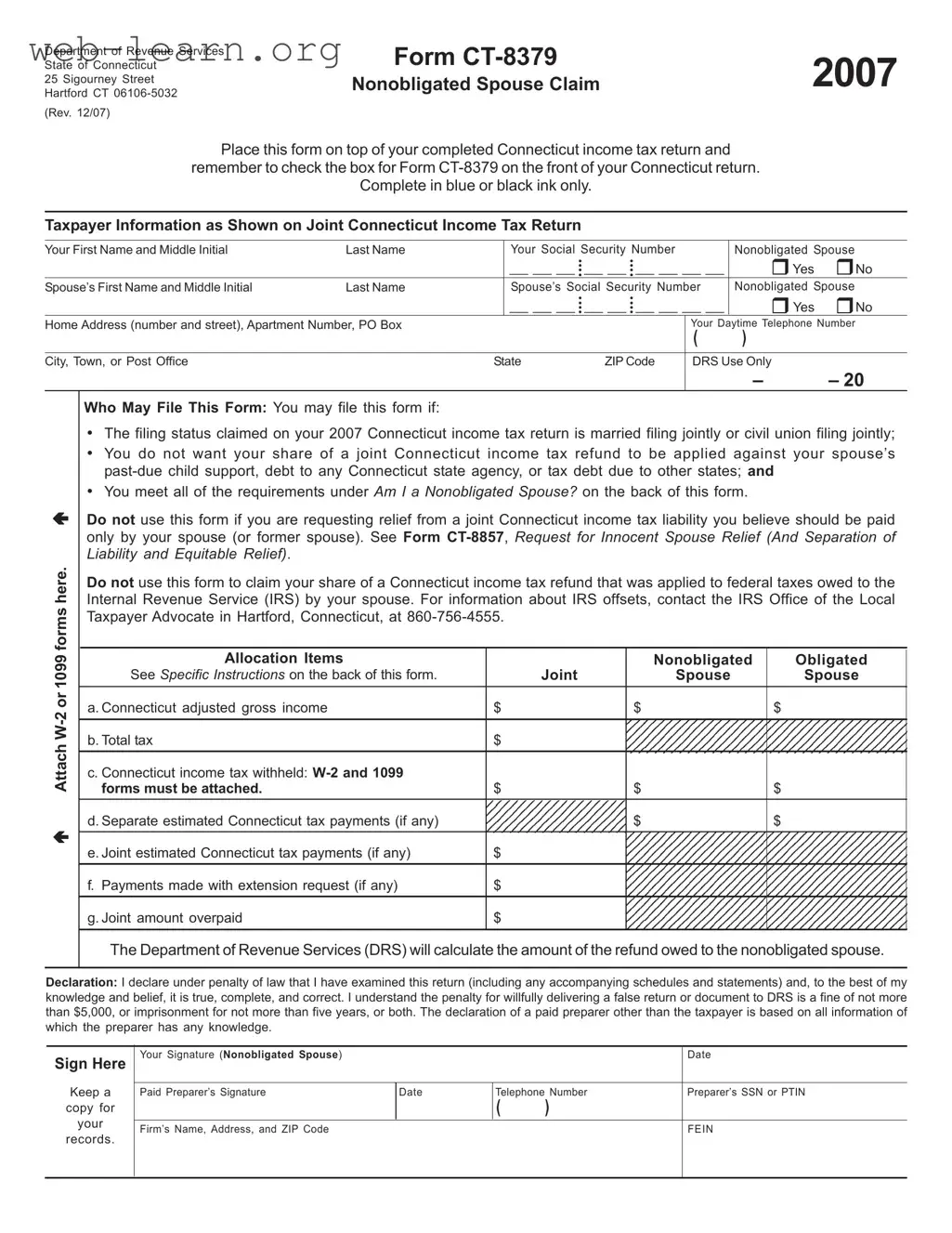
The Connecticut 8379 form, officially known as the Nonobligated Spouse Claim, serves a vital purpose for individuals who find themselves in a challenging financial situation due to their spouse’s debts. Specifically designed for those who filed a joint income tax return, this form allows the nonobligated spouse to claim their rightful share of any tax refund that may be applied against their partner's past-due obligations, such as child support or tax debts owed to the state. To utilize this form, it is essential to meet specific criteria, including having filed jointly while not being responsible for any debts themselves. When completing the form, taxpayers must provide accurate information regarding their income, tax payments, and any relevant documentation, such as W-2 or 1099 forms, to ensure a smooth processing of their claim. This form must be placed on top of the completed Connecticut income tax return, making it clear to the Department of Revenue Services that a claim is being made. Understanding the intricacies of the Connecticut 8379 form can empower individuals to reclaim their financial standing and ensure that they are not unfairly penalized for their spouse's financial missteps.


Sample - Connecticut 8379 Form

Form CT-8379
Nonobligated Spouse Claim
Place this form on top of your completed Connecticut income tax return and
remember to check the box for Form CT-8379 on the front of your Connecticut return.
Complete in blue or black ink only.
Your Signature (Nonobligated Spouse) Date
Paid Preparer’s Signature Date Telephone Number Preparer’s SSN or PTIN
Firm’s Name, Address, and ZIP Code FEIN
Sign Here
Keep a
copy for
your
records.
Department of Revenue Services
State of Connecticut
25 Sigourney Street
Hartford CT 06106-5032
(Rev. 12/07)
Who May File This Form: You may file this form if:
The filing status claimed on your 2007 Connecticut income tax return is married filing jointly or civil union filing jointly;
You do not want your share of a joint Connecticut income tax refund to be applied against your spouse’s
past-due child support, debt to any Connecticut state agency, or tax debt due to other states; and
You meet all of the requirements under Am I a Nonobligated Spouse? on the back of this form.
Do not use this form if you are requesting relief from a joint Connecticut income tax liability you believe should be paid
only by your spouse (or former spouse). See Form CT-8857, Request for Innocent Spouse Relief (And Separation of
Liability and Equitable Relief).
Do not use this form to claim your share of a Connecticut income tax refund that was applied to federal taxes owed to the
Internal Revenue Service (IRS) by your spouse. For information about IRS offsets, contact the IRS Office of the Local
Taxpayer Advocate in Hartford, Connecticut, at 860-756-4555.
2007
Declaration: I declare under penalty of law that I have examined this return (including any accompanying schedules and statements) and, to the best of my
knowledge and belief, it is true, complete, and correct. I understand the penalty for willfully delivering a false return or document to DRS is a fine of not more
than $5,000, or imprisonment for not more than five years, or both. The declaration of a paid preparer other than the taxpayer is based on all information of
which the preparer has any knowledge.
( )
a. Connecticut adjusted gross income $ $ $
b. Total tax $
c. Connecticut income tax withheld: W-2 and 1099
forms must be attached. $$$
d. Separate estimated Connecticut tax payments (if any) $ $
e. Joint estimated Connecticut tax payments (if any) $
f. Payments made with extension request (if any) $
g. Joint amount overpaid $
The Department of Revenue Services (DRS) will calculate the amount of the refund owed to the nonobligated spouse.
123456789012345678
1
2345678901234567
8
1
2345678901234567
8
1
2345678901234567
8
123456789012345678
12345678901234567890123456789012123
1
234567890123456789012345678901212
3
1
234567890123456789012345678901212
3
1
234567890123456789012345678901212
3
1
234567890123456789012345678901212
3
1
234567890123456789012345678901212
3
1
234567890123456789012345678901212
3
1
234567890123456789012345678901212
3
1
234567890123456789012345678901212
3
1
234567890123456789012345678901212
3
1
234567890123456789012345678901212
3
12345678901234567890123456789012123
12345678901234567890123456789012123
1
234567890123456789012345678901212
3
1
234567890123456789012345678901212
3
1
234567890123456789012345678901212
3
12345678901234567890123456789012123
Allocation Items
See Specific Instructions on the back of this form.
Joint
Nonobligated
Spouse
Obligated
Spouse
Attach W-2 or 1099 forms here.
ÅÅ
ÅÅ
Å
ÅÅ
ÅÅ
Å
Your First Name and Middle Initial Last Name
Spouse’s First Name and Middle Initial Last Name
Taxpayer Information as Shown on Joint Connecticut Income Tax Return
Home Address (number and street), Apartment Number, PO Box
City, Town, or Post Office State ZIP Code DRS Use Only
Your Daytime Telephone Number
( )
20
__ __ __ __ __ __ __ __ __
Your Social Security Number
Spouse’s Social Security Number
__ __ __ __ __ __ __ __ __
Nonobligated Spouse
Nonobligated Spouse
Yes No
Yes No
Purpose: Use Form CT-8379, Nonobligated Spouse Claim, if:
You are a nonobligated spouse and all or part of your
overpayment was (or is expected to be) applied against:
Your spouse’s past due State of Connecticut debt (such as
child support, student loan, or any debt to any Connecticut
state agency); or
A tax debt due to other states; and
You want your share of the joint overpayment refunded to you.
Any reference in this document to a spouse also refers to a party to
a civil union recognized under Connecticut law.
General Instructions
Am I a Nonobligated Spouse?
You are a nonobligated spouse, if you meet all of the
following requirements:
You filed a joint Connecticut income tax return with a spouse
who owes past-due child support, a debt to any Connecticut
state agency, or a tax debt due to other states (the obligated
spouse);
You received income (such as wages, interest, etc.) reported
on the joint return;
You made Connecticut income tax payments (such as
withholding or estimated tax payments) reported on the joint
return;
You do not owe past-due child support, a debt to any Connecticut
state agency, or a tax debt due to other states; and
You filed a joint return reporting an overpayment of Connecticut
income tax, all or part of which was or is expected to be applied
against past-due child support, a debt to any Connecticut state
agency, or a tax debt due to other states owed by the obligated
spouse.
Filing the Return: You must file Form CT-8379 with Form CT-1040,
Form CT-1040EZ, Form CT-1040NR/PY, or Form CT-1040X.
Remember to check the box for Form CT-8379 on the front of your
Connecticut income tax return.
You must place this form on top of the completed Connecticut
income tax return. If you previously filed your 2007 Connecticut
income tax return, mail this form separately to: Department of
Revenue Services, PO Box 5035, Hartford CT 06102-5035.
Important: Attach copies of all forms W-2 and 1099
showing Connecticut income tax withheld to Form CT- 8379.
Specific Instructions
Taxpayer Information: Enter the taxpayer information exactly as it
appears on your Connecticut income tax return. The name and
Social Security Number (SSN) entered first on the joint tax return
must also be entered first on Form CT-8379.
Allocation Items
a. Connecticut adjusted gross income: Enter the joint amount as
reported on your joint Connecticut income tax return (Form
CT-1040, Line 5; Form CT-1040EZ, Line 3; Connecticut Telefile
Tax Return, Line 4 minus Line 5; or Form CT-1040NR/PY,
Line 5).Then separately allocate the individual income according
to which spouse earned the income. The sum of these must
equal the amount reported as joint income.
Form CT-8379 Instructions
Nonresidents and Part-Year Residents only - Complete the
following chart. Enter the joint amount of your Connecticut
source income as reported on your Form CT-1040NR/PY.
Separately allocate the Connecticut source income according
to which spouse earned the income. The sum of these must
equal the amount reported as joint Connecticut source income.
Form CT-8379 Back (Rev. 12/07)
Allocation Item
Joint
Nonobligated Spouse
Obligated Spouse
Connecticut Source Income
(Form CT-1040NR/PY, Line 6)
Nonresidents and
Part-Year Residents
Only
b. Total tax: Enter the joint Connecticut tax liability as reported on
your joint Connecticut income tax return (Form CT-1040,
Line 16; Form CT-1040EZ, Line 8; Connecticut Telefile Tax
Return, Line 12; or Form CT-1040NR/PY, Line 18).
c. Connecticut income tax withheld: Enter the joint Connecticut
withholding as reported on your joint Connecticut income tax
return (Form CT-1040, Line 18; Form CT-1040EZ, Line 10;
Connecticut Telefile Tax Return, Line 13; or Form CT-1040NR/PY,
Line 20). List each spouse’s share separately as shown on your
individual withholding forms (such as W-2s or 1099s).
d. Separate estimated Connecticut tax payments: Enter any
separately paid estimated Connecticut income tax payments
in the appropriate spaces.
e. Joint estimated Connecticut tax payments: Enter the total
amount of any joint estimated Connecticut income tax
payments. Include overpayments applied from a previous year.
f. Payments made with extension request: Enter the joint amount
as reported on your joint Connecticut income tax return (Form
CT-1040, Line 20; Form CT-1040EZ, Line 12; or Form
CT-1040NR/PY, Line 22).
g. Joint amount overpaid: Enter the joint amount overpaid as
reported on your joint Connecticut income tax return (Form
CT-1040, Line 22; Form CT-1040EZ, Line 14; Connecticut
Telefile Tax Return, Line 15; or Form CT-1040NR/PY, Line 24).
DRS will compute the separate overpayments for the
nonobligated spouse and the obligated spouse.
Nonobligated Spouse Refund: DRS will calculate the amount of
the nonobligated spouse’s refund. The nonobligated spouse’s
share of the joint Connecticut tax overpayment cannot exceed the
joint overpayment.
Signature: The nonobligated spouse must sign this form.
Others Who May Sign for the Nonobligated Spouse: Anyone with
a signed Power of Attorney may sign on behalf of the nonobligated
spouse. Attach a copy of the Power of Attorney.
Paid Preparers Signature: Anyone you pay to prepare your return
must sign and date it. Paid preparers must also enter their SSN
or Personal Tax Identification Number (PTIN), and their firm’s
Federal Employer Identification Number (FEIN) in the spaces
provided.

Form Information

Fact Name Details
Form Purpose The Connecticut Form CT-8379 is designed for nonobligated spouses to claim their share of a joint tax refund that may have been applied against their spouse's past-due debts.
Eligibility Criteria To file this form, the taxpayer must have filed a joint return and must not owe any past-due child support or debts to Connecticut state agencies.
Filing Requirements This form must be placed on top of the completed Connecticut income tax return and the box for Form CT-8379 must be checked on the front of the return.
Governing Law Form CT-8379 is governed by Connecticut General Statutes, specifically those relating to tax refunds and obligations of spouses in tax matters.
Nonobligated Spouse Definition A nonobligated spouse is one who meets specific criteria, including not owing any debts that would affect the joint tax refund.
Refund Calculation The Department of Revenue Services will compute the refund owed to the nonobligated spouse based on the joint overpayment reported on the tax return.

Detailed Guide for Filling Out Connecticut 8379

Filling out the Connecticut 8379 form is an important step in ensuring that your share of a joint tax refund is processed correctly. Once you have completed the form, it should be placed on top of your Connecticut income tax return. Remember to check the box indicating that you have included Form CT-8379 on your return.

  1. Begin by obtaining the Connecticut 8379 form. Ensure you have a copy of your completed Connecticut income tax return.
  2. Use blue or black ink to fill out the form. Start with the taxpayer information as it appears on the joint tax return.
  3. Enter your first name, middle initial, last name, and Social Security number in the designated fields for the nonobligated spouse.
  4. Provide your spouse’s first name, middle initial, last name, and Social Security number in the respective sections.
  5. Fill in your home address, including the apartment number or PO Box, and your daytime telephone number.
  6. In the allocation items section, enter the joint Connecticut adjusted gross income, total tax, and Connecticut income tax withheld as reported on your joint return.
  7. List any separate estimated Connecticut tax payments made by you or your spouse, along with any joint estimated tax payments.
  8. Record any payments made with an extension request and the joint amount overpaid, as shown on your joint tax return.
  9. Sign and date the form as the nonobligated spouse. If applicable, include the signature of a paid preparer and their information.
  10. Attach copies of all W-2 and 1099 forms showing Connecticut income tax withheld to the form.
  11. Place the completed Form CT-8379 on top of your Connecticut income tax return and check the box indicating its inclusion.

Obtain Answers on Connecticut 8379

  1. What is the purpose of the Connecticut 8379 form?

    The Connecticut 8379 form, also known as the Nonobligated Spouse Claim, is used to request a refund of your share of a joint tax overpayment. This form is specifically for individuals who filed a joint income tax return but do not want their refund applied to their spouse's past-due debts, such as child support or state taxes. If you meet certain criteria, this form helps ensure that your portion of the refund is returned to you.

  2. Who is eligible to file the Connecticut 8379 form?

    You may file this form if:

    • Your filing status is married filing jointly or civil union filing jointly.
    • You do not want your share of the joint refund applied to your spouse's debts.
    • You meet all requirements to be considered a nonobligated spouse, which includes not owing any debts yourself.

    If you believe your spouse should be solely responsible for the tax liability, you should not use this form. Instead, consider filing Form CT-8857 for Innocent Spouse Relief.

  3. How do I file the Connecticut 8379 form?

    To file the Connecticut 8379 form, place it on top of your completed Connecticut income tax return. Make sure to check the box indicating that you are submitting Form CT-8379 on your tax return. If you have already filed your tax return, you will need to mail the form separately to the Department of Revenue Services. Remember to attach copies of all W-2 and 1099 forms showing Connecticut income tax withheld.

  4. What information do I need to provide on the form?

    When completing the form, you will need to provide:

    • Your personal information, including your name and Social Security Number.
    • Your spouse's information, including their name and Social Security Number.
    • Details about your joint income, tax withheld, and any overpayments.

    Ensure that all information matches what is on your joint tax return to avoid any processing delays.

  5. What happens after I submit the Connecticut 8379 form?

    Once submitted, the Department of Revenue Services will review your form and calculate the refund owed to you as the nonobligated spouse. They will determine your share of the joint overpayment. It’s important to keep a copy of the form for your records. If you have any questions about the status of your claim, you can contact the Department of Revenue Services directly.

Common mistakes

Filling out the Connecticut 8379 form can be a straightforward process, but many people make common mistakes that can delay their claims or even lead to denials. One frequent error is failing to place the form on top of the completed Connecticut income tax return. This simple step is crucial, as it ensures that the Department of Revenue Services (DRS) processes your claim correctly. Without this, your submission may not be reviewed in a timely manner.

Another common mistake involves not checking the box for Form CT-8379 on the front of the Connecticut return. This box is a signal to the DRS that you are submitting this specific claim. If you neglect to check it, your request for a refund may be overlooked, and you could miss out on the funds that are rightfully yours.

Additionally, many individuals incorrectly fill out the taxpayer information section. It's vital to enter the names and Social Security Numbers exactly as they appear on the joint tax return. Any discrepancies can lead to confusion and delays in processing. Remember, accuracy in this section is essential.

Some people also forget to attach the required W-2 or 1099 forms showing Connecticut income tax withheld. These documents are necessary for the DRS to calculate the refund owed to the nonobligated spouse. Failing to include them can result in a rejection of your claim or a significant delay in processing.

Another mistake is misallocating income and tax amounts. It’s important to ensure that the Connecticut adjusted gross income and tax amounts are accurately reported and allocated between the nonobligated and obligated spouse. Miscalculations here can lead to incorrect refund amounts and may require you to start the process over.

People sometimes overlook the requirement for a signature. The nonobligated spouse must sign the form for it to be valid. If you forget this step, the DRS will not process your claim, and you could face further complications.

Lastly, some individuals fail to keep a copy of the completed form for their records. This oversight can be problematic if there are questions or issues later on. Keeping a copy allows you to reference your submission and provides proof of what was filed. Avoiding these common mistakes can make the process of claiming your share of a tax refund much smoother and more efficient.

Documents used along the form

The Connecticut 8379 form is an important document for individuals who want to claim their share of a tax refund while protecting it from being applied to their spouse's debts. However, it is often used in conjunction with other forms and documents that help facilitate the tax filing process. Here’s a list of some common forms and documents that might accompany the Connecticut 8379 form.

  • Form CT-1040: This is the standard Connecticut income tax return form used by residents to report their income, deductions, and tax liability. It serves as the primary document for filing state taxes.
  • Form CT-1040EZ: A simplified version of the CT-1040, this form is for individuals with straightforward tax situations, such as those with no dependents and a limited income.
  • Form CT-1040NR/PY: This form is specifically for non-residents and part-year residents of Connecticut. It allows them to report income earned in the state and calculate their tax obligations accordingly.
  • Form CT-1040X: If you need to amend a previously filed Connecticut tax return, this form allows you to make corrections or updates to your tax information.
  • Form CT-8857: This form is used to request innocent spouse relief, which is a different process from the CT-8379. It helps individuals who believe they should not be held liable for tax debts incurred by their spouse.
  • W-2 Forms: These are wage and tax statements provided by employers, detailing the income earned and taxes withheld during the year. They must be attached to the CT-8379 for accurate calculations.
  • 1099 Forms: Similar to W-2 forms, 1099s report various types of income other than wages, such as freelance earnings or interest. These forms are also essential for tax filings.
  • Power of Attorney: If someone is filing on behalf of the nonobligated spouse, a Power of Attorney document must be included to authorize that individual to act in tax matters.
  • Proof of Payment: Documentation showing any estimated tax payments made throughout the year can support claims made on the CT-8379 and clarify tax obligations.

Understanding these forms and documents can simplify the tax filing process and ensure that all necessary information is submitted correctly. Always keep copies of everything you file for your records, and consult a tax professional if you have questions about your specific situation.

Similar forms

The Connecticut 8379 form, known as the Nonobligated Spouse Claim, shares similarities with several other tax-related documents. Each of these forms serves specific purposes related to tax filings and claims. Below is a list of seven documents that are similar to the Connecticut 8379 form:

  • Form CT-8857: This form, titled Request for Innocent Spouse Relief, allows a spouse to request relief from joint tax liability. Like the CT-8379, it addresses issues of tax liability in the context of marital status but focuses on separation of liability rather than refund claims.
  • Form 8379 (IRS): The IRS version of the Injured Spouse Claim form helps individuals claim their share of a joint refund that was applied to their spouse's debts. Both forms aim to protect the rights of a nonobligated spouse regarding tax refunds.
  • Form 1040: The standard U.S. individual income tax return form requires joint filers to report their combined income and tax liability. The CT-8379 is often filed alongside the 1040 to address specific claims related to joint overpayments.
  • Form 1040X: This is the amended U.S. individual income tax return form. It allows taxpayers to correct errors on their original tax returns, similar to how the CT-8379 corrects the allocation of tax refunds between spouses.
  • Form W-2: The Wage and Tax Statement reports wages paid and taxes withheld. This form is essential for both the CT-8379 and other tax filings, as it provides the necessary income information to calculate tax liabilities and refunds.
  • Form 1099: Various types of 1099 forms report income from sources other than wages. Like the W-2, these forms are critical for calculating tax obligations and are required attachments for the CT-8379.
  • Form CT-1040NR/PY: This is the Connecticut income tax return for nonresidents and part-year residents. It is relevant for individuals filing in Connecticut and can be associated with the CT-8379 when determining tax liabilities and refunds for joint filers.

Each of these forms plays a role in the broader context of tax filing and management, ensuring that taxpayers can navigate their obligations and rights effectively.

Dos and Don'ts

Filling out the Connecticut 8379 form can be straightforward if you keep a few essential guidelines in mind. Here’s a list of dos and don’ts to help you navigate the process smoothly.

  • Do complete the form using blue or black ink only.
  • Do place the CT-8379 form on top of your completed Connecticut income tax return.
  • Do check the box for Form CT-8379 on the front of your tax return.
  • Do ensure that your name and Social Security Number match exactly with what is on your joint tax return.
  • Don't use this form if you are seeking relief from a joint tax liability that you believe should only be paid by your spouse.
  • Don't forget to attach copies of all W-2 and 1099 forms showing Connecticut income tax withheld.
  • Don't file this form separately if you have already submitted your Connecticut income tax return; instead, mail it to the specified address.
  • Don't leave any sections blank; fill out all required fields to avoid delays in processing.

By following these guidelines, you can help ensure that your claim is processed quickly and accurately. Remember, attention to detail is key!

Misconceptions

Understanding the Connecticut 8379 form can be challenging, especially with the various misconceptions surrounding it. Here’s a list of common misunderstandings to clarify the purpose and use of this form.

  • Only Obligated Spouses Can Use This Form: Many believe that only the spouse with outstanding debts can file this form. In reality, it is specifically for the nonobligated spouse who wants to claim their share of a tax refund that may be withheld due to the other spouse's debts.
  • It Automatically Guarantees a Refund: Some think that filing Form CT-8379 guarantees a refund. However, the form only allows the nonobligated spouse to request their share of a refund. The Department of Revenue Services will determine the actual refund amount.
  • Filing This Form Eliminates All Joint Tax Liabilities: There is a misconception that submitting this form relieves the nonobligated spouse from any joint tax responsibilities. This form only addresses the distribution of the refund, not the underlying tax liability.
  • It Can Be Filed Anytime: Many individuals believe they can file this form at any time. In fact, it must be submitted with the Connecticut income tax return or separately if the return has already been filed.
  • W-2 and 1099 Forms Are Optional: Some think that attaching W-2 or 1099 forms is not necessary. However, these forms are essential for verifying income and tax withheld, and they must be included when filing.
  • Only Married Couples Can File: There is a common belief that this form is only for married couples. However, it also applies to civil unions recognized under Connecticut law, allowing partners in a civil union to utilize this form.
  • The Form Is Only for Child Support Issues: Many assume this form is solely for cases involving child support. While it does address child support debts, it also applies to other debts owed to Connecticut state agencies or tax debts to other states.
  • Once Filed, It Cannot Be Changed: Some individuals think that once the form is submitted, it cannot be altered. In reality, if errors are found after submission, it may be possible to amend the filing.
  • Filing This Form Will Affect Future Tax Returns: A common concern is that using Form CT-8379 will have negative implications for future tax filings. In truth, filing this form does not impact future returns; it merely addresses the current situation regarding the refund.

By dispelling these misconceptions, individuals can better understand their rights and responsibilities when it comes to filing the Connecticut 8379 form. Always consider seeking professional advice if there are uncertainties about the process.

Key takeaways

When filling out and using the Connecticut 8379 form, keep these key points in mind:

  • Purpose of the Form: This form is for nonobligated spouses who want their share of a tax refund that may have been applied to their spouse's debts.
  • Filing Requirements: You must have filed a joint tax return and meet specific criteria to qualify as a nonobligated spouse.
  • Form Placement: Always place the CT-8379 form on top of your completed Connecticut income tax return.
  • Required Attachments: Attach copies of all W-2 and 1099 forms that show Connecticut income tax withheld.
  • Signature Requirement: The nonobligated spouse must sign the form. If someone else prepares the form, they must also sign it.
  • Refund Calculation: The Department of Revenue Services will calculate the refund amount for the nonobligated spouse based on the information provided.