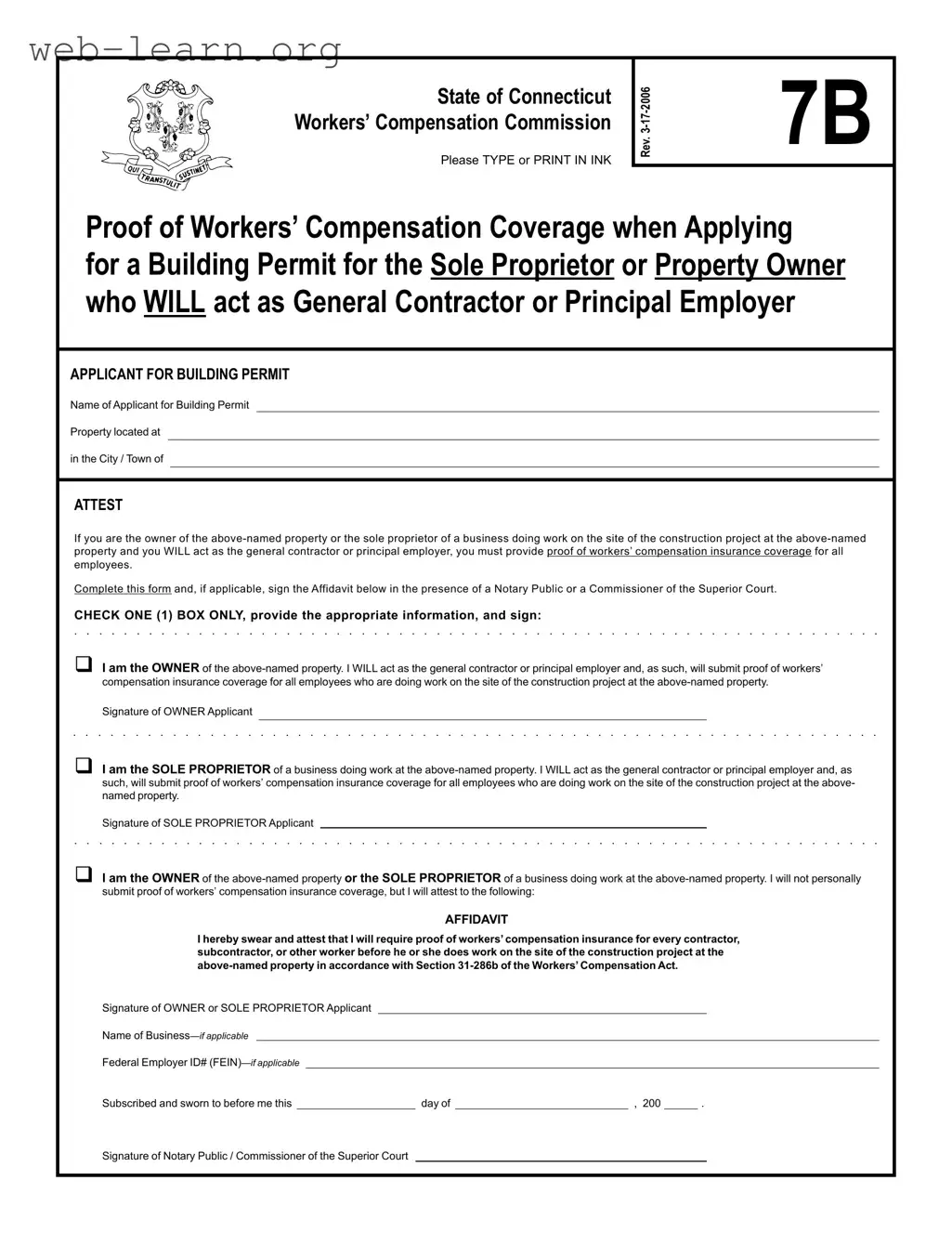
The Connecticut 7B form serves as a crucial document for individuals applying for a building permit who will act as general contractors or principal employers. This form is specifically designed for property owners and sole proprietors engaged in construction projects. It requires applicants to provide proof of workers' compensation insurance coverage for all employees working on the site. The form includes sections where applicants must identify themselves as either the property owner or sole proprietor, affirming their role in the project. They must also check the appropriate box to indicate their status and sign the affidavit, attesting to their responsibility for ensuring that all workers possess the necessary insurance. Notarization is required to validate the affidavit, emphasizing the importance of compliance with the Workers’ Compensation Act. This process not only protects workers but also ensures that property owners and contractors meet legal obligations before commencing construction activities.

| Fact Name | Description |
|---|---|
| Purpose | The Connecticut 7B form serves as proof of workers’ compensation coverage when applying for a building permit, specifically for property owners or sole proprietors acting as general contractors or principal employers. |
| Governing Law | This form is governed by Section 31-286b of the Connecticut Workers’ Compensation Act, which mandates that proof of insurance must be provided for all employees involved in construction projects. |
| Submission Requirements | Applicants must complete the form, check the appropriate box indicating their status (owner or sole proprietor), and provide signatures. If applicable, an affidavit must be signed in front of a Notary Public or a Commissioner of the Superior Court. |
| Version and Revision Date | The current version of the 7B form was revised on March 17, 2006, ensuring that the information remains up to date and compliant with state regulations. |
Filling out the Connecticut 7B form is a straightforward process. This form is essential for those applying for a building permit who will act as the general contractor or principal employer. Follow the steps below to ensure you complete the form correctly.
What is the Connecticut 7B form?
The Connecticut 7B form is a document required by the State of Connecticut Workers’ Compensation Commission. It serves as proof of workers’ compensation coverage when applying for a building permit. This form is specifically for sole proprietors or property owners who will act as the general contractor or principal employer on a construction project.
Who needs to fill out the 7B form?
Both property owners and sole proprietors who plan to act as general contractors or principal employers must complete the 7B form. If you are overseeing construction work on your property, you are responsible for providing proof of workers’ compensation insurance for all employees working on the site.
What information is required on the form?
The form requires several key pieces of information, including:
What if I am not submitting proof of insurance myself?
If you are the owner or sole proprietor but will not be submitting proof of workers’ compensation insurance yourself, you can still complete the form. You will need to sign an affidavit stating that you will require proof of insurance from any contractors, subcontractors, or workers before they begin their work on the project.
How do I submit the 7B form?
Once you have filled out the 7B form, you typically submit it along with your building permit application to your local building department. Ensure that all required signatures are included, particularly if an affidavit is needed. It's advisable to keep a copy for your records.
Is notarization required?
Yes, if you are signing the affidavit section of the 7B form, you will need to have it notarized. This means you must sign the form in the presence of a Notary Public or a Commissioner of the Superior Court to validate your statements.
What happens if I do not provide proof of workers’ compensation insurance?
If you fail to provide proof of workers’ compensation insurance when required, your building permit application may be denied. It is essential to comply with this requirement to ensure the safety of all workers on the construction site and to adhere to state laws.
Can I use the 7B form for multiple projects?
The 7B form is typically specific to a single building permit application. If you have multiple projects, you will need to complete a separate form for each project to provide the necessary proof of workers’ compensation coverage.
Where can I find the Connecticut 7B form?
You can obtain the Connecticut 7B form from the State of Connecticut Workers’ Compensation Commission website or through your local building department. It's important to ensure you are using the most current version of the form, as updates may occur.
When filling out the Connecticut 7B form, many applicants make common mistakes that can delay the building permit process. One frequent error is failing to provide complete and accurate information. For instance, if the applicant does not fill in the name of the property or the city/town correctly, it can lead to confusion and potential rejection of the application.
Another mistake is neglecting to check the appropriate box that indicates whether the applicant is the owner or sole proprietor. This step is crucial because it determines the responsibilities regarding workers’ compensation insurance coverage. If the wrong box is checked, it may result in the application being deemed invalid.
Some applicants also forget to sign the form. A signature is essential to confirm that the information provided is accurate and that the applicant agrees to the terms outlined. Without a signature, the form cannot be processed, causing unnecessary delays.
Additionally, failing to include proof of workers’ compensation insurance can be a significant oversight. Applicants must ensure they attach the necessary documentation that verifies their coverage for all employees working on the construction site. This proof is a requirement for the permit application.
Lastly, many individuals overlook the need for notarization. If the affidavit section is not signed in front of a Notary Public or a Commissioner of the Superior Court, the application will not be valid. It's vital to ensure this step is completed to avoid any complications with the permit approval process.
When applying for a building permit in Connecticut, several documents may accompany the Connecticut 7B form. Each of these documents plays a crucial role in ensuring compliance with state regulations and protecting the interests of all parties involved. Below is a list of commonly used forms and documents.
Submitting these documents along with the Connecticut 7B form is essential for a smooth application process. Ensure all forms are completed accurately to avoid delays in obtaining your building permit.
The Connecticut 7B form serves a specific purpose in the context of workers' compensation coverage when applying for a building permit. Other documents share similar functions, often related to proof of insurance or compliance with regulations. Here are five documents that are comparable to the Connecticut 7B form:
When filling out the Connecticut 7B form, it’s important to follow certain guidelines to ensure accuracy and compliance. Here are four things you should and shouldn’t do:
This form applies to all building permits, regardless of the project's size. Even small renovations require proof of workers’ compensation coverage.
Property owners acting as general contractors or principal employers must also submit this form. It’s not limited to licensed contractors.
If you plan to hire any workers, you must provide proof of coverage. This includes subcontractors and temporary workers.
The form must be submitted with the building permit application. Failing to do so can delay the approval process.
The affidavit is a crucial part of the form. It confirms your commitment to require proof of coverage from all workers involved in the project.
A notary public or a Commissioner of the Superior Court must witness the affidavit signature. This step is essential for the form to be valid.
When filling out the Connecticut 7B form, it is essential to keep the following key points in mind: