The Conditional Contractor’s Lien Release form is a vital document in the construction industry, serving to protect the rights of contractors and property owners alike. This form is typically used when a contractor has received partial payment for work completed but still holds a lien on the property until full payment is made. By signing this release, the contractor agrees to relinquish their claim to the lien conditionally, based on the receipt of specified payments. This ensures that the property owner can move forward with confidence, knowing that the contractor will not pursue a lien as long as the agreed payment terms are met. The form outlines key details, such as the amount of payment received, the scope of work completed, and the parties involved. It also includes important clauses that clarify the conditions under which the lien will be released, thereby minimizing disputes and fostering clear communication between all parties. Understanding this form is essential for anyone involved in construction projects, as it helps to navigate the complexities of payment and lien rights effectively.
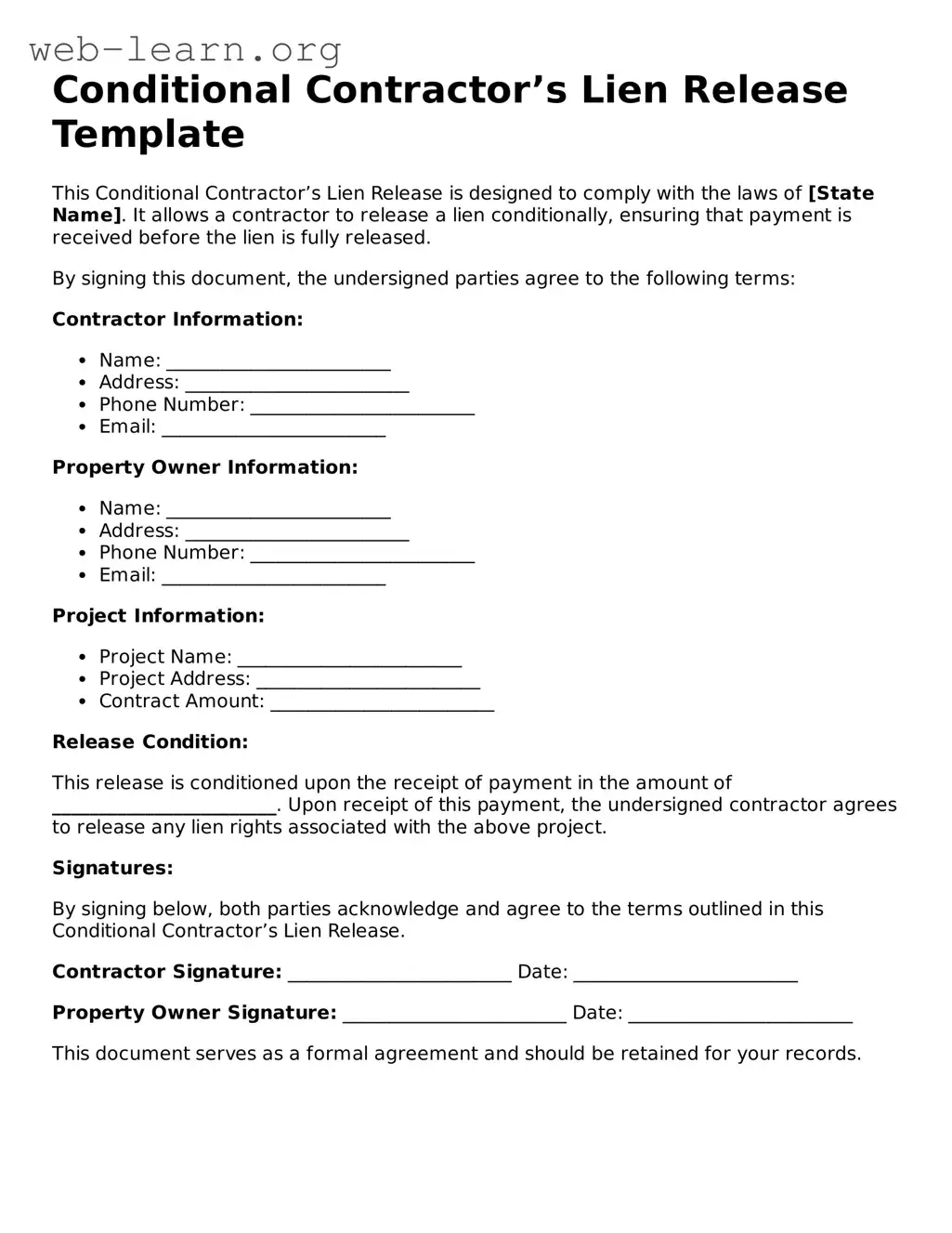
Conditional Contractor’s Lien Release Template
This Conditional Contractor’s Lien Release is designed to comply with the laws of [State Name]. It allows a contractor to release a lien conditionally, ensuring that payment is received before the lien is fully released.
By signing this document, the undersigned parties agree to the following terms:
Contractor Information:
Property Owner Information:
Project Information:
Release Condition:
This release is conditioned upon the receipt of payment in the amount of ________________________. Upon receipt of this payment, the undersigned contractor agrees to release any lien rights associated with the above project.
Signatures:
By signing below, both parties acknowledge and agree to the terms outlined in this Conditional Contractor’s Lien Release.
Contractor Signature: ________________________ Date: ________________________
Property Owner Signature: ________________________ Date: ________________________
This document serves as a formal agreement and should be retained for your records.
| Fact Name | Description |
|---|---|
| Purpose | The Conditional Contractor’s Lien Release form is used to waive a contractor's lien rights conditionally, typically upon receipt of payment for services rendered. |
| Governing Law | In many states, the use and requirements of this form are governed by state lien laws, such as the Texas Property Code or California Civil Code. |
| Conditional Nature | This form is conditional, meaning that the release of lien rights only takes effect once the specified payment is received. |
| Importance for Contractors | Contractors often use this form to ensure they maintain their right to a lien until payment is secured, thus protecting their financial interests. |
Once you have the Conditional Contractor’s Lien Release form in hand, it’s time to fill it out accurately. This form is essential for ensuring that all parties involved in a construction project understand the release of any lien rights. Follow these steps carefully to complete the form.
After completing the form, make sure to keep a copy for your records. You’ll need to submit the original to the relevant parties involved in the construction project to finalize the release.
What is a Conditional Contractor’s Lien Release form?
A Conditional Contractor’s Lien Release form is a legal document used by contractors and subcontractors to waive their right to file a lien against a property, provided that they have received payment or are assured of receiving payment for their work. This form protects property owners from potential claims while ensuring that contractors are compensated for their services.
When should I use this form?
This form should be used when a contractor or subcontractor is ready to release their lien rights conditionally. It is typically utilized after a payment has been made or when a payment is expected, but not yet received. This ensures that the contractor cannot file a lien against the property once the payment is confirmed.
What information is required to complete the form?
To complete the Conditional Contractor’s Lien Release form, you will need to provide:
Is this form legally binding?
Yes, once signed, the Conditional Contractor’s Lien Release form is legally binding. It signifies that the contractor relinquishes their right to file a lien on the property, contingent upon the payment being made. Both parties should keep a copy for their records.
What happens if the payment is not received?
If the payment is not received, the contractor retains the right to file a lien against the property, despite having signed the Conditional Contractor’s Lien Release form. This form is conditional, meaning it only takes effect once the agreed-upon payment is made.
Can I use this form for any type of construction work?
This form can generally be used for most types of construction work, including residential and commercial projects. However, it’s essential to ensure that it complies with state-specific laws and regulations regarding lien waivers.
Do I need a lawyer to complete this form?
While it is not mandatory to have a lawyer complete the form, consulting with a legal professional is advisable. They can ensure that the form is filled out correctly and that it meets all legal requirements in your state.
How can I ensure the form is properly executed?
To ensure proper execution of the form, follow these steps:
Where can I obtain a Conditional Contractor’s Lien Release form?
You can obtain a Conditional Contractor’s Lien Release form from various sources, including legal stationery stores, online legal form providers, or through legal professionals. Ensure that the form you choose is appropriate for your state and situation.
Filling out the Conditional Contractor’s Lien Release form can be a straightforward process, but many people make common mistakes that can lead to delays or complications. One frequent error is failing to include all necessary information. This includes the names of all parties involved, the property address, and the amount being released. Omitting even one detail can invalidate the form.
Another mistake is not signing the form correctly. Each party must sign in the appropriate section. If someone forgets to sign or uses a different name than what is on the contract, the release may be considered incomplete. It's crucial to ensure that signatures match the names listed on the document.
People often overlook the importance of dates. The form must be dated accurately to reflect when the release was completed. If the date is missing or incorrect, it can create confusion and potentially lead to disputes regarding the timing of the release.
In addition, some individuals fail to understand the implications of the term "conditional." This means that the release is only valid if certain conditions are met. Not clarifying these conditions can lead to misunderstandings about the status of payments or obligations, which can cause problems later on.
Another common oversight is not providing a clear description of the work performed. The form should specify the services or materials that were provided. A vague description can lead to disputes about what the release covers, creating unnecessary complications.
Moreover, people sometimes neglect to keep copies of the completed form. After submitting the release, it’s essential to retain a copy for personal records. Without this documentation, proving that the release was filed can be difficult if any issues arise.
Some individuals also fail to check for any local requirements. Different jurisdictions may have specific rules regarding lien releases. Not adhering to these regulations can render the form ineffective.
Lastly, rushing through the process can lead to errors. Taking the time to review the form carefully before submission is crucial. A thorough review can prevent mistakes that might otherwise complicate the release and the overall project.
The Conditional Contractor’s Lien Release form is a crucial document in the construction industry, particularly for contractors and subcontractors. It serves to release a lien on a property conditionally, often in exchange for payment. Alongside this form, several other documents are frequently utilized to ensure clarity and legal compliance in construction projects. Below is a list of five commonly associated forms and documents.
These documents play vital roles in the construction process, ensuring that all parties understand their rights and obligations. Proper use of these forms can help prevent disputes and promote smoother transactions in the construction industry.
The Conditional Contractor’s Lien Release form shares similarities with several other documents in the construction and contracting field. Each of these documents serves a unique purpose but often overlaps in function and intent. Below is a list of seven documents that are similar to the Conditional Contractor’s Lien Release form:
When filling out the Conditional Contractor’s Lien Release form, it's essential to follow certain guidelines to ensure the process goes smoothly. Here are five important things to consider:
By adhering to these guidelines, you can help ensure that your Conditional Contractor’s Lien Release form is filled out correctly and efficiently.
Understanding the Conditional Contractor’s Lien Release form is essential for anyone involved in construction projects. Unfortunately, several misconceptions can lead to confusion and potential legal issues. Here are nine common misconceptions:
By dispelling these misconceptions, individuals can better navigate the complexities of construction law and protect their rights effectively.
When filling out and using the Conditional Contractor’s Lien Release form, keep these key takeaways in mind: