Homepage Attorney-Approved Lease Agreement Template Blank Commercial Vehicle Lease Agreement Form
Outline

When entering into a Commercial Vehicle Lease Agreement, both the lessor and lessee should understand the critical components of the document that governs their relationship. This agreement outlines the terms under which a lessor provides vehicles to a lessee, typically for transportation services. It includes details about the leased vehicles, specifying the responsibilities of both parties, such as maintenance and operation of the vehicles. The agreement also addresses the financial aspects, including payment terms and the duration of the lease. Safety and compliance are emphasized, with requirements for drivers' licenses and adherence to federal and state regulations. Additionally, liability and insurance obligations are clearly defined, ensuring that both parties are protected in the event of accidents or damages. Training requirements for vehicle operators are stipulated to guarantee that all personnel are adequately prepared to operate the vehicles safely. Lastly, the agreement incorporates various federal and state requirements, ensuring that all operations are compliant with applicable laws. Understanding these elements is essential for both parties to fulfill their obligations and maintain a successful leasing relationship.


Sample - Commercial Vehicle Lease Agreement Form

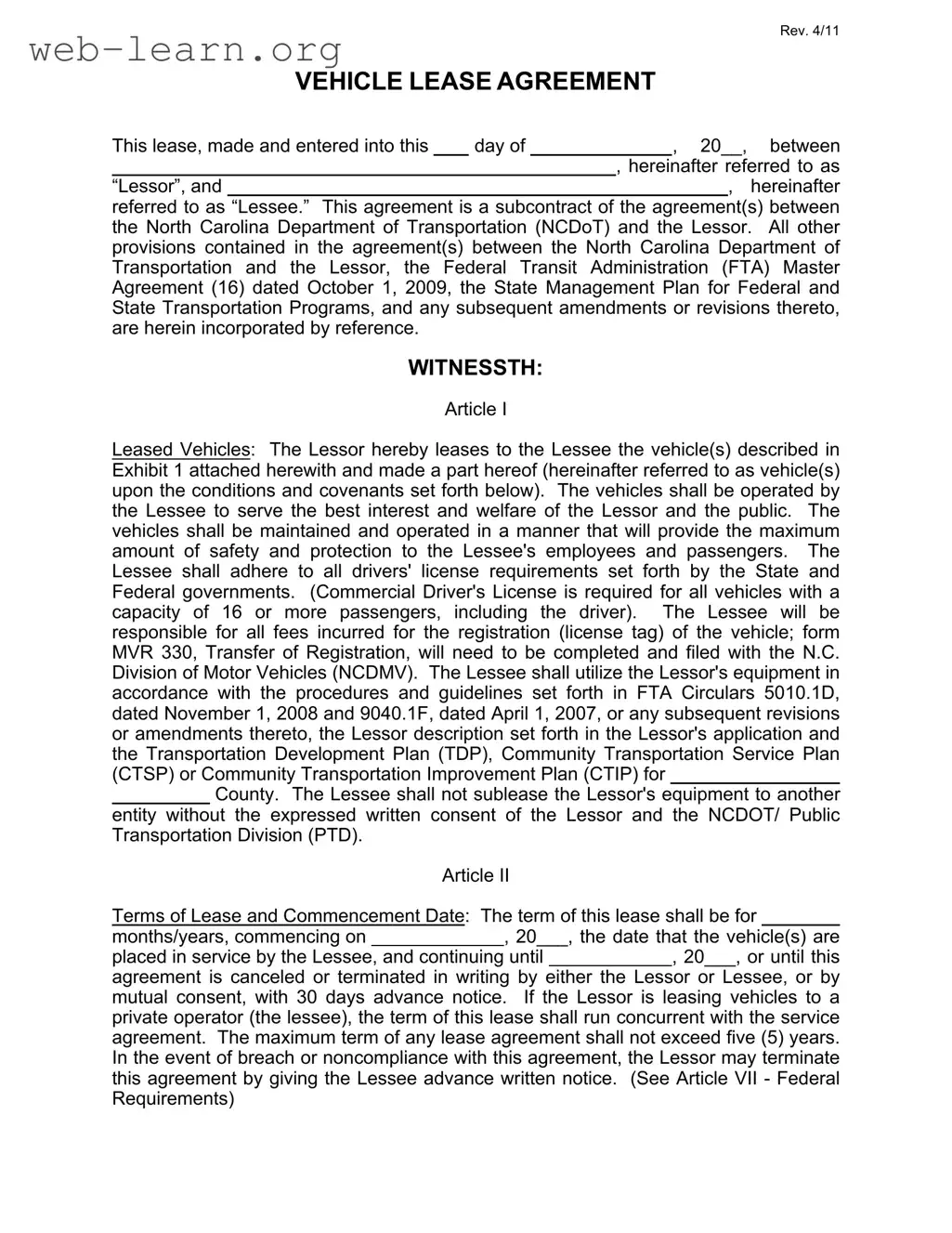
Rev. 4/11
VEHICLE LEASE AGREEMENT
This lease, made and entered into this day of , 20__, between
, hereinafter referred to as
“Lessor”, and , hereinafter
referred to as “Lessee.” This agreement is a subcontract of the agreement(s) between
the North Carolina Department of Transportation (NCDoT) and the Lessor. All other
provisions contained in the agreement(s) between the North Carolina Department of
Transportation and the Lessor, the Federal Transit Administration (FTA) Master
Agreement (16) dated October 1, 2009, the State Management Plan for Federal and
State Transportation Programs, and any subsequent amendments or revisions thereto,
are herein incorporated by reference.
WITNESSTH:
Article I
Leased Vehicles: The Lessor hereby leases to the Lessee the vehicle(s) described in
Exhibit 1 attached herewith and made a part hereof (hereinafter referred to as vehicle(s)
upon the conditions and covenants set forth below). The vehicles shall be operated by
the Lessee to serve the best interest and welfare of the Lessor and the public. The
vehicles shall be maintained and operated in a manner that will provide the maximum
amount of safety and protection to the Lessee's employees and passengers. The
Lessee shall adhere to all drivers' license requirements set forth by the State and
Federal governments. (Commercial Driver's License is required for all vehicles with a
capacity of 16 or more passengers, including the driver). The Lessee will be
responsible for all fees incurred for the registration (license tag) of the vehicle; form
MVR 330, Transfer of Registration, will need to be completed and filed with the N.C.
Division of Motor Vehicles (NCDMV). The Lessee shall utilize the Lessor's equipment in
accordance with the procedures and guidelines set forth in FTA Circulars 5010.1D,
dated November 1, 2008 and 9040.1F, dated April 1, 2007, or any subsequent revisions
or amendments thereto, the Lessor description set forth in the Lessor's application and
the Transportation Development Plan (TDP), Community Transportation Service Plan
(CTSP) or Community Transportation Improvement Plan (CTIP) for
County. The Lessee shall not sublease the Lessor's equipment to another
entity without the expressed written consent of the Lessor and the NCDOT/ Public
Transportation Division (PTD).
Article II
Terms of Lease and Commencement Date: The term of this lease shall be for
months/years, commencing on , 20___, the date that the vehicle(s) are
placed in service by the Lessee, and continuing until , 20___, or until this
agreement is canceled or terminated in writing by either the Lessor or Lessee, or by
mutual consent, with 30 days advance notice. If the Lessor is leasing vehicles to a
private operator (the lessee), the term of this lease shall run concurrent with the service
agreement. The maximum term of any lease agreement shall not exceed five (5) years.
In the event of breach or noncompliance with this agreement, the Lessor may terminate
this agreement by giving the Lessee advance written notice. (See Article VII - Federal
Requirements)
-2-
Article III
Consideration: In consideration for leasing the vehicle(s), the Lessee agrees to pay the
Lessor $ per vehicle for the term of the lease, and the Lessee further agrees
to bear all costs of maintenance, operation, and repair of leased vehicle(s) described in
Exhibit 1. The Lessee agrees to hold Lessor harmless for any damages arising out of
the use, maintenance, or operations of the leased vehicle by the Lessee or any third
party for any purpose whatsoever, with the Lessee’s responsibilities more fully
described hereinafter.
Article IV
Routine Maintenance and Operation Expenses: The Lessee assumes the full and sole
responsibility for maintaining the Lessor's equipment at a high level of cleanliness,
safety, and mechanical soundness. The Lessee agrees to pay all charges for gasoline,
oil, parts, services used or supplied for the vehicle during the term of this Lease and
shall indemnify the Lessor against all liability on such account. Lessor shall not be
required to furnish any services, parts/materials, facilities or personnel to make any
repairs to or maintain the vehicle(s); this is clearly and entirely the responsibility of the
Lessee. The Lessee shall have a Preventive Maintenance Program/Schedule that, at a
minimum, meets manufacturer guidelines and recommendations for maintaining
vehicles. The Lessee must document and track all vehicle maintenance activities in a
Preventive Maintenance Record format. The Preventive Maintenance Guidelines
published by the Public Transportation Division or any subsequent Maintenance
Program/Record issued by the division is available electronically upon request. The
Lessor may require periodic reports on operation or maintenance activities.
The Lessor, the Public Transportation Division, the Federal Transit Administration, or
any agent thereof, shall have the right to conduct periodic maintenance inspections for
the purpose of confirming the existence, condition, and the proper maintenance of the
leased equipment.
Article V
Liability and Insurance: The Lessee assumes all liability regarding the provision of
passenger service while utilizing the leased vehicle(s) and agrees to indemnify the
Lessor for any losses incurred by the Lessee, or its management, or Board of Directors
because of tortuous conduct occurring in the course of the operation of leased
vehicle(s). The Lessee will cover its activities and vehicle(s) with insurance sufficient to
protect the Lessee, their management and Board of Directors, the Lessor, the Public
Transportation Division, and the Federal Transit Administration from any loss
whatsoever, in regard to vehicle(s).
The Lessee shall provide a copy of the insurance policy to the Lessor. On an annual
basis, proof of adequate insurance shall be provided to the Lessor, the Public
Transportation Division or any agent thereof.
Liability Insurance: North Carolina law requires continuous liability coverage to be in
effect on the vehicle(s) during the entire time it is registered and the license plate is in
your possession. The insurance must be provided by a company that is licensed to do
business in the state of North Carolina. The law is designed to compensate accident
victims for property losses and personal injuries and is designed for the Lessee’s
protection.
-3-
Fire and Other Casualty Insurance: The Lessee, at its own cost and expense, shall
keep the vehicle(s) insured against loss or damage by fire or other risk now or
hereinafter embraced by the term “comprehensive and collision coverage.” The
coverage shall be sufficient to create and assure a fund to be used to replace or repair
the vehicle(s) in the event that damage or destruction necessitates the same. The
Lessee shall be responsible for protecting the vehicle(s), based on the current market
value, by maintaining adequate insurance throughout the lease period for the
equipment. Failure of the Lessee to provide adequate insurance shall be considered a
breach of this agreement and, after notification by the Lessor, may result in termination
of this agreement.
The Lessee agrees to notify the Lessor immediately when any vehicle is withdrawn from
service due to casualty loss. Fair market value shall be deemed to be equal to the
damages paid by the Lessee's insurance carrier or from a self-insured reserve account.
Lessor has no obligation for any loss in regard to the vehicle(s).
In no event shall salvage value be considered as fair market value for project
equipment.
Article VI
Training: The Lessee assures that its vehicle operators are properly trained on vehicle
operation and the correct use of special equipment, such as, but not limited to,
wheelchair lift equipment and wheelchair tie-down mechanisms and restraints. The
Lessor will provide proof of such training upon request.
Article VII
Leasing to a Private Operator: If the Lessee is a private operator under contract by a
service agreement with the Lessor, all references in the service agreement, dated
, are hereby incorporated by reference as is this lease agreement
incorporated by reference into the service agreement. The monetary consideration,
indicated in Article III, may be waived.
Article VIII
FEDERAL/STATE REQUIREMENTS AND SPECIAL CONDITIONS
Because the project activities performed by grant recipients, subrecipients, or extended through
to a lower tier contract or agreement must be carried out in accordance with the Master
Agreement, the applicable Federal and State requirements and conditions must be included in
this agreement. The Lessee is responsible under federal law to comply with these requirements
including, but not limited to, the following:
Federal Changes - The Lessee understands that any State or Federal laws, regulations,
policies, and related administrative practices applicable to this lease agreement may be
modified, amended or promulgated from time to time during the term of this agreement. The
Lessee agrees and shall comply with the most recent of such Federal requirements that will
govern this agreement at any particular time, unless the Federal Government determines
otherwise. Likewise, new Federal laws, regulations, policies and administrative practices may
be established after this agreement is executed and may apply to this agreement. The Lessee's
failure to so comply shall constitute a material breach of this agreement. The following
identifies, but is not limited to, the federal requirements that shall apply to this agreement.
-4-
Conflict of Interest - No employee, officer, board member, or agent of the Lessee shall
participate in the selection, award, or administration of a contract supported by State and/or
Federal Transit Administration (FTA) funds if a conflict of interest, real or apparent, would be
involved. Such a conflict would arise when the employee, officer, board member, or agent, any
member of his or her immediate family, his or her partner, or an organization that employs, or is
about to employ any of the above, has a financial or other interest in the firm selected for award.
Lobbying - Byrd Anti-Lobbying Amendment, 31 U.S.C. 1352, as amended by the Lobbying
Disclosure Act of 1995, PL 104-65 (2 U.S.C. §1601,et seq.). Lessee agrees that it will not use
any funds for Lobbying, 49 CFR part 20, “New Restrictions on Lobbying.” Each tier certifies to
the tier above that it will not and has not used Federal appropriated funds to pay any person or
organization for influencing or attempting to influence an officer or employee of any agency, a
member of Congress, officer or employee of Congress, or an employee of a member of
Congress in connection with obtaining any Federal contract, grant or any other award covered
by 31 U.S. C. 1352. Each tier shall comply with Federal statutory provisions or the extent
applicable prohibiting the use of Federal assistance funds for activities designed to influence
congress to a State legislature on legislation or appropriations, except through proper official
channels. Each tier shall also disclose the name of any registrant under the Lobbying
Disclosure Act of 1995 who has made lobbying contacts on its behalf with non-Federal funds
with respect to that Federal contract, grant or award covered by 31 U.S.C. 1352. Such
disclosures are forwarded from tier to tier up to the recipient.
Debarment and Suspensions - This agreement is a covered transaction for purposes of 2
CFR Part 1200, which adopts and supplements the provisions of U.S. Office of Management
and Budget (U.S. OMB) “Guidelines to Agencies on Governmentwide Debarment and
Suspension (Nonprocurement),” 2 CFR Part 180. As such, the Lessor is required to verify that
none of the third party contractors, (Lessee), its principals, as defined at 2 CFR 180.995, or
affiliates, as defined at 2 CFR 180.905, are excluded or disqualified as defined at 2 CFR
180.940, 180.935 and 180.945.
The Lessee is required to comply with 2 CFR 180, Subpart C and must include the requirement
to comply with 2 CFR 180, Subpart C in any lower tier covered transaction it enters into.
By signing and submitting this agreement, the Lessee certifies as follows:
The certification in this clause is a material representation of fact relied upon by the Lessor. If it
is later determined that the Lessee knowingly rendered an erroneous certification, in addition to
remedies available to the Lessor, the Federal Government may pursue available remedies,
including but not limited to suspension and/or debarment. The Lessee agrees to comply with the
requirements of 2 CFR 180, Subpart C while this agreement is valid and throughout the period
of this agreement. The Lessee further agrees to include a provision requiring such compliance
in its lower tier covered transactions.
The Lessor will be reviewing all third party contractors (Lessees) under the Excluded Parties
Listing System at http://epls.gov/ before entering into any contracts.
No Federal Government Obligations to Third Parties - The Lessee acknowledges and
agrees that, notwithstanding any concurrence by Federal and/or State Government in or
approval of the solicitation or award of the underlying agreement, absent the express written
consent by Federal and/or State Government, Federal and State Governments are not parties
to this agreement and shall not be subject to any obligations or liabilities to the Lessee, or any
other party (whether or not a party to that agreement) pertaining to any matter resulting from the
underlying agreement.
-5-
Civil Rights:
(1) Nondiscrimination - In accordance with Title VI of the Civil Rights Act, as amended,
42 U.S.C. § 2000d, section 303 of the Age Discrimination Act of 1975, as amended, 42
U.S.C. § 6101 et seq., section 202 of the Americans with Disabilities Act of 1990, 42
U.S.C. § 12101, and Federal transit law at 49 U.S.C. § 5332, the Lessee agrees that it
will not discriminate against any employee or applicant for employment because of race,
color, creed, national origin, sex, age, or disability. In addition, the Lessee agrees to
comply with applicable Federal implementing regulations and other implementing
requirements FTA may issue.
(a) The third party Lessee and all lower tiers shall comply with all provisions of FTA
Circular 4701.1A, “Title VI and Title VI Dependent Guidelines for Federal Transit
Administration recipients”, May 13, 2007.
(2) Equal Employment Opportunity - The following equal employment opportunity
requirements apply to the underlying contract:
(a) Race, Color, Creed, National Origin, Sex - In accordance with Title VII of the Civil
Rights Act, as amended, 42 U.S.C. § 2000e, and Federal transit laws at 49 U.S.C. §
5332, the Lessee agrees to comply with all applicable equal employment opportunity
requirements of U.S. Department of Labor (U.S. DOL) regulations, "Office of Federal
Contract Compliance Programs, Equal Employment Opportunity, Department of
Labor," 41 C.F.R. Parts 60 et seq., (which implement Executive Order No. 11246,
"Equal Employment Opportunity," as amended by Executive Order No. 11375,
"Amending Executive Order 11246 Relating to Equal Employment Opportunity," 42
U.S.C. § 2000e note), and with any applicable Federal statutes, executive orders,
regulations, and Federal policies that may in the future affect construction activities
undertaken in the course of the Project. The Lessee agrees to take affirmative action
to ensure that applicants are employed, and that employees are treated during
employment, without regard to their race, color, creed, national origin, sex, or age.
Such action shall include, but not be limited to, the following: employment, upgrading,
demotion or transfer, recruitment or recruitment advertising, layoff or termination; rates
of pay or other forms of compensation; and selection for training, including
apprenticeship. In addition, the Lessee agrees to comply with any implementing
requirements FTA may issue.
(b) Equal Employment Opportunity Requirements for Construction Activities. For
activities determined by the U.S. Department of Labor (U.S. DOL) to qualify as
“construction,” the Lessee agrees to comply and assures the compliance of each sub-
lessee at any tier of the Project, with all applicable equal employment opportunity
requirements of U.S. DOL regulations, "Office of Federal Contract Compliance
Programs, Equal Employment Opportunity, Department of Labor," 41 C.F.R. Parts 60
et seq., which implement Executive Order No. 11246, "Equal Employment
Opportunity," as amended by Executive Order No. 11375, "Amending Executive Order
No. 11246 Relating to Equal Employment Opportunity," 42 U.S.C. § 2000(e) note, and
also with any Federal laws, regulations, and directives affecting construction
undertaken as part of the Project.
(3) Nondiscrimination on the Basis of Age – The Lessee agrees to comply with all
applicable requirements of the Age Discrimination Act of 1975, as amended, 42 U.S.C.
§§ 6101 et seq., and with implementing U.S. Health and Human Services regulations,
“Nondiscrimination on the Basis of Age in Programs or Activities Receiving Federal
Financial Assistance, 45 C.F.R. Part 90, which prohibit discrimination against individuals
on the basis of age.
-6-
The Age Discrimination in Employment Act (ADEA) 29 U.S.C. §§ 621 through 634 and
with implementing U.S. Equal Employment Opportunity Commission (U.S. EEOC)
regulations, “Age Discrimination in Employment Act,” 29 C.F.R. Part 1625.
(4) Access for Individuals with Disabilities - The Lessee agrees to comply with
49 U.S.C. § 5301(d), which states the Federal policy that elderly individuals and
individuals with disabilities have the same right as other individuals to use public
transportation services and facilities, and that special efforts shall be made in planning
and designing those services and facilities to implement transportation accessibility
rights for elderly individuals and individuals with disabilities. The Lessee also agrees to
comply with all applicable provisions of section 504 of the Rehabilitation Act of 1973, as
amended, with 29 U.S.C. § 794, which prohibits discrimination on the basis of disability;
with the Americans with Disabilities Act of 1990 (ADA), as amended, 42 U.S.C.
§§ 12101 et seq., which requires that accessible facilities and services be made
available to individuals with disabilities; and with the Architectural Barriers Act of 1968,
as amended, 42 U.S.C. §§ 4151 et seq., which requires that buildings and public
accommodations be accessible to individuals with disabilities. In addition, the Lessee
agrees to comply with applicable Federal regulations and directives and any subsequent
amendments thereto, except to the extent the Federal Government determines
otherwise in writing, as follows:
(1) U.S. DOT regulations “Transportation Services for Individuals with Disabilities
(ADA)” 49 C.F.R. Part 37;
(2) U.S. DOT regulations “Nondiscrimination on the Basis of Handicap in Programs
and Activities Receiving or Benefiting from Federal Financial Assistance,” 49
C.F.R. Part 27;
(3) Joint U.S. Architectural and Transportation Barriers Compliance Board (U.S.
ATBCB) U.S. DOT regulations, “Americans with Disabilities (ADA) Accessibility
Specifications for Transportation Vehicles,” 36 C.F.R. Part 1192 and 49 C.F. R.
Part 38;
(4) U.S. DOJ regulations “Nondiscrimination on the Basis of Disability in State and
Local Government Services,”28 C.F.R. Part 35;
(5) U.S. DOJ regulations “Nondiscrimination on the Basis of Disability by Public
Accommodations and in Commercial Facilities.” 28 C.F.R. Part 36;
(6) U.S. GSA regulations “Accommodations for the Physically Handicapped,” 41
C.F.R. Subpart 101-19;
(7) U.S. Equal Employment Opportunity Commission, “Regulations to Implement the
Equal Employment Provisions of the Americans with Disabilities Act,” 29 C.F.R.
Part 1630;
(8) U.S. Federal Communications Commission regulations “Telecommunications
Relay Services and Related Customer Premises Equipment for the Hearing and
Speech Disabled,” 49 C.F.R. Part 64, Subpart F;
(9) U.S. Architectural and Transportation Barriers Compliance Board regulations,
“Electronic and Information Technology Accessibility Standards.” 36 C.F.R. Part
1194;
-7-
(10) FTA regulations, "Transportation of Elderly and Handicapped Persons," 49
C.F.R. part 609; and
(11) Federal civil rights and nondiscrimination directives implementing the foregoing
regulations.
(5) Access to Services for Persons with Limited English Proficiency. The Lessee
agrees to comply with Executive Order No. 13166,"Improving Access to Services for
Persons with Limited English Proficiency," 42 U.S.C. § 2000d-1 note, and U.S. DOT
Notice, "DOT Policy Guidance Concerning Recipients’ Responsibilities to Limited
English Proficiency (LEP) Persons," 70 Fed. Reg. 74087, December 14, 2005.
(6) Environmental Justice. The Lessee agrees to comply with the policies of Executive
Order No. 12898, "Federal Actions to Address Environmental Justice in Minority
Populations and Low-Income Populations," 42 U.S.C. § 4321 note.
(7) Drug or Alcohol Abuse-Confidentiality and Other Civil Rights Protections. To
the extent applicable, the Lessee agrees to comply with the confidentiality and other civil
rights protections of the Drug Abuse Office and Treatment Act of 1972, as amended,
21 U.S.C. §§ 1101 et seq., with the Comprehensive Alcohol Abuse and Alcoholism
Prevention, Treatment and Rehabilitation Act of 1970, as amended, 42 U.S.C. §§ 4541
et seq., and with the Public Health Service Act of 1912, as amended, 42 U.S.C. §§ 201
et seq., and any amendments to these laws.
(8) Other Nondiscrimination Statutes. The Lessee agrees to comply with all applicable
requirements of any other nondiscrimination statute(s) that may apply to this Contract.
(9) The Lessee also agrees to include these requirements in each subcontract financed
in whole or in part with Federal assistance provided by FTA, modified only if necessary
to identify the affected parties.
Clean Air Act –
(a) The Lessee agrees to comply with all applicable standards, orders, or regulations
issued pursuant to Section 306 of the Clean Air Act as amended, 42 U.S.C. § 7414 as
amended and other applicable provisions of the Clean Air Act, as amended, 42 U.S.C.
§§ 7401 through 7671q. The Lessee agrees to report each violation to the Lessor and
understands and agrees that the Lessor will, in turn, report each violation as required to
assure notification to FTA and the appropriate EPA Regional Office.
(b) The Lessee also agrees to comply with the applicable requirements of section 176(c)
of the Clean Air Act, 42 U.S.C. § 7506(c), consistent with the joint FHWA/FTA document,
“Interim Guidance for Implementing Key SAFETEA-LU Provisions on Planning,
Environment, and Air Quality for Joint FHWA/FTA Authorities,” dated September 2,
2005, and any subsequent applicable Federal directives that may be issued; with
U.S. EPA regulations, "Conformity to State or Federal Implementation Plans of
Transportation Plans, Programs, and Projects Developed, Funded or Approved Under
Title 23 US.C. or the Federal Transit Act," 40 C.F.R. Part 51, Subpart T; and
"Determining Conformity of Federal Actions to State or Federal Implementation Plans,"
40 C.F.R. Part 93, and any subsequent Federal conformity regulations that may be
promulgated. To support the requisite air quality conformity finding for the Project, the
Lessee agrees to implement each air quality mitigation or control measure incorporated
in the Project. The Lessee further agrees that any Project identified in an applicable
State Implementation Plan (SIP) as a Transportation Control Measure will be wholly
consistent with the design concept and scope of the Project described in the SIP.
-8-
(c) The Lessee also agrees to include these requirements in each subcontract
exceeding $100,000 financed in whole or in part with Federal Assistance provided by
FTA.
Clean Water –
(a) The Lessee agrees to comply with all applicable standards, orders, or regulations
issued pursuant to Section 508 of the Clean Water Act, as amended, 33 U.S.C. § 1368,
and other applicable requirements of the Clean Water Act, as amended, 33 U.S.C.
§§ 1251 through 1377, The Lessee agrees to report each violation as required to assure
notification to FTA and the appropriate EPA Regional Office.
(b) The Lessee also agrees to include these requirements in each subcontract exceeding
$100,000 financed in whole or in part with Federal assistance provided by FTA.
Environmental Protection - The Lessee agrees to comply with all applicable requirements of
the National Environmental Policy Act of 1969, as amended 42 U.S.C. subsection 4321 et seq.
in accordance with Executive Order No. 12898, “Federal Actions to Address Environmental
Justice in Minority Populations and Low-Income Populations,” 59 Fed. Reg. 7629, Feb. 16,
1994, FTA statutory requirements on environmental matters at 49 U.S.C. section 5324(b);
Council on Environmental Quality regulations on compliance with the National Environmental
Policy Act of 1969, as amended, 40 C.F.R. Part 1500 et seq. and joint FHWA FTA regulations,
“environmental Impact and Related procedures,” 23 C.F.R. Part 771 and 49 C.F.R. Part 622;
and when promulgated, FHWA/FTA joint regulations, "NEPA and Related Procedures for
Transportation Decision-making, Protection of Public Parks, Wildlife and Waterfowl Refuges,
and Historic Sites," 23 C.F.R. Part 1420 and 49 C.F.R. Part 623. As a result of enactment of
23 U.S.C. §§ 139 and 326 as well as amendments to 23 U.S.C. § 138, environmental decision-
making requirements imposed on FTA projects to be implemented consistent with the joint
FHWA/FTA final guidance, “SAFETEA-LU Environmental Review Process (Public Law 109-59),
“71 Fed. Reg. 66576 et seq. November 15, 2006 and any subsequent applicable Federal
directives that may be issued, except to the extent that FTA determines otherwise in writing.
Energy Conservation - The Lessee agrees to comply with mandatory standards and policies
relating to energy efficiency that are contained in the state energy conservation plans issued in
compliance with the Energy Policy and Conservation Act, 42 U.S.C. Sect. 6321 et seq.
Recycled Products - To the extent possible the contractor agrees to comply with U. S.
Environmental Protection Agency (U.S. EPA), “Comprehensive Procurement Guidelines for
Products Containing Recovered Materials,” 40 CFR Part 247, which implements section 6002
of the Resource Conservation and Recovery Act (RCRA), as amended, 42 U.S.C. 6962. The
contractor agrees to provide competitive preference for products and services that conserve
natural resources, protect the environment and are energy efficient, except to the extent that the
Federal Government determines otherwise in writing.
These items include, but may not be limited too:
Paper and paper products, excluding building and construction paper grades.
Vehicular products:
(a) Lubricating oils containing re-refined oil, including engine lubricating oils, hydraulic
fluids, and gear oils, excluding marine and aviation oils.
(b) Tires, excluding airplane tires.
(c) Reclaimed engine coolants, excluding coolants used in non- vehicular applications.
(d) Rebuilt vehicular parts.
Transportation products:
(a) Traffic barricades and traffic cones used in controlling or restricting vehicular traffic.
(b) Parking stops made from concrete or containing recovered plastic or rubber.
(c) Channelizers containing recovered plastic or rubber.
(d) Delineators containing recovered plastic, rubber, or steel.
-9-
(e) Flexible delineators containing recovered plastic.
Miscellaneous products:
(a) Pallets containing recovered wood, plastic, or paperboard.
(b) Sorbents containing recovered materials for use in oil and solvent clean-ups and as
animal bedding.
(c) Industrial drums containing recovered steel, plastic, or paper.
(d) Awards and plaques containing recovered glass, wood, paper, or plastic.
(e) Mats containing recovered rubber and/or plastic.
(f) (1) Non-road signs containing recovered plastic or aluminum and road signs
containing recovered aluminum.
(2) Sign supports and posts containing recovered plastic or steel.
(g) Manual-grade strapping containing recovered steel or plastic.
(h) Bike racks containing recovered steel or plastic.
(i) Blasting grit containing recovered steel, coal and metal slag, bottom ash, glass,
plastic, fused alumina oxide, or walnut shells.
Park and recreation products:
(a) Playground surfaces and running tracks containing recovered rubber or plastic.
(b) Plastic fencing containing recovered plastic for use in controlling snow or sand
drifting and as a warning/safety barrier in construction or other applications.
(c) Park benches and picnic tables containing recovered steel, aluminum, plastic, or
concrete.
(d) Playground equipment containing recovered plastic, steel, or aluminum.
Landscaping products:
(a) Hydraulic mulch products containing recovered paper or recovered wood used for
hydroseeding and as an over-spray for straw mulch in landscaping, erosion control,
and soil reclamation.
(b) Compost made from yard trimmings, leaves, grass clippings, and/ or food waste for
use in landscaping, seeding of grass or other plants on roadsides and
embankments, as a nutritious mulch under trees and shrubs, and in erosion control
and soil reclamation.
(c) Garden and soaker hoses containing recovered plastic or rubber.
(d) Lawn and garden edging containing recovered plastic or rubber.
(e) Plastic lumber landscaping timbers and posts containing recovered materials.
Non-paper office products:
(a) Office recycling containers and office waste receptacles.
(b) Plastic desktop accessories.
(c) Toner cartridges.
(d) Plastic-covered binders containing recovered plastic; chipboard and pressboard
binders containing recovered paper; and solid plastic binders containing recovered
plastic.
(e) Plastic trash bags.
(f) Printer ribbons.
(g) Plastic envelopes.
(h) Plastic clipboards containing recovered plastic.
(i) Plastic file folders containing recovered plastic.
(j) Plastic clip portfolios containing recovered plastic.
(k) Plastic presentation folders containing recovered plastic.
(l) Office furniture containing recovered steel, aluminum, wood, agricultural fiber, or
plastic.
Termination or Cancellation of Agreement - Termination or cancellation of this agreement, in
whole or in part, may be initiated by either the Lessor or the Lessee if it is in the best interest of
that party. A notice of termination shall be delivered to the Lessee or Lessor, specifying the
extent to which performance of work under this agreement is terminated, and the date upon
which such termination becomes effective. A 30-day notice of termination shall be required. If
this agreement is terminated, the Lessor shall be liable only for payments under the payment
provisions of the contract for services rendered before the effective date of termination.
-10-
Breach of Contract - If the Lessee fails to provide the services within the specified terms of this
agreement, or fails to perform within the provisions of this agreement, this agreement may be
terminated by reason of default or breach. A written notice of default or breach of agreement
shall be presented to the Lessee within three (3) working days of such failure, advising the
Lessee that this agreement may be terminated in thirty (30) days.
If it is determined that the Lessee had an excusable reason for not providing service, such as a
strike, fire, or flood, events which are not the fault of or are beyond the control of the Lessee,
the Lessor may allow the Lessee to continue the service, or treat the termination as a
termination for convenience.
The Lessor may allow the Lessee a specified period of time in which to correct the deficiency;
the notice of termination will state the time period in which the correction is permitted and other
appropriate conditions. If the Lessee fails to remedy to the Lessor's satisfaction the breach or
default or any of the terms, covenants, or conditions of this agreement within the specified time
period, the Lessor shall have the right to terminate this agreement without any further obligation
to Lessee. Any such termination for default shall not in any way operate to preclude the Lessor
from also pursuing all available remedies against Lessee and its sureties for said breach or
default.
Resolution of Disputes -
Disputes - Disputes arising in the performance of this agreement which are not resolved through
discussions by the parties shall be decided in writing by the authorized representative of the
Lessor. This decision shall be final and conclusive unless within ten (10) days from the date of
receipt of its copy, the Lessee mails or otherwise furnishes a written appeal to the authorized
representative of the Lessor. In connection with any such appeal, the Lessee shall be afforded
an opportunity to be heard and to offer evidence in support of its position. The decision of the
authorized representative of the Lessor shall be binding upon the Lessee and the Lessee shall
abide by the decision.
Performance during Dispute - Unless otherwise directed by the Lessor, the Lessee shall
continue performance under this agreement while matters in dispute are being resolved.
Claims for Damages - Any claim resulting from injury or damage to person or property
because of any act or omission of the Lessee or of any of his employees, agents or others for
whose acts he is legally liable, should be made in writing to the Lessee. The Lessee is
responsible for settlement of all such claims.
Remedies - Unless this agreement provides otherwise, all claims, counterclaims, disputes and
other matters in question between the Lessor and the Lessee arising out of or relating to this
agreement or its breach will be decided by arbitration if the parties mutually agree, or in a court
of competent jurisdiction within the County in which the Lessor is located.
Rights and Remedies - The duties and obligations imposed by this agreement and the rights
and remedies available thereunder shall be in addition to and not a limitation of any duties,
obligations, rights and remedies otherwise imposed or available by law. No action or failure to
act by the Lessor or Lessee shall constitute a waiver of any right or duty afforded any of them
under this agreement, nor shall any such action or failure to act constitute an approval of or
acquiescence in any breach thereunder, except as may be specifically agreed in writing.
Nonconstruction Employee Protection Requirements - Section 102 of the Contract Work
Hours and Safety Standards Act, as amended, 40 U.S.C Sections 327 through 333 are
mandated under DOL regulation 29 C.F.R. Section 5.5.
(1) Overtime requirements - No Lessee contracting for any part of the contract work which may

Form Information

Fact Name Details
Parties Involved This lease agreement is made between a Lessor and a Lessee, defining their roles in the leasing process.
Governing Law The lease is governed by the laws of North Carolina, including specific state transportation regulations.
Lease Duration The term of the lease can last up to five years, starting from the date the vehicle is put into service.
Liability Assumption The Lessee takes on all liability for the operation of the leased vehicle, including indemnifying the Lessor against any losses.
Insurance Requirements The Lessee must maintain continuous liability insurance and comprehensive coverage for the leased vehicle throughout the lease period.
Maintenance Responsibilities The Lessee is responsible for all maintenance and operational costs associated with the leased vehicle, ensuring it remains in good condition.
Training Obligations The Lessee must ensure that vehicle operators are properly trained, particularly in the use of special equipment.

Detailed Guide for Filling Out Commercial Vehicle Lease Agreement

Filling out the Commercial Vehicle Lease Agreement form requires careful attention to detail. Each section must be completed accurately to ensure compliance with the terms of the lease. Below are the steps to guide you through the process.

  1. Begin by entering the date at the top of the form where indicated.
  2. Identify the Lessor by providing their name in the designated space.
  3. Next, enter the name of the Lessee in the corresponding section.
  4. In Article I, list the vehicles being leased as described in Exhibit 1. Make sure to include all necessary details.
  5. Specify the term of the lease in Article II, including the start date and end date. Ensure that the duration does not exceed five years.
  6. In Article III, write the payment amount per vehicle for the lease term.
  7. Confirm that you understand the responsibilities for maintenance and operation outlined in Article IV. Acknowledge this by signing where required.
  8. In Article V, ensure you have adequate insurance coverage as specified. Provide proof of insurance to the Lessor.
  9. Complete Article VI by confirming that vehicle operators are properly trained. Document this training as necessary.
  10. Review Article VIII for compliance with federal and state requirements. Ensure you understand all obligations outlined.
  11. Finally, sign and date the agreement at the bottom of the form. Make sure all parties have signed before submitting.

Obtain Answers on Commercial Vehicle Lease Agreement

  1. What is a Commercial Vehicle Lease Agreement?

    A Commercial Vehicle Lease Agreement is a legal document that outlines the terms under which a lessor (the owner of the vehicle) leases a commercial vehicle to a lessee (the person or entity renting the vehicle). This agreement specifies the responsibilities of both parties, including payment terms, maintenance obligations, and insurance requirements.

  2. What are the key responsibilities of the lessee?

    The lessee has several important responsibilities under the lease agreement:

    • Maintain the vehicle in a clean and safe condition.
    • Pay for all operational costs, including fuel, maintenance, and repairs.
    • Ensure that all drivers have the necessary licenses to operate the vehicle.
    • Provide proof of insurance coverage to protect against potential liabilities.
    • Document all maintenance activities as per the guidelines provided.
  3. What happens if the lessee does not comply with the terms of the agreement?

    If the lessee breaches any terms of the lease agreement, the lessor has the right to terminate the agreement. This termination requires the lessor to provide written notice to the lessee. The lessee may also face financial penalties or be held liable for damages resulting from the breach.

  4. What insurance is required for the leased vehicle?

    The lessee must maintain continuous liability insurance on the vehicle throughout the lease period. This insurance must be provided by a company licensed to operate in North Carolina. Additionally, the lessee is responsible for securing comprehensive and collision coverage to protect against loss or damage to the vehicle.

  5. Can the lessee sublease the vehicle to another party?

    No, the lessee cannot sublease the vehicle to another entity without obtaining written consent from the lessor and the North Carolina Department of Transportation. This requirement ensures that the lessor retains control over the use of the vehicle and maintains compliance with applicable regulations.

Common mistakes

Filling out the Commercial Vehicle Lease Agreement form can be straightforward, but many people make common mistakes that can lead to complications. One significant error is failing to complete all required fields. Each section of the form is essential for clarity and legality. Leaving blanks can create confusion and delay the leasing process.

Another frequent mistake is incorrect dates. Entering the wrong commencement or termination dates can lead to misunderstandings about the lease duration. It is crucial to double-check these dates to ensure they accurately reflect the intended lease term.

Many individuals also neglect to specify the correct payment terms. The agreement requires clear financial details, including the amount per vehicle and any additional costs. Omitting this information can result in disputes over payment obligations later on.

Some Lessees fail to provide proof of insurance or do not include adequate coverage details. This oversight can lead to liability issues if an incident occurs. Ensuring that all insurance requirements are met and documented is vital for compliance and protection.

Another common mistake involves misunderstanding maintenance responsibilities. The Lessee is fully responsible for maintaining the leased vehicle(s). Failing to acknowledge this can lead to unexpected costs and potential breaches of the agreement.

Inaccurate vehicle descriptions in Exhibit 1 can also pose problems. The vehicles must be clearly identified to avoid confusion. Ensuring that all details match the actual vehicles being leased is essential for a smooth agreement.

People often overlook the need for a Preventive Maintenance Program. This program is not only a requirement but also critical for ensuring the vehicles remain in good condition. Neglecting this aspect can result in compliance issues and damage to the vehicles.

Some Lessees do not pay attention to the conflict of interest clause. It is crucial to understand the implications of this section, as any violations can lead to serious legal consequences. Awareness of this requirement is necessary for all parties involved.

Lastly, failing to include signatures from all necessary parties can invalidate the agreement. All signatures must be present to ensure that both the Lessor and Lessee are bound by the terms. Missing signatures can lead to disputes about the validity of the lease.

By avoiding these common mistakes, individuals can ensure a smoother leasing process and maintain compliance with the terms of the Commercial Vehicle Lease Agreement.

Documents used along the form

When entering into a Commercial Vehicle Lease Agreement, several other forms and documents may be necessary to ensure compliance and proper management of the lease. Here is a list of commonly used documents that accompany the lease agreement.

  • Vehicle Registration Form: This document is essential for registering the leased vehicle with the appropriate state authorities. It includes details about the vehicle and the lessee, ensuring that the vehicle is legally recognized for operation on public roads.
  • Insurance Certificate: This certificate serves as proof that the lessee has obtained the required insurance coverage for the leased vehicle. It protects both the lessee and the lessor from potential liabilities arising from accidents or damages.
  • Maintenance Log: A record that tracks all maintenance activities performed on the leased vehicle. This log helps ensure that the vehicle remains in good working condition and complies with safety regulations.
  • Driver Qualification File: This file contains documentation proving that the drivers operating the leased vehicle meet all necessary qualifications, including valid licenses and training certifications. It is crucial for compliance with safety standards.
  • Inspection Report: A document that outlines the results of periodic inspections of the leased vehicle. This report helps identify any maintenance issues and ensures that the vehicle meets safety requirements.
  • Sublease Agreement (if applicable): If the lessee intends to sublease the vehicle, this agreement outlines the terms and conditions under which the vehicle may be leased to another party, ensuring that all parties are aware of their responsibilities.
  • Termination Notice: This document is used to formally notify the other party when the lease agreement is to be terminated. It typically includes the reason for termination and any necessary details regarding the return of the vehicle.

Having these documents in order can help streamline the leasing process and ensure that all parties fulfill their obligations. Proper documentation promotes accountability and protects the interests of both the lessor and lessee.

Similar forms

  • Vehicle Rental Agreement: Similar to a Commercial Vehicle Lease Agreement, a Vehicle Rental Agreement outlines the terms under which a vehicle is rented. Both documents specify responsibilities for maintenance, liability, and insurance, ensuring that the renter understands their obligations while using the vehicle.
  • Equipment Lease Agreement: An Equipment Lease Agreement details the terms for leasing equipment, much like a vehicle lease. Both agreements include provisions for the duration of the lease, payment terms, and maintenance responsibilities, ensuring the lessee is aware of their duties regarding the equipment's care.
  • Real Estate Lease Agreement: This document governs the rental of property and shares similarities with a vehicle lease in terms of outlining the rights and responsibilities of both parties. Both agreements typically include terms about duration, payment, and maintenance, providing a clear framework for the lessee's obligations.
  • Service Agreement: A Service Agreement outlines the terms of service between a provider and a client. Like a Commercial Vehicle Lease Agreement, it includes specifics about the scope of services, payment terms, and compliance with regulations, ensuring both parties understand their roles and responsibilities.
  • Subcontractor Agreement: This agreement is used when one party hires another to perform part of a contract. Similar to a vehicle lease, it includes terms regarding performance expectations, payment, and liability, ensuring that the subcontractor is clear on their responsibilities.
  • Franchise Agreement: A Franchise Agreement governs the relationship between a franchisor and franchisee. Like a vehicle lease, it includes terms about operational guidelines, fees, and compliance with regulations, ensuring that both parties understand their obligations in the business arrangement.

Dos and Don'ts

When filling out the Commercial Vehicle Lease Agreement form, it's important to follow certain guidelines to ensure accuracy and compliance. Here’s a list of things you should and shouldn't do:

  • Do fill in all required fields completely and accurately.
  • Do review the entire agreement before signing.
  • Do ensure that all information about the vehicle is correct, including make, model, and VIN.
  • Do keep a copy of the signed agreement for your records.
  • Do understand your responsibilities regarding maintenance and insurance.
  • Don't leave any sections blank unless specified.
  • Don't sign the agreement without reading it thoroughly.
  • Don't ignore the requirements for insurance coverage.
  • Don't sublease the vehicle without written consent from the Lessor.

Misconceptions

Understanding the Commercial Vehicle Lease Agreement can be challenging, and several misconceptions may arise. Here are ten common misunderstandings, along with clarifications:

  1. All lease agreements are the same. Many people assume that all lease agreements for commercial vehicles follow the same structure. However, each agreement can have unique terms and conditions that reflect the specific needs of the parties involved.
  2. The lessee is not responsible for maintenance. Some believe that once they lease a vehicle, the lessor is responsible for all maintenance. In reality, the lessee is fully responsible for maintaining the vehicle and covering all associated costs.
  3. Insurance is optional. It's a common misconception that insurance coverage can be skipped. In fact, the lessee must provide adequate insurance to protect against potential liabilities and damages.
  4. Subleasing is always allowed. Many lessees think they can sublease the vehicle without restrictions. However, subleasing typically requires written consent from the lessor and may not be permitted at all.
  5. Lease terms can be changed easily. Some believe they can modify lease terms without any formal process. Changes usually require mutual consent and may involve written amendments to the agreement.
  6. The lessor is liable for accidents. There is a misconception that the lessor holds liability in case of accidents involving the leased vehicle. In fact, the lessee assumes all liability for accidents and must indemnify the lessor.
  7. All fees are covered in the lease. Many lessees think that all costs related to the vehicle are included in the lease payments. However, the lessee is responsible for additional costs such as registration and operational expenses.
  8. Training for drivers is optional. Some believe that training for drivers is not required. However, the lessee must ensure that all vehicle operators are properly trained, especially when using specialized equipment.
  9. Compliance with federal laws is unnecessary. It's a misconception that federal and state compliance is optional. The lessee is obligated to follow all applicable laws and regulations throughout the lease period.
  10. Termination of the lease is straightforward. Many assume they can terminate the lease at any time without consequences. However, termination usually requires a written notice and adherence to specific terms outlined in the agreement.

Key takeaways

Key Takeaways for Filling Out and Using the Commercial Vehicle Lease Agreement

  • The agreement must clearly identify both the Lessor and Lessee, including their roles and responsibilities, as well as the specific vehicle(s) being leased.
  • Lessee is responsible for all maintenance, operation, and insurance costs associated with the leased vehicle(s), ensuring compliance with state and federal regulations.
  • It is essential to adhere to the lease term and conditions, including providing written notice for termination and maintaining proper documentation of vehicle maintenance.
  • Compliance with federal and state laws is mandatory, and any changes to these laws during the lease period must be acknowledged and followed by the Lessee.