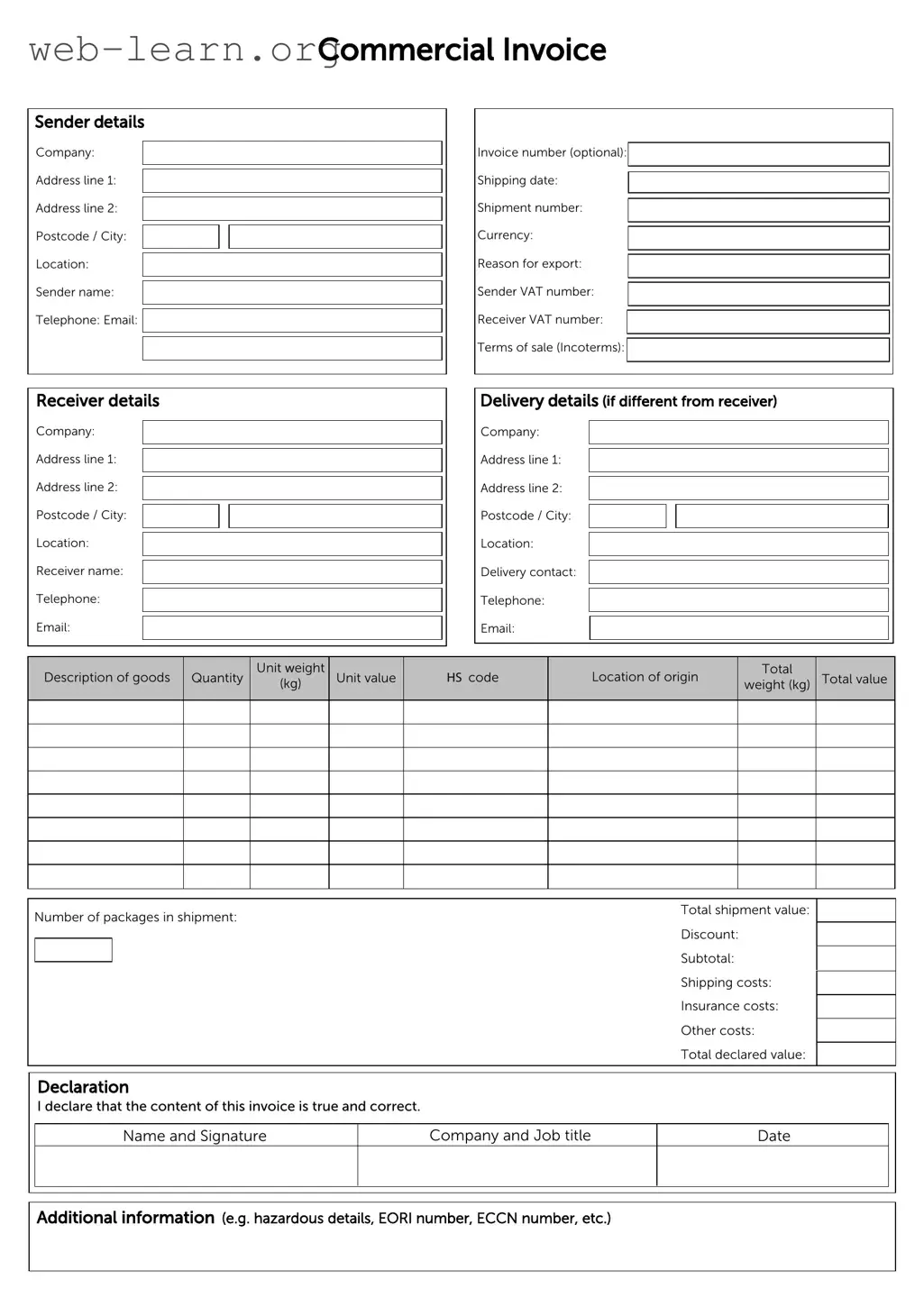
Homepage Blank Commercial Invoice Form
Outline

When engaging in international trade, a Commercial Invoice serves as a vital document that facilitates smooth transactions between buyers and sellers. This form is not just a simple bill; it encapsulates essential information about the goods being shipped, including their description, quantity, and value. Importantly, it also includes details about the seller and buyer, ensuring that both parties are clearly identified. The Commercial Invoice often outlines payment terms, shipping methods, and any applicable taxes or duties, making it an indispensable tool for customs clearance. Furthermore, it may contain additional information, such as the country of origin for the goods, which can influence tariff rates. Understanding how to properly fill out this form is crucial for anyone involved in importing or exporting goods, as inaccuracies can lead to delays or additional costs. With the right knowledge, you can navigate the complexities of international shipping with confidence and efficiency.

Sample - Commercial Invoice Form







Location 








Location






























Location








Location

 


Form Information

Fact Name Description
Definition A Commercial Invoice is a document used in international trade that details the transaction between a buyer and a seller.
Purpose This form serves as a bill for the goods sold, providing information necessary for customs clearance.
Contents Typically includes details such as item descriptions, quantities, prices, and terms of sale.
Governing Law In the U.S., the Uniform Commercial Code (UCC) governs commercial transactions, including invoices.
Currency Invoices can be issued in various currencies, depending on the agreement between the buyer and seller.
Importance for Customs Customs authorities rely on the Commercial Invoice to assess duties and taxes on imported goods.
Record Keeping Businesses must retain copies of Commercial Invoices for accounting and tax purposes, typically for at least seven years.

Detailed Guide for Filling Out Commercial Invoice

Completing the Commercial Invoice form is an important step in ensuring your shipment is processed smoothly. This form requires accurate information about the transaction, including details about the buyer, seller, and the goods being shipped. Follow the steps below to fill out the form correctly.

  1. Identify the Seller: Enter the name and address of the seller in the designated section.
  2. Identify the Buyer: Provide the name and address of the buyer in the appropriate field.
  3. Invoice Number: Assign a unique invoice number for tracking purposes.
  4. Invoice Date: Fill in the date when the invoice is created.
  5. Currency: Indicate the currency used for the transaction.
  6. Item Description: List each item being shipped, including a detailed description.
  7. Quantity: Specify the quantity of each item being shipped.
  8. Unit Value: Enter the value of each item in the specified currency.
  9. Total Value: Calculate and provide the total value of the shipment.
  10. Shipping Information: Include details about the shipping method and any relevant tracking numbers.
  11. Signature: Sign and date the form to validate the information provided.

Obtain Answers on Commercial Invoice

  1. What is a Commercial Invoice?

    A Commercial Invoice is a crucial document used in international trade. It provides detailed information about the goods being shipped, including their value, description, and the terms of sale. This document serves as a bill for the goods and is often required by customs authorities for clearance.

  2. Why is a Commercial Invoice necessary?

    The Commercial Invoice is necessary for several reasons. It facilitates the customs clearance process by providing essential information about the shipment. Customs officials use this document to assess duties and taxes. Additionally, it serves as proof of the transaction between the buyer and the seller.

  3. What information should be included in a Commercial Invoice?

    A complete Commercial Invoice should include the following information:

    • Seller's name and address
    • Buyer's name and address
    • Description of the goods
    • Quantity of items
    • Unit price and total value
    • Currency used for the transaction
    • Terms of sale (e.g., FOB, CIF)
    • Shipping method
    • Invoice date
    • Invoice number
  4. How does a Commercial Invoice differ from a pro forma invoice?

    A pro forma invoice is typically issued before the sale is finalized. It outlines the expected costs and terms but does not serve as a demand for payment. In contrast, a Commercial Invoice is issued after the sale and requests payment for the goods delivered.

  5. Who is responsible for preparing the Commercial Invoice?

    The seller or exporter is usually responsible for preparing the Commercial Invoice. They must ensure that all information is accurate and complies with both local and international regulations. However, the buyer may also request specific details to be included.

  6. What is the role of a Commercial Invoice in customs clearance?

    The Commercial Invoice plays a vital role in customs clearance. It is one of the primary documents that customs officials review to determine the value of the goods and assess any applicable duties and taxes. Inaccuracies or omissions can lead to delays or additional charges.

  7. Can a Commercial Invoice be used for multiple shipments?

    No, a Commercial Invoice is specific to a single shipment. Each shipment should have its own invoice to accurately reflect the details of that particular transaction. This helps avoid confusion and ensures compliance with customs regulations.

  8. Is there a specific format for a Commercial Invoice?

    While there is no universally mandated format, a Commercial Invoice should be clear and organized. It is advisable to follow a standard layout that includes all necessary information. Many companies use templates to ensure consistency and completeness.

  9. What should I do if I make an error on the Commercial Invoice?

    If an error is discovered on the Commercial Invoice, it is important to correct it as soon as possible. Depending on the nature of the error, you may need to issue a revised invoice or provide an explanation to customs officials. Timely communication can help mitigate potential issues.

Common mistakes

Filling out a Commercial Invoice form can be straightforward, but many people make mistakes that can lead to delays or issues with shipments. One common error is incomplete information. It is crucial to fill out every required field accurately. Missing details like the sender's address or the recipient's contact information can cause shipping problems.

Another frequent mistake is incorrect descriptions of goods. Each item should be clearly described, including its value and quantity. If the description is vague or inaccurate, customs may hold the shipment for further inspection, leading to delays.

People often overlook currency specifications. The invoice should clearly state the currency in which the transaction is made. If this detail is missing, it can lead to confusion regarding the value of the goods and affect customs duties.

Additionally, not including the correct shipping terms can create misunderstandings. It's important to specify whether the shipment is sent "free on board" (FOB) or "delivered duty paid" (DDP), among other terms. This clarity helps both the sender and recipient understand their responsibilities.

Lastly, many individuals fail to sign and date the invoice. An unsigned invoice may be deemed invalid by customs officials. Ensuring that the invoice is properly signed and dated is a simple yet essential step to avoid complications.

Documents used along the form

The Commercial Invoice is a critical document in international trade, serving as a detailed record of the transaction between the seller and buyer. However, it is often accompanied by several other important documents that facilitate the shipping and customs clearance processes. Each of these documents plays a unique role in ensuring compliance with legal requirements and smooth logistics.

  • Bill of Lading: This document serves as a contract between the shipper and the carrier. It details the type, quantity, and destination of the goods being transported. The Bill of Lading acts as a receipt once the goods are delivered, confirming that the carrier has received the cargo in good condition.
  • Certificate of Origin: This document certifies the country in which the goods were manufactured. It is often required by customs authorities to determine tariff rates and ensure compliance with trade agreements.
  • Packing List: A packing list provides detailed information about the contents of a shipment. It includes descriptions of the items, their quantities, and their packaging. This document helps customs officials verify the shipment and assists in the efficient handling of goods upon arrival.
  • Insurance Certificate: This document proves that the goods are insured during transit. It outlines the coverage details and serves as evidence that the shipper has taken precautions against potential loss or damage to the cargo.
  • Import/Export License: Depending on the nature of the goods, an import or export license may be required. This document grants permission from the relevant government authority to engage in the trade of specific goods, ensuring compliance with national regulations.

Understanding the purpose and importance of these accompanying documents is essential for anyone involved in international trade. Each document contributes to a transparent and efficient shipping process, ultimately benefiting all parties involved in the transaction.

Similar forms

The Commercial Invoice is a crucial document in international trade, serving as a detailed record of a transaction between a buyer and seller. Several other documents share similar functions or purposes in various business contexts. Below are ten documents that are comparable to the Commercial Invoice:

  • Pro Forma Invoice: This document provides an estimate of costs before the actual sale occurs. It outlines the expected prices and terms, similar to how a Commercial Invoice details the final transaction.
  • Bill of Lading: This document serves as a receipt for goods shipped and can also act as a contract between the shipper and carrier. Like the Commercial Invoice, it provides essential details about the shipment.
  • Packing List: A packing list details the contents of a shipment, including item descriptions and quantities. It complements the Commercial Invoice by providing additional information about the goods being shipped.
  • Purchase Order: A purchase order is a document issued by a buyer to a seller, indicating the types and quantities of products they wish to purchase. It establishes the terms of sale, much like a Commercial Invoice does after the sale.
  • Certificate of Origin: This document certifies the country in which the goods were manufactured. While it serves a different purpose, it is often used alongside the Commercial Invoice in international transactions.
  • Customs Declaration: This document is required by customs authorities to declare the contents of a shipment. It includes information that is also present in the Commercial Invoice, such as item descriptions and values.
  • Sales Receipt: A sales receipt provides proof of purchase and details the transaction. It shares similarities with the Commercial Invoice in that it confirms the sale and outlines the items purchased.
  • Credit Note: A credit note is issued by a seller to a buyer, indicating a reduction in the amount owed. It is related to the Commercial Invoice as it may reference the original invoice for adjustments.
  • Debit Note: This document is issued to request payment for goods or services. It functions similarly to a Commercial Invoice by detailing amounts due for transactions.
  • Invoice Receipt: An invoice receipt acknowledges the receipt of payment for goods or services. It parallels the Commercial Invoice as both serve to document financial transactions between parties.

Dos and Don'ts

When filling out the Commercial Invoice form, there are several important things to keep in mind. Here’s a list of what to do and what to avoid:

  • Do provide accurate and complete information. Double-check your entries for errors.
  • Do include a detailed description of the goods. This helps customs understand the nature of the items.
  • Do specify the correct value of the goods. Misrepresentation can lead to penalties.
  • Do ensure that all necessary signatures are included. This validates the document.
  • Don't leave any sections blank. Incomplete forms can delay processing.
  • Don't use vague terms. Be specific about the items being shipped.
  • Don't forget to include your contact information. This allows for quick communication if needed.

Misconceptions

Understanding the Commercial Invoice form is crucial for anyone involved in international shipping or trade. However, several misconceptions can lead to confusion. Here are nine common misconceptions about the Commercial Invoice:

  1. It is only required for international shipments. Many believe that a Commercial Invoice is only necessary when shipping goods across borders. In reality, it can also be useful for domestic shipments, especially for tracking and record-keeping purposes.
  2. All invoices are the same. Not all invoices serve the same purpose. A Commercial Invoice has specific requirements and details that distinguish it from other types of invoices, such as pro forma invoices or retail invoices.
  3. It is optional for customs clearance. Some think that submitting a Commercial Invoice is optional. However, customs authorities often require it to assess duties and taxes on imported goods.
  4. Only the seller needs to complete it. While the seller typically fills out the Commercial Invoice, both the seller and buyer should review it to ensure accuracy and completeness.
  5. It only needs to include a description of the goods. A common misconception is that a description of the goods is all that’s needed. In fact, the Commercial Invoice should also include details like the value, quantity, and terms of sale.
  6. It does not affect shipping costs. Some believe that the Commercial Invoice has no impact on shipping costs. However, the declared value of the goods on the invoice can influence shipping fees and insurance rates.
  7. It is the same as a packing list. While both documents are important for shipping, they serve different purposes. A packing list details the contents of the shipment, while a Commercial Invoice outlines the transaction details.
  8. It can be filled out in any language. Many think that any language is acceptable for the Commercial Invoice. However, it is best to use the language required by the destination country or English, as this is often the standard for international trade.
  9. Once submitted, it cannot be changed. Some assume that the information on a Commercial Invoice is set in stone after submission. In reality, if errors are found, corrections can be made, but it may require additional documentation or clarification with customs.

By understanding these misconceptions, individuals can better navigate the complexities of international shipping and ensure compliance with regulations.

Key takeaways

When filling out and using the Commercial Invoice form, it is important to keep several key points in mind to ensure accuracy and compliance. Here are some essential takeaways:

  • Complete Information: Ensure that all sections of the form are filled out completely. Missing information can lead to delays in customs clearance.
  • Accurate Descriptions: Provide clear and detailed descriptions of the goods being shipped. This helps customs officials understand the nature of the items.
  • Correct Value Declaration: Accurately declare the value of the goods. This is crucial for determining duties and taxes that may apply.
  • Consistent Currency: Use the same currency throughout the invoice. This avoids confusion and ensures that the values are interpreted correctly.
  • Signature Requirement: Don’t forget to sign the invoice. A signature is often required to validate the document.
  • Keep Copies: Always keep copies of the Commercial Invoice for your records. This is important for tracking shipments and for any future reference.

By following these guidelines, you can streamline the shipping process and help ensure that your goods reach their destination without unnecessary complications.