Homepage Blank Colorado Wc 1 Form
Outline

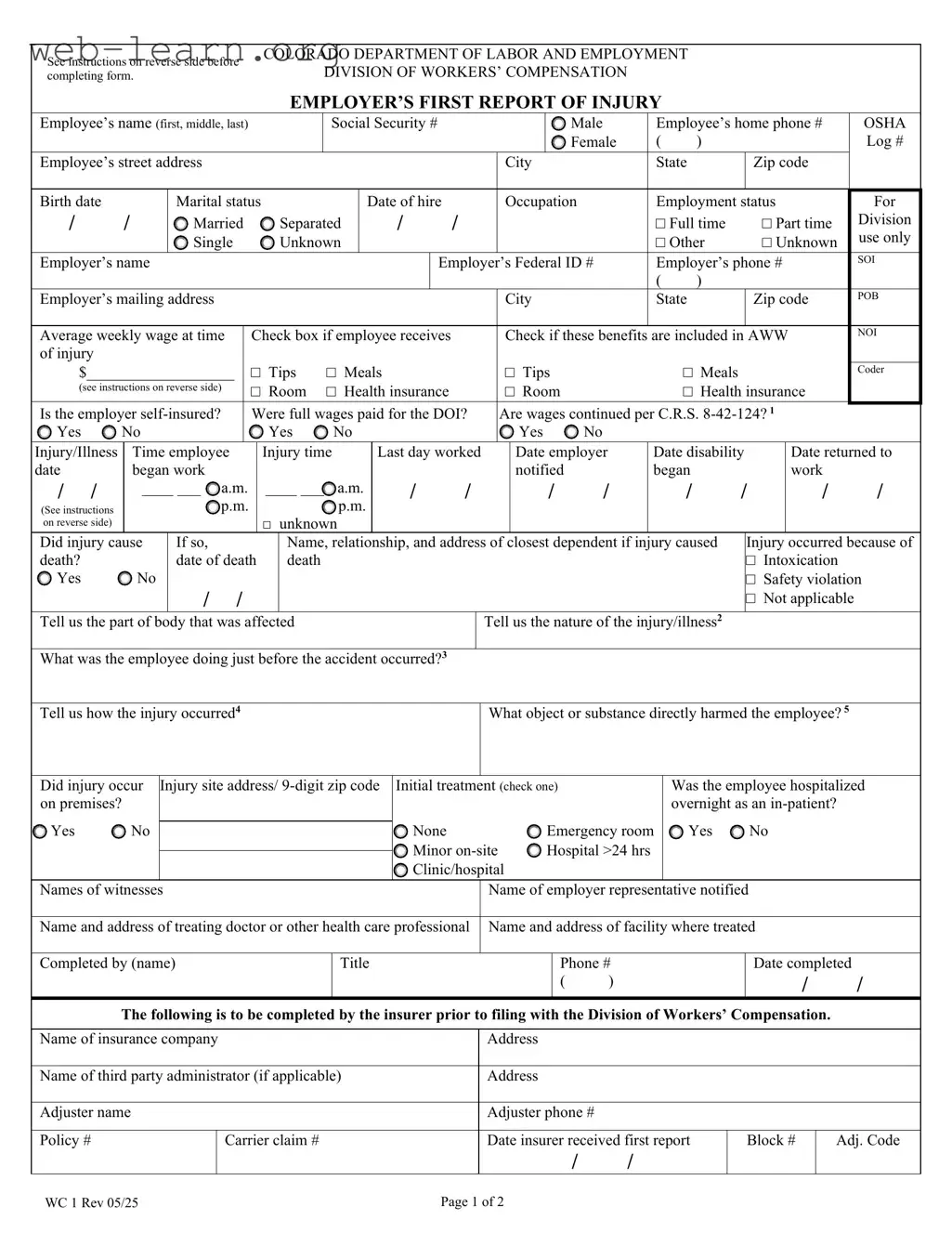
The Colorado WC 1 form, known as the Employer’s First Report of Injury, is a crucial document in the workers' compensation process. This form serves as the initial report that employers must submit to their insurance carriers following an employee's work-related injury or illness. It captures essential information about the injured employee, including their name, address, and social security number, as well as details about the employer and the nature of the injury. The form requires specifics such as the date of the injury, the last day worked, and whether the injury resulted in death. Additionally, it gathers information about the circumstances surrounding the injury, including what the employee was doing at the time and how the injury occurred. Employers must also disclose the average weekly wage of the employee, which can influence compensation calculations. It is important to note that all injuries, regardless of severity, must be reported, particularly those leading to lost time from work. Failure to comply with these reporting requirements can have significant implications for both the employer and the injured employee. By understanding the components and requirements of the WC 1 form, employers can ensure they fulfill their obligations under Colorado's workers' compensation laws, ultimately supporting their employees during a challenging time.

Sample - Colorado Wc 1 Form

COLORADO DEPARTMENT OF LABOR AND EMPLOYMENT
DIVISION OF WORKERS’ COMPENSATION
EMPLOYER’S FIRST REPORT OF INJURY
See instructions on reverse side before
completing form.
Employee’s name
(first, middle, last)
Social Security #
Male
Female
Employee’s home phone #
( )
OSHA
Log #
Employee’s street address
City State Zip code
Birth date
/ /
Married
Separated
Single
Unknown
Date of hire
/ /
Occupation
Employment status
Full time
Other
Part time
Unknown
For
Division
use only
SOI
POB
NOI
Coder
Employer’s name
Employer’s Federal ID #
Employer’s phone #
( )
Employer’s mailing address
City
State
Zip code
Average weekly wage at time
of injury
$___________________
(see instructions on reverse side)
Check box if employee receives
Tips
Meals
Room
Health insurance
Check if these benefits are included in AWW
Tips
Meals
Room Health insurance
Is the employer self-insured?
Yes No
Were full wages paid for the DOI?
Yes No
Are wages continued per C.R.S. 8-42-124?
1
Yes No
Injury/Illness
date
/ /
(See instructions
on reverse side)
Time employee
began work
____ ___ a.m.
p.m.
Injury time
____ ___a.m.
p.m.
unknown
Last day worked
/ /
Date employer
notified
/ /
Date disability
began
/ /
Date returned to
work
/ /
Did injury cause
death?
Yes No
If so,
date of death
/ /
Name, relationship, and address of closest dependent if injury caused
death
Injury occurred because of
Intoxication
Safety violation
Not applicable
Tell us the part of body that was affected
Tell us the nature of the injury/illness
2
What was the employee doing just before the accident occurred?
3
Tell us how the injury occurred
4
What object or substance directly harmed the employee?
5
Did injury occur
on premises?
Yes No
Injury site address/ 9-digit zip code
Initial treatment
(check one)
None
Emergency room
Minor on-site Hospital >24 hrs
Clinic/hospital
Was the employee hospitalized
overnight as an in-patient?
Yes No
Names of witnesses
Name of employer representative notified
Name and address of treating doctor or other health care professional
Name and address of facility where treated
Completed by (name)
Title
Phone #
( )
Date completed
/
/
The following is to be completed by the insurer prior to filing with the Division of Workers’ Compensation.
Name of insurance company
Address
Name of third party administrator (if applicable)
Address
Adjuster name
Adjuster phone #
Policy #
Carrier claim #
Date insurer received first report
/ /
Block #
Adj. Code
WC 1 Rev 05/25
Page 1 of 2
INSTRUCTIONS
This form contains all items requested on OSHA Form No. 301,
“Injuries & Illnesses Incident Report
General
All injuri
es
no matter how trivial must be reported to your insurance company.
All injuries or occupational diseases which result in lost time from work in excess of three shifts or calendar days, or in
permanent physical impairment, must be reported to your insurance carrier on this form within ten days after notice or
knowledge of the injury or disease. Fatalities must be reported to your insurance carrier immediately.
Forms should be typed or printed legibly.
All questions must be answered completely to meet requirements of the Colorado Workers’ Compensation Act and to conform to
the OSHA requirements for Form No. 301.
The employer has the right in the first instance, to select the physician who attends the injured employee.
Calculation of
Average Wee
kly Wage
Determine t
he w
eekly wage rate.
Add the average weekly amount of any overtime wages, tips or commissions.
Add the average weekly value of any board, rent, housing, or lodging provided by the employer if the employer will not be
paying such benefit during the period of disability.
If the employee is covered by group health insurance and the employer does not continue the employee’s health insurance
coverage during the period of disability, add the employee’s cost of conversion to a similar or lesser insurance plan and include
this cost in the average weekly wage computation.
Compute the total from the above categories and insert in the Average weekly wage at time of injury field.
Injury Date Information
In the case of an occupa
tional disease, use the date of the last injurious exposure.
Notes
Are Wages continued per C.
R.S. 8-42-124?
1
(Subject to application with and approval of the Director of the Colorado Division of Workers’ Compensation)
1 Any employer who is subject to the provisions of articles 40 to 47 of this title and who, by separate agreement, working
agreement, contract of hire, or any other procedure, continues to pay a sum in excess of the temporary total disability
benefits prescribed by articles 40 to 47 of this title to any employee temporarily disabled as a result of any injury arising out
of and in the course of such employee's employment and has not charged the employee with any earned vacation leave, sick
leave, or other
similar benefits shall be reimbursed if insured by an insurance carrier or shall take credit if self-insured to the
extent of all moneys that such employee may be eligible to receive as compensation or benefits for temporary partial or
temporary total disability under the provisions of said articles, subject to the approval of the director.
Injury Description (Tell us the part of body that was affected. Tell us the nature of the injury/illness
2
; What was the employee doing
just before the accident occurred?
3
; What happened?
4
; What object or substance directly harmed the employee?
5
)
2 Be more s
pecific than “”hurt”, “pain”, or “sore.” Examples: “strained back
”; “chemical burn, hand”; “carpal tunnel syndrome.”
3 Describe the activity, as well as the tools, equipment or material the e
mployee was using. Be specific. Examples: “climbing a
ladder while carrying roofing materials”; “spraying chlorine from hand sprayer”; or “daily computer key-entry.
4 Tell us how the injury occurred. Examples: “When ladder slipped on wet floor, worker fell 20 feet”; “Worker was sprayed with
chlorine when gasket broke during replacement”; “Worker developed soreness in wrist over time.”
5 Examples: “concrete floor”; “chlorine”; “radial arm saw.” If this question does not apply to the incident, leave it blank
Notices
You are hereby notified that if a child support obligation is owed, compensation benefits may be attached and payment of the
child support obligation may
be withheld and forwarded to the obligee pursuant to sections 8-42-124 and 26-13-122, C.R.S.
YOU ARE FURTHER NOTIFIED that you must provide written notice of any award for social security, pension, disability or
other source of income that might reduce your compensation benefits. This notice must be sent to the insurance carrier or
self-insured employer within 20 days after learning of the payment or award. Failure to report may result in suspension of
your benefits pursuant to section 8-42-113.5, C.R.S.
C.R.S. Section 10-1-128 states: “It is unlawful to knowingly provide false, incomplete, or misleading facts or information to
an insurance company for the purposes of defrauding or attempting to defraud the company. Penalties may include
imprisonment, fines, denial of insurance, and civil damages. Any insurance company or agent of an insurance company who
knowingly provides false, incomplete, or misleading facts or information to a policyholder or claimant for the purpose of
defrauding or attempting to defraud the policyholder or claimant with regard to a settlement or award payable from
insurance proceeds shall be reported to the Colorado division of insurance within the department of regulatory agencies.”
WC 1 Rev 05/25
Page 2 of 2

Form Information

Fact Name Description
Form Purpose The Colorado WC 1 form is used to report work-related injuries or illnesses to the employer's insurance carrier.
Governing Law The form is governed by the Colorado Workers' Compensation Act, specifically C.R.S. 8-42-124.
Reporting Timeframe Injuries that result in lost time must be reported within ten days of notice or knowledge of the injury.
Injury Types All injuries, regardless of severity, must be reported, including occupational diseases and fatalities.
Employee Information The form requires detailed employee information, including name, address, Social Security number, and employment status.
Employer Responsibilities Employers must select the physician for the injured employee's treatment and report injuries promptly.
Average Weekly Wage Calculation The average weekly wage is calculated by considering overtime, tips, and other benefits provided by the employer.
Witness Information The form allows for the inclusion of witnesses to the injury, which can be crucial for claims processing.
Penalties for Misrepresentation Providing false information on the form can lead to penalties, including fines and imprisonment, as stated in C.R.S. 10-1-128(6)(a).

Detailed Guide for Filling Out Colorado Wc 1

Filling out the Colorado WC 1 form is an essential step in reporting a workplace injury. Accurate completion of this form ensures that all necessary information is provided for the employer's insurance carrier. Follow these steps carefully to ensure the form is filled out correctly.

  1. Begin by entering the employee's name (first, middle, last) at the top of the form.
  2. Fill in the employee's street address, city, state, and zip code.
  3. Provide the employee's Social Security number.
  4. Indicate the date of hire and the employee's birth date.
  5. Select the employee's gender (Male/Female) and marital status (Married/Single/Separated/Unknown).
  6. Specify the employee's home phone number and occupation.
  7. Enter the employer's name and Federal ID number.
  8. Provide the employer's mailing address and phone number, including the OSHA log number.
  9. Calculate and enter the average weekly wage at the time of injury, including any tips, meals, or health insurance benefits.
  10. Check the box if the employee is self-insured and indicate if full wages were paid for the date of injury.
  11. Fill in the injury/illness date, last day worked, date employer was notified, date disability began, and date returned to work.
  12. Record the time the employee began work and the time of the injury.
  13. Indicate whether the injury caused death and provide the date of death if applicable.
  14. List the part of the body affected and describe what the employee was doing just before the accident occurred.
  15. Explain how the injury occurred and identify the object or substance that directly harmed the employee.
  16. State whether the injury occurred on the premises and provide the injury site address.
  17. Check the appropriate box for initial treatment received and indicate if the employee was hospitalized overnight.
  18. List the names of any witnesses and the employer representative notified.
  19. Provide the name and address of the treating doctor or healthcare professional.
  20. Complete the form with the name, title, and phone number of the person filling it out, along with the date completed.
  21. Ensure the insurance company and adjuster information is filled out prior to filing with the Division of Workers’ Compensation.

Obtain Answers on Colorado Wc 1

  1. What is the Colorado WC 1 form?

    The Colorado WC 1 form, also known as the Employer’s First Report of Injury, is a document that employers must complete to report workplace injuries or illnesses. This form is essential for initiating a claim for workers' compensation benefits and must be submitted to the insurance carrier within a specific timeframe after an injury occurs.

  2. When should the WC 1 form be filed?

    Employers must file the WC 1 form within ten days after they are notified of an injury or illness that results in lost time from work exceeding three shifts or calendar days. If the injury results in death, the form must be submitted immediately.

  3. What information is required on the WC 1 form?

    The form requires detailed information about the employee, including their name, address, Social Security number, date of hire, and employment status. Additionally, it asks for specifics about the injury, such as the date it occurred, the nature of the injury, and the circumstances surrounding the accident.

  4. How do I calculate the Average Weekly Wage (AWW)?

    To calculate the AWW, add the employee's regular weekly wage to any average weekly overtime, tips, or commissions. If the employer provides benefits like housing or health insurance that will not continue during the disability period, include their average weekly value in the calculation. The total should be recorded in the designated field on the form.

  5. What happens if the injury leads to death?

    If the injury causes death, the form must indicate this, and the employer should provide the name, relationship, and address of the closest dependent. This information is crucial for the processing of any death benefits that may be applicable.

  6. Can employers choose the treating physician?

    Yes, under Colorado law, employers have the right to select the physician who will treat the injured employee. This is an important aspect of managing workers' compensation claims effectively.

  7. What if the employee was intoxicated at the time of the injury?

    If the injury occurred due to intoxication, this should be noted on the form. Intoxication can affect the eligibility for benefits, so it’s essential to provide accurate information regarding the circumstances of the injury.

  8. What are the consequences of providing false information?

    Providing false, incomplete, or misleading information on the WC 1 form is unlawful and can result in severe penalties. This includes potential imprisonment, fines, or denial of insurance claims. It’s crucial to ensure that all information is accurate and truthful.

  9. How should the WC 1 form be submitted?

    The completed form should be submitted to the employee’s insurance carrier. It is recommended to keep a copy for your records. Ensure that the form is filled out legibly and completely to avoid delays in processing the claim.

Common mistakes

Completing the Colorado WC 1 form accurately is crucial for ensuring that workers' compensation claims are processed smoothly. One common mistake is failing to provide complete and accurate personal information. For instance, if the employee’s name or Social Security number is incorrect, it can lead to delays or even denial of benefits. Always double-check that all names are spelled correctly and that all identification numbers are accurate.

Another frequent error occurs in the section regarding the average weekly wage. Many individuals miscalculate this figure, which can have significant implications for the benefits the employee may receive. It is essential to include not only the base salary but also any overtime, tips, or other compensation that may apply. Neglecting to factor in these additional earnings can result in an inadequate compensation amount, impacting the employee’s financial stability during recovery.

People often overlook the importance of providing detailed information about the injury itself. Vague descriptions can lead to misunderstandings and complications in the claims process. For example, instead of simply stating “hurt back,” it is better to specify the nature of the injury, such as “strained lower back while lifting a heavy box.” Clear and specific descriptions help in accurately assessing the situation and determining the appropriate benefits.

Additionally, some individuals fail to check all relevant boxes in the form. Each checkbox serves a purpose and provides necessary information for the claim. Skipping these can create gaps in the report, leading to further inquiries and delays. It is advisable to carefully review each section and ensure that all applicable boxes are checked before submission.

Lastly, many people neglect to keep a copy of the completed form for their records. This oversight can create difficulties if there are questions or disputes later on. Retaining a copy ensures that both the employee and the employer have access to the information submitted, which can be invaluable for follow-up communications. Keeping thorough records is always a best practice in any legal or administrative process.

Documents used along the form

When dealing with workplace injuries in Colorado, the WC 1 form, or the Employer's First Report of Injury, is just one piece of the puzzle. Several other forms and documents are often required to ensure that all aspects of the workers' compensation process are properly addressed. Here’s a brief overview of five commonly used documents that accompany the WC 1 form.

  • WC 2 - Employer's Supplemental Report of Injury: This form is used to provide additional information about the employee's injury after the initial report has been filed. It helps keep the workers' compensation insurer updated on the employee's condition and any changes in treatment or recovery status.
  • WC 3 - Employee's Claim for Compensation: This document is completed by the injured employee to formally request compensation benefits. It outlines the specifics of the injury, the impact on the employee's ability to work, and any medical treatment received.
  • WC 4 - Notice of Contest: If the employer or insurance company disputes the claim, they may file this form to formally contest the employee's right to benefits. It details the reasons for the contest and initiates the dispute resolution process.
  • WC 5 - Notice of Acceptance or Denial: After reviewing the claim, the insurance carrier issues this notice to inform the employee whether their claim has been accepted or denied. It provides crucial information regarding the next steps for the employee.
  • WC 6 - Medical Report: This form is typically completed by the treating physician and provides detailed medical information about the injury, treatment received, and the employee's prognosis. It plays a vital role in determining the employee's eligibility for benefits.

Understanding these documents can significantly streamline the workers' compensation process. Each form serves a specific purpose, ensuring that both the employer and employee have a clear understanding of the situation and the steps that need to be taken. Properly managing these forms can help facilitate timely compensation and support for injured workers.

Similar forms

The Colorado WC 1 form is a crucial document for reporting workplace injuries. Several other forms serve similar purposes in different contexts. Here’s a list of ten documents that share similarities with the Colorado WC 1 form:

  • OSHA Form 301: This form is used to record work-related injuries and illnesses. Like the WC 1, it requires detailed information about the incident, the employee, and the nature of the injury.
  • First Report of Injury (FROI): Many states have their own versions of the FROI. This document serves to notify the workers' compensation insurance carrier about an employee's injury, similar to the WC 1 form.
  • Employee Incident Report: This internal document is often used by employers to document workplace accidents. It collects similar information about the incident and the employee as the WC 1 form.
  • Workers' Compensation Claim Form: This form is filed by employees to claim benefits after an injury. It includes details about the injury and is akin to the WC 1 in terms of information required.
  • Return to Work Form: This document is used to communicate an employee's ability to return to work after an injury. It often references the original injury report, similar to the WC 1.
  • Medical Release Form: This form allows employers to obtain medical information about an injured employee. It complements the WC 1 by ensuring that the employer can follow up on the employee's recovery.
  • Incident Investigation Report: This report is created following a workplace incident to analyze what happened. It often includes information found on the WC 1, such as the nature of the injury and circumstances surrounding it.
  • Health and Safety Incident Report: This form is used to report any health and safety incidents in the workplace. It gathers similar data as the WC 1, focusing on the injury and contributing factors.
  • Accident Report Form: Many organizations use this form to document workplace accidents. It collects essential details about the incident, much like the WC 1 form does.
  • Claim for Compensation Form: This form is often used to initiate a claim for compensation benefits due to a workplace injury. It parallels the WC 1 in its purpose of documenting the injury and initiating the claims process.

Dos and Don'ts

When completing the Colorado WC 1 form, attention to detail is crucial. Here are some key dos and don'ts to ensure the process goes smoothly.

  • Do provide accurate and complete information for the employee's name, address, and Social Security number.
  • Do report all injuries, regardless of how minor they may seem, to the insurance company.
  • Do ensure that all questions on the form are answered fully to comply with Colorado Workers’ Compensation requirements.
  • Do type or print the form legibly to avoid any misunderstandings or errors.
  • Don't leave any sections blank; incomplete forms can lead to delays in processing.
  • Don't provide misleading or false information, as this can result in serious penalties.

By following these guidelines, you can help facilitate a smoother reporting process and ensure compliance with state regulations.

Misconceptions

Here are five misconceptions about the Colorado WC 1 form that need clarification:

  • All injuries must be reported within 24 hours. Many believe that all injuries need immediate reporting. In reality, injuries that result in lost time beyond three shifts or days must be reported within ten days of the employer's knowledge.
  • The form is only for serious injuries. Some think the WC 1 form is only necessary for severe injuries. However, all injuries, regardless of severity, should be reported to ensure proper documentation and compliance.
  • Employers can choose any doctor for the injured employee. While employers have the right to select the initial physician, employees may have preferences that should be considered. This can lead to better care and recovery.
  • Only full-time employees are covered. There is a misconception that only full-time employees are eligible for benefits. Part-time employees are also covered under workers' compensation if they meet the criteria.
  • The WC 1 form is optional. Some may think that submitting the WC 1 form is optional. In fact, it is mandatory for any work-related injury that meets the reporting criteria.

Key takeaways

When filling out the Colorado WC 1 form, it’s important to keep several key points in mind:

  • Report All Injuries: Every injury, no matter how minor, must be reported to your insurance company. This includes injuries that may not seem serious at first.
  • Timely Submission: If an injury results in lost work time exceeding three shifts or calendar days, it must be reported within ten days. Fatalities require immediate notification.
  • Complete Information: Ensure that all questions on the form are answered fully. Incomplete forms may delay processing and could lead to complications.
  • Average Weekly Wage Calculation: Accurately calculate the average weekly wage by including overtime, tips, and any other benefits. This figure is crucial for determining compensation.

By following these guidelines, you can help ensure that the process runs smoothly and that all necessary information is provided for a timely response from your insurance carrier.