The Colorado Transfer-on-Death Deed (TOD Deed) offers a straightforward way for property owners to transfer their real estate to designated beneficiaries upon their passing, without the need for probate. This legal document allows individuals to retain full control of their property during their lifetime, ensuring that they can sell, mortgage, or change their mind about the transfer at any time. The TOD Deed is particularly appealing because it simplifies the transfer process, allowing heirs to inherit property directly, which can save time and reduce costs associated with traditional estate planning methods. To create a valid TOD Deed, specific requirements must be met, including proper execution and recording with the county clerk and recorder. Beneficiaries named in the deed will receive the property automatically upon the owner’s death, making it an efficient option for those looking to streamline their estate planning. Understanding the nuances of the TOD Deed can empower property owners to make informed decisions about their assets and their legacy.
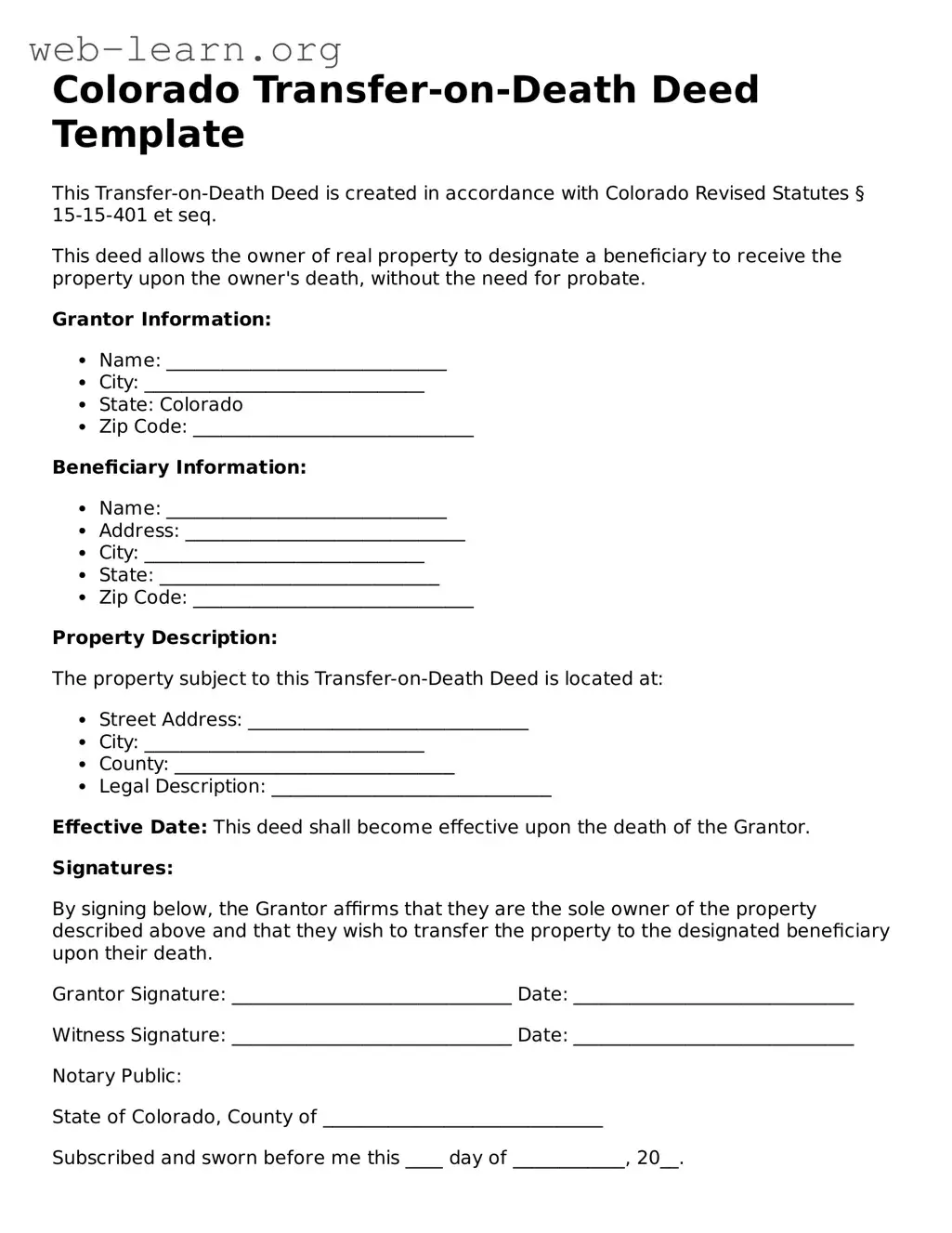
Colorado Transfer-on-Death Deed Template
This Transfer-on-Death Deed is created in accordance with Colorado Revised Statutes § 15-15-401 et seq.
This deed allows the owner of real property to designate a beneficiary to receive the property upon the owner's death, without the need for probate.
Grantor Information:
Beneficiary Information:
Property Description:
The property subject to this Transfer-on-Death Deed is located at:
Effective Date: This deed shall become effective upon the death of the Grantor.
Signatures:
By signing below, the Grantor affirms that they are the sole owner of the property described above and that they wish to transfer the property to the designated beneficiary upon their death.
Grantor Signature: ______________________________ Date: ______________________________
Witness Signature: ______________________________ Date: ______________________________
Notary Public:
State of Colorado, County of ______________________________
Subscribed and sworn before me this ____ day of ____________, 20__.
Notary Signature: ______________________________
My commission expires: ______________________________
| Fact Name | Details |
|---|---|
| Definition | A Transfer-on-Death Deed allows an individual to transfer real property to a beneficiary upon the individual's death without going through probate. |
| Governing Law | The Transfer-on-Death Deed is governed by Colorado Revised Statutes, Title 15, Article 15.5. |
| Eligibility | Any individual who owns real property in Colorado can execute a Transfer-on-Death Deed. |
| Beneficiary Designation | The deed allows for one or more beneficiaries to be named, who will inherit the property upon the owner's death. |
| Revocation | The Transfer-on-Death Deed can be revoked at any time by the property owner, provided the revocation is executed in writing. |
| Recording Requirement | To be effective, the deed must be recorded with the county clerk and recorder in the county where the property is located. |
| Impact on Taxes | The transfer of property through a Transfer-on-Death Deed does not affect the property owner's tax obligations during their lifetime. |
Filling out the Colorado Transfer-on-Death Deed form is a straightforward process. Once you complete the form, it will need to be filed with the appropriate county clerk and recorder's office. This step is crucial for ensuring the deed is valid and recognized by the state.
What is a Transfer-on-Death (TOD) Deed in Colorado?
A Transfer-on-Death Deed is a legal document that allows property owners in Colorado to designate a beneficiary who will receive their property upon their death. This deed enables the property to transfer outside of probate, simplifying the process for your heirs. It’s a straightforward way to ensure your property goes directly to the person you choose without the delays and costs associated with probate court.
How do I create a Transfer-on-Death Deed?
Creating a TOD Deed involves several steps:
Once recorded, the deed becomes effective, and your chosen beneficiaries will inherit the property upon your death.
Can I change or revoke a Transfer-on-Death Deed?
Yes, you can change or revoke a TOD Deed at any time while you are alive. To do this, you must create a new deed that either designates different beneficiaries or explicitly revokes the previous deed. It’s essential to follow the same recording process to ensure that the new deed is valid and recognized.
Are there any limitations on who can be a beneficiary?
In Colorado, you can designate individuals, such as family members or friends, as beneficiaries. However, you cannot name an entity, like a corporation or trust, as a beneficiary. Additionally, all beneficiaries must be alive at the time of your death for the transfer to be valid. If a beneficiary predeceases you, their share may pass to their heirs or be divided among the surviving beneficiaries, depending on how the deed is structured.
What happens if I have debts at the time of my death?
If you have outstanding debts when you pass away, those debts must be settled before any property transfers to your beneficiaries. The property may be subject to claims from creditors, which means that it could be sold to pay off those debts. However, because a TOD Deed allows for a direct transfer to beneficiaries, the property itself typically avoids the probate process, which can be beneficial in managing your estate.
Filling out a Colorado Transfer-on-Death Deed form can be straightforward, but many people make common mistakes that can lead to complications down the road. One frequent error is failing to include all necessary property details. When you don’t specify the exact address or legal description of the property, it can create confusion and might even invalidate the deed.
Another mistake often seen is neglecting to sign the document properly. In Colorado, both the grantor and the witnesses must sign the deed for it to be valid. Forgetting this step can render the entire transfer ineffective, causing delays and potential disputes among heirs.
People sometimes overlook the importance of recording the deed with the county clerk and recorder. Even if the form is filled out correctly, if it isn’t filed, the transfer won’t take effect upon the grantor's death. This can lead to the property being treated as part of the estate, which can complicate the probate process.
Misunderstanding the implications of the Transfer-on-Death Deed is another common pitfall. Some individuals mistakenly believe that it offers the same protections as a living trust. However, this deed does not provide asset protection during the grantor's lifetime, which can lead to unexpected consequences if the grantor faces financial difficulties.
Finally, failing to communicate intentions with heirs can create confusion and conflict. If family members are unaware of the deed or its implications, they may have unrealistic expectations about inheritance. Clear communication can help prevent disputes and ensure that the grantor’s wishes are understood and respected.
The Colorado Transfer-on-Death Deed form is a valuable tool for individuals looking to simplify the transfer of property upon death. However, there are several other forms and documents that may be needed in conjunction with this deed to ensure a smooth transfer process. Below is a list of commonly used documents that can complement the Transfer-on-Death Deed.
Utilizing these forms alongside the Colorado Transfer-on-Death Deed can help ensure that property is transferred smoothly and according to the individual's wishes. Each document plays a distinct role in the estate planning process, contributing to a comprehensive strategy for asset management and transfer.
The Transfer-on-Death Deed form has similarities with several other legal documents. Each serves a purpose related to property transfer or estate planning. Here are nine documents that share characteristics with the Transfer-on-Death Deed:
When filling out the Colorado Transfer-on-Death Deed form, it's important to follow certain guidelines to ensure the process goes smoothly. Here’s a list of things you should and shouldn’t do:
Misconception 1: The Transfer-on-Death Deed automatically transfers property upon the owner's death.
This is incorrect. The deed only takes effect upon the death of the owner. Until that time, the owner retains full control over the property, including the ability to sell or mortgage it.
Misconception 2: A Transfer-on-Death Deed avoids probate entirely.
While it can simplify the transfer process and may help avoid some probate complications, it does not eliminate the need for probate in all situations. Certain debts or claims against the estate may still require probate proceedings.
Misconception 3: The Transfer-on-Death Deed is only for individuals without a will.
This is not true. Individuals with a will can also use a Transfer-on-Death Deed to designate beneficiaries for specific properties, providing an additional layer of estate planning.
Misconception 4: Once a Transfer-on-Death Deed is recorded, it cannot be changed.
This is misleading. The owner can revoke or change the deed at any time before death, as long as they follow the proper legal procedures to do so.
Filling out and using the Colorado Transfer-on-Death Deed form can be a straightforward process, but it is essential to understand its implications and requirements. Here are key takeaways to consider:
Does a Beneficiary Deed Avoid Probate - A Transfer-on-Death Deed is effective immediately upon signing, but the transfer occurs only after death.
Transfer on Death Deed Connecticut - It’s an empowering tool that allows you to take charge of your legacy and how your property is handled after your death.
Arizona Beneficiary Deed - Transfer-on-Death Deeds can help avoid potential conflicts among heirs.
Arkansas Beneficiary Deed Pdf - Transfer-on-Death Deeds can be particularly useful for single property owners.