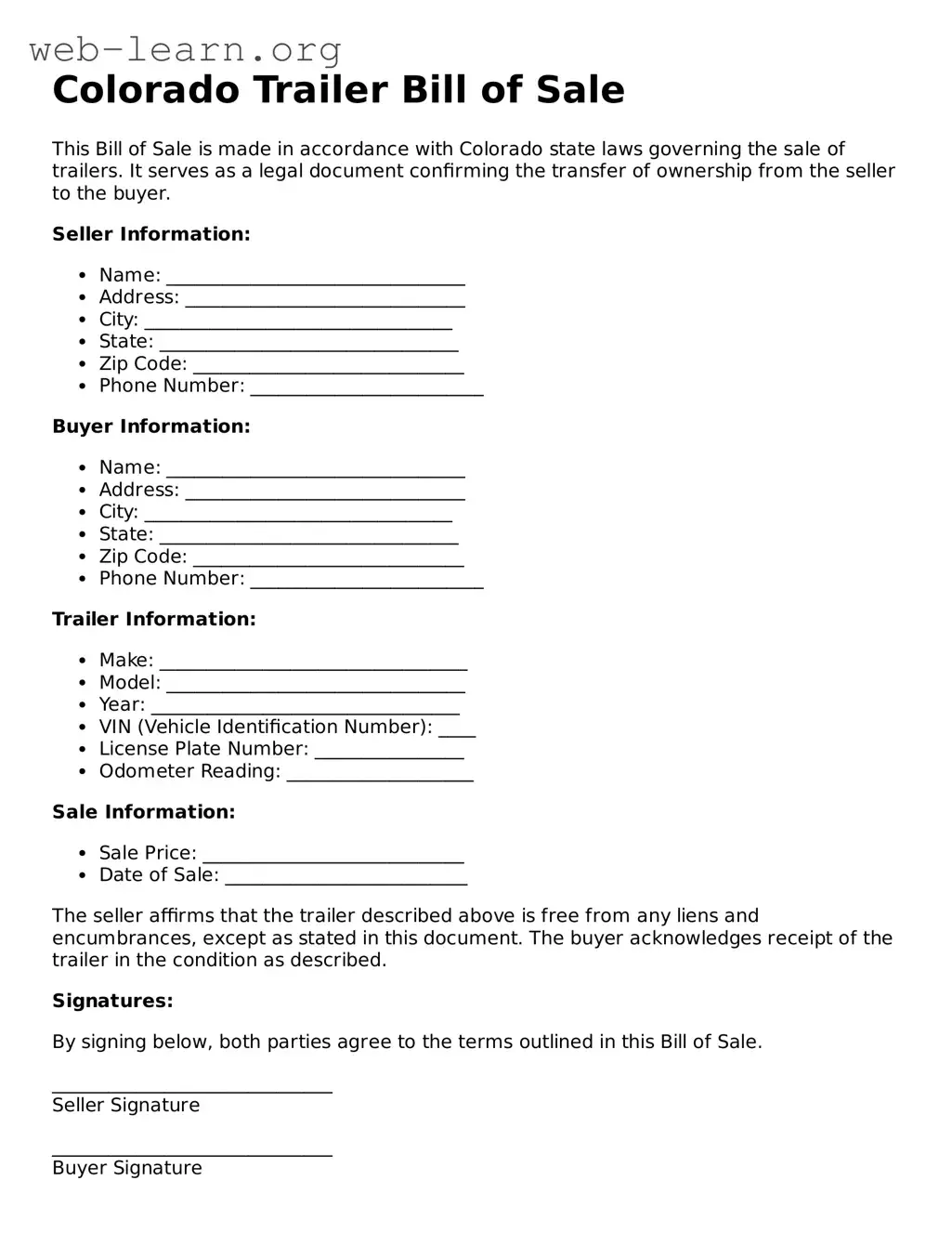
The Colorado Trailer Bill of Sale form serves as a crucial document for individuals involved in the buying or selling of a trailer within the state. This form not only provides essential information about the transaction but also helps establish legal ownership. It typically includes details such as the buyer's and seller's names and addresses, a description of the trailer—including its make, model, year, and Vehicle Identification Number (VIN)—and the sale price. In addition, the form may require the seller's signature, confirming that they are transferring ownership of the trailer. Properly completing this document is vital for both parties, as it ensures that the transaction is recorded and recognized by the state, thereby protecting the rights of the buyer and seller alike. Utilizing the Colorado Trailer Bill of Sale form can streamline the process of ownership transfer and provide peace of mind during what can often be a complex transaction.
Colorado Trailer Bill of Sale
This Bill of Sale is made in accordance with Colorado state laws governing the sale of trailers. It serves as a legal document confirming the transfer of ownership from the seller to the buyer.
Seller Information:
Buyer Information:
Trailer Information:
Sale Information:
The seller affirms that the trailer described above is free from any liens and encumbrances, except as stated in this document. The buyer acknowledges receipt of the trailer in the condition as described.
Signatures:
By signing below, both parties agree to the terms outlined in this Bill of Sale.
______________________________
Seller Signature
______________________________
Buyer Signature
Date: _____________________________
| Fact Name | Description |
|---|---|
| Purpose | The Colorado Trailer Bill of Sale form is used to document the sale and transfer of ownership of a trailer. |
| Governing Law | This form is governed by the Colorado Revised Statutes, specifically Title 42, which covers motor vehicles. |
| Required Information | Buyers and sellers must provide their names, addresses, and signatures on the form. |
| Trailer Details | Specific details about the trailer, including make, model, year, and Vehicle Identification Number (VIN), must be included. |
| Sales Price | The sale price of the trailer should be clearly stated to reflect the transaction value. |
| Notarization | While notarization is not mandatory, it is recommended to add an extra layer of authenticity to the transaction. |
| Tax Implications | Buyers may need to pay sales tax based on the purchase price when registering the trailer. |
| Record Keeping | Both parties should retain a copy of the completed bill of sale for their records. |
| Transfer of Title | The bill of sale is often required to facilitate the transfer of the trailer's title at the Department of Motor Vehicles (DMV). |
| Availability | The Colorado Trailer Bill of Sale form can be obtained online or at local DMV offices. |
Once you have the Colorado Trailer Bill of Sale form in front of you, it's time to fill it out accurately. This form will require specific details about the trailer and the transaction. Completing it correctly ensures a smooth transfer of ownership.
After completing the form, ensure that both parties retain a copy for their records. This will serve as proof of the transaction for future reference.
What is a Trailer Bill of Sale in Colorado?
A Trailer Bill of Sale is a legal document used to transfer ownership of a trailer from one person to another in the state of Colorado. This form provides a record of the transaction, outlining essential details such as the buyer's and seller's information, the trailer's description, and the sale price. It serves as proof of ownership for the buyer and can be essential for registration purposes.
What information is required on the Trailer Bill of Sale?
To complete a Trailer Bill of Sale in Colorado, several key pieces of information must be included:
Including all this information ensures that the document is complete and legally binding.
Is the Trailer Bill of Sale required for registration?
Yes, the Trailer Bill of Sale is often required when registering a trailer in Colorado. When you go to the Department of Motor Vehicles (DMV) to register your trailer, you will need to present this document along with other necessary paperwork. It verifies that you are the rightful owner of the trailer and provides a record of the transaction. Failing to provide this document may delay the registration process.
Can I create my own Trailer Bill of Sale?
Yes, you can create your own Trailer Bill of Sale, but it is important to ensure that it includes all the required information to be valid in Colorado. Many templates are available online that can guide you in drafting your own document. However, using a standard form from the DMV or a legal professional can help ensure that all legal requirements are met and that the document is properly formatted.
Filling out the Colorado Trailer Bill of Sale form can seem straightforward, but many people make common mistakes that can lead to issues later on. One frequent error is not providing complete information about the trailer. It's essential to include details such as the make, model, year, and Vehicle Identification Number (VIN). Omitting any of this information can create confusion and may even complicate the registration process.
Another common mistake is failing to accurately list the sale price. This figure should reflect the actual amount paid for the trailer. If the price is left blank or is listed incorrectly, it may raise questions during the transfer of ownership or when calculating taxes.
Many individuals also overlook the importance of both the seller's and buyer's signatures. Both parties must sign the form to validate the sale. Without these signatures, the bill of sale may not be considered legally binding, leaving both parties vulnerable to potential disputes.
Additionally, some people forget to date the form. Including the date of the sale is crucial for record-keeping and can be important if any issues arise in the future. A missing date can lead to misunderstandings about when the transaction took place.
Not providing accurate contact information is another mistake that can cause problems. Both the seller and buyer should ensure that their names, addresses, and phone numbers are clearly written on the form. This information is vital for communication should any questions arise after the sale.
Another error involves not checking local requirements. While the Colorado Trailer Bill of Sale form is standardized, some counties may have additional requirements. It's wise to verify whether any extra documentation is needed to avoid complications during the registration process.
People sometimes forget to make copies of the completed bill of sale. Keeping a copy for personal records is important for both the buyer and seller. This documentation serves as proof of the transaction and can be useful in case of future disputes or inquiries.
In some instances, individuals do not include a description of the trailer's condition. Providing details about the trailer's condition at the time of sale can help prevent misunderstandings later on. Buyers appreciate knowing whether the trailer has any existing issues, and this transparency fosters trust between both parties.
Finally, not understanding the implications of the bill of sale can lead to problems. This document is not just a receipt; it officially transfers ownership. Buyers should ensure they are ready to take on the responsibilities that come with ownership, including registration and insurance. Being informed helps make the transaction smoother and more successful for everyone involved.
When completing a transaction involving a trailer in Colorado, several forms and documents may be necessary in addition to the Trailer Bill of Sale. These documents help ensure a smooth transfer of ownership and compliance with state regulations. Below is a list of commonly used documents that may accompany the Trailer Bill of Sale.
Gathering these documents will help facilitate a successful trailer transaction in Colorado. It is important to ensure all paperwork is completed accurately to avoid any issues in the future.
The Trailer Bill of Sale form is an important document for transferring ownership of a trailer. Several other documents serve similar purposes in different contexts. Here’s a list of those documents and how they relate to the Trailer Bill of Sale:
When filling out the Colorado Trailer Bill of Sale form, it’s essential to follow specific guidelines to ensure the process goes smoothly. Here are eight important dos and don’ts.
When dealing with the Colorado Trailer Bill of Sale form, several misconceptions can lead to confusion. Understanding these can help ensure a smoother transaction process.
This is incorrect. The Colorado Trailer Bill of Sale form is required for both new and used trailers. Regardless of the age of the trailer, proper documentation is essential for legal ownership transfer.
While having a notary can add an extra layer of authenticity, it is not a legal requirement in Colorado. The bill of sale can be valid without notarization as long as it is signed by both the buyer and the seller.
This is a misunderstanding. Including the Vehicle Identification Number (VIN) is crucial. The VIN uniquely identifies the trailer and is necessary for registration and title purposes.
Using a generic template can lead to issues. It's best to use the specific Colorado Trailer Bill of Sale form to ensure all state requirements are met, preventing potential legal complications down the line.
When filling out and using the Colorado Trailer Bill of Sale form, keep these key takeaways in mind:
Bill of Sale Print - The Trailer Bill of Sale can be a simple yet effective way to formalize a trailer sale.
Bull of Sale - The Trailer Bill of Sale is often required when applying for a new title.
Ky Trailer Laws - This document can promote accountability in the buying and selling process.