Homepage Blank Colorado Summons Form
Outline

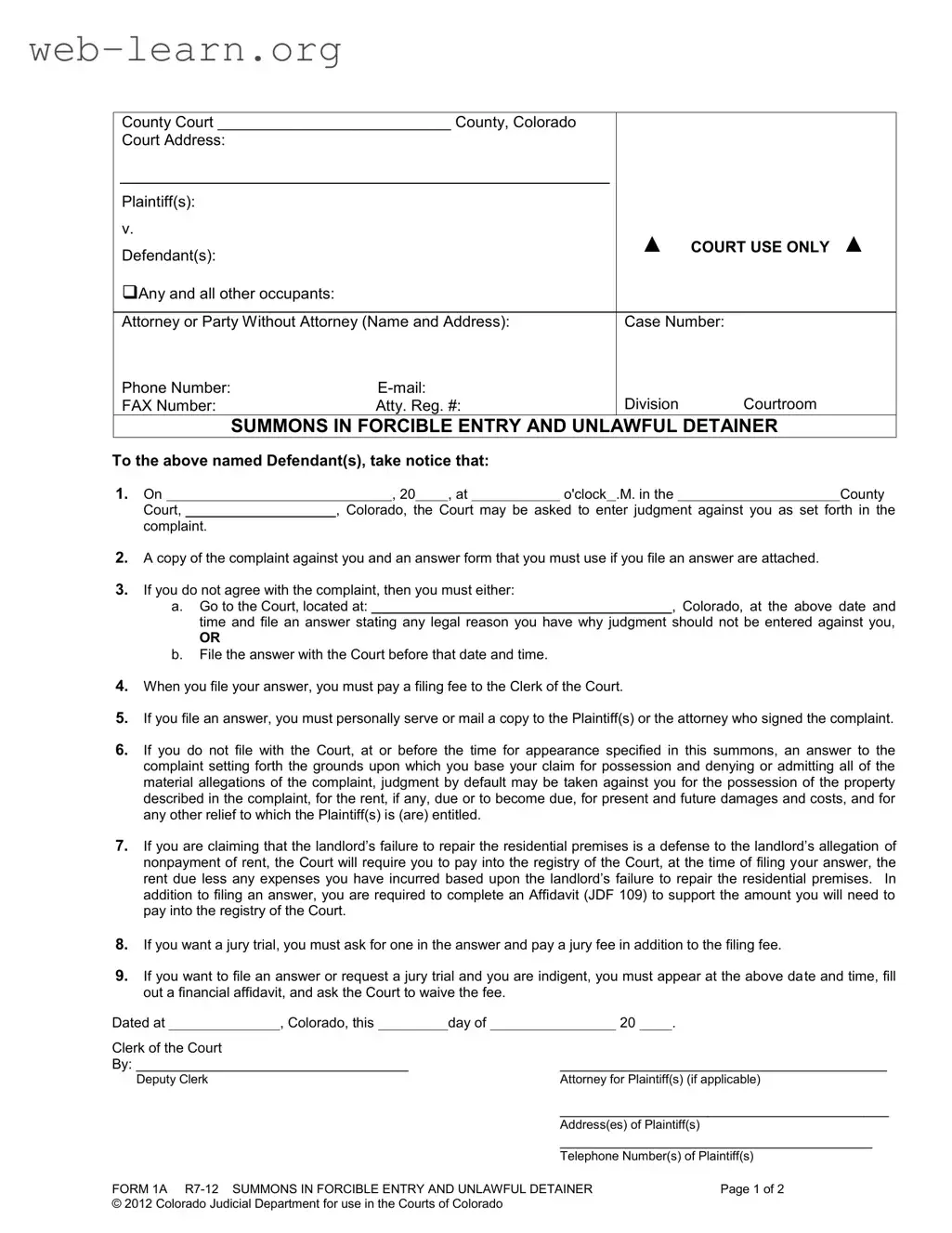
The Colorado Summons form plays a crucial role in the legal process surrounding forcible entry and unlawful detainer actions. This document serves as a formal notification to defendants, informing them of the impending court proceedings. It outlines essential information, including the court's address, the names of the parties involved, and the case number. The summons specifies the date and time when the court will consider the plaintiff's complaint, urging defendants to respond appropriately. Attached to the summons are a copy of the complaint and an answer form, which the defendant must complete if they wish to contest the claims made against them. The form emphasizes the importance of timely action, detailing the consequences of failing to respond, such as the potential for a default judgment. Additionally, it addresses specific circumstances, such as defenses related to the landlord's failure to repair the premises, and provides guidance for those who may be unable to afford filing fees. The clarity and structure of the Colorado Summons form are designed to ensure that all parties understand their rights and responsibilities within the legal framework, fostering a fair process for resolving disputes over property possession.


Sample - Colorado Summons Form

FORM 1A R7-12 SUMMONS IN FORCIBLE ENTRY AND UNLAWFUL DETAINER Page 1 of 2
© 2012 Colorado Judicial Department for use in the Courts of Colorado
County Court ___________________________ County, Colorado
Court Address:
Plaintiff(s):
v.
Defendant(s):
Any and all other occupants:
COURT USE ONLY
Attorney or Party Without Attorney (Name and Address):
Phone Number: E-mail:
FAX Number: Atty. Reg. #:
Case Number:
Division Courtroom
SUMMONS IN FORCIBLE ENTRY AND UNLAWFUL DETAINER
To the above named Defendant(s), take notice that:
1. On , 20 , at o'clock .M. in the County
Court, , Colorado, the Court may be asked to enter judgment against you as set forth in the
complaint.
2. A copy of the complaint against you and an answer form that you must use if you file an answer are attached.
3. If you do not agree with the complaint, then you must either:
a. Go to the Court, located at: , Colorado, at the above date and
time and file an answer stating any legal reason you have why judgment should not be entered against you,
OR
b. File the answer with the Court before that date and time.
4. When you file your answer, you must pay a filing fee to the Clerk of the Court.
5. If you file an answer, you must personally serve or mail a copy to the Plaintiff(s) or the attorney who signed the complaint.
6. If you do not file with the Court, at or before the time for appearance specified in this summons, an answer to the
complaint setting forth the grounds upon which you base your claim for possession and denying or admitting all of the
material allegations of the complaint, judgment by default may be taken against you for the possession of the property
described in the complaint, for the rent, if any, due or to become due, for present and future damages and costs, and for
any other relief to which the Plaintiff(s) is (are) entitled.
7. If you are claiming that the landlord’s failure to repair the residential premises is a defense to the landlord’s allegation of
nonpayment of rent, the Court will require you to pay into the registry of the Court, at the time of filing your answer, the
rent due less any expenses you have incurred based upon the landlord’s failure to repair the residential premises. In
addition to filing an answer, you are required to complete an Affidavit (JDF 109) to support the amount you will need to
pay into the registry of the Court.
8. If you want a jury trial, you must ask for one in the answer and pay a jury fee in addition to the filing fee.
9. If you want to file an answer or request a jury trial and you are indigent, you must appear at the above date and time, fill
out a financial affidavit, and ask the Court to waive the fee.
Dated at , Colorado, this day of 20 .
Clerk of the Court
By: ___________________________________ __________________________________________
Deputy Clerk Attorney for Plaintiff(s) (if applicable)
________________________________________
Address(es) of Plaintiff(s)
______________________________________
Telephone Number(s) of Plaintiff(s)
FORM 1A R7-12 SUMMONS IN FORCIBLE ENTRY AND UNLAWFUL DETAINER Page 2 of 2
© 2012 Colorado Judicial Department for use in the Courts of Colorado
This Summons is issued pursuant to §13-40-111, C.R.S. A copy of the Complaint together with a blank answer form must be
served with this Summons. This form should be used only for actions filed under Colorado's Forcible Entry and Detainer Act.
To the clerk: If this Summons is issued by the Clerk of the Court, the signature block for the clerk, deputy and the seal of the
Court should be provided by stamp, or typewriter, in the space to the left of the attorney's name.
WARNING: ALL FEES ARE NON-REFUNDABLE. IN SOME CASES, A REQUEST FOR A JURY TRIAL MAY BE DENIED
PURSUANT TO LAW EVEN THOUGH A JURY FEE HAS BEEN PAID.
CERTIFICATE OF MAILING
I/we, the undersigned Plaintiff(s) (or agent for Plaintiff(s)), certify that on ____________________(date), the date
on which the Summons, Complaint, and Answer were filed, I/we mailed a copy of the Summons/Alias Summons,
a copy of the Complaint, and Answer form by postage prepaid, first class mail, to
______________________________________________, the Defendant(s) at the following address(es):
_________________________________________________________________________________________.
______________________________________
Plaintiff/(s)Agent for Plaintiff(s)
Section 13-40-111 Colorado Revised Statutes, as amended.
13-40-111. Issuance and return of summons.
(1) Upon filing the complaint as provided in §13-40-110, C.R.S., the clerk of the court or the attorney
for the plaintiff shall issue a summons. The summons shall command the Defendant to appear before the Court
at a place named in such summons and at a time and on a day which shall be not less than seven days nor more
than fourteen days from the day of issuing the same to answer the complaint of Plaintiff. The summons shall
also contain a statement addressed to the Defendant stating: “If you fail to file with the Court, at or before the
time for appearance specified in the summons, an answer to the complaint setting forth the grounds upon which
you base your claim or possession and denying or admitting all of the material allegations of the complaint,
judgment by default may be taken against you for the possession of the property described in the complaint, for
the rent, if any, due or to become due, for present and future damages and costs, and for any other relief to
which the Plaintiff is entitled”. If you are claiming that the landlord’s failure to repair the residential premises is a
defense to the landlord’s allegation of nonpayment of rent, the Court will require you to pay into the registry of the
Court, at the time of filing your answer, the rent due less any expenses you have incurred based upon the
landlord’s failure to repair the residential premises.
13-40-112. Service.
(1) Such summons may be served by personal service as in any civil action. A copy of the complaint must be
served with the summons.
(2) If personal service cannot be had upon the Defendant by a person qualified under the Colorado Rules of
Civil Procedure to serve process, after having made diligent effort to make such personal service, such person
may make service by posting a copy of the summons and the complaint in some conspicuous place upon the
premises. In addition thereto, the Plaintiff shall mail, no later than the next day following the day on which he/she
files the complaint, a copy of the summons, or, in the event that an alias summons is issued, a copy of the alias
summons, and a copy of the complaint to the Defendant at the premises by postage prepaid, first class mail.
(3) Personal service or service by posting shall be made at least seven days before the day for appearance
specified in such summons, and the time and manner of such service shall be endorsed upon such summons by
the person making service thereof.

Form Information

Fact Name Details
Purpose The Colorado Summons form is used in forcible entry and unlawful detainer actions, notifying defendants of court proceedings related to eviction.
Governing Law This form is issued pursuant to §13-40-111 of the Colorado Revised Statutes, which outlines the requirements for summons issuance and service.
Filing Deadline Defendants must file an answer to the complaint within seven to fourteen days from the date the summons is issued.
Service Requirements The summons must be served with a copy of the complaint. Personal service is preferred, but if unavailable, posting the summons on the premises is acceptable.
Consequences of Non-Response If a defendant fails to respond, a default judgment may be entered against them, resulting in loss of possession and potential financial liabilities.

Detailed Guide for Filling Out Colorado Summons

Completing the Colorado Summons form is an essential step in the legal process. After filling out this form, it will be filed with the court, and the defendant will be notified of the legal action. This summons will inform them of their rights and responsibilities regarding the complaint filed against them. Follow the steps below to ensure the form is filled out correctly.

  1. Identify the County where the case is being filed and write it in the designated space.
  2. Provide the Court Address in the appropriate section.
  3. List the names of the Plaintiff(s) in the section labeled "Plaintiff(s):".
  4. Write the names of the Defendant(s) in the section labeled "v. Defendant(s):".
  5. If applicable, include the names of any and all other occupants in the designated checkbox.
  6. Fill in the name and address of the Attorney or Party Without Attorney in the specified area.
  7. Assign a Case Number if one has already been provided by the court.
  8. Enter the Phone Number, E-mail, and FAX Number of the attorney or party.
  9. List the Atty. Reg. # if an attorney is involved.
  10. Complete the Division and Courtroom sections as required.
  11. Specify the Date, Time, and Location of the court appearance in the designated fields.
  12. Sign and date the form at the bottom, ensuring that the Clerk of the Court and Deputy Clerk sections are completed correctly.
  13. If applicable, include the Attorney for Plaintiff(s) information, along with the Address(es) and Telephone Number(s) of the Plaintiff(s).

Obtain Answers on Colorado Summons

  1. What is a Colorado Summons form?

    The Colorado Summons form is a legal document used in forcible entry and unlawful detainer actions. It notifies the defendant that a court case has been filed against them regarding possession of a property. This form outlines the date and time of the court hearing, along with instructions for the defendant on how to respond to the complaint.

  2. What should I do if I receive a Colorado Summons?

    If you receive a Colorado Summons, it is crucial to take immediate action. You have the option to either appear in court at the specified date and time or file a written answer with the court before that date. Your answer must state any legal reasons you have for contesting the complaint. Failing to respond may result in a default judgment against you, allowing the plaintiff to gain possession of the property.

  3. What happens if I disagree with the complaint?

    If you disagree with the complaint, you must file an answer with the court. This answer should outline your defenses and any claims you may have. Remember, when you file your answer, you will need to pay a filing fee. Additionally, you must serve a copy of your answer to the plaintiff or their attorney.

  4. Can I request a jury trial?

    Yes, you can request a jury trial if you wish. To do this, you must include the request in your answer and pay a jury fee. If you cannot afford the fees, you may appear in court on the specified date, complete a financial affidavit, and request a fee waiver. Be aware that the court may deny your request for a jury trial in certain circumstances, even if you have paid the fee.

Common mistakes

Completing the Colorado Summons form can be a daunting task, and mistakes can lead to significant delays or complications in your case. One common error is failing to include the correct county information. The summons must specify the county where the case is filed. Omitting this detail can result in the summons being considered invalid.

Another frequent mistake involves not providing the plaintiff’s and defendant’s full names and addresses. Incomplete or incorrect names can create confusion and may hinder the court’s ability to serve the summons properly. It is essential to ensure that all parties are clearly identified.

People often overlook the importance of the date and time for the court appearance. This information must be accurate and clearly stated in the summons. If the date is incorrect or missing, the defendant may not receive proper notice, which could lead to a default judgment against the plaintiff.

Additionally, individuals sometimes forget to attach the necessary documents, such as the complaint and the answer form. These documents are crucial for the defendant to understand the claims being made against them and to respond appropriately. Without these attachments, the summons may not fulfill its purpose.

Lastly, failing to sign the summons can invalidate the entire document. Whether it is the plaintiff or their attorney, a signature is required to authenticate the summons. Neglecting this step can lead to unnecessary complications and delays in the legal process.

Documents used along the form

The Colorado Summons form is a crucial document in eviction cases, specifically for forcible entry and unlawful detainer actions. When dealing with such cases, there are several other forms and documents that often accompany the Summons. Understanding these documents can help ensure that all necessary steps are taken in the legal process.

  • Complaint: This document outlines the plaintiff's reasons for seeking eviction. It details the claims against the defendant and provides the basis for the legal action.
  • Answer Form: Attached to the Summons, this form allows the defendant to respond to the allegations in the Complaint. It is essential for the defendant to fill this out if they wish to contest the eviction.
  • Affidavit (JDF 109): If the defendant claims that the landlord has failed to make necessary repairs, this form must be completed. It supports the defendant's claim regarding the amount of rent owed and any deductions for repairs.
  • Certificate of Mailing: This document certifies that the Summons and Complaint were mailed to the defendant. It serves as proof that the defendant was notified of the legal action.
  • Financial Affidavit: If the defendant cannot afford the filing fees, this form is used to request a waiver. It provides the court with information about the defendant's financial situation.
  • Jury Trial Request: If the defendant wishes to have a jury trial, they must include a request in their Answer and pay an additional fee. This document formally indicates the desire for a jury to hear the case.
  • Notice of Hearing: This document informs both parties of the date and time of the court hearing. It is crucial for ensuring that everyone is aware of the proceedings.
  • Judgment Order: After the court hearing, if a decision is made, this document outlines the court's ruling. It may include details about possession, damages, and any other relief granted to the plaintiff.

Having these documents prepared and properly filed can make a significant difference in the outcome of an eviction case. It’s important to stay organized and ensure that all required forms are completed accurately and submitted on time.

Similar forms

The Colorado Summons form is similar to several other legal documents that serve the purpose of notifying parties involved in legal proceedings. Here are nine such documents:

  • Civil Summons: This document notifies a defendant of a lawsuit filed against them, similar to the Colorado Summons. It outlines the requirement to respond within a specified timeframe.
  • Eviction Notice: Like the Colorado Summons, an eviction notice informs tenants that legal action is being taken to remove them from a property due to lease violations or nonpayment.
  • Complaint: This document initiates a lawsuit and is often served alongside the summons. It details the plaintiff's claims, just as the Colorado Summons references the attached complaint.
  • Notice of Default: This document is sent to borrowers who have missed payments. It serves as a warning before foreclosure, similar to how the Colorado Summons warns defendants of potential judgment.
  • Subpoena: A subpoena commands a person to appear in court or produce evidence. While it serves a different function, it also requires a response and compliance, much like the Colorado Summons.
  • Order to Show Cause: This document requires a party to appear in court and explain why a certain action should not be taken. It shares the same urgency as the Colorado Summons in requiring a timely response.
  • Writ of Possession: This document is issued after a judgment in favor of the landlord, allowing them to reclaim property. It follows the process initiated by the Colorado Summons.
  • Notice of Hearing: Similar to the Colorado Summons, this document informs parties of a scheduled court date and the need to respond or appear.
  • Affidavit of Service: This document verifies that legal documents have been served to the involved parties. It complements the Colorado Summons by confirming that the defendant has been notified.

Dos and Don'ts

When filling out the Colorado Summons form, it’s important to be careful and thorough. Here are some things you should and shouldn’t do:

  • Do ensure all information is accurate, including names and addresses of all parties involved.
  • Do file your answer with the court before the specified date and time to avoid default judgment.
  • Do pay any required filing fees when you submit your answer.
  • Do serve a copy of your answer to the plaintiff or their attorney after filing.
  • Do keep a copy of all documents for your records.
  • Don't leave any sections of the form blank; incomplete forms can lead to delays.
  • Don't ignore the deadlines; timely action is crucial in legal matters.
  • Don't forget to include your case number on all documents submitted.
  • Don't assume that the court will contact you; it’s your responsibility to follow up.
  • Don't overlook the requirement for a jury trial request if you desire one.

Misconceptions

  • All Summons Forms are the Same: Many people believe that all summons forms are interchangeable. In reality, the Colorado Summons for forcible entry and unlawful detainer is specific to eviction cases. Using the wrong form can lead to delays or complications in your case.
  • Filing an Answer is Optional: Some individuals think that they can ignore the summons and not file an answer. However, failing to respond can result in a default judgment against them, which may lead to losing their property.
  • The Court Automatically Schedules a Hearing: A common misconception is that a hearing will automatically be scheduled after receiving a summons. In fact, it is the responsibility of the defendant to file an answer and appear in court if they wish to contest the claims made against them.
  • Paying Rent Affects the Case: Many believe that simply paying rent during the process will automatically resolve the situation. While paying rent is important, it does not negate the need to respond to the summons or address the claims in court.
  • Jury Trials are Guaranteed: Some people think they can demand a jury trial whenever they want. However, a request for a jury trial must be explicitly made in the answer, and there may be fees associated with this request.
  • The Summons is the Final Decision: A misconception exists that the summons itself represents the court's final decision. In truth, the summons is merely a notification of the claims against the defendant, and the court will make a decision based on the arguments presented during the hearing.
  • Indigency Waivers are Automatic: Many assume that if they are low-income, the court will automatically waive fees. Instead, individuals must appear in court, fill out a financial affidavit, and formally request a fee waiver.
  • Service of the Summons is Optional: Some believe that it is acceptable to ignore how the summons is served. However, proper service is crucial, as it ensures that the defendant is aware of the legal actions being taken against them.

Key takeaways

Understanding the Colorado Summons form is essential for anyone involved in a forcible entry and unlawful detainer case. Here are key takeaways to keep in mind:

  • The summons must be filled out completely, including the court address, plaintiff, and defendant information.
  • It is crucial to file the summons within the correct timeframe, which is typically between seven and fourteen days from the date of issuance.
  • Attach a copy of the complaint and an answer form when serving the summons to the defendant.
  • Filing an answer is mandatory if the defendant disagrees with the complaint. The answer must be filed before the specified date and time.
  • A filing fee is required when submitting an answer to the court.
  • Defendants must serve a copy of their answer to the plaintiff or the plaintiff's attorney.
  • If a defendant claims the landlord failed to repair the property, they must pay the rent due, minus repair costs, into the court's registry when filing their answer.
  • To request a jury trial, defendants must state this in their answer and pay an additional jury fee.
  • If a defendant cannot afford the fees, they should appear in court on the specified date to request a fee waiver.