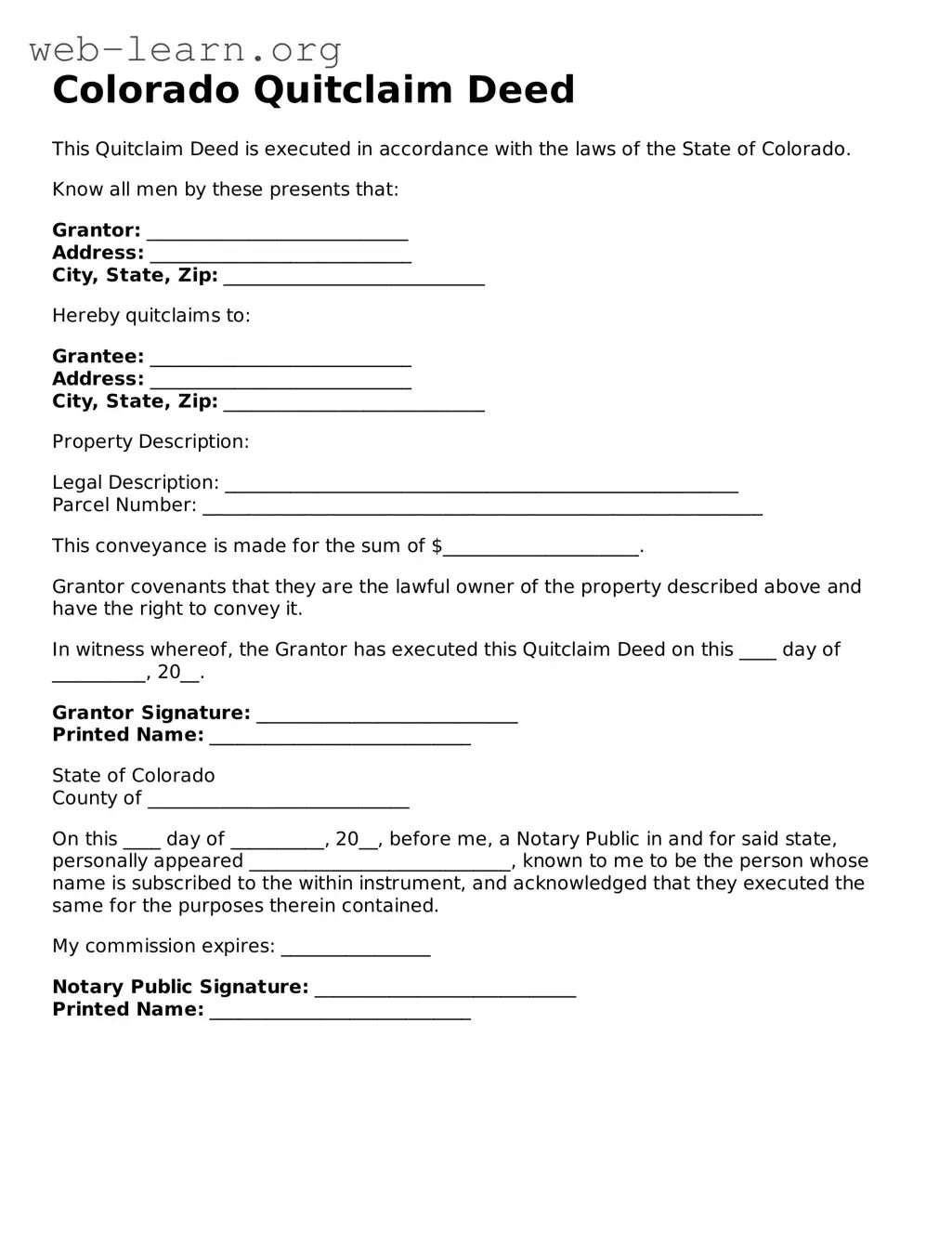
The Colorado Quitclaim Deed is a legal document used to transfer ownership of real property from one party to another. This form is particularly significant in situations where the grantor, the person transferring the property, may not guarantee that the title is free from claims or encumbrances. Unlike warranty deeds, which provide a higher level of protection to the grantee, a quitclaim deed conveys whatever interest the grantor has in the property without any warranties. This makes it a popular choice for transferring property between family members, in divorce settlements, or in situations where the parties trust each other. The form typically includes essential information such as the names of the grantor and grantee, a legal description of the property, and the signature of the grantor. Additionally, the document must be notarized to be legally effective. Understanding the Colorado Quitclaim Deed is crucial for anyone involved in real estate transactions, as it helps clarify ownership rights and responsibilities.
Colorado Quitclaim Deed
This Quitclaim Deed is executed in accordance with the laws of the State of Colorado.
Know all men by these presents that:
Grantor: ____________________________
Address: ____________________________
City, State, Zip: ____________________________
Hereby quitclaims to:
Grantee: ____________________________
Address: ____________________________
City, State, Zip: ____________________________
Property Description:
Legal Description: _______________________________________________________
Parcel Number: ____________________________________________________________
This conveyance is made for the sum of $_____________________.
Grantor covenants that they are the lawful owner of the property described above and have the right to convey it.
In witness whereof, the Grantor has executed this Quitclaim Deed on this ____ day of __________, 20__.
Grantor Signature: ____________________________
Printed Name: ____________________________
State of Colorado
County of ____________________________
On this ____ day of __________, 20__, before me, a Notary Public in and for said state, personally appeared ____________________________, known to me to be the person whose name is subscribed to the within instrument, and acknowledged that they executed the same for the purposes therein contained.
My commission expires: ________________
Notary Public Signature: ____________________________
Printed Name: ____________________________
| Fact Name | Description |
|---|---|
| Definition | A Colorado Quitclaim Deed is a legal document used to transfer ownership of real property without any warranties regarding the title. |
| Governing Law | The use of Quitclaim Deeds in Colorado is governed by the Colorado Revised Statutes, specifically Title 38, Article 30. |
| Parties Involved | The deed involves two parties: the grantor (the person transferring the property) and the grantee (the person receiving the property). |
| Consideration | While a Quitclaim Deed can be executed for no consideration, it is common to include a nominal amount to validate the transfer. |
| Recording | To ensure the transfer is legally recognized, the Quitclaim Deed must be recorded with the county clerk and recorder in the county where the property is located. |
Once you have your Colorado Quitclaim Deed form ready, it's time to fill it out accurately. This form allows you to transfer property ownership without any warranties. Make sure to have all necessary information on hand to complete the form correctly.
After completing these steps, the Quitclaim Deed will be processed by the county, officially recording the change in property ownership. Make sure to keep a copy for your records.
What is a Quitclaim Deed in Colorado?
A Quitclaim Deed is a legal document used to transfer ownership of real estate from one party to another without making any guarantees about the property’s title. In Colorado, this form is often utilized in situations such as transferring property between family members, during divorce settlements, or when a property owner wants to relinquish their interest in a property. It is important to note that the Quitclaim Deed does not provide any warranty or assurance that the title is clear or free of liens. The grantor simply transfers whatever interest they may have in the property, if any.
How do I complete a Quitclaim Deed in Colorado?
Completing a Quitclaim Deed involves several steps:
Are there any fees associated with filing a Quitclaim Deed in Colorado?
Yes, there are typically fees involved when filing a Quitclaim Deed in Colorado. These fees can vary by county but generally include a recording fee charged by the county clerk and recorder’s office. Additionally, if you choose to have the document prepared by an attorney or a professional service, there may be associated costs for their services. It is advisable to check with your local county office for specific fee structures and potential additional costs.
Can a Quitclaim Deed be revoked in Colorado?
Once a Quitclaim Deed is executed and recorded, it is generally considered final and cannot be easily revoked. However, if the grantor and grantee agree, they can execute a new deed to reverse the transfer. This new deed would effectively restore ownership to the original grantor. In situations where there is a dispute or concern about the validity of the Quitclaim Deed, it may be necessary to seek legal counsel to explore potential remedies or actions that can be taken.
Filling out a Colorado Quitclaim Deed form can be straightforward, but several common mistakes can complicate the process. One frequent error is failing to include the legal description of the property. This description is crucial as it identifies the exact location and boundaries of the property being transferred. Without it, the deed may be considered invalid.
Another mistake often seen is not properly identifying the grantor and grantee. The grantor is the person transferring the property, while the grantee is the one receiving it. Missing or incorrect names can lead to confusion and potential legal issues down the line. Always double-check the spelling and ensure that full names are used.
Some individuals overlook the requirement for notarization. A Quitclaim Deed must be signed in front of a notary public to be legally binding. Neglecting this step can render the deed unenforceable. Ensure that all signatures are properly notarized before submitting the document.
People also frequently forget to include the date of the transfer. While it may seem minor, the date is essential for establishing the timeline of ownership. Omitting this detail can lead to disputes about when the transfer occurred, which may complicate matters in the future.
Another common error is failing to record the deed with the county clerk and recorder. After completing the Quitclaim Deed, it is vital to file it with the appropriate county office. This step ensures that the transfer is publicly documented, protecting the rights of both parties involved.
Lastly, some individuals do not seek legal advice before completing the form. While the Quitclaim Deed may appear simple, the implications of property transfer can be complex. Consulting with a legal professional can help avoid pitfalls and ensure that all necessary details are correctly addressed.
A Quitclaim Deed is a legal document used to transfer ownership of real property without making any guarantees about the title. When completing this process in Colorado, several other forms and documents may be necessary to ensure a smooth transfer. Below is a list of common documents often used alongside the Quitclaim Deed.
Each of these documents plays a vital role in the property transfer process. It is important to ensure that all necessary forms are completed accurately to protect the interests of both parties involved in the transaction.
A Quitclaim Deed is a specific type of legal document used to transfer property ownership. Several other documents serve similar purposes in property transactions. Here is a list of nine documents that share similarities with a Quitclaim Deed:
When filling out the Colorado Quitclaim Deed form, it’s essential to approach the task with care. This document is a legal instrument used to transfer ownership of property. Here are some important dos and don’ts to keep in mind:
By following these guidelines, you can help ensure a smooth transfer of property ownership in Colorado. Remember, attention to detail is key in legal matters.
Many people believe that a quitclaim deed guarantees a full transfer of ownership rights. In reality, it only conveys whatever interest the grantor has in the property at the time of the transfer. If the grantor has no ownership, the recipient receives nothing.
While quitclaim deeds are often associated with divorce settlements, they are used in various situations. These can include transferring property between family members, clearing up title issues, or as part of estate planning. Their versatility makes them a common choice for many types of property transfers.
Some individuals mistakenly think that by using a quitclaim deed, they can escape any financial obligations tied to the property. However, this is not the case. While the deed transfers ownership, it does not absolve the new owner from existing mortgages, liens, or other debts associated with the property.
Although quitclaim deeds are simpler than other types of deeds, they still need to be executed properly. This includes being signed by the grantor and notarized. Failing to follow these steps can lead to complications or disputes in the future.
Not every property transfer is best served by a quitclaim deed. In situations where a buyer wants to ensure they receive clear title and full ownership rights, a warranty deed may be a better choice. Understanding the differences can help individuals make informed decisions based on their specific circumstances.
When dealing with the Colorado Quitclaim Deed form, it’s important to understand its purpose and how to fill it out correctly. Here are some key takeaways:
Understanding these points can help ensure a smooth process when transferring property in Colorado.
New York Quitclaim Deed - A Quitclaim Deed is often used in divorce settlements to transfer property rights.
Idaho Quit Claim Deed Form - While it transfers interest, it does not guarantee that the property is free from liens or other claims.
Louisiana Quitclaim Deed - This form is not recommended for high-value properties without due diligence.