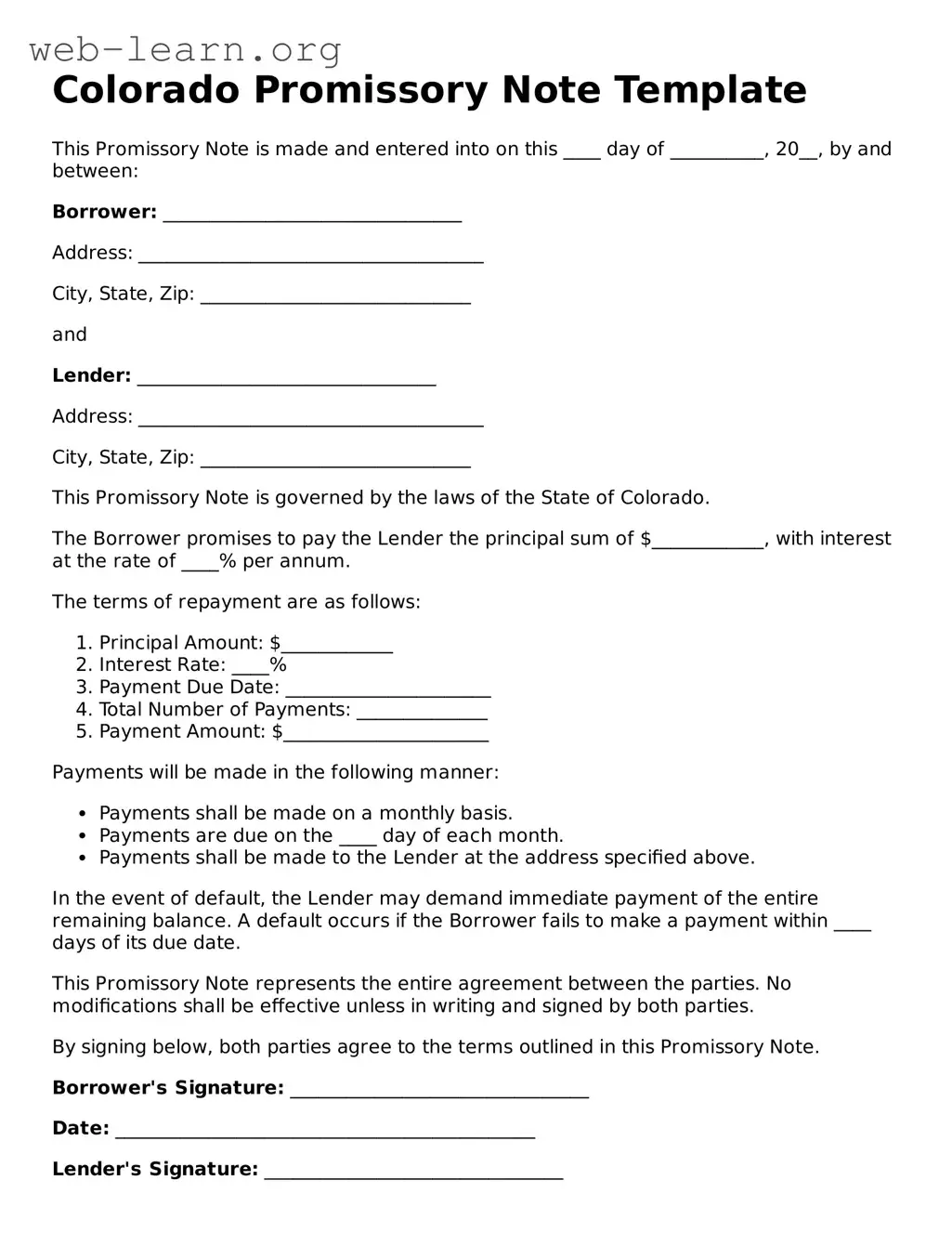
The Colorado Promissory Note form serves as a critical financial document in various lending scenarios, facilitating clear agreements between borrowers and lenders. This form outlines the essential terms of the loan, including the principal amount, interest rate, payment schedule, and maturity date. By specifying these details, the note helps prevent misunderstandings and provides a framework for repayment. Additionally, it may include provisions for late fees, prepayment options, and default consequences, ensuring both parties understand their rights and responsibilities. The simplicity and clarity of the Colorado Promissory Note make it accessible for individuals and businesses alike, promoting transparency in financial transactions. Understanding this form is vital for anyone involved in lending or borrowing, as it not only formalizes the agreement but also serves as a legal safeguard in case of disputes.
Colorado Promissory Note Template
This Promissory Note is made and entered into on this ____ day of __________, 20__, by and between:
Borrower: ________________________________
Address: _____________________________________
City, State, Zip: _____________________________
and
Lender: ________________________________
Address: _____________________________________
City, State, Zip: _____________________________
This Promissory Note is governed by the laws of the State of Colorado.
The Borrower promises to pay the Lender the principal sum of $____________, with interest at the rate of ____% per annum.
The terms of repayment are as follows:
Payments will be made in the following manner:
In the event of default, the Lender may demand immediate payment of the entire remaining balance. A default occurs if the Borrower fails to make a payment within ____ days of its due date.
This Promissory Note represents the entire agreement between the parties. No modifications shall be effective unless in writing and signed by both parties.
By signing below, both parties agree to the terms outlined in this Promissory Note.
Borrower's Signature: ________________________________
Date: _____________________________________________
Lender's Signature: ________________________________
Date: _____________________________________________
| Fact Name | Details |
|---|---|
| Definition | A promissory note is a written promise to pay a specified amount of money to a designated person at a specified time. |
| Governing Law | The Colorado Uniform Commercial Code (UCC) governs promissory notes in Colorado. |
| Parties Involved | The note involves a borrower (maker) and a lender (payee). |
| Interest Rate | The interest rate can be fixed or variable, as agreed upon by both parties. |
| Payment Terms | Payment terms should clearly state when payments are due and how they should be made. |
| Default Clause | A default clause outlines the consequences if the borrower fails to make payments. |
| Signatures | Both parties must sign the promissory note for it to be legally binding. |
| Notarization | While notarization is not required, it can add an extra layer of authenticity. |
| Enforcement | If the borrower defaults, the lender may take legal action to enforce the note. |
After obtaining the Colorado Promissory Note form, individuals must accurately complete the document to ensure its validity. Following the completion of the form, the next steps typically involve signing the document and potentially having it notarized, depending on the specific requirements of the transaction.
What is a Colorado Promissory Note?
A Colorado Promissory Note is a legal document that outlines a borrower's promise to repay a loan to a lender. This note specifies the amount borrowed, the interest rate, the repayment schedule, and any consequences for defaulting on the loan. It serves as a formal agreement between the parties involved, ensuring clarity and protecting both the lender's and borrower's rights.
What are the key components of a Colorado Promissory Note?
Several important elements should be included in a Colorado Promissory Note:
Do I need a lawyer to create a Colorado Promissory Note?
While it's not strictly necessary to hire a lawyer to create a Colorado Promissory Note, it can be beneficial. If you have a straightforward loan arrangement, you might be able to draft the note yourself using templates available online. However, if the loan amount is significant or if there are complex terms involved, consulting with a legal professional can help ensure that your note is valid and protects your interests.
How do I enforce a Colorado Promissory Note?
If a borrower defaults on a Colorado Promissory Note, the lender has several options for enforcement. First, the lender can contact the borrower to discuss the missed payments and work out a solution. If that doesn't resolve the issue, the lender may need to take legal action. This could involve filing a lawsuit to recover the owed amount. Having a well-drafted promissory note is crucial, as it provides the necessary documentation to support the lender's claims in court.
Filling out a Colorado Promissory Note form may seem straightforward, but many people make common mistakes that can lead to complications down the line. Understanding these pitfalls can save you time, money, and potential legal headaches. Here are six mistakes to avoid.
First, many individuals forget to include all necessary parties involved in the agreement. A Promissory Note should clearly identify both the borrower and the lender. Omitting a party can create confusion and complicate enforcement of the note. Always double-check that you have included full names and addresses for all parties.
Second, people often overlook the importance of specifying the loan amount. While it may seem obvious, failing to write out the exact dollar amount can lead to disputes later. Make sure to clearly state both the numerical and written forms of the amount. For example, write "One Thousand Dollars ($1,000)" to eliminate any ambiguity.
Another common mistake is neglecting to define the interest rate. If the loan involves interest, it’s crucial to specify the rate clearly. Not doing so can lead to misunderstandings about repayment amounts. Be explicit about whether the interest is fixed or variable, and include the frequency of interest calculations.
Additionally, many people forget to outline the repayment terms. This includes the schedule for payments, the due date for each installment, and any grace periods. Without these details, both parties may have different expectations, which can lead to disputes. Clearly state whether payments are monthly, quarterly, or another schedule.
Furthermore, individuals sometimes fail to include a default clause. This clause outlines what happens if the borrower fails to make payments. Without it, the lender may have limited options for recourse in the event of non-payment. Including this clause protects both parties and clarifies the consequences of default.
Finally, many overlook the importance of signatures. A Promissory Note is not legally binding without the appropriate signatures from all parties involved. Ensure that everyone signs the document in the appropriate places, and consider having it notarized to add an extra layer of authenticity. This simple step can prevent disputes about whether the agreement was valid.
By being aware of these common mistakes, you can fill out your Colorado Promissory Note form accurately and effectively. Take the time to review each section carefully, and don’t hesitate to seek assistance if you have questions. A well-prepared Promissory Note can provide peace of mind and protect your interests.
When entering into a loan agreement in Colorado, several additional forms and documents may accompany the Promissory Note. Each of these documents serves a specific purpose and can help clarify the terms of the loan or provide necessary legal protections for both parties involved.
These documents, when used in conjunction with the Colorado Promissory Note, help ensure clarity and protect the interests of both the lender and the borrower throughout the loan process.
A Promissory Note is a financial document that outlines a borrower's promise to repay a specified amount of money to a lender under agreed-upon terms. It shares similarities with several other documents. Here are eight documents that are similar to a Promissory Note:
When filling out the Colorado Promissory Note form, it's essential to follow specific guidelines to ensure the document is valid and enforceable. Here’s a list of things you should and shouldn’t do:
Understanding the Colorado Promissory Note form is crucial for anyone involved in lending or borrowing money. However, several misconceptions can lead to confusion and potential legal issues. Here’s a breakdown of some common misunderstandings:
Being aware of these misconceptions can help both borrowers and lenders navigate the complexities of promissory notes more effectively. Always consider seeking legal advice to ensure that your agreements are clear and enforceable.
When filling out and using the Colorado Promissory Note form, it is essential to keep several key points in mind. Understanding these takeaways can help ensure that the document serves its intended purpose effectively.
By paying attention to these key elements, individuals can create a comprehensive and enforceable Promissory Note that clearly outlines the terms of the loan agreement.
Basic Promissory Note - This document outlines the terms of a loan, including the principal amount, interest rate, and repayment schedule.
Promissory Note Template Illinois - They are often accompanied by additional agreements, such as a loan agreement.
Oregon Promissory Note - Clear communication between the lender and borrower can help prevent issues with the note.