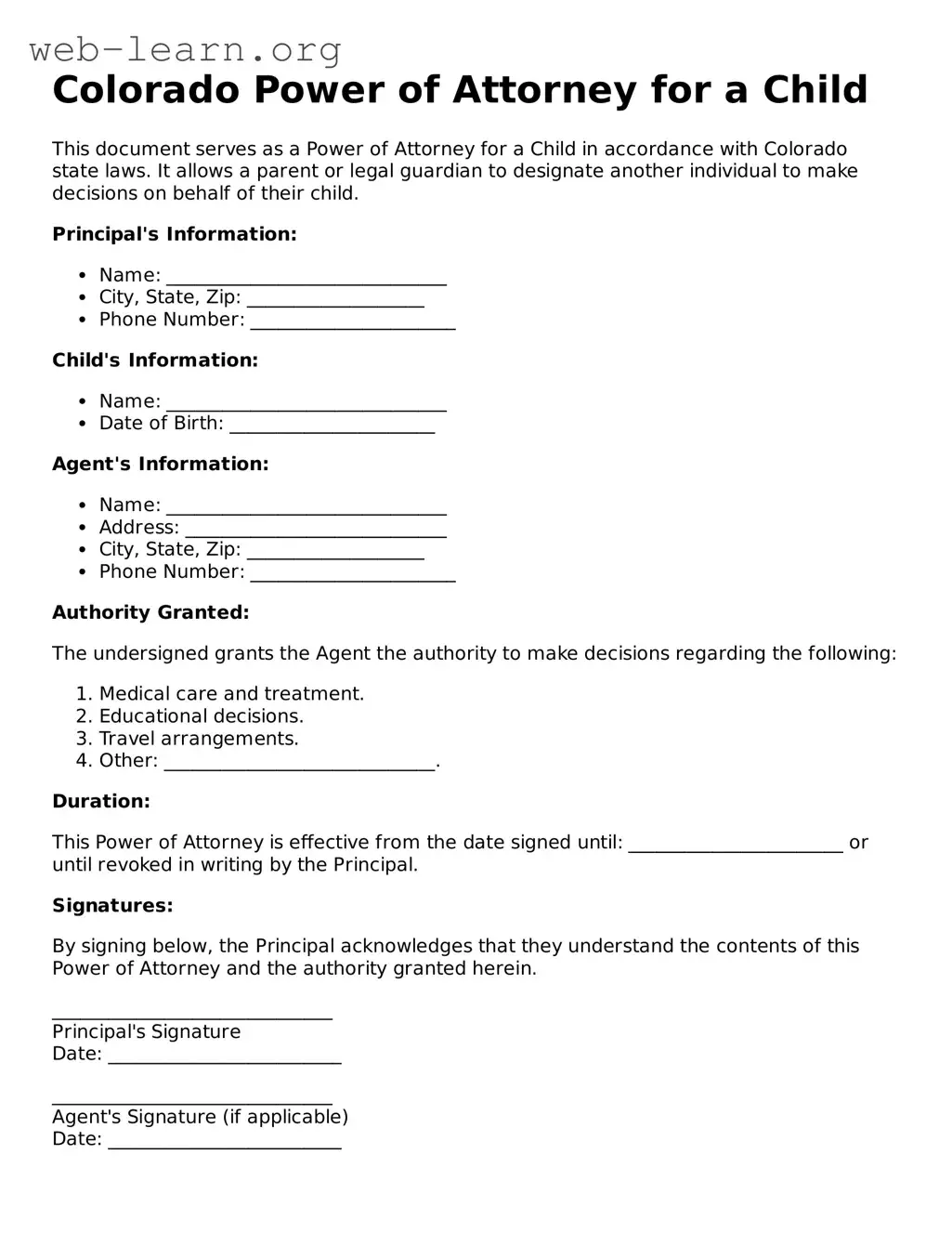
When it comes to the well-being of children, ensuring they have the right support during times of need is essential. The Colorado Power of Attorney for a Child form serves as a vital tool for parents and guardians who wish to designate another adult to make decisions on behalf of their child. This form allows parents to grant authority for a range of responsibilities, including medical care, education, and general welfare. By completing this document, parents can ensure that their child is cared for by a trusted individual, especially in situations where they may be unable to provide direct supervision or care. It is important to understand that this power of attorney is temporary and can be tailored to fit specific needs, providing peace of mind for both parents and caregivers. Additionally, the form must be signed and dated in the presence of a notary public, which adds an extra layer of validity and security. With clear guidelines and a straightforward process, the Colorado Power of Attorney for a Child form empowers families to navigate unexpected circumstances with confidence.
Colorado Power of Attorney for a Child
This document serves as a Power of Attorney for a Child in accordance with Colorado state laws. It allows a parent or legal guardian to designate another individual to make decisions on behalf of their child.
Principal's Information:
Child's Information:
Agent's Information:
Authority Granted:
The undersigned grants the Agent the authority to make decisions regarding the following:
Duration:
This Power of Attorney is effective from the date signed until: _______________________ or until revoked in writing by the Principal.
Signatures:
By signing below, the Principal acknowledges that they understand the contents of this Power of Attorney and the authority granted herein.
______________________________
Principal's Signature
Date: _________________________
______________________________
Agent's Signature (if applicable)
Date: _________________________
Witnesses:
______________________________
Witness Signature
Date: _________________________
______________________________
Witness Signature
Date: _________________________
This document should be kept in a safe place and a copy provided to the Agent and any relevant parties.
| Fact Name | Details |
|---|---|
| Purpose | The Colorado Power of Attorney for a Child form allows a parent or legal guardian to designate another adult to make decisions for their child in their absence. |
| Duration | This power of attorney can be effective for a specific time period, up to 12 months, or until revoked by the parent or guardian. |
| Governing Law | The form is governed by Colorado Revised Statutes, specifically § 15-14-501 through § 15-14-507. |
| Requirements | The form must be signed by the parent or legal guardian and may require notarization to be legally binding. |
To complete the Colorado Power of Attorney for a Child form, individuals should gather the necessary information and ensure that all sections are filled out accurately. This form allows a parent or legal guardian to designate another adult to make decisions on behalf of their child.
After completing the form, it is advisable to keep a copy for personal records. The original should be provided to the attorney-in-fact to ensure they have the authority to act on behalf of the child as specified.
A Power of Attorney for a Child in Colorado is a legal document that allows a parent or legal guardian to designate another adult to make decisions on behalf of their child. This can include decisions related to medical care, education, and general welfare. It is especially useful in situations where the parent or guardian may be unavailable, such as during travel or extended absences.
The agent can be any trusted adult, such as a family member, friend, or neighbor. However, it is important to choose someone who is responsible and capable of making decisions in the best interest of the child. The agent must be at least 18 years old and should be willing to take on the responsibilities outlined in the document.
The Power of Attorney for a Child typically remains in effect until a specified date or until the parent or guardian revokes it. It is important to clearly state the duration in the document. If no duration is specified, the authority may continue until the child reaches the age of 18, unless revoked earlier by the parent or guardian.
Yes, in Colorado, the Power of Attorney for a Child must be signed by the parent or legal guardian in the presence of a notary public. This step helps ensure that the document is valid and legally binding. It is also a good idea to provide copies to the designated agent, schools, and healthcare providers to avoid any confusion in emergency situations.
Filling out the Colorado Power of Attorney for a Child form can be straightforward, but several common mistakes can lead to complications. One frequent error is failing to provide complete information about the child. It's crucial to include the child's full name, date of birth, and address. Incomplete details can cause delays or even invalidate the document.
Another mistake is not specifying the powers granted to the agent. The form allows for various powers, such as making medical decisions or enrolling the child in school. Omitting these details can lead to confusion later on. Clearly outlining the scope of authority ensures that the agent knows exactly what they can and cannot do.
People often forget to sign and date the form. A signature is necessary for the document to be legally binding. Without a signature, the Power of Attorney holds no weight, and the intended authority cannot be exercised. Always double-check that all required signatures are present before finalizing the document.
In some cases, individuals neglect to have the form notarized. While notarization is not always mandatory, it adds an extra layer of authenticity. A notarized document is less likely to be challenged, providing peace of mind for both the parent and the agent.
Another common oversight is failing to inform the child about the arrangement. It's essential for the child to understand who will be acting on their behalf and the reasons behind it. Open communication can help alleviate any fears or confusion the child may have regarding the situation.
Lastly, people sometimes forget to keep a copy of the completed form. Retaining a copy ensures that both the parent and the agent have access to the document when needed. This can prevent misunderstandings and provide clarity during emergencies. Always make sure to store copies in a safe and accessible location.
When preparing a Power of Attorney for a Child in Colorado, it is often helpful to consider other related documents. These documents can provide additional clarity and support for the authority granted to the agent. Below is a list of commonly used forms that may accompany the Power of Attorney for a Child.
Considering these additional forms can help ensure that the Power of Attorney for a Child is comprehensive and effective. Each document plays a vital role in safeguarding the child's well-being and ensuring that their needs are met in various situations.
When filling out the Colorado Power of Attorney for a Child form, it is crucial to approach the task with care. Here are some important things to keep in mind:
Taking these steps can help ensure that the Power of Attorney is properly executed and serves its intended purpose. Act promptly to protect your child's interests.
When it comes to the Colorado Power of Attorney for a Child form, there are several misconceptions that can lead to confusion. Understanding these myths is essential for parents and guardians who wish to ensure their child's well-being in various situations. Here are seven common misconceptions:
Many people believe that this form is only necessary in case of an emergency. However, it can also be useful for planned situations, such as travel or temporary guardianship during a family event.
Some think that signing a Power of Attorney means they are relinquishing their parental rights. In reality, this document allows a designated person to make decisions on behalf of the child while the parent retains all legal rights.
This form is often viewed as a permanent solution, but it is actually temporary. Parents can specify the duration of the authority granted, and it can be revoked at any time.
While it is true that parents can choose an adult to act on their behalf, it is crucial to select someone who is trustworthy and capable of making decisions in the child's best interest.
Although having the document notarized can add an extra layer of validity, it is not a legal requirement in Colorado. Parents can sign the form without a notary, provided it meets the necessary criteria.
This form does not grant authority for every possible decision. It is important to specify the areas in which the appointed person can make decisions, such as healthcare or education.
While this form is specific to Colorado law, it can be used by non-residents as long as it complies with the state's requirements. Parents traveling or temporarily residing in Colorado can benefit from it as well.
By addressing these misconceptions, parents can make informed decisions about the Colorado Power of Attorney for a Child form, ensuring their child's needs are met in a variety of situations.
When considering a Power of Attorney for a Child in Colorado, it is essential to understand its significance and how to properly fill it out. Here are some key takeaways to keep in mind:
Michigan Power of Attorney - This document can serve as a crucial part of a family’s emergency preparedness plan.
Power of Attorney in Louisiana - Having this form can help avoid potential disputes over the child's care.
Poa Papers - Parents should provide a copy of the completed form to the designated adult and keep one for their records.