Homepage Blank Colorado Post Closing Occupancy Agreement Form
Outline

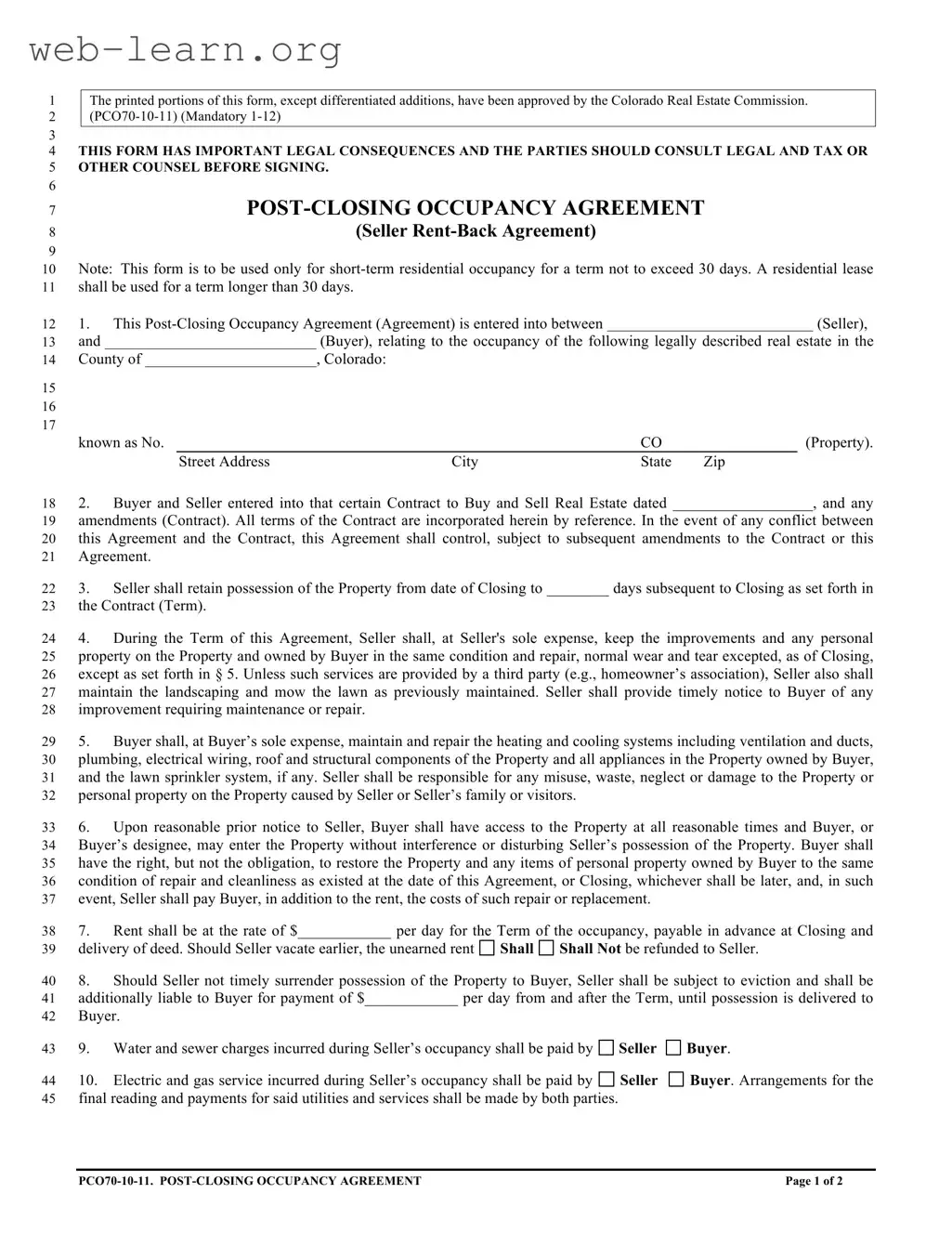
The Colorado Post Closing Occupancy Agreement (PCO70-10-11) serves as a crucial document in real estate transactions, particularly for situations where the seller requires additional time to occupy the property after the closing date. This form is specifically designed for short-term residential occupancy, with a maximum duration of 30 days. It allows sellers to remain in the property while providing buyers with certain rights and responsibilities. Key elements of the agreement include the duration of the seller's occupancy, maintenance obligations for both parties, and the stipulation of rent payments. The agreement also addresses utility responsibilities, security deposits, and potential liabilities in case of damages or delays in vacating the property. Both parties are encouraged to seek legal and tax advice before finalizing the agreement, as it can have significant legal implications. Clarity in the terms helps ensure a smooth transition of ownership while safeguarding the interests of both the seller and the buyer.


Sample - Colorado Post Closing Occupancy Agreement Form

PCO70-10-11. POST-CLOSING OCCUPANCY AGREEMENT Page 1 of 2
The printed portions of this form, except differentiated additions, have been approved by the Colorado Real Estate Commission. 1
(PCO70-10-11) (Mandatory 1-12)
2
3
THIS FORM HAS IMPORTANT LEGAL CONSEQUENCES AND THE PARTIES SHOULD CONSULT LEGAL AND TAX OR 4
OTHER COUNSEL BEFORE SIGNING. 5
6
POST-CLOSING OCCUPANCY AGREEMENT 7
(Seller Rent-Back Agreement) 8
9
Note: This form is to be used only for short-term residential occupancy for a term not to exceed 30 days. A residential lease 10
shall be used for a term longer than 30 days. 11
1. This Post-Closing Occupancy Agreement (Agreement) is entered into between (Seller), 12
and (Buyer), relating to the occupancy of the following legally described real estate in the
13
County of , Colorado:
14
15
16
17
known as No.
CO
(Property).
Street Address
City
State
Zip
2. Buyer and Seller entered into that certain Contract to Buy and Sell Real Estate dated __________________, and any 18
amendments (Contract). All terms of the Contract are incorporated herein by reference. In the event of any conflict between 19
this Agreement and the Contract, this Agreement shall control, subject to subsequent amendments to the Contract or this 20
Agreement. 21
3. Seller shall retain possession of the Property from date of Closing to ________ days subsequent to Closing as set forth in 22
the Contract (Term). 23
4. During the Term of this Agreement, Seller shall, at Seller's sole expense, keep the improvements and any personal 24
property on the Property and owned by Buyer in the same condition and repair, normal wear and tear excepted, as of Closing, 25
except as set forth in § 5. Unless such services are provided by a third party (e.g., homeowner’s association), Seller also shall 26
maintain the landscaping and mow the lawn as previously maintained. Seller shall provide timely notice to Buyer of any 27
improvement requiring maintenance or repair. 28
5. Buyer shall, at Buyer’s sole expense, maintain and repair the heating and cooling systems including ventilation and ducts, 29
plumbing, electrical wiring, roof and structural components of the Property and all appliances in the Property owned by Buyer, 30
and the lawn sprinkler system, if any. Seller shall be responsible for any misuse, waste, neglect or damage to the Property or 31
personal property on the Property caused by Seller or Seller’s family or visitors. 32
6. Upon reasonable prior notice to Seller, Buyer shall have access to the Property at all reasonable times and Buyer, or 33
Buyer’s designee, may enter the Property without interference or disturbing Sellers possession of the Property. Buyer shall 34
have the right, but not the obligation, to restore the Property and any items of personal property owned by Buyer to the same 35
condition of repair and cleanliness as existed at the date of this Agreement, or Closing, whichever shall be later, and, in such 36
event, Seller shall pay Buyer, in addition to the rent, the costs of such repair or replacement. 37
7. Rent shall be at the rate of $____________ per day for the Term of the occupancy, payable in advance at Closing and 38
delivery of deed. Should Seller vacate earlier, the unearned rent
Shall Shall Not be refunded to Seller. 39
8. Should Seller not timely surrender possession of the Property to Buyer, Seller shall be subject to eviction and shall be 40
additionally liable to Buyer for payment of $____________ per day from and after the Term, until possession is delivered to 41
Buyer. 42
9. Water and sewer charges incurred during Seller’s occupancy shall be paid by Seller Buyer. 43
10. Electric and gas service incurred during Seller’s occupancy shall be paid by
Seller Buyer. Arrangements for the 44
final reading and payments for said utilities and services shall be made by both parties. 45
PCO70-10-11. POST-CLOSING OCCUPANCY AGREEMENT Page 2 of 2
11. Seller Shall Shall Not maintain and pay the cost of (1) a Seller’s “Renters Policy” covering Seller’s personal 46
property on the Property and (2)
Shall Shall Not maintain and pay the cost of adequate liability insurance in favor of 47
both Seller and Buyer and supply to Buyer evidence of such insurance. Buyer agrees to maintain and shall pay the cost of 48
Homeowner’s Property Insurance Policy (which may be endorsed as a non-owner occupant/Buyer). 49
12. Seller agrees that a security deposit in the amount of $______________ will be held by
Buyer ________________ 50
from Closing until Seller vacates the Property. The security deposit shall be held and disbursed pursuant to Colorado law, 51
generally within one month after the Term of this Agreement. 52
13. Anything to the contrary herein notwithstanding, in the event of any arbitration or litigation relating to this Agreement, 53
prior to or after the Term of this Agreement, the arbitrator or court shall award to the prevailing party all reasonable costs and 54
expenses, including attorney fees, legal fees and expenses. 55
14. ADDITIONAL PROVISIONS. (The following additional provisions have not been approved by the Colorado Real 56
Estate Commission.) 57
58
59
60
61
Buyer’s Name:
Buyer’s Name:
Buyer’s Signature
Date
Buyer’s Signature
Date
Address:
Address:
Phone No.:
Phone No.:
Fax No.:
Fax No.:
Electronic Address:
Electronic Address:
Seller’s Name:
Seller’s Name:
Seller’s Signature
Date
Seller’s Signature
Date
Address:
Address:
Phone No.:
Phone No.:
Fax No.:
Fax No.:
Electronic Address:
Electronic Address:
62

Form Information

Fact Name Details
Approval The Colorado Real Estate Commission has approved this form for use.
Occupancy Duration This agreement is only for short-term occupancy, not exceeding 30 days.
Responsibilities Seller must maintain the property in good condition during the occupancy period.
Rent Payment Rent is due in advance at closing, with a specified daily rate.
Security Deposit A security deposit is required and must be held according to Colorado law.
Legal Consequences Parties should seek legal and tax advice before signing, as the agreement has significant legal implications.

Detailed Guide for Filling Out Colorado Post Closing Occupancy Agreement

Completing the Colorado Post Closing Occupancy Agreement form requires careful attention to detail. After filling out the form, both parties will need to review it to ensure that all terms are understood and agreed upon. This agreement outlines the responsibilities and conditions for the seller's occupancy after closing.

  1. Begin by entering the Seller's name and Buyer's name at the top of the form.
  2. Fill in the address of the property, including street address, city, state, and zip code.
  3. Indicate the date of the original Contract to Buy and Sell Real Estate in the designated space.
  4. Specify the number of days the seller will retain possession of the property after closing in the appropriate section.
  5. Detail the responsibilities for maintaining the property during the occupancy period, including any specific maintenance tasks.
  6. Enter the daily rent amount the seller will pay for the occupancy period.
  7. Decide whether the unearned rent will be refunded to the seller if they vacate earlier, and check the appropriate box.
  8. Indicate who will be responsible for paying water, sewer, electric, and gas charges during the seller's occupancy.
  9. Determine if the seller will maintain a renter's policy and liability insurance, and check the appropriate boxes.
  10. Specify the amount of the security deposit that will be held by the buyer.
  11. Include any additional provisions that may not be approved by the Colorado Real Estate Commission, if necessary.
  12. Have both the buyer and seller sign and date the form, ensuring all contact information is provided.

Obtain Answers on Colorado Post Closing Occupancy Agreement

  1. What is the purpose of the Colorado Post Closing Occupancy Agreement?

    The Colorado Post Closing Occupancy Agreement (PCOA) serves as a legal document that allows the seller to remain in the property for a short period after the closing of a real estate transaction. This agreement is specifically designed for occupancy terms not exceeding 30 days. It is essential for ensuring that both parties understand their responsibilities and rights during this transitional phase.

  2. What are the responsibilities of the seller during the occupancy period?

    During the occupancy term, the seller must maintain the property in its original condition, barring normal wear and tear. This includes keeping the landscaping and any personal property in good repair. The seller is also responsible for notifying the buyer of any maintenance or repair needs. If any damage occurs due to the seller or their visitors, the seller will be held accountable for those repairs.

  3. How is rent structured in the Post Closing Occupancy Agreement?

    The agreement stipulates that the seller must pay rent at a predetermined daily rate for the duration of their occupancy. This rent is typically paid in advance at the closing of the sale. If the seller vacates the property earlier than agreed, the terms regarding the refund of unearned rent will apply as specified in the agreement.

  4. What happens if the seller does not vacate the property on time?

    If the seller fails to surrender possession of the property by the end of the occupancy term, they may face eviction. Additionally, the seller will be liable for a specified daily fee for each day they remain in the property beyond the agreed-upon term. This provision ensures that the buyer can regain possession of their property in a timely manner.

Common mistakes

Filling out the Colorado Post Closing Occupancy Agreement form can be a straightforward process, but many people make common mistakes that could lead to complications down the road. One frequent error is failing to specify the exact dates for the occupancy term. The agreement requires a clear start and end date, and neglecting to fill this in can create confusion about when the seller must vacate the property.

Another mistake involves overlooking the payment details. Rent must be clearly stated, including the amount per day and how it will be paid. If this information is incomplete or incorrect, it can lead to disputes between the buyer and seller regarding payment expectations.

People often forget to address the issue of utilities during the occupancy period. The agreement specifies who is responsible for paying water, gas, and electric charges. Failing to clarify these responsibilities can result in unexpected bills and disagreements after the seller has moved out.

In addition, some individuals neglect to include provisions for insurance. The agreement mentions the need for a renter's policy and liability insurance, but not specifying these can leave both parties vulnerable. It's essential to ensure that all insurance obligations are clearly documented to protect against potential damages or losses.

Another common oversight is not addressing the security deposit. The amount should be filled in, and both parties must agree on who will hold the deposit. This detail is crucial for ensuring that the funds are managed correctly and returned in accordance with Colorado law.

Some individuals also fail to include additional provisions that may be necessary for their specific situation. While the form has standard clauses, unique circumstances might require additional terms. Not taking the time to add these can lead to misunderstandings later.

Moreover, it’s important to ensure that all parties involved have signed the agreement. Sometimes, people mistakenly think that a verbal agreement is sufficient. However, without all required signatures, the agreement may not be legally binding, which can lead to complications if disputes arise.

Lastly, many overlook the importance of keeping a copy of the signed agreement. After filling out the form, it’s vital to ensure that each party retains a copy for their records. This helps in resolving any future disputes or misunderstandings about the terms of the occupancy.

By being aware of these common mistakes, both buyers and sellers can navigate the Post Closing Occupancy Agreement process more smoothly, ensuring a positive experience for everyone involved.

Documents used along the form

The Colorado Post Closing Occupancy Agreement is an essential document in real estate transactions where the seller needs to remain in the property for a short period after closing. Several other forms and documents are often used in conjunction with this agreement to ensure a smooth transition and to clarify responsibilities. Below is a list of these related documents, along with a brief description of each.

  • Residential Lease Agreement: This document is used for longer-term occupancy arrangements, typically exceeding 30 days. It outlines the terms of the lease, including rent, duration, and responsibilities of both parties.
  • Contract to Buy and Sell Real Estate: This foundational document details the terms and conditions of the property sale, including price, contingencies, and obligations of both the buyer and seller.
  • Security Deposit Agreement: This agreement specifies the amount of the security deposit, the conditions under which it may be withheld, and the timeline for its return after the seller vacates the property.
  • Utility Transfer Agreement: This document outlines the arrangements for transferring utility services from the seller to the buyer, including responsibilities for final readings and payments.
  • Insurance Policy Documentation: Proof of insurance coverage is essential. This documentation verifies that both parties have appropriate insurance during the occupancy period.
  • Walk-Through Checklist: A checklist used to document the condition of the property before and after the seller's occupancy. This helps prevent disputes regarding damages or repairs.
  • Eviction Notice (if applicable): In the event the seller does not vacate the property as agreed, this document initiates the legal process for eviction.
  • Maintenance Agreement: This outlines the responsibilities for property maintenance during the seller’s occupancy, ensuring both parties understand their obligations.
  • Disclosure Statements: These statements provide information about the property, including any known issues or defects, which can be crucial for both parties’ awareness and liability protection.

Utilizing these documents in conjunction with the Colorado Post Closing Occupancy Agreement can help clarify expectations and responsibilities, ultimately facilitating a smoother transaction and occupancy experience for both the buyer and seller. Understanding these forms is crucial for anyone involved in real estate transactions in Colorado.

Similar forms

  • Residential Lease Agreement: Similar to the Post Closing Occupancy Agreement, a Residential Lease Agreement outlines the terms under which a tenant occupies a property. However, it typically covers longer durations, often exceeding 30 days. Both documents specify responsibilities regarding maintenance and repairs, though the lease tends to delve deeper into tenant rights and obligations.
  • Seller Financing Agreement: This document allows the seller to provide financing to the buyer for the purchase of the property. Like the Post Closing Occupancy Agreement, it establishes terms for the duration of the buyer's occupancy. Both agreements require clear communication about payments, responsibilities, and timelines, though the Seller Financing Agreement focuses more on financial arrangements.
  • Short-Term Rental Agreement: A Short-Term Rental Agreement, often used for vacation rentals, shares similarities with the Post Closing Occupancy Agreement in its focus on brief occupancy periods. Both documents outline rental rates and conditions of use, but the Short-Term Rental Agreement usually includes specific provisions for guest behavior and property use, catering to transient occupants.
  • Leaseback Agreement: A Leaseback Agreement involves a seller leasing a property back from the buyer after the sale. This is similar to the Post Closing Occupancy Agreement in that it allows the seller to remain in the property post-sale. Both agreements clarify terms of occupancy and responsibilities, but the Leaseback Agreement often emphasizes the financial implications of the arrangement.

Dos and Don'ts

When filling out the Colorado Post Closing Occupancy Agreement form, there are important guidelines to follow. Here’s a list of things you should and shouldn't do:

  • Do ensure all parties involved are clearly identified, including full names and contact information.
  • Do specify the exact dates for the occupancy term to avoid confusion.
  • Do outline the responsibilities for maintenance and repairs explicitly to prevent disputes.
  • Do confirm the rent amount and payment terms are clearly stated and agreed upon.
  • Don't leave any blank spaces in the form; fill in all required information completely.
  • Don't ignore the need for legal counsel; consult a professional if unsure about any terms.
  • Don't overlook the importance of insurance; ensure both parties understand their responsibilities.
  • Don't forget to keep a copy of the signed agreement for your records.

Misconceptions

Misconceptions about the Colorado Post Closing Occupancy Agreement can lead to confusion for both buyers and sellers. Here are six common misunderstandings:

  • This agreement is a long-term lease. Many people mistakenly believe that the Post Closing Occupancy Agreement serves as a long-term lease. In reality, it is designed for short-term occupancy, not exceeding 30 days. For longer terms, a residential lease must be used.
  • Sellers are not responsible for property maintenance. Some sellers think that once the property is sold, they have no obligations. However, sellers must maintain the property in the same condition as it was at closing, excluding normal wear and tear.
  • Buyers can access the property at any time without notice. There is a misconception that buyers can freely enter the property during the occupancy period. In fact, buyers must provide reasonable prior notice to sellers before accessing the property.
  • Rent is optional. Some sellers believe they can choose not to pay rent during their occupancy. However, the agreement stipulates that rent is due at a specified rate, payable in advance at closing.
  • Utilities are always the seller's responsibility. There is a common belief that sellers are responsible for all utility payments during their occupancy. In reality, the agreement specifies that sellers are responsible for certain utilities, while buyers may be responsible for others.
  • The security deposit is non-refundable. Some individuals think that once a security deposit is paid, it cannot be refunded. However, the deposit is held until the seller vacates the property and is subject to Colorado law regarding its disbursement.

Understanding these misconceptions is crucial for both buyers and sellers to navigate the Post Closing Occupancy Agreement effectively.

Key takeaways

When utilizing the Colorado Post Closing Occupancy Agreement form, there are several important points to consider. Here are key takeaways to keep in mind:

  • Short-term Use Only: This agreement is specifically designed for short-term residential occupancy, lasting no longer than 30 days. For longer stays, a residential lease should be used instead.
  • Responsibilities of the Seller: The Seller must maintain the property in good condition during the occupancy period. This includes keeping the property and any personal belongings in the same state as at closing, except for normal wear and tear.
  • Buyer’s Access: The Buyer has the right to access the property at reasonable times, provided they give the Seller prior notice. This access is crucial for the Buyer to ensure the property remains in good condition.
  • Rent Payment: Rent is set at a specified daily rate and is due in advance at closing. If the Seller vacates the property early, the terms regarding any unearned rent should be clearly defined in the agreement.
  • Security Deposit: A security deposit may be required and held by the Buyer until the Seller vacates. The handling of this deposit must comply with Colorado law, ensuring proper disbursement after the occupancy period.
  • Insurance Considerations: Both parties should consider their insurance needs. The Seller may need a renter’s policy, while the Buyer should maintain a homeowner’s policy. Evidence of insurance may be required by the Buyer.

Understanding these aspects can help both parties navigate the agreement effectively, ensuring a smooth transition during the post-closing occupancy period.