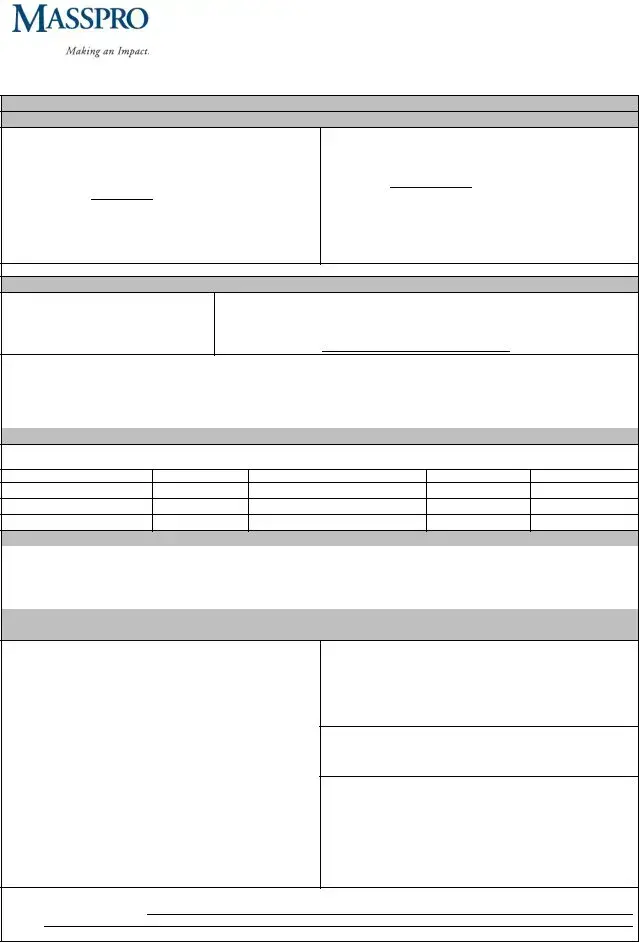
Homepage Blank Colorado Post Admission Level 1 Passr Form
Outline

The Colorado Post Admission Level 1 PASRR form serves as a critical tool for assessing individuals who may require specialized care in nursing facilities. This form collects essential personal information, including the individual's name, date of birth, and social security number, alongside their current location and payment method. It also addresses various mental health conditions and symptoms, allowing for a comprehensive evaluation of the individual's mental health history. Sections of the form specifically inquire about diagnoses related to mental illnesses, symptoms exhibited in the past six months, and any history of psychiatric treatment. Additionally, the form assesses cognitive impairments and the presence of developmental disabilities. It includes important questions regarding exemptions and categorical decisions, which must be approved prior to admission. The outcome section of the form determines whether further screening is necessary based on the responses provided. Overall, the Colorado Post Admission Level 1 PASRR form is a vital component in ensuring that individuals receive the appropriate level of care tailored to their specific needs.

Sample - Colorado Post Admission Level 1 Passr Form

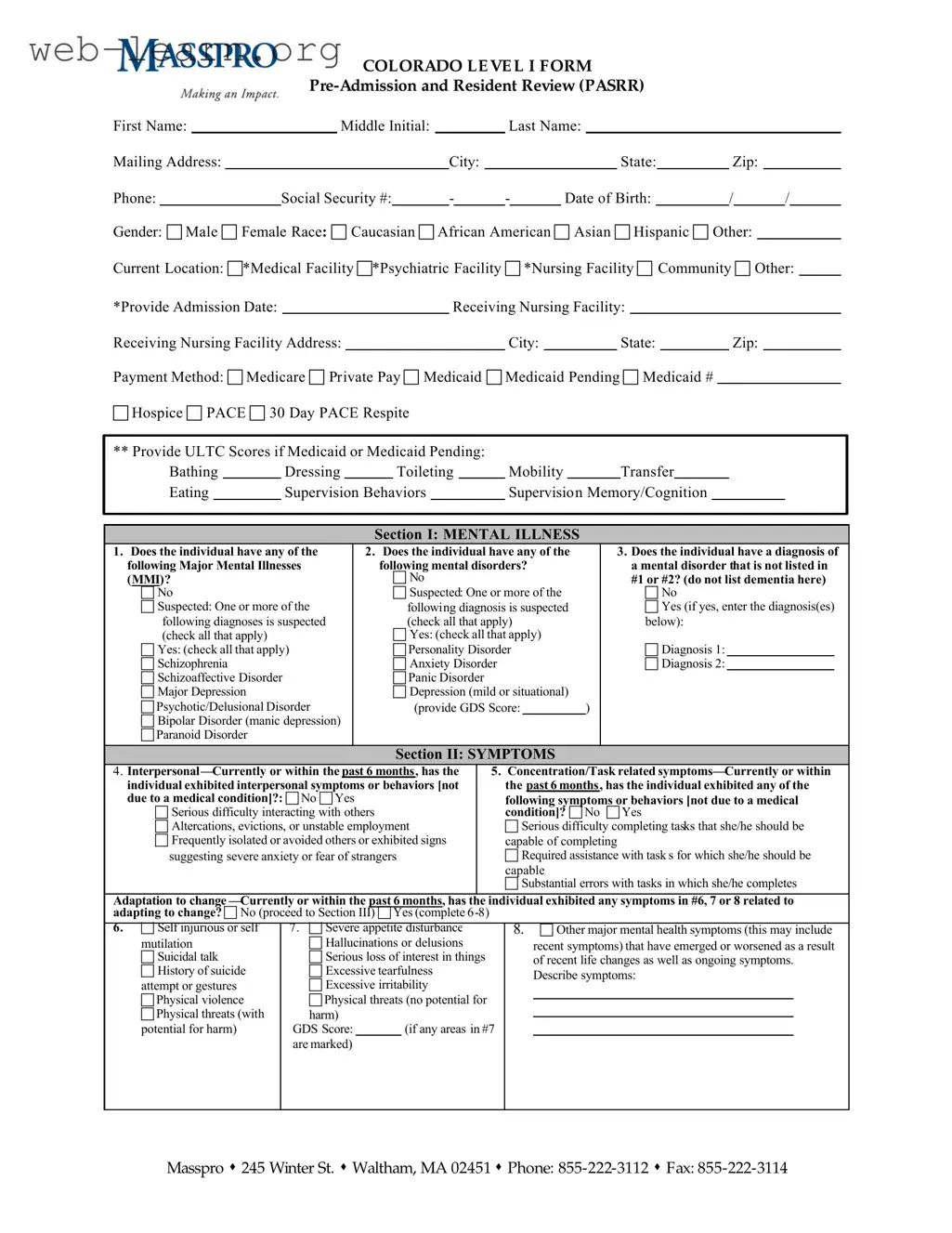
COLORADO LE VE L I F ORM
Pre-Admission and Resident Review (PASRR)
Masspro s 245 Winter St. s Waltham, MA 02451 s Phone: 855-222-3112 s Fax: 855-222-3114
First Name: Middle Initial: Last Name:
Mailing Address: City: State: Zip:
Phone: Social Security #: - - Date of Birth: / /
Gender: c Male c Female Race: c Caucasian c African American c Asian c Hispanic c Other:
Current Location: c*Medical Facility c*Psychiatric Facility c *Nursing Facility c Community c Other:
*Provide Admission Date: Receiving Nursing Facility:
Receiving Nursing Facility Address: City: State: Zip:
Payment Method: c Medicare c Private Pay c Medicaid c Medicaid Pending c Medicaid #
c Hospice c PACE c 30 Day PACE Respite
** Provide ULTC Scores if Medicaid or Medicaid Pending:
Bathing Dressing Toileting Mobility Transfer
Eating Supervision Behaviors Supervision Memory/Cognition
Section I: MENTAL ILLNESS
1.
Does the individual have any of the
following Major Mental Illnesses
(MMI)?
c No
c Suspected: One or more of the
following diagnoses is suspected
(check all that apply)
c Yes: (check all that apply)
c Schizophrenia
c Schizoaffective Disorder
c Major Depression
c Psychotic/Delusional Disorder
c Bipolar Disorder (manic depression)
c Paranoid Disorder
2.
Does the individual have any of the
following mental disorders?
c No
c Suspected: One or more of the
following diagnosis is suspected
(check all that apply)
c Yes: (check all that apply)
c Personality Disorder
c Anxiety Disorder
c Panic Disorder
c Depression (mild or situational)
(provide GDS Score: )
3.
Does the individual have a diagnosis of
a mental disorder that is not listed in
#1 or #2? (do not list dementia here)
c No
c Yes (if yes, enter the diagnosis(es)
below):
c Diagnosis 1:
c Diagnosis 2:
Section II: SYMPTOMS
4.
Interpersonal
Currently or within the
, has the
individual exhibited interpersonal symptoms or behaviors [not
due to a medical condition]?: c No c Yes
c Serious difficulty interacting with others
c Altercations, evictions, or unstable employment
c Frequently isolated or avoided others or exhibited signs
suggesting severe anxiety or fear of strangers
5.
Concentration/Task related symptoms
Currently or within
the past 6 months, has the individual exhibited any of the
following symptoms or behaviors [not due to a medical
condition]? c No c Yes
c Serious difficulty completing tasks that she/he should be
capable of completing
c Required assistance with task s for which she/he should be
capable
c Substantial errors with tasks in which she/he completes
Adaptation to change
Currently or within the
, has the individual exh
ibited any symptoms in #6, 7 or 8 related to
adapting to change? c No (proceed to Section III) c Yes (complete 6-8)
6.
c
Self injurious or self
mutilation
c Suicidal talk
c History of suicide
attempt or gestures
c Physical violence
c Physical threats (with
potential for harm)
7.
c
Severe appetite disturbance
c Hallucinations or delusions
c Serious loss of interest in things
c Excessive tearfulness
c Excessive irritability
c Physical threats (no potential for
harm)
GDS Score: (if any areas in #7
are marked)
8.
c
Other major mental health symptoms
(this may include
recent symptoms) that have emerged or worsened as a result
of recent life changes as well as ongoing symptoms.
Describe symptoms:
COLORADO LE VE L I F ORM
Pre-Admission and Resident Review (PASRR)
Masspro s 245 Winter St. s Waltham, MA 02451 s Phone: 855-222-3112 s Fax: 855-222-3114
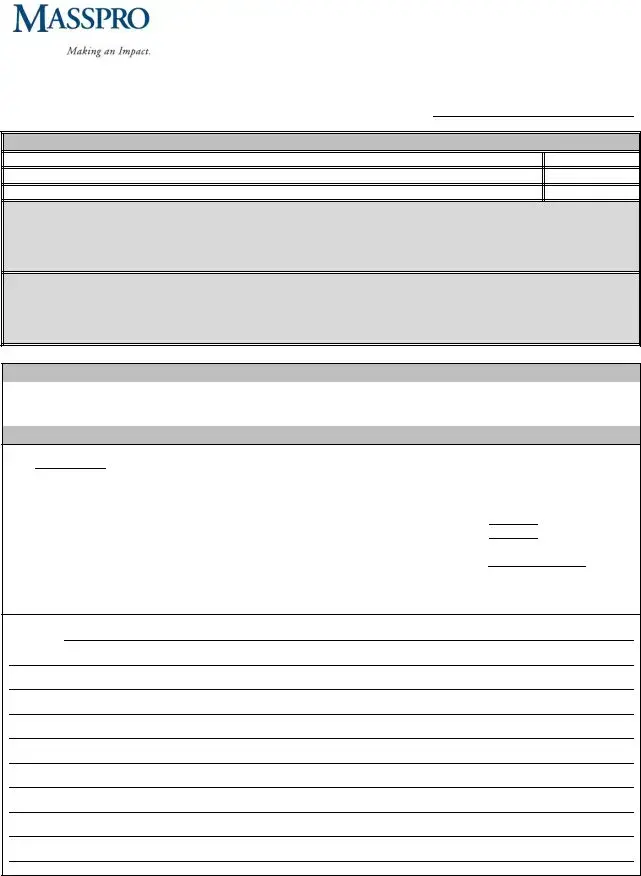
Patient Last Name: Patient First Name:
Section III: HISTORY OF PSYCHIATRIC TREATMENT
9.
Currently or within the
past 2 years
, has the individual
received any of the following mental health services?
c No
c Yes (the individual has received the following service[s]):
c Inpatient psychiatric hospitalization (if yes, provide
date: )
c Partial hospitalization/ day treatment (if yes, provide
date: )
cResidential treatment (if yes, provide date: )
c Other: (if yes,
provide date: )
10.
Currently or within the past 2 years, has the ind
ividual
experienced significant life disruption because of mental health
symptoms? c No c Yes (check all that apply):
c Legal intervention due to mental health symptoms
(date: )
c Housing change because of mental illness
(date: )
c Suicide attempt or ideation (date[s]: )
c Other: (date: )
11.
Has the individual had a recent psychiatric/behavioral evaluation?
c
No
c
Yes (date:
)
Section IV: DEMENTIA
12.
Does the
individual
have a diagnosis
of dementia or Alzheimer’s disease?
c No (proceed to 15) c Yes
13.
If yes
to #12, is corroborative testin
g
or other information ava
ilable to verify the presence
or progression of the dementia?
c No c Yes (check all that apply)
c Dementia work up c Comprehensive Mental Status Exam
c Other (specify):
14.
If yes t
o12
, list currently prescribed antidepressant or antipsychotic medications
listed on the Beer’s List.
Medication
Dosage MG/Day
Refer to Beer’s List
Does dosage exceed Beer’s List?
c
No
c
Yes
Does dosage exceed Beer’s List?
c
No
c
Yes
Does dosage exc
eed Beer’s List?
c
No
c
Yes
Section V: PSYCHOTROPIC MEDICATIONS
15.
Has the individual been prescribed psychoactive (mental health) medications now or within the past 6 months
other than those listed in
question 14? c No c Yes (list below) [use separate sheet if necessary] * Do not list medications if used for a medical diagnosis.
Medication
Dosage MG/Day
Diagnosis
Started
Ended
Section VI: MENTAL RETARDATION & DEVELOPMENTAL DISABILITIES
16.
Does the individual have a diagnosis of mental reta
rdation
(MR) or developmental disability (DD)? c No c Yes
17.
Does the individual have any history of MR or DD?
c
No
c
Yes
18.
Is there presenting evidence of a cognitive or behavioral
impairment prior to age 22 or suspicion of MR condition that
occurred prior to age 18? c No c Yes
19.
Has the indi
vidual ever received services f
r
o
m an agency that
serves people affected by MR/DD? c No
c Yesagency:
Section VII: EXEMPTION AND CATEGORICAL DECISIONS
(MASSPRO MUST APPROVE USE OF CATEGORIES AND EXEMPTION PRIOR TO ADMISSION)
20.
Does the admission meet criteria for Hospital Exemption?
c No
c Yes (meets all the following and has a known or suspected
MMI or MR/DD):
Admission to NF directly from hospital after
receiving acute medical care, and
Need for NF is required for the condition treated in
the hospital (specify condition: , )
and
The attending physician has certified prior to NF
admission the individual will require less than 30
calendar days of NF services and the individual’s
symptoms or behaviors are stable.
Physician Name:
Physician Phone:
Physician License #:
22.
Does the admission meet the criteria for Terminal Illness?
c No
c Yes (Has a known or suspected MMI or MR/DD and MD
has certified in writing that the patient has 6 months or less to
live. The physician signed certification must be submitted to
Masspro via facsimile within 6 business hours of submission
of this form)
23.
Does the admission meet the criteria for Severity of Illness?
c No
c Yes (Has a known or suspected MMI or MR/DD
and is ventilator dependent or comatose unresponsive)
2
4. Does the admission meet criteria for 60 day Convalescence?
c No
c Yes (meets all the following and has a known or suspected
MMI or MR/DD): c Admission to NF directly from hospital
after receiving acute medical care; and c Need for NF is
required for the condition treated in the hospital, and c The
attending physician has certified prior to NF admission the
individual will require less than 60 calendar days of NF
services.
21. Additional Comments:
COLORADO LE VE L I F ORM
Pre-Admission and Resident Review (PASRR)
Masspro s 245 Winter St. s Waltham, MA 02451 s Phone: 855-222-3112 s Fax: 855-222-3114
Patient Last Name: Patient First Name:
Section VIII: OUTCOME
25. Are any of the following numbers marked yes or, if
applicable, suspected 1, 3,
6
,
7
, 8, 9, 10, 14, 15, 16, 17, 18,
or
19?
c
No
c
Yes
26. Check yes if #2 is marked yes or
suspected and any areas in #4
-
8
are marked
c
No
c
Yes
if #4 or 5
or (any areas in) #7 are marked affirmatively and #12
is no
c
No
c
Yes
28
.
Are
any of the #25
-
27 marked yes?
c No (if No, NO further screening is required. Proceed to Section IX)
c Yes (Screening information must be submitted to Masspro via fax at 1-855-222-3114 for a determination of whether further screening is
required).
Provide a copy of this form to the individual and, if applicable, guardian.
Does the individual have a legal guardian? c No legal guardian c Yes, legal guardian information is below:
Guardian Last Name: First Name:
Street: City: State: Zip:
Section IX: SOURCE SIGNATURE
Print Name:
Signature:
Date:
/
/
Agency/Facility:
Phone:
Fax:
Section X: MASSPRO OUTCOME: MASSPRO USE ONLY
Date:
Non-Cert c
Level I Approved: PASRR Aut horization #:
c No MMI/DD
c Follow-up next qtr. c PACE Respite c 30 Day Exemption
c Hospice c Convalescent Care c Terminal
c Severity of Illness
c Provisional-Out of state Adm. c Provisional-Emergency Adm.
Level II Referred: c MI c MR/DD c Dual
Comments:

Form Information

Fact Name Description
Form Purpose The Colorado Post Admission Level 1 PASRR form is designed to assess individuals for mental illness or developmental disabilities prior to admission to a nursing facility.
Governing Law This form is governed by the federal PASRR regulations under the Omnibus Budget Reconciliation Act (OBRA) of 1987 and Colorado state law.
Submission Requirements Completed forms must be submitted to Masspro within specified time frames to ensure timely review and approval for nursing facility admissions.
Key Sections The form includes critical sections such as mental illness assessment, history of psychiatric treatment, and exemptions for specific conditions.
Importance of Accuracy Accurate completion of the form is essential, as it directly impacts eligibility for services and the level of care required by the individual.

Detailed Guide for Filling Out Colorado Post Admission Level 1 Passr

Completing the Colorado Post Admission Level 1 Passr form is a crucial step in the admission process for individuals requiring specific care. This form gathers essential information about the individual’s mental health status, treatment history, and current living situation. Once filled out, the form will be submitted to the appropriate authorities for review and processing.

  1. Begin by entering the individual's First Name, Middle Initial, and Last Name.
  2. Fill in the Mailing Address, City, State, and Zip code.
  3. Provide a contact Phone number.
  4. Enter the Social Security # in the specified format.
  5. Indicate the Date of Birth using the format provided.
  6. Select the individual's Gender by checking the appropriate box.
  7. Choose the individual's Race by checking one of the options provided.
  8. Select the Current Location from the given options and provide the Admission Date if applicable.
  9. Fill in the Receiving Nursing Facility name and address, including City, State, and Zip.
  10. Choose the Payment Method from the list.
  11. If Medicaid or Medicaid Pending is selected, provide the ULTC Scores for the specified categories.
  12. In Section I, answer the questions regarding Mental Illness by checking the appropriate boxes and providing any necessary diagnoses.
  13. Proceed to Section II and indicate any Symptoms experienced by the individual.
  14. In Section III, provide information regarding the individual's History of Psychiatric Treatment.
  15. If applicable, complete Section IV regarding Dementia and any corroborative testing.
  16. In Section V, list any Psychotropic Medications prescribed within the last six months.
  17. Complete Section VI by indicating any diagnoses of Mental Retardation or Developmental Disabilities.
  18. In Section VII, answer the questions regarding Exemption and Categorical Decisions.
  19. Section VIII requires marking any applicable outcomes based on previous sections.
  20. Indicate whether the individual has a legal guardian and provide their information if applicable.
  21. Finally, in Section IX, print the name, sign, and date the form, along with agency or facility information.

Obtain Answers on Colorado Post Admission Level 1 Passr

  1. What is the Colorado Post Admission Level 1 PASRR form?

    The Colorado Post Admission Level 1 PASRR form is a standardized document used to assess individuals with mental illness or developmental disabilities who are being admitted to nursing facilities. The form collects essential information about the individual's medical history, current condition, and any prior psychiatric treatments to determine their eligibility for services and support.

  2. Who needs to complete the PASRR form?

    The PASRR form must be completed for individuals who are being admitted to a nursing facility and are suspected of having a mental illness or developmental disability. This requirement applies to all potential residents to ensure they receive appropriate care and services tailored to their needs.

  3. What information is required on the PASRR form?

    The form requires various details, including:

    • Personal information such as name, date of birth, and address.
    • Current location and admission date.
    • Payment method (e.g., Medicare, Medicaid).
    • Details regarding mental health history and any diagnoses.
    • Information about past psychiatric treatments and evaluations.
  4. How does the PASRR process work?

    Once the PASRR form is completed, it is submitted to Masspro, the organization responsible for reviewing the information. They assess whether the individual meets the criteria for further evaluation or services. If further screening is necessary, additional information may be requested.

  5. What happens if an individual does not meet the criteria for further screening?

    If the individual does not meet the criteria for further screening, the PASRR process concludes. The facility can proceed with the admission, and no additional assessments are required.

  6. What are the potential outcomes of the PASRR assessment?

    The outcomes can include:

    • Approval for admission without further screening.
    • Referral for Level II evaluation if mental illness or developmental disability is suspected.
    • Determination of eligibility for various programs such as PACE or hospice care.
  7. How is confidentiality maintained during the PASRR process?

    Confidentiality is a critical component of the PASRR process. The information collected is protected under HIPAA regulations, ensuring that personal health information is only shared with authorized individuals involved in the assessment and care of the individual.

  8. What should be done if there are changes in the individual's condition after submission?

    If there are significant changes in the individual's mental or physical condition after the PASRR form has been submitted, it is essential to notify the nursing facility and Masspro. This information may impact the individual's care plan and eligibility for services.

  9. Where can I get assistance with completing the PASRR form?

    Assistance with completing the PASRR form can be obtained from healthcare professionals, social workers, or the admissions office of the nursing facility. Additionally, Masspro provides resources and support for individuals and families navigating the PASRR process.

Common mistakes

Filling out the Colorado Post Admission Level 1 PASRR form requires careful attention to detail. One common mistake is failing to provide complete personal information. Individuals often leave out essential details such as the middle initial or the full mailing address. This omission can delay the processing of the application and may lead to complications in the admission process.

Another frequent error is the incomplete selection of payment methods. Applicants may forget to check the appropriate box for their payment source, whether it be Medicare, Medicaid, or private pay. This oversight can create confusion regarding financial responsibilities and eligibility for services.

In Section I, individuals sometimes do not clearly indicate the presence of mental illnesses or disorders. Failing to check the appropriate boxes or providing vague responses can result in an inaccurate assessment of the individual's mental health status. It is crucial to be as specific as possible when noting diagnoses and symptoms.

Additionally, applicants often overlook the need to provide supporting documentation for diagnoses listed in the form. For instance, if a diagnosis of dementia is indicated, corroborative testing information should be included. Without this information, the review process may be stalled.

Another mistake involves the failure to list all prescribed medications accurately. In Section V, individuals may neglect to mention psychoactive medications that were taken within the past six months. This could lead to an incomplete understanding of the individual's treatment history and current needs.

Many applicants also misinterpret the questions regarding psychiatric treatment history. Some may fail to disclose significant life disruptions or previous mental health services, which could influence the evaluation of the individual’s current mental health status. Transparency in this section is vital for appropriate care.

Moreover, individuals sometimes do not check for exemptions or categorical decisions accurately. Misunderstanding the criteria for hospital exemption or terminal illness can lead to incorrect submissions. It is essential to review the requirements thoroughly before marking these sections.

Lastly, applicants may neglect to sign and date the form. This final step is crucial, as an unsigned form may be considered invalid, causing delays in processing. Ensuring all sections are completed, reviewed, and signed is necessary for a smooth admission process.

Documents used along the form

The Colorado Post Admission Level 1 PASRR form is a critical document used to assess individuals before their admission to certain healthcare facilities. It gathers essential information about the individual's mental health status, history, and current needs. Several other forms and documents complement this process to ensure a comprehensive evaluation and appropriate care. Below is a list of these documents, each serving a specific purpose in the admission process.

  • Level II PASRR Evaluation: This document is used when an individual is identified as needing further evaluation after the Level 1 PASRR. It provides a more in-depth assessment of mental health conditions and recommendations for care.
  • Medicaid Application: This form is necessary for individuals seeking Medicaid coverage. It collects financial and personal information to determine eligibility for benefits that may cover long-term care services.
  • Physician's Orders: This document contains medical directives from a physician regarding the individual's treatment plan. It is crucial for ensuring that the facility provides appropriate medical care upon admission.
  • Consent for Treatment: This form ensures that the individual or their legal guardian agrees to the proposed treatment plan. It is a legal requirement that protects patient rights and informs them of their treatment options.
  • Discharge Summary: If applicable, this document summarizes the individual's previous hospital stay, including diagnoses, treatments received, and recommendations for future care. It aids in continuity of care during the transition to a new facility.
  • Behavioral Health Assessment: This assessment evaluates the individual's mental health status and needs. It helps identify any behavioral issues that may require specialized attention in the new setting.
  • Guardian Information Form: If the individual has a legal guardian, this document collects the guardian's contact information and authority details. It is essential for communication and decision-making regarding the individual's care.

These documents collectively contribute to a thorough understanding of the individual's needs and ensure that appropriate care is provided from the moment of admission. Timely completion and submission of these forms can significantly impact the quality of care and support the individual receives.

Similar forms

The Colorado Post Admission Level 1 PASRR form is a critical document used in assessing individuals for mental health and developmental disabilities prior to admission to certain facilities. There are several other documents that share similarities with this form in terms of purpose and structure. Here are five comparable documents:

  • Medicaid Application Form: Like the PASRR form, the Medicaid application gathers personal information, medical history, and financial details to determine eligibility for services. Both documents require comprehensive information to assess the needs of individuals seeking care.
  • Long-Term Care Assessment Form: This form evaluates an individual’s need for long-term care services. Similar to the PASRR, it includes sections on medical history, functional abilities, and mental health status to ensure appropriate care planning.
  • Psychiatric Evaluation Form: Used by mental health professionals, this document assesses an individual’s mental health status, symptoms, and treatment history. Both forms aim to gather detailed information to inform care decisions, focusing on mental health diagnoses and functional impairments.
  • Disability Determination Form: This form is used to assess eligibility for disability benefits. It collects information on medical conditions and daily living activities, paralleling the PASRR’s focus on mental health and functional capabilities.
  • Informed Consent for Treatment Form: This document ensures that individuals understand their treatment options and consent to care. Both forms emphasize the importance of informed decision-making and the need for clear communication about mental health conditions and treatments.

Dos and Don'ts

When filling out the Colorado Post Admission Level 1 PASRR form, it’s essential to approach the task with care and attention. Here’s a list of ten things to keep in mind:

  • Do ensure accuracy: Double-check all personal information, including names, addresses, and dates.
  • Don’t rush: Take your time to read each section carefully before answering.
  • Do provide complete information: Fill out every required field to avoid delays in processing.
  • Don’t leave blank spaces: If a question does not apply, indicate that appropriately rather than leaving it blank.
  • Do be honest: Provide truthful answers regarding medical history and current conditions.
  • Don’t use jargon: Stick to clear and straightforward language when describing symptoms or conditions.
  • Do gather supporting documents: Have any necessary medical records or evaluations on hand to reference.
  • Don’t forget signatures: Ensure that all required signatures are obtained before submission.
  • Do keep a copy: Make a copy of the completed form for your records before sending it off.
  • Don’t hesitate to ask for help: If you have questions, seek assistance from a knowledgeable professional.

Following these guidelines can help ensure that the form is filled out correctly and efficiently, facilitating a smoother admission process.

Misconceptions

Understanding the Colorado Post Admission Level 1 PASRR form is crucial for ensuring proper care and compliance. However, several misconceptions exist regarding its purpose and use. Here are six common misconceptions:

  • The PASRR form is only for nursing facilities. Many believe this form is exclusively for nursing home admissions. In reality, it applies to various settings, including psychiatric and medical facilities, as well as community placements.
  • Completion of the PASRR form guarantees admission to a facility. Some individuals think that filling out the form automatically secures a spot in a facility. This is not true; the form is part of a screening process to determine eligibility based on mental health needs.
  • Only individuals with severe mental illness need to complete the PASRR form. While the form is designed to assess mental health conditions, it is also required for individuals with suspected mental disorders, regardless of severity.
  • The form is only necessary for elderly patients. There is a misconception that only older adults require this assessment. In fact, the PASRR form is applicable to individuals of all ages who may be entering a nursing facility or similar care setting.
  • Providing accurate information on the form is optional. Some may think that they can provide vague or incomplete information. However, accurate and thorough responses are essential for proper evaluation and care planning.
  • The PASRR form is a one-time requirement. Many believe that once the form is submitted, it is no longer needed. In truth, it may need to be updated or resubmitted if the individual's condition changes or if they require a new admission.

Being aware of these misconceptions can help ensure that the PASRR process is navigated correctly, leading to appropriate care and support for individuals in need.

Key takeaways

Filling out the Colorado Post Admission Level 1 PASRR form is a crucial step in ensuring appropriate care for individuals with mental health needs. Here are some key takeaways to keep in mind:

  • Accurate Information is Essential: Provide complete and correct details about the individual, including their name, address, and Social Security number. This information helps in processing the form efficiently.
  • Current Location Matters: Clearly indicate the individual's current location, whether it is a medical facility, psychiatric facility, nursing facility, or community setting. This helps determine the appropriate level of care needed.
  • Document Mental Health History: Be thorough when detailing any mental health diagnoses and symptoms. This includes checking all relevant boxes and providing additional explanations where necessary.
  • Medication Review: List any psychoactive medications the individual has been prescribed, including dosages. Ensure to check if any medications exceed the limits outlined in the Beer’s List.
  • Screening for Exemptions: Understand the criteria for exemptions, such as terminal illness or hospital exemptions. This can significantly impact the care the individual receives.
  • Follow Submission Guidelines: After completing the form, submit it to Masspro via fax. Keep a copy for your records and provide one to the individual or their guardian.

By paying attention to these details, you can help ensure that the individual receives the necessary evaluations and services they require.