When starting a business in Colorado, understanding the Colorado Operating Agreement form is crucial for any limited liability company (LLC). This form serves as a foundational document that outlines the management structure, operational procedures, and ownership rights of the company. It details how decisions will be made, how profits and losses will be distributed, and the roles and responsibilities of each member. Moreover, it addresses what happens if a member wants to leave the company or if the company needs to be dissolved. By clearly defining these elements, the Operating Agreement helps prevent misunderstandings and disputes among members, fostering a cooperative environment. Without this agreement, members may rely on state laws that might not reflect their specific intentions, leading to unwanted complications. Therefore, having a well-crafted Operating Agreement is not just a formality; it is an essential tool for ensuring smooth operations and protecting the interests of all involved.
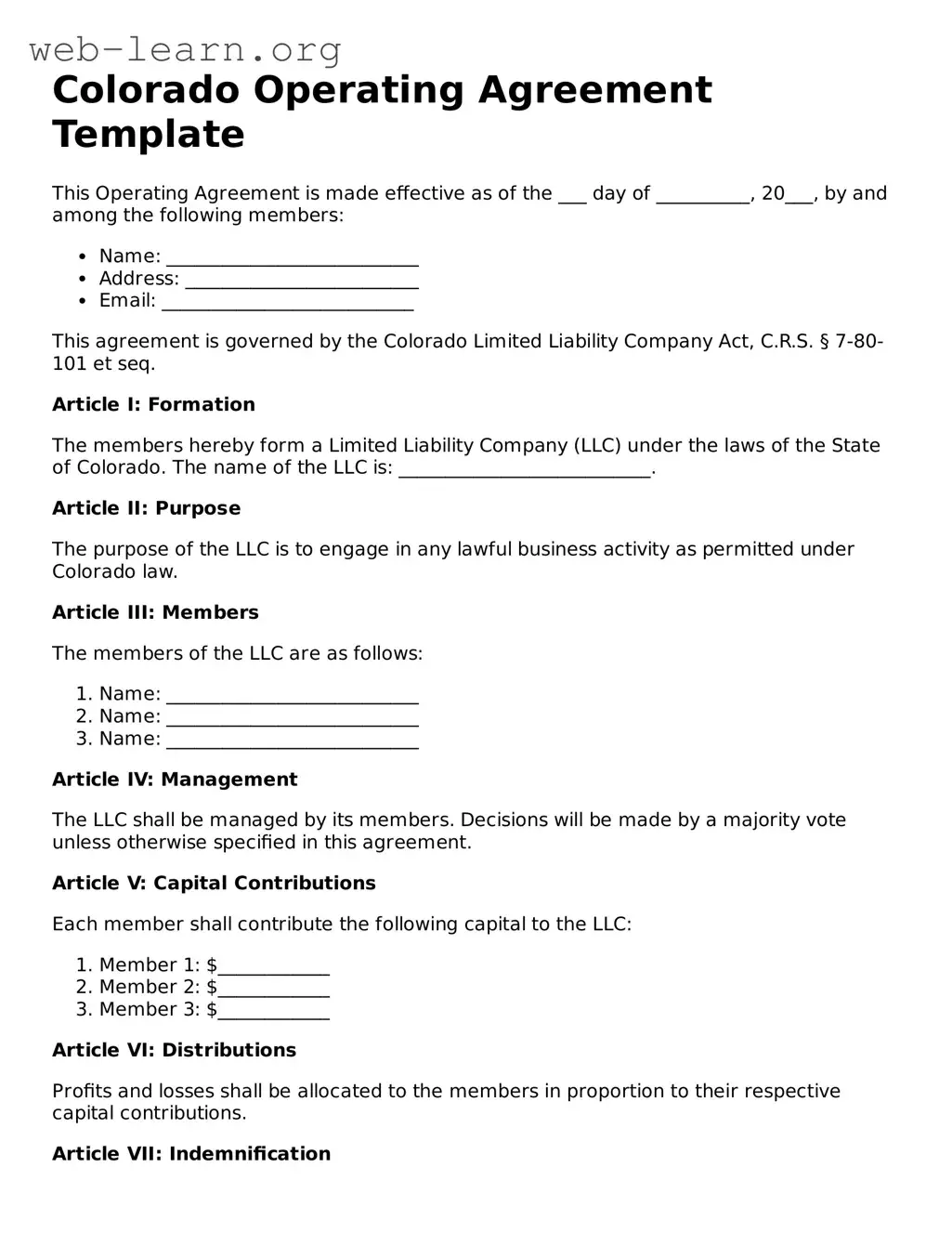
Colorado Operating Agreement Template
This Operating Agreement is made effective as of the ___ day of __________, 20___, by and among the following members:
This agreement is governed by the Colorado Limited Liability Company Act, C.R.S. § 7-80-101 et seq.
Article I: Formation
The members hereby form a Limited Liability Company (LLC) under the laws of the State of Colorado. The name of the LLC is: ___________________________.
Article II: Purpose
The purpose of the LLC is to engage in any lawful business activity as permitted under Colorado law.
Article III: Members
The members of the LLC are as follows:
Article IV: Management
The LLC shall be managed by its members. Decisions will be made by a majority vote unless otherwise specified in this agreement.
Article V: Capital Contributions
Each member shall contribute the following capital to the LLC:
Article VI: Distributions
Profits and losses shall be allocated to the members in proportion to their respective capital contributions.
Article VII: Indemnification
The LLC shall indemnify each member against any losses or damages incurred in connection with the LLC, except in cases of gross negligence or willful misconduct.
Article VIII: Amendments
This Operating Agreement may be amended only by a written agreement signed by all members.
Article IX: Governing Law
This agreement shall be governed by the laws of the State of Colorado.
IN WITNESS WHEREOF, the members have executed this Operating Agreement as of the date first above written.
_____________________________ _____________________________
Member Signature Member Signature
_____________________________ _____________________________
Member Name Member Name
| Fact Name | Description |
|---|---|
| Purpose | The Colorado Operating Agreement outlines the management structure and operating procedures of a limited liability company (LLC). |
| Governing Law | The agreement is governed by the Colorado Revised Statutes, specifically Title 7, Article 80. |
| Members' Rights | It defines the rights and responsibilities of the members, including voting rights and profit distribution. |
| Flexibility | The Operating Agreement allows for flexibility in management, permitting members to choose between member-managed or manager-managed structures. |
| Amendments | Members can amend the agreement as needed, which allows for adaptability to changing circumstances. |
| Dispute Resolution | It often includes provisions for resolving disputes among members, which can help avoid costly litigation. |
| Not Mandatory | While it is not legally required to have an Operating Agreement in Colorado, it is highly recommended for clarity and protection. |
After obtaining the Colorado Operating Agreement form, you will need to provide specific information about your business and its members. This document serves as an internal guideline for the management and operation of your LLC. Following these steps will help ensure that all necessary information is accurately filled out.
What is a Colorado Operating Agreement?
A Colorado Operating Agreement is a legal document that outlines the management structure and operating procedures of a limited liability company (LLC) in Colorado. It serves as an internal guideline for the members of the LLC, detailing their rights, responsibilities, and the distribution of profits and losses.
Is an Operating Agreement required in Colorado?
While Colorado does not legally require LLCs to have an Operating Agreement, it is highly recommended. Having this document can help prevent disputes among members and provide clarity on how the business should operate. It can also be beneficial for establishing credibility with banks and investors.
What should be included in a Colorado Operating Agreement?
Key elements to include in an Operating Agreement are:
Can I modify my Operating Agreement later?
Yes, you can modify your Operating Agreement at any time. It is advisable to do so in writing and to have all members sign the amended agreement. This ensures that everyone is on the same page and helps maintain clarity in your business operations.
How does an Operating Agreement help in case of disputes?
An Operating Agreement can significantly aid in resolving disputes among members. It provides a clear framework for how decisions should be made and outlines procedures for handling disagreements. If a conflict arises, having a documented agreement can help prevent misunderstandings and provide a basis for resolution.
Do I need a lawyer to create an Operating Agreement?
While it is not mandatory to hire a lawyer, consulting one can be beneficial, especially if your LLC has multiple members or complex operations. A legal professional can help ensure that your Operating Agreement complies with Colorado laws and meets the specific needs of your business.
How can I ensure my Operating Agreement is enforceable?
To ensure that your Operating Agreement is enforceable, it should be written clearly and comprehensively. All members should sign the document, and it is advisable to keep it in a safe place along with other important business records. Regularly reviewing and updating the agreement can also help maintain its relevance and enforceability.
Where can I find a template for a Colorado Operating Agreement?
Templates for Colorado Operating Agreements can be found online through various legal websites, or you may choose to consult with a lawyer who can provide a tailored agreement specific to your LLC’s needs. Ensure that any template you use complies with Colorado laws and is suitable for your business structure.
Filling out the Colorado Operating Agreement form is an essential step for anyone looking to establish a limited liability company (LLC) in the state. However, many individuals make common mistakes that can lead to complications down the line. Understanding these pitfalls can save time, money, and frustration.
One frequent error is neglecting to include all members in the agreement. It’s crucial to list every member involved in the LLC, as this establishes ownership and responsibilities. Failing to do so can create confusion and disputes later, especially when it comes to profit distribution or decision-making.
Another common mistake is not specifying the management structure. Some people assume that the default structure will suffice, but it’s vital to clearly outline whether the LLC will be member-managed or manager-managed. This distinction affects how decisions are made and who has authority within the company.
Additionally, many individuals overlook the importance of detailing the capital contributions of each member. Each member’s initial investment should be clearly stated to avoid misunderstandings about financial responsibilities. This clarity helps in future funding rounds or when new members join.
People often forget to include provisions for profit and loss distribution. The agreement should specify how profits and losses will be allocated among members. If this is left vague, it could lead to disputes when it comes time to distribute earnings.
Another mistake is failing to outline procedures for adding or removing members. Life circumstances change, and members may need to exit the LLC or new members may want to join. Without a clear process, these transitions can become contentious and complicated.
Lastly, many individuals skip the legal review of the Operating Agreement. While it may seem like an unnecessary step, having a legal professional review the document can help identify potential issues and ensure compliance with state laws. This small investment can prevent significant headaches in the future.
By being aware of these common mistakes, individuals can fill out the Colorado Operating Agreement form more effectively. Taking the time to ensure accuracy and clarity will lead to a smoother operation of the LLC and foster better relationships among its members.
When forming a Limited Liability Company (LLC) in Colorado, the Operating Agreement is a crucial document that outlines the management structure and operational guidelines. However, several other forms and documents are often used in conjunction with the Operating Agreement to ensure compliance with state laws and to facilitate smooth business operations. Here’s a list of ten essential documents you might encounter:
Understanding these documents is essential for any LLC owner. Each plays a unique role in ensuring your business operates smoothly and remains compliant with state regulations. Having the right paperwork in order not only protects your interests but also sets a solid foundation for future growth.
When filling out the Colorado Operating Agreement form, it's important to follow certain guidelines to ensure accuracy and compliance. Here are seven things you should and shouldn't do:
Following these guidelines will help ensure that your Operating Agreement is effective and legally sound.
Here are 10 common misconceptions about the Colorado Operating Agreement form, along with explanations to clarify each one:
While it is highly recommended for LLCs to have an Operating Agreement, it is not legally required in Colorado. However, having one can help outline the structure and rules of the LLC.
The Operating Agreement is a private document. It does not need to be filed with the Colorado Secretary of State. It is kept within the LLC's records.
Single-member LLCs can also benefit from having an Operating Agreement. It helps establish clear ownership and operational guidelines.
The Articles of Organization is a document filed with the state to create the LLC. The Operating Agreement is an internal document that outlines how the LLC will operate.
Operating Agreements can be amended as needed. Members can agree to changes, and it’s important to keep the document updated to reflect the current operations of the LLC.
There is no one-size-fits-all template for Operating Agreements. Each agreement can be customized to fit the specific needs and preferences of the LLC members.
Operating Agreements are useful for businesses of all sizes, including small and family-owned LLCs. They help clarify roles and responsibilities.
While profit distribution is a part of the Operating Agreement, it also covers management structure, decision-making processes, and member responsibilities.
In Colorado, if there is no Operating Agreement, the default rules in the Colorado Limited Liability Company Act will apply. This may not align with the members' intentions.
Members can revisit and revise the Operating Agreement as circumstances change. It is important to keep the document relevant and reflective of the LLC's operations.
When filling out and using the Colorado Operating Agreement form, consider the following key takeaways:
Llc Operating Agreement Arkansas - The Operating Agreement can include provisions for indemnification of members and managers.
How to Create an Operating Agreement - This document is essential for defining the roles and responsibilities of members.
Indiana Llc Operating Agreement - The Operating Agreement can specify the roles of non-member managers.
Operating Agreement Llc California Template - This document can establish a clear chain of command.