The Colorado Notice to Quit form serves as an essential tool for landlords and tenants navigating the complexities of rental agreements in the state. This document is typically used when a landlord wishes to terminate a lease due to various reasons, such as non-payment of rent or violation of lease terms. It outlines the necessary steps that a landlord must follow to formally notify a tenant of the intent to terminate their tenancy. The form specifies the time frame in which the tenant must vacate the premises, which can vary depending on the reason for the notice. Additionally, the Notice to Quit form must be delivered in a manner that complies with Colorado law, ensuring that the tenant receives proper notice. Understanding the nuances of this form is crucial for both parties, as it helps to protect their rights and responsibilities during the eviction process. Clarity in communication is vital, and utilizing this form can facilitate a smoother transition for both landlords and tenants.
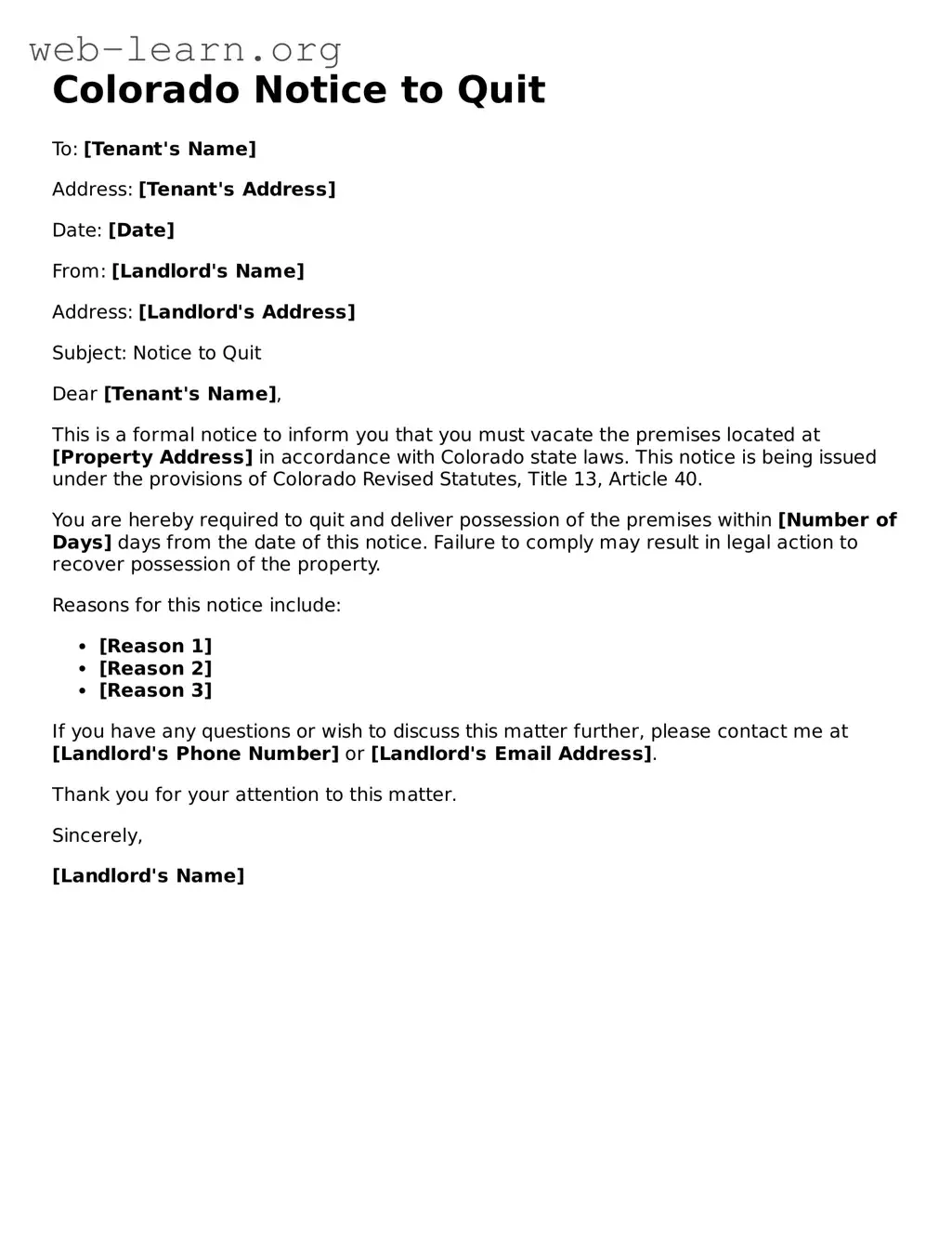
Colorado Notice to Quit
To: [Tenant's Name]
Address: [Tenant's Address]
Date: [Date]
From: [Landlord's Name]
Address: [Landlord's Address]
Subject: Notice to Quit
Dear [Tenant's Name],
This is a formal notice to inform you that you must vacate the premises located at [Property Address] in accordance with Colorado state laws. This notice is being issued under the provisions of Colorado Revised Statutes, Title 13, Article 40.
You are hereby required to quit and deliver possession of the premises within [Number of Days] days from the date of this notice. Failure to comply may result in legal action to recover possession of the property.
Reasons for this notice include:
If you have any questions or wish to discuss this matter further, please contact me at [Landlord's Phone Number] or [Landlord's Email Address].
Thank you for your attention to this matter.
Sincerely,
[Landlord's Name]
| Fact Name | Description |
|---|---|
| Purpose | The Colorado Notice to Quit form is used to inform a tenant that they must vacate the rental property. |
| Governing Law | This form is governed by Colorado Revised Statutes, specifically § 13-40-107. |
| Types of Notice | There are different types of notices, including those for non-payment of rent and lease violations. |
| Notice Period | The required notice period varies depending on the reason for eviction, typically ranging from 3 to 30 days. |
| Delivery Methods | The notice can be delivered in person, via certified mail, or posted on the property. |
| Tenant Response | Tenants have the right to respond to the notice, often by rectifying the issue or disputing the claim. |
| Legal Compliance | Failure to use the proper form or follow the correct procedures can lead to delays in the eviction process. |
| Form Availability | The form can typically be obtained from local courts, legal aid organizations, or online legal resources. |
| Filing for Eviction | After the notice period expires, landlords may file for eviction if the tenant has not vacated the property. |
| Importance of Legal Advice | Seeking legal advice is recommended to ensure compliance with all applicable laws and regulations. |
After obtaining the Colorado Notice to Quit form, you will need to fill it out accurately to ensure it serves its intended purpose. This form is essential in the process of addressing tenancy issues. Follow the steps below to complete the form correctly.
Once the form is filled out, you will need to deliver it to the tenant. This can be done in person, by mail, or through other legal methods of delivery. Ensure that you keep a record of how and when the notice was delivered.
What is a Colorado Notice to Quit form?
The Colorado Notice to Quit form is a legal document used by landlords to notify tenants that they must vacate the rental property. This notice is typically issued when a tenant has violated the terms of their lease agreement or has failed to pay rent. It serves as a formal request to leave the premises within a specified time frame.
When should a landlord use a Notice to Quit?
A landlord should use a Notice to Quit when they wish to terminate a tenancy due to specific reasons, such as:
It's important to ensure that the reason for the notice complies with Colorado rental laws.
How much notice must be given to tenants?
The amount of notice required can vary based on the reason for the eviction. Generally, landlords must provide:
Always check local regulations, as they can differ.
Can a tenant contest a Notice to Quit?
Yes, tenants have the right to contest a Notice to Quit. They can respond by addressing the issues raised in the notice or by disputing the validity of the notice itself. If the matter escalates, it may lead to a court hearing where both parties can present their cases.
What happens if a tenant does not comply with the Notice to Quit?
If a tenant does not comply with the Notice to Quit within the specified timeframe, the landlord may proceed with legal action to evict the tenant. This typically involves filing an eviction lawsuit in the local court. The court will then schedule a hearing to determine the outcome.
Are there any specific requirements for completing a Notice to Quit?
Yes, a Notice to Quit should include essential details such as:
Ensuring that all information is accurate helps prevent disputes later on.
Where can I find a Colorado Notice to Quit form?
A Colorado Notice to Quit form can be obtained from various sources, including online legal document services, local housing authorities, or legal aid organizations. It's advisable to use a template that complies with Colorado laws to ensure it is valid.
Filling out the Colorado Notice to Quit form can be straightforward, but many people make mistakes that can lead to complications. One common error is failing to provide the correct date. It's essential to include the date when the notice is served. Without this information, the notice may not be considered valid.
Another frequent mistake is not clearly stating the reason for the eviction. The form requires a specific reason, such as non-payment of rent or lease violations. If this section is vague or incomplete, it could lead to confusion or disputes later on.
Many people also overlook the importance of including the tenant's full name. Using nicknames or abbreviations can cause issues. The tenant's name should match the name on the lease agreement to avoid any potential legal challenges.
In addition, some individuals forget to sign and date the form. A signature is a crucial part of the document, as it shows that the landlord or property manager acknowledges the notice. Without a signature, the notice may not be enforceable.
Another mistake is not providing proper delivery of the notice. Colorado law requires that the notice be delivered in specific ways, such as in person or by certified mail. Failing to follow these guidelines can invalidate the notice.
People often neglect to keep a copy of the notice for their records. This can be problematic if there are disputes later on. Having a copy can serve as proof of the notice being issued and the date it was delivered.
Lastly, some individuals do not understand the timeline for responding to a Notice to Quit. Tenants have a limited amount of time to respond or vacate the property. Not being aware of these timelines can lead to unnecessary legal complications.
When dealing with rental agreements and tenant issues in Colorado, the Notice to Quit form is just one piece of the puzzle. This document serves as a formal notice to a tenant to vacate the premises. However, several other forms and documents may accompany it to ensure that the eviction process is handled correctly and legally. Here’s a brief overview of some of these important documents.
Understanding these documents is crucial for both landlords and tenants. Each plays a specific role in the rental process, particularly when disputes arise. Being informed can help ensure that rights are protected and that the process is as smooth as possible.
The Notice to Quit form is similar to several other legal documents in terms of purpose and function. Here are five documents that share similarities:
When completing the Colorado Notice to Quit form, it is important to adhere to specific guidelines to ensure accuracy and compliance with legal requirements. Below is a list of things to do and avoid during this process.
Things to Do:
Things Not to Do:
The Colorado Notice to Quit form is an important document in the eviction process. However, there are several misconceptions about it that can lead to confusion. Here are five common misconceptions:
This is incorrect. The Notice to Quit is specifically for non-payment of rent or lease violations. Other reasons for eviction may require different forms.
Some people think that sending the notice by mail is sufficient. However, the law requires that it be delivered in person or posted at the property.
This is a misunderstanding. The Notice to Quit specifies a timeframe, usually three days, for tenants to leave the property after receiving the notice.
This is not true. The content of the Notice to Quit may vary based on the specific lease agreement and the reason for eviction.
This is misleading. A Notice to Quit is just the first step. The landlord must still go through the legal process to evict a tenant.
Understanding these misconceptions can help both landlords and tenants navigate the eviction process more effectively.
When filling out and using the Colorado Notice to Quit form, keep these key takeaways in mind:
Three Day Notice to Quit - Tenants may have the right to contest the eviction in court after receiving the notice.
Florida Eviction Notice - The notice must be delivered in accordance with state laws.
Printable Indiana Eviction Notice Form - It is a formal request for the tenant to vacate the premises.