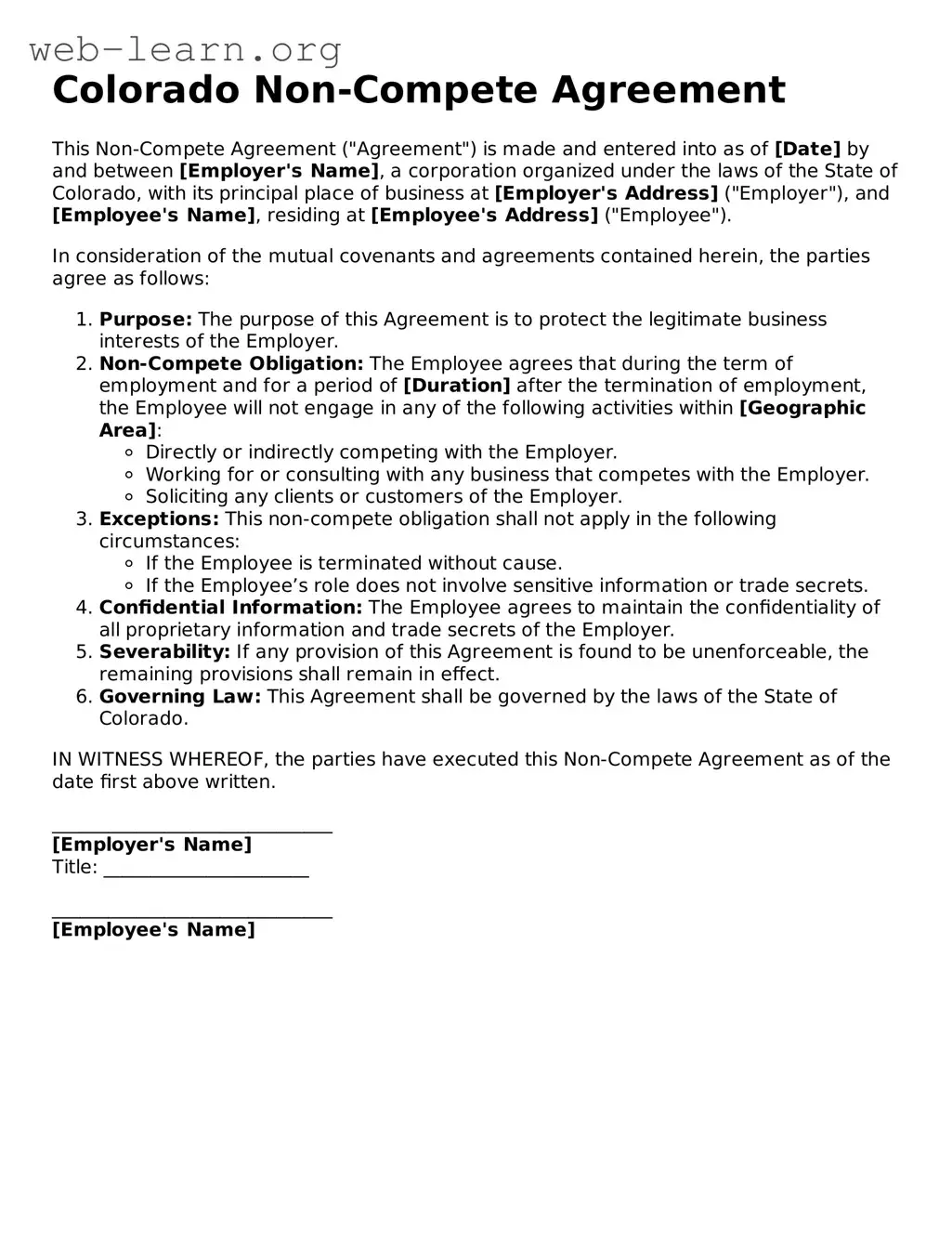
The Colorado Non-compete Agreement form serves as a crucial legal document designed to protect the interests of employers while outlining the limitations placed on employees regarding post-employment activities. This form typically includes essential elements such as the duration of the non-compete period, the geographical scope of the restrictions, and the specific activities that are prohibited after employment ends. It is important to note that Colorado law imposes certain restrictions on the enforceability of non-compete agreements, requiring them to be reasonable in scope and duration. Additionally, the form often addresses the potential for compensation during the non-compete period, ensuring that employees are not left without financial support. Understanding these components is vital for both employers and employees, as it helps clarify rights and obligations, ultimately fostering a fair working environment.
Colorado Non-Compete Agreement
This Non-Compete Agreement ("Agreement") is made and entered into as of [Date] by and between [Employer's Name], a corporation organized under the laws of the State of Colorado, with its principal place of business at [Employer's Address] ("Employer"), and [Employee's Name], residing at [Employee's Address] ("Employee").
In consideration of the mutual covenants and agreements contained herein, the parties agree as follows:
IN WITNESS WHEREOF, the parties have executed this Non-Compete Agreement as of the date first above written.
______________________________
[Employer's Name]
Title: ______________________
______________________________
[Employee's Name]
| Fact Name | Description |
|---|---|
| Governing Law | The Colorado Non-compete Agreement is governed by Colorado Revised Statutes, specifically § 8-2-113. |
| Enforceability | Non-compete agreements in Colorado are generally unenforceable unless they meet specific criteria. |
| Limitations on Duration | The maximum duration for a non-compete agreement in Colorado is typically one year. |
| Geographic Scope | The agreement must specify a reasonable geographic area where the restrictions apply. |
| Consideration | There must be valid consideration, such as a job offer or promotion, for the agreement to be enforceable. |
| Employee Protections | Colorado law protects employees from overly broad non-compete agreements that restrict their ability to work. |
| Exceptions | Non-compete agreements are generally unenforceable for low-wage workers and certain professions, like healthcare. |
| Written Requirement | The agreement must be in writing and signed by both parties to be valid. |
| Judicial Review | Courts in Colorado can modify or void non-compete agreements that are deemed unreasonable. |
Filling out the Colorado Non-compete Agreement form is an important step in ensuring that both parties understand the terms of their agreement. After completing the form, you will need to review it carefully and ensure that all information is accurate before submitting it to the relevant parties.
What is a Non-compete Agreement?
A Non-compete Agreement is a contract between an employer and an employee. It restricts the employee from working for competitors or starting a competing business for a specific period after leaving the company. This agreement is intended to protect the employer's business interests and confidential information.
Are Non-compete Agreements enforceable in Colorado?
Yes, Non-compete Agreements can be enforceable in Colorado, but there are specific conditions. The agreement must be reasonable in scope, duration, and geographic area. Colorado law limits the enforceability of these agreements, especially for low-wage employees.
What is considered a reasonable duration for a Non-compete Agreement?
In Colorado, a duration of six months to one year is generally considered reasonable. However, the specific circumstances of the job and industry can influence what is deemed acceptable.
Can a Non-compete Agreement restrict me from working in my profession entirely?
No, a Non-compete Agreement cannot completely prevent you from working in your profession. It can only limit your ability to work for specific competitors or within a certain geographic area for a defined period.
What happens if I violate a Non-compete Agreement?
If you violate a Non-compete Agreement, your former employer may take legal action against you. This could include seeking an injunction to prevent you from working for a competitor or pursuing damages for any losses incurred due to the violation.
Can I negotiate the terms of a Non-compete Agreement?
Yes, you can negotiate the terms of a Non-compete Agreement before signing it. It is advisable to discuss any concerns with your employer and seek a mutually agreeable arrangement. Consulting with a legal professional may also be beneficial.
Do I need to sign a Non-compete Agreement to get a job?
Not necessarily. While some employers require a Non-compete Agreement as a condition of employment, others may not. If you are asked to sign one, you should review it carefully and understand its implications before agreeing.
What is the difference between a Non-compete Agreement and a Non-disclosure Agreement?
A Non-compete Agreement restricts an employee from working for competitors after leaving a job, while a Non-disclosure Agreement (NDA) protects confidential information from being shared with outside parties. Both serve to protect an employer's interests but address different concerns.
Can I challenge a Non-compete Agreement in court?
Yes, you can challenge a Non-compete Agreement in court if you believe it is unreasonable or unenforceable. Courts will evaluate the agreement based on its terms and the specific circumstances surrounding it. Legal advice is recommended for this process.
What should I do if I have questions about my Non-compete Agreement?
If you have questions about your Non-compete Agreement, it is best to consult with a legal professional who specializes in employment law. They can provide guidance tailored to your specific situation and help you understand your rights and obligations.
Filling out a Non-compete Agreement in Colorado can be a daunting task. Many individuals make common mistakes that can render the agreement ineffective or unenforceable. Understanding these pitfalls is essential for anyone navigating this legal landscape.
One frequent mistake is failing to clearly define the scope of the agreement. A vague description of what activities are restricted can lead to confusion and disputes later on. It is crucial to specify the exact nature of the competitive activities that the employee is prohibited from engaging in after leaving the company.
Another common error is not considering the geographic limitations. Non-compete agreements should have a reasonable geographic scope. If the area is too broad, it may be deemed unenforceable. Conversely, if it is too narrow, it might not adequately protect the employer's interests. Striking the right balance is key.
Many individuals also overlook the duration of the restriction. A non-compete agreement must specify how long the restrictions will last. An excessively long duration can be viewed as unreasonable, while a very short one may fail to protect the employer’s business interests. Understanding what is considered reasonable in Colorado is vital.
In addition, failing to provide adequate consideration is a critical mistake. For a non-compete agreement to be enforceable, there must be something of value exchanged. This could be employment itself or additional benefits offered to the employee. Without this, the agreement may not hold up in court.
Another mistake is neglecting to review the state-specific laws governing non-compete agreements. Colorado has specific regulations that dictate what can and cannot be included in these agreements. Ignoring these laws can lead to unenforceability and potential legal challenges.
Finally, individuals often forget to seek legal advice before signing the agreement. Consulting with an attorney can provide clarity and ensure that the terms are fair and legally sound. Legal professionals can also help identify any potential pitfalls that may not be immediately apparent.
By being aware of these common mistakes, individuals can better navigate the complexities of the Colorado Non-compete Agreement and protect their interests while respecting their employer's rights.
When entering into a Non-compete Agreement in Colorado, it’s essential to consider other related documents that may be necessary for a comprehensive understanding of the employment relationship. These documents help clarify expectations, protect interests, and ensure that both parties are on the same page.
Understanding these related documents can provide clarity and protection for both employers and employees. Each plays a crucial role in establishing a clear framework for the employment relationship and safeguarding interests post-employment.
A Non-compete Agreement is a crucial document in the realm of business and employment. It helps protect a company’s interests by preventing employees from engaging in competitive activities after leaving the organization. Several other documents serve similar purposes, each with its own nuances. Here are six documents that share similarities with a Non-compete Agreement:
Understanding these documents can help individuals and businesses navigate the complexities of employment relationships and protect their interests effectively.
When filling out the Colorado Non-compete Agreement form, it’s essential to be thorough and precise. Here’s a list of what you should and shouldn’t do to ensure that your agreement is clear and enforceable.
By following these guidelines, you can navigate the process of completing the Colorado Non-compete Agreement form with confidence.
Non-compete agreements can often be misunderstood. Here are five common misconceptions about the Colorado Non-compete Agreement form:
This is not true. In Colorado, non-compete agreements are generally unenforceable unless they meet specific criteria, such as protecting trade secrets or ensuring the sale of a business.
Many employees believe they must accept the terms as-is. However, it is possible to negotiate the terms, including duration and geographic scope, to better suit individual circumstances.
While both agreements aim to protect business interests, they serve different purposes. Non-disclosure agreements focus on confidentiality, while non-compete agreements restrict employment opportunities.
This misconception can be alarming. In reality, non-compete agreements often limit specific employment opportunities but do not completely prohibit working in the same industry.
This is a common myth. Non-compete agreements can be applied to various positions, not just executives or high-level employees, depending on the business's needs.
When filling out and using the Colorado Non-compete Agreement form, consider the following key takeaways:
Are Non Competes Enforceable in Kentucky - Employers often use non-compete agreements as part of a broader strategy to protect their business interests and competitive edge.
How to Get Out of a Non Compete Agreement - A Non-compete Agreement is often part of a larger employment contract.
How to Beat a Non Compete in Pa - Non-compete Agreements can also include provisions for non-solicitation, preventing former employees from poaching clients.