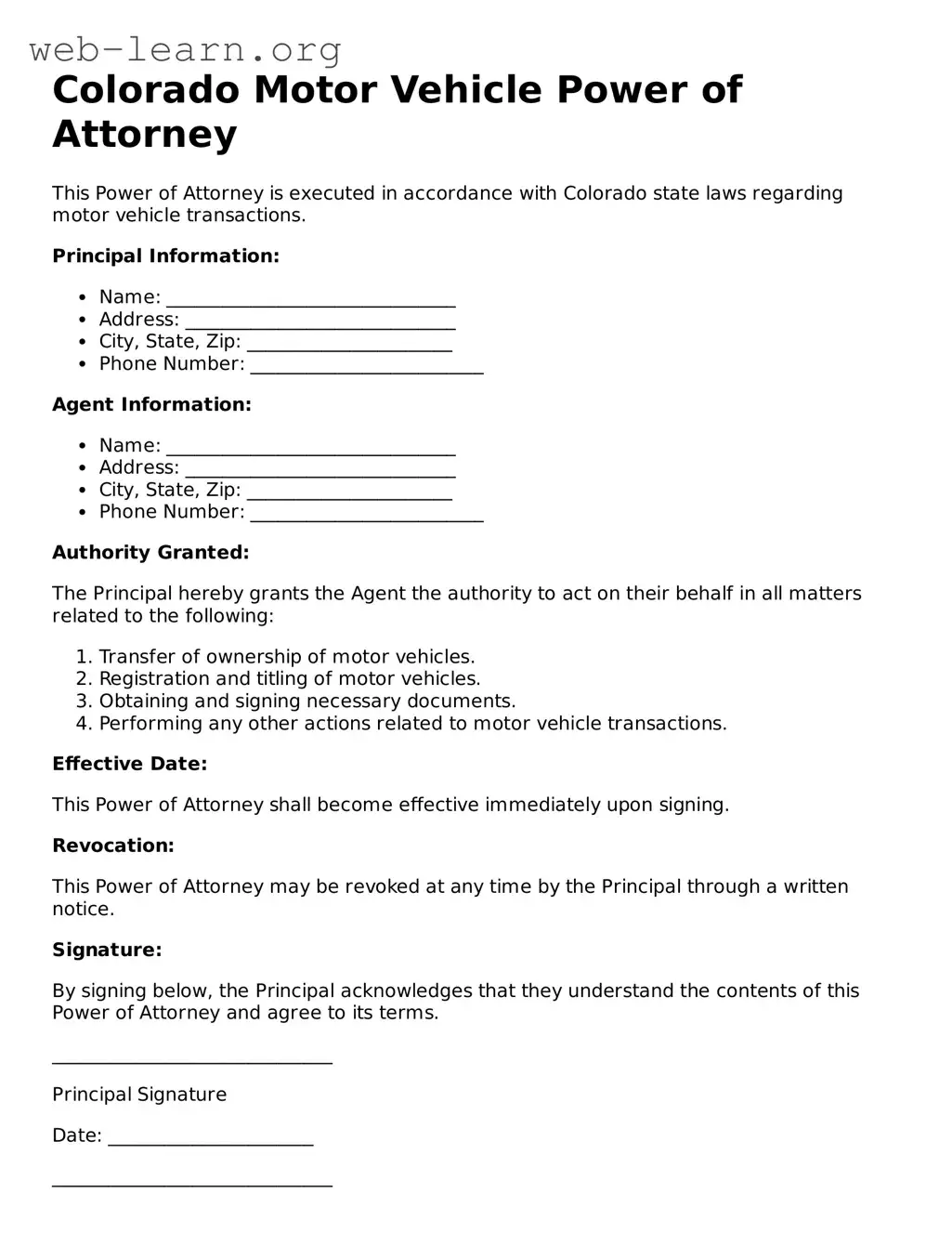
In the beautiful state of Colorado, managing motor vehicle transactions can sometimes feel overwhelming, especially when you’re unable to handle them personally. This is where the Colorado Motor Vehicle Power of Attorney form comes into play. Designed to empower individuals, this legal document allows you to designate someone you trust to act on your behalf in matters related to your vehicle. Whether you need assistance with registering a new car, transferring ownership, or handling title issues, this form simplifies the process. It ensures that your chosen representative can make decisions and sign documents, all while you maintain peace of mind. By understanding the key components of this form, including the necessary information about the vehicle, the powers granted, and the signature requirements, you can navigate the complexities of vehicle management with confidence. Knowing how to properly utilize this document can save you time and effort, making your life a little easier when it comes to your motor vehicle needs.
Colorado Motor Vehicle Power of Attorney
This Power of Attorney is executed in accordance with Colorado state laws regarding motor vehicle transactions.
Principal Information:
Agent Information:
Authority Granted:
The Principal hereby grants the Agent the authority to act on their behalf in all matters related to the following:
Effective Date:
This Power of Attorney shall become effective immediately upon signing.
Revocation:
This Power of Attorney may be revoked at any time by the Principal through a written notice.
Signature:
By signing below, the Principal acknowledges that they understand the contents of this Power of Attorney and agree to its terms.
______________________________
Principal Signature
Date: ______________________
______________________________
Agent Signature
Date: ______________________
| Fact Name | Details |
|---|---|
| Purpose | The Colorado Motor Vehicle Power of Attorney form allows an individual to designate another person to handle motor vehicle transactions on their behalf. |
| Governing Law | This form is governed by Colorado Revised Statutes, Title 12, Article 55. |
| Signature Requirement | The form must be signed by the principal (the person granting authority) in the presence of a notary public. |
| Revocation | The Power of Attorney can be revoked at any time by the principal, provided that the revocation is made in writing. |
Filling out the Colorado Motor Vehicle Power of Attorney form is a straightforward process. Once completed, this form allows someone to act on your behalf regarding motor vehicle matters. Follow these steps to ensure that the form is filled out correctly.
After completing these steps, ensure you keep a copy for your records. The original should be given to your agent, who can then use it as needed for vehicle-related transactions.
What is a Colorado Motor Vehicle Power of Attorney form?
The Colorado Motor Vehicle Power of Attorney form allows an individual to designate another person to act on their behalf regarding motor vehicle transactions. This can include tasks such as signing documents for title transfers, registration, and other motor vehicle-related matters.
Who can be appointed as an agent?
Any competent adult can be appointed as an agent. This could be a family member, friend, or any trusted individual who is willing to handle the motor vehicle transactions for you.
What transactions can my agent perform?
Your agent can handle various transactions, including:
Do I need to have the form notarized?
Yes, the form must be notarized to be valid. This adds a layer of protection by ensuring that the signatures are authentic and that the document was signed willingly.
How long is the Power of Attorney valid?
The Power of Attorney remains valid until you revoke it or until the specific task is completed. It’s important to communicate with your agent about any changes you wish to make.
Can I revoke the Power of Attorney?
Yes, you can revoke the Power of Attorney at any time. To do this, you should notify your agent in writing and, if necessary, file a revocation form with the appropriate authorities.
Is there a fee to file the Power of Attorney?
There is typically no fee to complete the Power of Attorney form itself. However, fees may apply when processing vehicle transactions, such as title transfers or registrations.
Where can I obtain the Colorado Motor Vehicle Power of Attorney form?
You can obtain the form from the Colorado Department of Revenue's website or at your local county clerk and recorder’s office. Ensure you are using the most current version of the form.
What should I do if my agent misuses the Power of Attorney?
If you suspect that your agent is misusing their authority, you should revoke the Power of Attorney immediately. Additionally, consider consulting with a legal professional to explore your options for addressing any misuse.
Filling out the Colorado Motor Vehicle Power of Attorney form can seem straightforward, yet many individuals encounter pitfalls that can lead to complications down the road. One common mistake is failing to provide complete information. The form requires specific details about both the principal and the agent, including names, addresses, and identification numbers. Omitting any of this information can render the document invalid.
Another frequent error is neglecting to sign the form. While it may seem obvious, many individuals forget this crucial step. A signature is not just a formality; it signifies consent and intent. Without it, the form holds no legal weight. Additionally, individuals often overlook the requirement for a witness or notary signature, which is necessary for the document to be legally binding in Colorado.
People sometimes misinterpret the powers they are granting. The form allows for various levels of authority, and failing to specify the exact powers can lead to misunderstandings. For example, if someone grants broad powers without realizing the implications, the agent may act in ways that the principal did not intend.
Another mistake is using outdated forms. Legal documents can change over time, and using an old version of the Motor Vehicle Power of Attorney form may result in issues. It is essential to ensure that the most current form is being utilized to avoid complications.
In some cases, individuals may not properly communicate their intentions to the agent. Clear communication is vital to ensure that the agent understands the principal's wishes. A lack of clarity can lead to actions that may not align with the principal's desires, creating conflict and confusion.
People often underestimate the importance of reviewing the completed form. Before submission, it is wise to double-check all entries for accuracy. Simple typographical errors or incorrect information can cause significant delays or problems in the future.
Another common oversight is failing to keep a copy of the completed form. Once the form is signed and submitted, individuals should retain a copy for their records. This can be crucial if any disputes arise or if the agent needs to prove their authority in the future.
Moreover, individuals sometimes forget to update the form when their circumstances change. Life events such as marriage, divorce, or the death of an agent can impact the validity of the Power of Attorney. Regularly reviewing and updating the document is essential to ensure it reflects current intentions.
Lastly, people may not fully understand the implications of granting a Power of Attorney. This document gives significant authority to the agent, and it is vital to choose someone trustworthy. Individuals should carefully consider their choice of agent and understand the responsibilities that come with this role.
The Colorado Motor Vehicle Power of Attorney form is a crucial document that allows one person to authorize another to handle specific vehicle-related tasks on their behalf. When dealing with motor vehicle transactions, several other forms and documents may be necessary to ensure a smooth process. Below is a list of common forms that often accompany the Motor Vehicle Power of Attorney in Colorado.
Having these forms readily available can streamline the process of transferring ownership or handling other vehicle-related matters in Colorado. Each document serves a specific purpose and contributes to a clear and legal transaction.
When filling out the Colorado Motor Vehicle Power of Attorney form, it is important to follow certain guidelines to ensure accuracy and compliance. Here are ten things to keep in mind:
Following these guidelines will help you complete the form correctly and avoid potential issues.
Understanding the Colorado Motor Vehicle Power of Attorney form can be challenging due to various misconceptions. Below are some common misunderstandings along with clarifications to help you navigate this important document.
This is not true. While many people associate the form with vehicle sales, it can also be used for a variety of purposes, such as transferring title, registering a vehicle, or handling other motor vehicle-related matters.
While legal assistance can be helpful, it is not necessary to have a lawyer complete the form. Many individuals can accurately fill it out by following the instructions provided.
Notarization is not always required for the Colorado Motor Vehicle Power of Attorney form. However, it is advisable to have it notarized to ensure that it is accepted without issues.
The validity of the form does not automatically expire. It remains in effect until the principal revokes it or until the purpose for which it was created is completed.
This is incorrect. The principal can revoke the Power of Attorney at any time and appoint a new agent if necessary. Communication is key in this process.
Each state has its own laws and regulations regarding Power of Attorney forms. It is important to understand the specific requirements and implications in Colorado.
By addressing these misconceptions, individuals can approach the Colorado Motor Vehicle Power of Attorney form with greater confidence and clarity. Always ensure that you have the most current information and guidance when completing any legal document.
When dealing with the Colorado Motor Vehicle Power of Attorney form, it’s important to understand how to effectively fill it out and use it. Here are some key takeaways to keep in mind:
Understanding these key points will help you navigate the process smoothly and ensure that your motor vehicle transactions are handled as you intend.
Indiana Vehicle Power of Attorney - It ensures that your vehicle is taken care of, even if you are unable to manage it yourself.
Oregon Dmv Poa - The principal should keep a record of all transactions made by the agent.