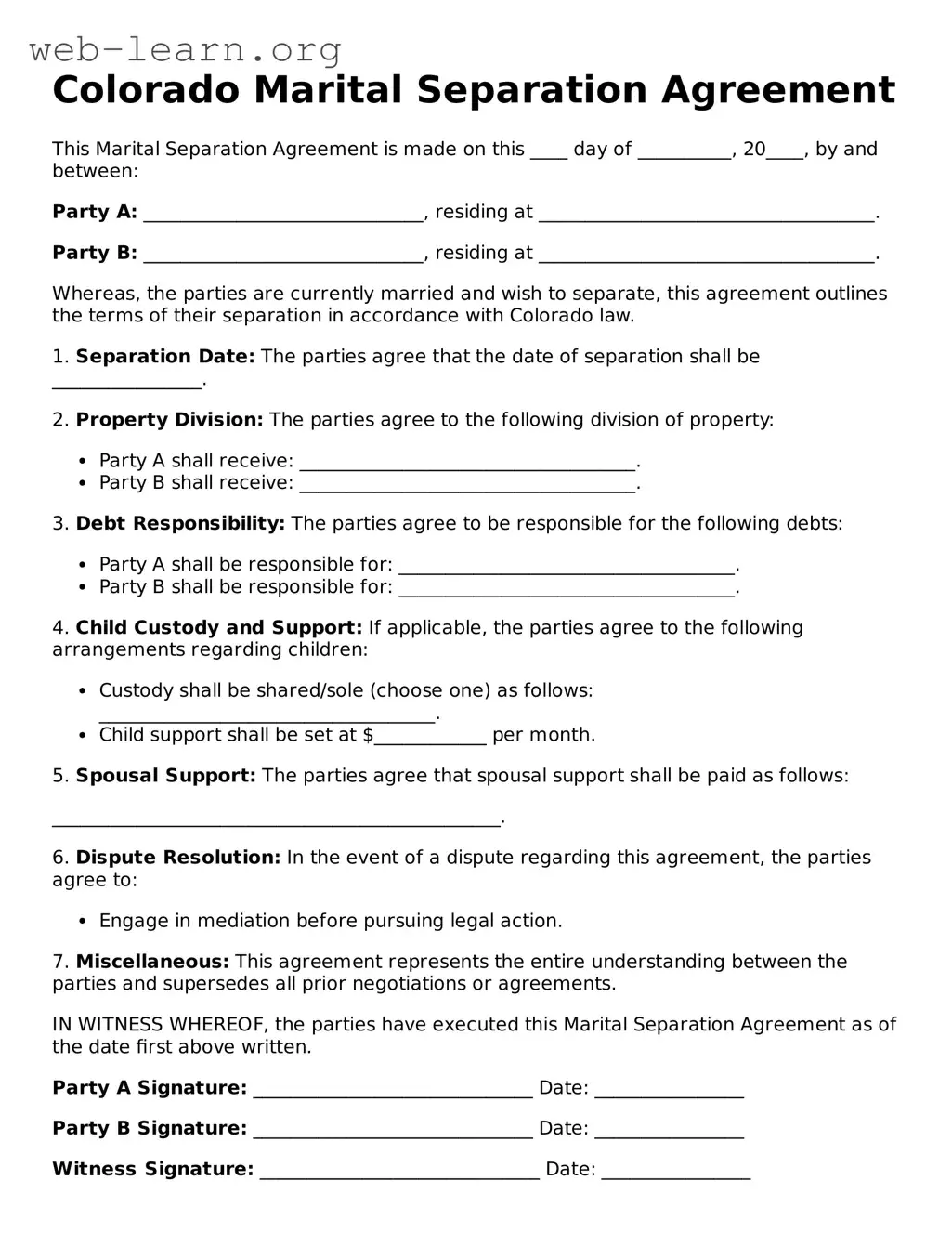
The Colorado Marital Separation Agreement form serves as a critical tool for couples who choose to live apart while addressing various aspects of their marital relationship. This legally binding document outlines key agreements regarding property division, debt allocation, child custody, and support obligations. It allows both parties to clarify their rights and responsibilities during the separation period. By detailing how assets will be divided and how children will be cared for, the form aims to minimize conflict and provide a clear framework for both individuals. Additionally, it can play a significant role in future divorce proceedings, ensuring that both parties have a mutual understanding of their arrangements. Understanding the nuances of this form is essential for couples navigating the complexities of separation in Colorado.
Colorado Marital Separation Agreement
This Marital Separation Agreement is made on this ____ day of __________, 20____, by and between:
Party A: ______________________________, residing at ____________________________________.
Party B: ______________________________, residing at ____________________________________.
Whereas, the parties are currently married and wish to separate, this agreement outlines the terms of their separation in accordance with Colorado law.
1. Separation Date: The parties agree that the date of separation shall be ________________.
2. Property Division: The parties agree to the following division of property:
3. Debt Responsibility: The parties agree to be responsible for the following debts:
4. Child Custody and Support: If applicable, the parties agree to the following arrangements regarding children:
5. Spousal Support: The parties agree that spousal support shall be paid as follows:
________________________________________________.
6. Dispute Resolution: In the event of a dispute regarding this agreement, the parties agree to:
7. Miscellaneous: This agreement represents the entire understanding between the parties and supersedes all prior negotiations or agreements.
IN WITNESS WHEREOF, the parties have executed this Marital Separation Agreement as of the date first above written.
Party A Signature: ______________________________ Date: ________________
Party B Signature: ______________________________ Date: ________________
Witness Signature: ______________________________ Date: ________________
| Fact Name | Description |
|---|---|
| Purpose | The Colorado Marital Separation Agreement form outlines the terms of separation between spouses, addressing issues such as property division, child custody, and support obligations. |
| Governing Law | This agreement is governed by Colorado state law, specifically under the Colorado Revised Statutes (C.R.S.) Title 14, Article 10. |
| Filing Requirements | While the agreement itself does not need to be filed with the court, it should be presented during divorce proceedings to ensure enforceability. |
| Mutual Agreement | Both parties must voluntarily agree to the terms outlined in the separation agreement for it to be valid and enforceable. |
After obtaining the Colorado Marital Separation Agreement form, it's essential to complete it accurately to ensure that all necessary details are included. This will facilitate a smoother process as you move forward with your separation. Follow these steps carefully to fill out the form correctly.
Once the form is completed, ensure that both parties have copies for their records. Consider seeking legal advice to confirm that all aspects of the agreement are enforceable and meet your needs.
A Colorado Marital Separation Agreement is a legal document that outlines the terms of a couple's separation. It details how assets and debts will be divided, child custody arrangements, and any spousal support obligations. This agreement serves as a framework for the couple to navigate their separation while addressing the needs of both parties.
While it is not legally required to have an attorney draft a Marital Separation Agreement, it is highly recommended. An attorney can ensure that the agreement complies with Colorado laws and adequately protects your rights. They can also help clarify any complex issues that may arise during the separation process.
Yes, a Marital Separation Agreement can be modified if both parties agree to the changes. It is essential to document any modifications in writing and have both parties sign the amended agreement. This ensures that the changes are legally recognized and enforceable.
The Marital Separation Agreement should include specific provisions regarding child custody and visitation. It outlines each parent's rights and responsibilities, including where the child will live and how decisions regarding the child's welfare will be made. This agreement aims to prioritize the best interests of the child while providing clarity for both parents.
If one party fails to comply with the terms of the Marital Separation Agreement, the other party may seek legal remedies. This could involve mediation, court intervention, or enforcement actions. It is crucial to keep a record of any violations to support your case if legal action becomes necessary.
Filling out the Colorado Marital Separation Agreement form can be a daunting task. Many individuals make common mistakes that can lead to complications down the road. One significant error is failing to provide complete and accurate information. Incomplete forms can delay the process and may even result in the court rejecting the agreement. It is crucial to ensure that all sections are filled out thoroughly and that the information is truthful.
Another frequent mistake involves overlooking the importance of financial disclosures. Parties are required to disclose their assets, debts, and income fully. Neglecting to include all financial information can lead to disputes later on. Transparency is vital for a fair separation, and omitting details can undermine trust and lead to legal repercussions.
People often rush through the process without understanding the implications of their choices. For instance, not considering the long-term effects of child custody arrangements can be detrimental. Decisions made in haste may not serve the best interests of the children involved. It is essential to take the time to think through these arrangements carefully.
Some individuals mistakenly believe that a verbal agreement is sufficient. However, a written and signed Marital Separation Agreement is necessary for it to be enforceable in court. Relying on informal agreements can lead to misunderstandings and disputes that could have been avoided with proper documentation.
Additionally, neglecting to seek legal advice is a common misstep. Many people think they can handle the process independently, but the nuances of the law can be complex. Consulting with a legal professional can provide clarity and ensure that all legal requirements are met. This step can save time and prevent costly mistakes.
Another mistake is failing to update the agreement as circumstances change. Life events, such as job changes or relocations, may affect the terms of the separation. Regularly reviewing and adjusting the agreement ensures that it remains relevant and fair for both parties.
Finally, some individuals do not consider the emotional aspects of separation. It is easy to focus solely on the legalities, but the emotional toll can be significant. Taking care of mental health and seeking support during this process is just as important as addressing legal matters. A well-rounded approach can lead to a smoother transition for everyone involved.
A Colorado Marital Separation Agreement is an important document for couples who wish to outline the terms of their separation. Along with this agreement, several other forms and documents may be necessary to ensure a smooth process. Here are four commonly used documents that often accompany the Marital Separation Agreement:
Each of these documents plays a crucial role in the separation process, ensuring that both parties have a clear understanding of their rights and responsibilities. Properly completing and filing these forms can help avoid misunderstandings and facilitate a smoother transition during this challenging time.
When filling out the Colorado Marital Separation Agreement form, it is essential to approach the process with care. Here are some important dos and don'ts to keep in mind:
When navigating the complexities of a marital separation, many individuals encounter misunderstandings about the Colorado Marital Separation Agreement form. Here are six common misconceptions that can lead to confusion:
Understanding these misconceptions can empower individuals to make informed decisions during their separation process. Taking the time to learn about the Colorado Marital Separation Agreement form can lead to better outcomes for all parties involved.
When filling out and using the Colorado Marital Separation Agreement form, consider the following key points:
Separation From Spouse - This form can be revisited and amended as needed.
Separation Agreement California Template - It helps ensure that both parties are on the same page regarding finances.
Disadvantages of Legal Separation in Illinois - Can provide peace of mind through clearly defined agreements.