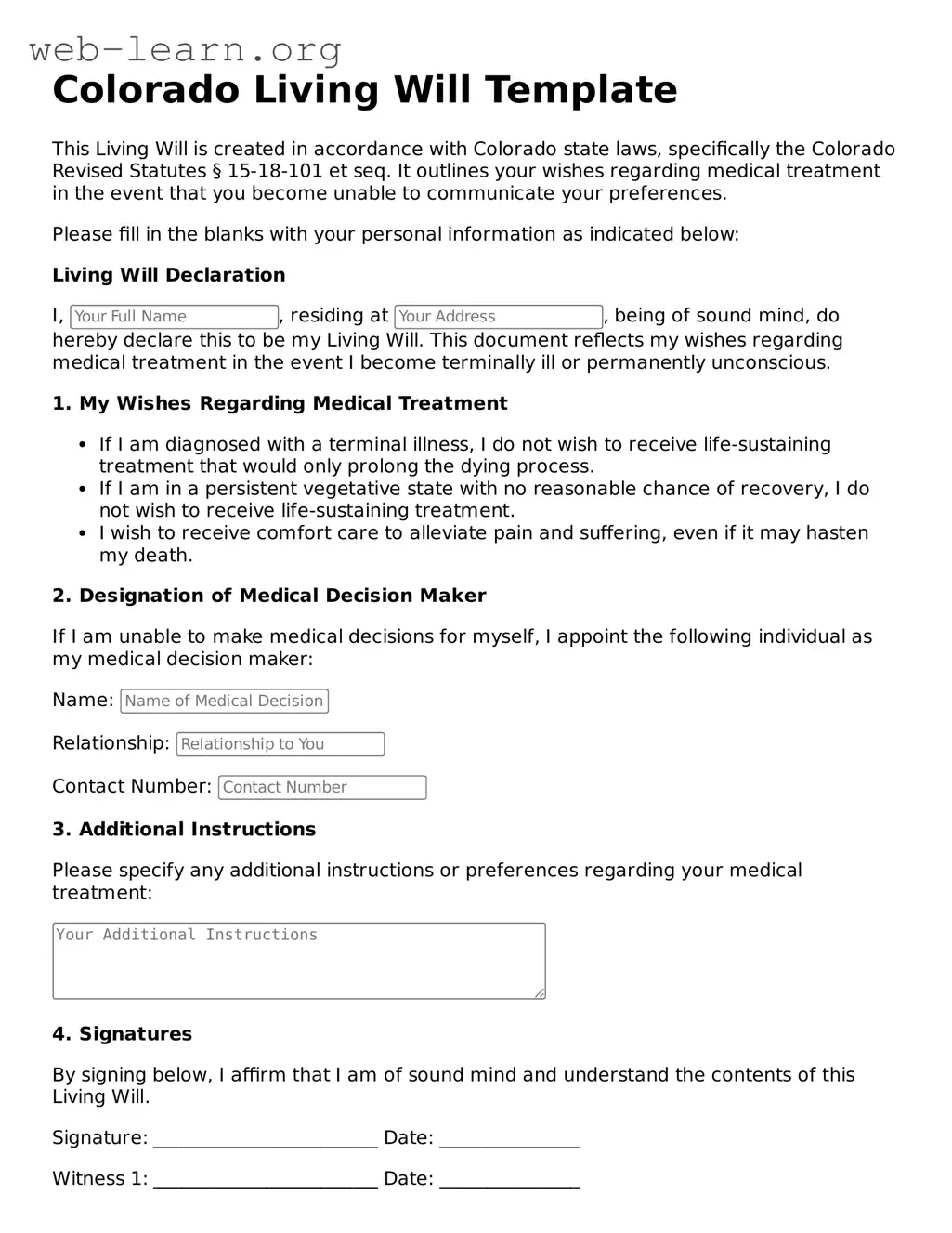
In the state of Colorado, individuals have the opportunity to express their healthcare preferences through a Living Will, a vital document that allows people to articulate their wishes regarding medical treatment in the event they become unable to communicate those decisions themselves. This form is particularly significant for those who wish to ensure that their values and desires are respected during critical moments of medical care. The Living Will addresses various aspects of healthcare, including the types of medical interventions one may want or refuse, such as life-sustaining treatments, resuscitation efforts, and palliative care options. By completing this document, individuals can provide clear guidance to their loved ones and healthcare providers, alleviating the burden of decision-making during emotionally charged situations. Additionally, the Colorado Living Will form is designed to be straightforward, allowing individuals to make their preferences known without excessive complexity. Understanding the nuances of this form empowers people to take charge of their healthcare decisions, ensuring that their voices are heard even when they cannot speak for themselves.
Colorado Living Will Template
This Living Will is created in accordance with Colorado state laws, specifically the Colorado Revised Statutes § 15-18-101 et seq. It outlines your wishes regarding medical treatment in the event that you become unable to communicate your preferences.
Please fill in the blanks with your personal information as indicated below:
Living Will Declaration
I, , residing at , being of sound mind, do hereby declare this to be my Living Will. This document reflects my wishes regarding medical treatment in the event I become terminally ill or permanently unconscious.
1. My Wishes Regarding Medical Treatment
2. Designation of Medical Decision Maker
If I am unable to make medical decisions for myself, I appoint the following individual as my medical decision maker:
Name:
Relationship:
Contact Number:
3. Additional Instructions
Please specify any additional instructions or preferences regarding your medical treatment:
4. Signatures
By signing below, I affirm that I am of sound mind and understand the contents of this Living Will.
Signature: ________________________ Date: _______________
Witness 1: ________________________ Date: _______________
Witness 2: ________________________ Date: _______________
This Living Will should be kept in a safe place and copies should be provided to your medical decision maker and healthcare providers.
| Fact Name | Details |
|---|---|
| Purpose | A Colorado Living Will outlines your wishes regarding medical treatment in case you become terminally ill or incapacitated. |
| Governing Law | The Colorado Living Will is governed by Colorado Revised Statutes, Title 15, Article 18. |
| Eligibility | You must be at least 18 years old and of sound mind to create a Living Will in Colorado. |
| Signature Requirements | The form must be signed in the presence of two witnesses or a notary public to be valid. |
| Revocation | You can revoke your Living Will at any time, provided you communicate your decision clearly. |
| Storage | Keep the Living Will in a safe place and share copies with your healthcare provider and loved ones. |
Completing a Living Will form in Colorado is an important step in ensuring that your healthcare preferences are respected in the event that you are unable to communicate them. The following steps will guide you through the process of filling out the form accurately and thoughtfully.
After completing the form, ensure that your loved ones are aware of your wishes and where to find the document. Open communication about your preferences can provide peace of mind for both you and your family.
What is a Living Will in Colorado?
A Living Will is a legal document that allows individuals to express their wishes regarding medical treatment in the event they become incapacitated and unable to communicate their preferences. It specifically addresses end-of-life decisions and can guide healthcare providers and loved ones in making choices that align with the individual's values and desires.
Who can create a Living Will in Colorado?
Any adult who is at least 18 years old and of sound mind can create a Living Will in Colorado. This means that the individual must understand the nature and consequences of the document they are signing. It's important to consider discussing your wishes with family members and healthcare providers before completing the form.
What should be included in a Living Will?
A Living Will typically includes:
It's essential to be clear and specific about your wishes to avoid any confusion later.
Is a Living Will the same as a Durable Power of Attorney for Healthcare?
No, a Living Will and a Durable Power of Attorney for Healthcare are different documents. A Living Will outlines your specific wishes regarding medical treatment, while a Durable Power of Attorney designates someone you trust to make healthcare decisions on your behalf if you are unable to do so. Many people choose to have both documents to ensure comprehensive healthcare planning.
How do I revoke or change my Living Will?
You can revoke or change your Living Will at any time as long as you are of sound mind. To do this, you should:
It's vital to ensure that everyone involved in your care is aware of the updated document.
Do I need a lawyer to create a Living Will?
While it's not legally required to have a lawyer to create a Living Will in Colorado, consulting with one can be beneficial. A lawyer can help ensure that your document meets all legal requirements and accurately reflects your wishes. They can also assist you in navigating any complex family dynamics that may arise.
Where should I keep my Living Will?
Store your Living Will in a safe but accessible place. It’s advisable to keep copies with trusted family members, your healthcare provider, and any designated healthcare agents. This way, your wishes are readily available when needed.
Can I use a Living Will from another state in Colorado?
In general, a Living Will from another state may be honored in Colorado, provided it meets the legal requirements of Colorado law. However, it's recommended to create a new Living Will that complies with Colorado regulations to avoid any potential issues. Consulting with a local attorney can provide clarity on this matter.
What happens if I don’t have a Living Will?
If you do not have a Living Will and become incapacitated, your healthcare decisions may be made by family members or legal representatives. This can sometimes lead to disagreements among loved ones regarding your care. Having a Living Will can help prevent confusion and ensure your wishes are honored.
Filling out a Colorado Living Will form can be a straightforward process, but many individuals make common mistakes that can lead to confusion or even legal issues. One significant error is failing to sign the document in the presence of a witness. In Colorado, the law requires that the Living Will be signed by the individual and witnessed by at least one person. Without this signature, the document may not be considered valid.
Another frequent mistake is not dating the form. A Living Will should always include the date it was signed. This detail is crucial because it establishes when the wishes were articulated. If there is no date, it may lead to disputes regarding the validity of the document.
People often overlook the importance of clearly stating their medical preferences. The Living Will should explicitly outline what types of medical treatment the individual does or does not want in case of terminal illness or incapacity. Vague language can lead to misunderstandings among family members and healthcare providers.
Some individuals forget to review their Living Will regularly. Life circumstances change, and so do personal preferences regarding medical treatment. Failing to update the document can result in outdated instructions that no longer reflect the individual’s wishes.
Additionally, many people neglect to discuss their Living Will with family members. Open communication can prevent confusion and conflict when the time comes to make healthcare decisions. Family members should understand the contents of the Living Will and the individual’s intentions.
Another common mistake is assuming that the Living Will is the only necessary document. While it is an essential part of advance planning, it should be accompanied by other documents, such as a durable power of attorney for healthcare. Relying solely on the Living Will can leave gaps in the decision-making process.
Some individuals fail to keep copies of their Living Will. It is important to provide copies to family members, healthcare providers, and anyone who may need to refer to it in the future. Without access to the document, there is a risk that the individual’s wishes may not be honored.
People often make the mistake of not choosing the right witnesses. In Colorado, certain individuals, such as healthcare providers or their employees, cannot serve as witnesses. Selecting appropriate witnesses is essential to ensure the validity of the Living Will.
Lastly, individuals may mistakenly believe that a Living Will is the same as a Do Not Resuscitate (DNR) order. While both documents relate to medical decisions, they serve different purposes. A Living Will outlines preferences for end-of-life care, while a DNR specifically instructs medical personnel not to perform CPR. Understanding these differences is crucial for effective advance care planning.
The Colorado Living Will form is an important document that allows individuals to express their wishes regarding medical treatment in the event they become unable to communicate. However, several other forms and documents complement the Living Will to ensure comprehensive planning for healthcare decisions. Below are five such documents commonly used alongside the Colorado Living Will.
Incorporating these documents can provide a more comprehensive approach to healthcare planning. Individuals are encouraged to consider their personal wishes and consult with legal or medical professionals when preparing these important forms.
A Living Will is an important document that outlines your wishes regarding medical treatment in case you become unable to communicate those wishes yourself. There are several other documents that serve similar purposes, each with its own unique focus. Here are six documents that share similarities with a Living Will:
Each of these documents plays a crucial role in ensuring that your healthcare preferences are respected, particularly when you cannot voice them yourself. Understanding their similarities and differences can help you make informed decisions about your end-of-life care.
When filling out the Colorado Living Will form, it's essential to approach the task with care and attention. Here’s a helpful list of things you should and shouldn’t do:
Understanding the Colorado Living Will form is essential for making informed decisions about your healthcare preferences. However, several misconceptions often arise. Here are seven common misunderstandings:
This is not entirely accurate. While Living Wills are often associated with end-of-life care, they can also address medical decisions in other scenarios where a person is unable to communicate their wishes, such as severe illness or incapacitation.
These documents serve different purposes. A Living Will outlines your preferences for medical treatment, while a DNR specifically instructs healthcare providers not to perform CPR if your heart stops.
This is incorrect. You have the right to update or revoke your Living Will at any time, as long as you are mentally competent to do so.
Anyone over the age of 18 can benefit from having a Living Will. Unexpected medical emergencies can happen to anyone, making it important for all adults to consider their healthcare wishes.
This is a limited view. A Living Will can be useful for anyone who wants to specify their healthcare preferences, regardless of their current health status.
While healthcare providers are generally obligated to respect a Living Will, there may be situations where they cannot comply due to legal or ethical reasons. Open communication with your healthcare team is crucial.
This is false. In Colorado, a properly executed Living Will is a legally binding document that outlines your wishes regarding medical treatment.
By addressing these misconceptions, you can better understand the importance of a Living Will and ensure your healthcare preferences are honored.
Filling out a Colorado Living Will form is an important step in ensuring your healthcare wishes are honored. Here are some key takeaways to keep in mind:
By taking these steps, you can help ensure that your healthcare preferences are respected, even when you cannot voice them yourself.
Advance Directive - It is advisable to review and update your Living Will periodically, especially after major life changes.
Living Will Template Louisiana - A Living Will can be a vital resource for your healthcare providers.