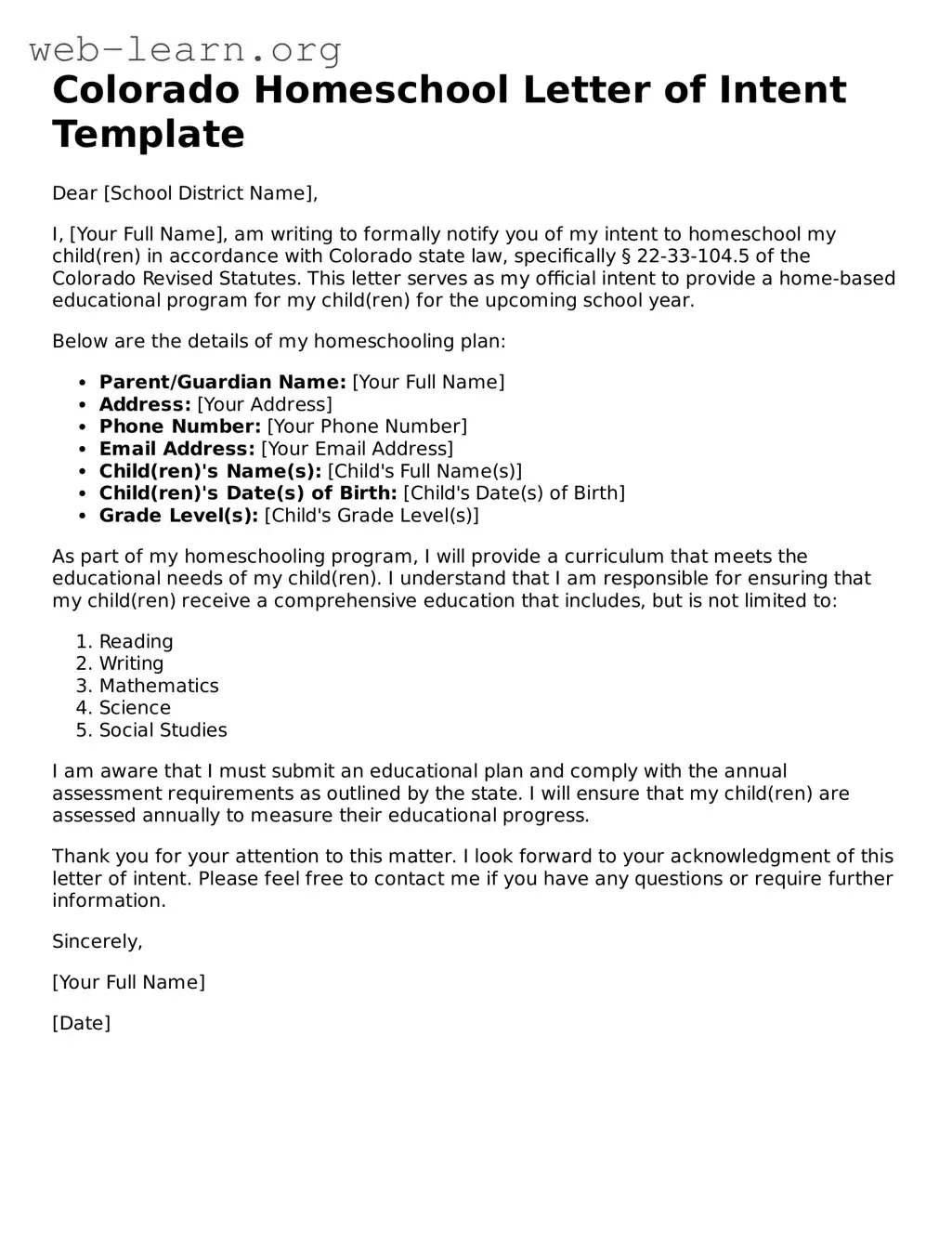
For families considering homeschooling in Colorado, the Homeschool Letter of Intent form is a crucial first step in the process. This form serves as a formal notification to the local school district that parents or guardians have chosen to educate their children at home. It's important to understand that submitting this letter is not just a formality; it sets the stage for the educational journey ahead. The form typically requires basic information such as the names and ages of the children being homeschooled, as well as the educational curriculum or methods that will be used. Additionally, it may outline the duration of the homeschooling period, giving parents a chance to express their commitment to providing a comprehensive education. Completing and submitting this letter helps ensure compliance with state regulations, while also affirming a family’s dedication to personalized learning. Understanding the nuances of this form can empower parents to embark on their homeschooling adventure with confidence.
Colorado Homeschool Letter of Intent Template
Dear [School District Name],
I, [Your Full Name], am writing to formally notify you of my intent to homeschool my child(ren) in accordance with Colorado state law, specifically § 22-33-104.5 of the Colorado Revised Statutes. This letter serves as my official intent to provide a home-based educational program for my child(ren) for the upcoming school year.
Below are the details of my homeschooling plan:
As part of my homeschooling program, I will provide a curriculum that meets the educational needs of my child(ren). I understand that I am responsible for ensuring that my child(ren) receive a comprehensive education that includes, but is not limited to:
I am aware that I must submit an educational plan and comply with the annual assessment requirements as outlined by the state. I will ensure that my child(ren) are assessed annually to measure their educational progress.
Thank you for your attention to this matter. I look forward to your acknowledgment of this letter of intent. Please feel free to contact me if you have any questions or require further information.
Sincerely,
[Your Full Name]
[Date]
| Fact Name | Description |
|---|---|
| Governing Law | The Colorado Homeschool Letter of Intent is governed by Colorado Revised Statutes, Title 22, Article 33, Part 2. |
| Submission Requirement | Parents must submit the Letter of Intent to the school district in which they reside. |
| Deadline | The form must be submitted within 14 days of beginning homeschooling for the academic year. |
| Information Included | The form requires basic information such as the name and address of the student, and the name of the parent or guardian. |
| Annual Submission | Parents are required to submit a new Letter of Intent each year to continue homeschooling. |
| Notification of Changes | If there are any changes to the student's status or educational plan, parents must notify the school district. |
| Access to Resources | Submitting the Letter of Intent may provide access to certain educational resources and services from the school district. |
After completing the Colorado Homeschool Letter of Intent form, you will submit it to your local school district. This step is crucial to ensure that your homeschooling is officially recognized. Make sure to keep a copy for your records.
The Colorado Homeschool Letter of Intent is a formal document that parents or guardians must submit to their school district when they choose to homeschool their children. This letter notifies the district of the intent to provide home education and outlines the educational plan for the child.
Any parent or guardian who wishes to homeschool a child aged between 6 and 16 in Colorado must submit this letter. This requirement applies regardless of whether the child has previously attended a public or private school.
The Letter of Intent should include:
The Letter of Intent must be submitted by the beginning of the school year or within two weeks of withdrawing a child from a public or private school. Timely submission ensures compliance with state regulations and allows for a smooth transition to homeschooling.
There is no mandated format for the Letter of Intent, but it should be clear and concise. Many families choose to use a template to ensure that all necessary information is included. The key is to provide all required details in an organized manner.
Once the Letter of Intent is submitted, the school district may acknowledge receipt of the letter. Parents are not required to wait for approval before starting their homeschooling program. However, it is advisable to keep a copy of the letter for personal records.
Filling out the Colorado Homeschool Letter of Intent form can be straightforward, but many make common mistakes that can lead to delays or complications. One frequent error is not providing complete information. This includes omitting the names of all children being homeschooled or failing to include the address where the homeschooling will take place. Ensure that every child’s name is clearly listed to avoid any confusion.
Another mistake is neglecting to sign and date the form. It may seem minor, but without a signature, the form is not valid. Always double-check that you have signed it before submitting. Additionally, some people forget to keep a copy for their records. Having a copy can be crucial if there are questions or issues later on.
People often misinterpret the deadline for submitting the Letter of Intent. It must be filed within a specific timeframe, typically within 14 days of beginning the homeschooling process. Missing this deadline can lead to unnecessary complications. Mark your calendar to ensure timely submission.
Another common oversight involves misunderstanding the requirements for educational plans. The form may ask for a brief description of the educational curriculum or methods you plan to use. Providing vague or incomplete descriptions can raise red flags. Be specific about your approach to education.
Finally, some individuals mistakenly think that the form is a one-time requirement. However, it must be submitted annually. Keeping track of the renewal process is essential to maintain compliance with state regulations. Set reminders to ensure you stay on top of this requirement each year.
When families decide to homeschool in Colorado, they often need to complete various forms and documents in addition to the Homeschool Letter of Intent. These documents help ensure compliance with state regulations and provide a clear framework for the homeschooling process. Below is a list of commonly used forms that can accompany the Homeschool Letter of Intent.
Each of these documents plays a vital role in the homeschooling process, helping families stay organized and ensuring that they meet state requirements. By maintaining thorough records and planning effectively, parents can provide a rich educational experience for their children.
When filling out the Colorado Homeschool Letter of Intent form, it's crucial to follow certain guidelines to ensure a smooth process. Here’s a list of what you should and shouldn’t do:
By following these guidelines, you can help ensure that your homeschooling journey starts off on the right foot.
Many families considering homeschooling in Colorado may encounter misconceptions regarding the Homeschool Letter of Intent form. Understanding the truth behind these misconceptions can help ensure a smooth homeschooling experience. Here are seven common misconceptions:
In reality, the Letter of Intent is simply a notification to the school district that a family intends to homeschool. It does not create a binding contract or agreement.
While it is necessary to submit the form when starting homeschooling, families only need to submit it once unless they change their educational plans or move to a different district.
The form itself is straightforward and does not require detailed documentation of educational plans or curricula. Basic information about the student and the educational approach is sufficient.
After submitting the form, families generally have the freedom to educate their children without ongoing oversight from the school district, unless specific circumstances arise.
This is not true. Any child can be homeschooled in Colorado, regardless of their educational needs or background.
There is no requirement for parents to hold teaching certifications in order to homeschool their children in Colorado.
There is no requirement for notarization. The form can be submitted without any notarized signatures.
By addressing these misconceptions, families can approach the homeschooling process with greater confidence and clarity.
Filling out the Colorado Homeschool Letter of Intent form is a necessary step for parents who wish to homeschool their children.
The form must be submitted to the school district where the child resides.
Provide accurate information about the child, including their name and age.
The letter should indicate that the parent is choosing to homeschool the child.
It is recommended to submit the form at least 14 days before the start of the homeschooling program.
Parents must also include a brief educational plan outlining how they intend to educate their child.
Once submitted, the school district may not impose additional requirements beyond those specified by state law.
Keep a copy of the submitted letter for your records as proof of intent to homeschool.
Ghea Homeschool - A notification to ensure compliance with home education regulations.
Homeschool Programs Indiana - Required by some states to initiate a homeschooling program.
How Does Homeschooling Work - This letter outlines your educational philosophy and approach to homeschooling.