Homepage Blank Colorado Exemption Form
Outline

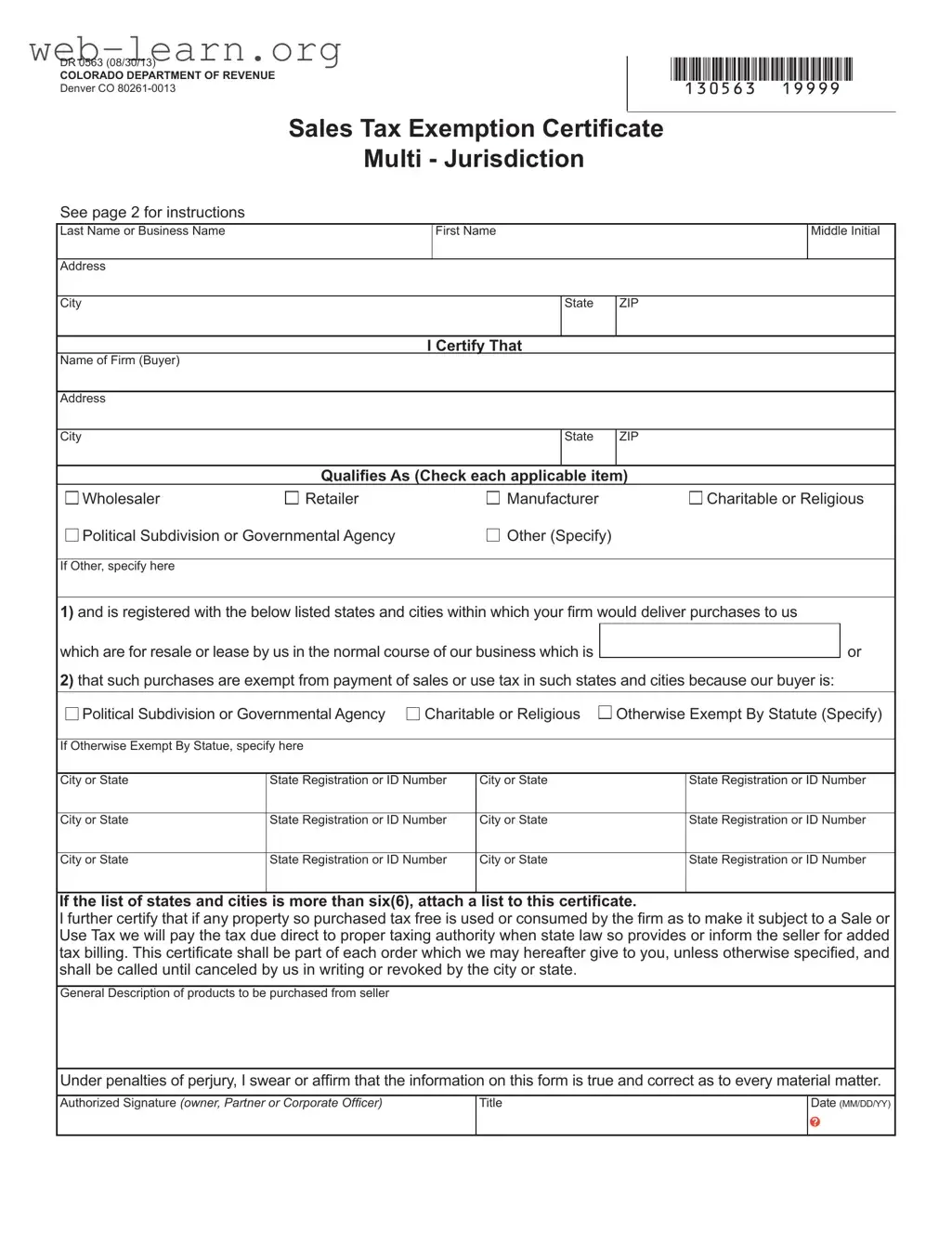
In Colorado, the Sales Tax Exemption Certificate, known as the DR 0563 form, plays a crucial role for businesses seeking to navigate the complexities of sales tax regulations. This form allows eligible buyers to purchase goods without paying sales tax, provided they meet certain criteria. It is essential for wholesalers, retailers, manufacturers, and even charitable or governmental entities to understand how to properly fill out this certificate. The form requires the buyer's name, address, and details about their business, including the specific reasons for claiming an exemption. Buyers must check applicable boxes indicating their status and provide information about the states and cities where they are registered. This ensures that the purchases are intended for resale or are otherwise exempt from sales tax. Additionally, the form includes a certification clause where the buyer swears that the information is accurate, emphasizing the importance of honesty in the process. Sellers must also be diligent in verifying that the goods sold are typically eligible for resale or use in manufacturing, as failure to do so could result in tax liabilities. Understanding the nuances of the Colorado Exemption form is vital for both buyers and sellers to ensure compliance and avoid potential penalties.
Sample - Colorado Exemption Form

DR 0563 (08/30/13)
COLORADO DEPARTMENT OF REVENUE
Denver CO 80261-0013


See page 2 for instructions
Last Name or Business Name First Name Middle Initial
Address
City State ZIP
I Certify That
Name of Firm (Buyer)
Address
City State ZIP

Wholesaler Retailer Manufacturer Charitable or Religious
Political Subdivision or Governmental Agency Other (Specify)
If Other, specify here

which are for resale or lease by us in the normal course of our business which is or
 that such purchases are exempt from payment of sales or use tax in such states and cities because our buyer is:
Political Subdivision or Governmental Agency Charitable or Religious Otherwise Exempt By Statute (Specify)
If Otherwise Exempt By Statue, specify here
City or State State Registration or ID Number City or State State Registration or ID Number
General Description of products to be purchased from seller

Authorized Signature (owner, Partner or Corporate Oficer) Title Date (MM/DD/YY)

Which are for resale or lease by us in the normal course of our business which is _________________________or
 that such purchases are exempt from payment of sales or use tax in such states and cities because our buyer is:


Use Tax we will pay the tax due direct to proper taxing authority when state law so provides or inform the seller for added


*130563==19999*
In order to comply with the majority of state and local sales
tax law requirements, it is necessary that we have in our






a reason for which this form does not provide, please send

*Lessor: A form DR0440, “Permit to Collect Sales Tax
on the Rental or Lease Basis” must be completed and

Caution To Seller:
accepted in good faith by the seller, the seller must exercise
care that the property being sold is of a type normally
sold wholesale, resold, leased, rented , or utilized as an
ingredient or component part of a product manufactured by

to exercise due care could be held liable for the sales tax

-



To Our Customers:

Form Information

Fact Name Description
Form Identification The Colorado Sales Tax Exemption Certificate is designated as DR 0563, with the latest revision date being August 30, 2013.
Purpose This form allows buyers to certify their eligibility for sales tax exemption when purchasing goods for resale, lease, or other exempt purposes.
Governing Law The use of this exemption certificate is governed by Colorado state sales tax laws, specifically outlined in the Colorado Revised Statutes.
Filing Requirements Buyers must provide a properly executed exemption certificate to sellers to avoid sales tax collection. Without it, sellers are required to collect the tax.
Liability Warning Sellers must ensure that the items sold qualify for the exemption. Failure to do so may result in liability for unpaid sales taxes.

Detailed Guide for Filling Out Colorado Exemption

To properly fill out the Colorado Exemption form, follow these steps carefully. This process ensures that the necessary information is accurately provided, which is essential for compliance with state and local sales tax laws.

  1. Obtain the Colorado Exemption form (DR 0563) from the Colorado Department of Revenue or an authorized source.
  2. Fill in the Last Name or Business Name and First Name fields at the top of the form.
  3. Provide your Address, City, State, and ZIP code in the designated fields.
  4. In the section labeled "I Certify That," enter the Name of Firm (Buyer) and its Address, City, State, and ZIP code.
  5. Check each applicable item that qualifies your firm, such as Wholesaler, Retailer, Manufacturer, Charitable or Religious, Political Subdivision or Governmental Agency, or Other. If you select "Other," specify the reason in the provided space.
  6. List the states and cities where your firm is registered. For each location, provide the City or State and the corresponding State Registration or ID Number. If there are more than six locations, attach a separate list.
  7. In the section regarding tax-free purchases, indicate if the purchases are exempt due to being a Political Subdivision or Governmental Agency, Charitable or Religious, or Otherwise Exempt By Statute. If applicable, specify the statute.
  8. Provide a General Description of products to be purchased from the seller.
  9. Sign the form in the Authorized Signature field, including your Title and the date in MM/DD/YY format.

Once completed, submit the form to the seller to ensure they have the necessary documentation for tax exemption. Keep a copy for your records as it may be needed for future transactions or compliance verification.

Obtain Answers on Colorado Exemption

  1. What is the purpose of the Colorado Exemption form?

    The Colorado Exemption form, specifically the DR 0563, serves as a sales tax exemption certificate. It allows eligible buyers, such as wholesalers, retailers, manufacturers, or governmental agencies, to purchase goods without paying sales tax. This form ensures compliance with state and local tax laws, protecting both buyers and sellers from unnecessary tax liabilities.

  2. Who qualifies to use the Colorado Exemption form?

    Various entities can qualify to use this form. These include:

    • Wholesalers
    • Retailers
    • Manufacturers
    • Charitable organizations
    • Religious institutions
    • Political subdivisions or governmental agencies
    • Others, as specified

    Each buyer must check the applicable item on the form to confirm their qualification.

  3. What information do I need to provide on the form?

    When completing the Colorado Exemption form, you will need to provide several key pieces of information:

    • Your name or business name
    • Your address, including city, state, and ZIP code
    • The name and address of the firm making the purchase
    • The type of business you operate
    • State registration or ID numbers for the states and cities where you are registered
    • A general description of the products you plan to purchase

    Accurate and complete information is crucial to ensure the form is valid.

  4. What happens if I do not provide a completed exemption certificate?

    If a seller does not receive a properly executed exemption certificate, they are required to collect sales tax on the transaction. This can lead to additional costs for the buyer, as the seller must remit the collected tax to the state. Therefore, it is essential for buyers claiming an exemption to submit the completed form promptly.

  5. What are the consequences of misusing the exemption certificate?

    Misuse of the Colorado Exemption form can result in serious consequences. Sellers, lessors, buyers, or their representatives may face penalties such as fines, imprisonment, or the loss of the right to issue certificates. It is vital for all parties involved to use the form correctly and ensure compliance with the law.

  6. How long is the exemption certificate valid?

    The exemption certificate remains valid until it is canceled in writing by the buyer or revoked by the city or state. Sellers should keep the certificate on file for each order unless otherwise specified. Regular updates and reviews of these certificates can help maintain compliance with tax regulations.

Common mistakes

Filling out the Colorado Exemption form correctly is crucial for ensuring that you can claim your sales tax exemption without any issues. However, many people make common mistakes that can lead to complications. Here are ten mistakes to avoid when completing this important document.

1. Incomplete Information - One of the most frequent errors is failing to fill out all required fields. Missing information such as your business name, address, or the name of the buyer can invalidate the exemption. Always double-check that every section is complete before submission.

2. Incorrect Certification - When certifying the nature of your business, it’s essential to check all applicable boxes. Neglecting to indicate whether you are a wholesaler, retailer, or another category can lead to confusion and potential rejection of the form.

3. Failing to Specify "Other" Categories

- If your business falls into a category not listed on the form, it’s critical to specify this clearly. Leaving the "Other" section blank can result in delays or denials of your exemption claim.

4. Ignoring State Registration Numbers - Each state and city where your business operates may require a registration number. Omitting these numbers can lead to complications. Always ensure that you provide accurate and complete registration information.

5. Not Updating Information

- If your business changes, such as a new address or a change in ownership, it’s vital to update your exemption form accordingly. Using outdated information can create legal issues down the line.

6. Misunderstanding Tax Exemption Criteria - Some individuals mistakenly believe that all purchases are exempt. It’s important to understand that only specific purchases qualify for exemption. Familiarize yourself with the criteria to avoid misunderstandings.

7. Failing to Attach Additional Documentation

- If your list of states and cities exceeds the limit on the form, be sure to attach a detailed list. Neglecting to do so can result in the form being rejected.

8. Ignoring Signature Requirements - The form must be signed by an authorized individual, such as an owner or corporate officer. Failing to include a signature can render the form invalid. Always ensure that the correct person signs the document.

9. Not Keeping Copies

- After submitting the form, it’s a good practice to keep a copy for your records. This can be invaluable if any questions arise later regarding your exemption status.

10. Overlooking Expiration and Revocation - The exemption certificate is not permanent. If it is canceled or revoked, you must be aware and take action to maintain compliance. Regularly review your exemption status to avoid unexpected tax liabilities.

By being mindful of these common pitfalls, you can navigate the Colorado Exemption form process more smoothly and ensure that your business remains compliant with state tax regulations.

Documents used along the form

The Colorado Exemption form is an essential document for businesses seeking to claim sales tax exemptions. Along with this form, several other documents may be required to ensure compliance with state regulations. Below is a list of commonly used forms and documents that often accompany the Colorado Exemption form.

  • DR 0440 - Permit to Collect Sales Tax on the Rental or Lease Basis: This form allows lessors to collect sales tax on rental or lease transactions. It must be submitted to the Department of Revenue for approval.
  • DR 0564 - Sales Tax Exemption Certificate for Nonprofit Organizations: Nonprofits can use this form to claim sales tax exemptions on purchases made for their charitable activities.
  • DR 0565 - Sales Tax Exemption Certificate for Government Entities: This document is specifically for governmental agencies to certify their tax-exempt status when making purchases.
  • DR 0566 - Sales Tax Exemption Certificate for Educational Institutions: Schools and educational institutions can use this form to exempt certain purchases from sales tax.
  • DR 0573 - Certificate of Exemption for Resale: Retailers can use this certificate to claim an exemption on purchases of goods intended for resale.
  • DR 0574 - Certificate of Exemption for Manufacturing: Manufacturers can claim exemptions for materials and supplies used in production with this certificate.
  • DR 0575 - Certificate of Exemption for Charitable Organizations: This form allows charitable organizations to purchase goods without paying sales tax, provided they meet specific criteria.
  • DR 0576 - Certificate of Exemption for Religious Organizations: Religious entities can use this document to claim sales tax exemptions on their purchases.
  • DR 0577 - Certificate of Exemption for Political Subdivisions: This form is designed for political subdivisions to certify their tax-exempt status when making purchases.

Understanding these forms and their purposes is crucial for businesses and organizations looking to navigate sales tax exemptions effectively. Ensure that all necessary documentation is completed accurately to avoid potential issues with tax compliance.

Similar forms

The Colorado Exemption form shares similarities with several other documents that serve similar purposes in the realm of sales tax exemption. Below is a list of five such documents, each with a brief explanation of how they relate to the Colorado Exemption form.

  • Sales Tax Exemption Certificate: This document allows businesses to purchase goods without paying sales tax. Like the Colorado Exemption form, it certifies that the buyer qualifies for an exemption based on their business type or purpose.
  • Resale Certificate: This certificate is used by retailers to buy goods intended for resale without paying sales tax. Similar to the Colorado Exemption form, it confirms that the items purchased will not be used for personal consumption.
  • Nonprofit Organization Exemption Certificate: Nonprofits can use this document to claim sales tax exemption on purchases. It parallels the Colorado Exemption form in that it requires verification of the organization's tax-exempt status.
  • Government Entity Exemption Certificate: This form is utilized by government agencies to avoid sales tax on purchases. Much like the Colorado Exemption form, it certifies that the buyer is a governmental entity, thus exempt from tax obligations.
  • Manufacturing Exemption Certificate: Manufacturers can use this certificate to exempt certain purchases related to production. It aligns with the Colorado Exemption form by confirming that the purchases are necessary for manufacturing operations and are therefore exempt from sales tax.

Dos and Don'ts

When filling out the Colorado Exemption Form (DR 0563), it is essential to follow certain guidelines to ensure the form is completed accurately and effectively. Below is a list of things you should and shouldn't do.

  • Do provide accurate and complete information.
  • Do check each applicable item that qualifies your business.
  • Do ensure that you have the correct state registration or ID numbers for all relevant states and cities.
  • Do sign and date the form to validate the information provided.
  • Don't leave any required fields blank.
  • Don't submit the form without confirming that your business qualifies for the exemption.

Following these guidelines will help ensure that your exemption form is processed smoothly and that you maintain compliance with state and local tax laws.

Misconceptions

Understanding the Colorado Exemption form is crucial for businesses looking to navigate sales tax exemptions effectively. However, several misconceptions can lead to confusion. Here are ten common misunderstandings about the form:

  1. The form is only for large businesses. Many believe that only large corporations can benefit from the Colorado Exemption form. In reality, any qualifying business, regardless of size, can utilize this certificate to claim tax exemptions.
  2. It is not necessary to submit the form every time. Some think that once the form is submitted, it does not need to be updated. However, the form must be resubmitted or updated if there are changes in the business status or tax exemption eligibility.
  3. All purchases are exempt from sales tax. There is a misconception that all purchases made with the exemption form are tax-free. In truth, the exemption applies only to specific purchases that meet the criteria outlined in the form.
  4. Only certain industries can use the form. Many believe that only wholesalers or manufacturers can use the Colorado Exemption form. However, various entities, including charitable organizations and governmental agencies, may also qualify.
  5. Once the form is submitted, it cannot be revoked. Some individuals think that once the exemption is granted, it cannot be taken back. In fact, the seller or the state can revoke the exemption if the criteria are no longer met.
  6. The form is only valid in Colorado. There is a common belief that the Colorado Exemption form is only valid within the state. However, it can also be used in other jurisdictions that recognize the form and its exemptions.
  7. There are no penalties for misuse. Some people assume that there are no consequences for misusing the exemption form. In reality, misuse can lead to significant penalties, including fines and loss of the right to issue certificates.
  8. Filling out the form is optional. Many think that submitting the exemption form is optional. In fact, businesses must provide a properly executed form to avoid being obligated to collect sales tax.
  9. Only the buyer needs to sign the form. It is a misconception that only the buyer's signature is necessary. The form requires an authorized signature from the buyer, but it also has implications for the seller, who must ensure compliance.
  10. The form guarantees tax exemption for all transactions. Some believe that submitting the form guarantees tax exemption on every transaction. However, the exemption only applies to qualifying purchases and must be used correctly.

Clarifying these misconceptions can help businesses navigate the complexities of sales tax exemptions more effectively. It is essential to understand the requirements and responsibilities associated with the Colorado Exemption form to avoid potential pitfalls.

Key takeaways

Here are key takeaways for filling out and using the Colorado Exemption Form (DR 0563):

  • Eligibility Criteria: Ensure that your business qualifies for exemption by checking the appropriate boxes, such as wholesaler, retailer, or charitable organization.
  • Accurate Information: Provide complete and accurate details, including the name, address, and registration numbers for your business and any applicable states or cities.
  • Multiple Jurisdictions: If your business operates in more than six states or cities, attach a separate list to the form.
  • Use of Purchased Items: Understand that if exempt items are used or consumed in a way that incurs tax, your business is responsible for paying that tax directly to the appropriate authority.
  • Submission Requirement: Submit the completed form to your seller promptly to avoid unnecessary tax collection on your purchases.
  • Seller's Responsibility: Sellers must ensure that the property sold is typically sold wholesale or used in manufacturing. Failure to do so could result in tax liability.