The Colorado Durable Power of Attorney form is a vital legal document that allows individuals to designate someone they trust to make decisions on their behalf in the event they become incapacitated. This form covers a range of important aspects, including financial management and healthcare decisions, ensuring that the appointed agent can act in the best interest of the individual. It is crucial to understand that this power remains effective even if the individual becomes unable to make decisions due to illness or injury. The form requires careful consideration of who to appoint, as this person will have significant authority over financial and medical matters. Furthermore, the Colorado Durable Power of Attorney can be tailored to fit specific needs, allowing individuals to grant broad or limited powers to their agents. By preparing this document, individuals can have peace of mind knowing that their wishes will be respected and that their affairs will be handled according to their preferences during challenging times.
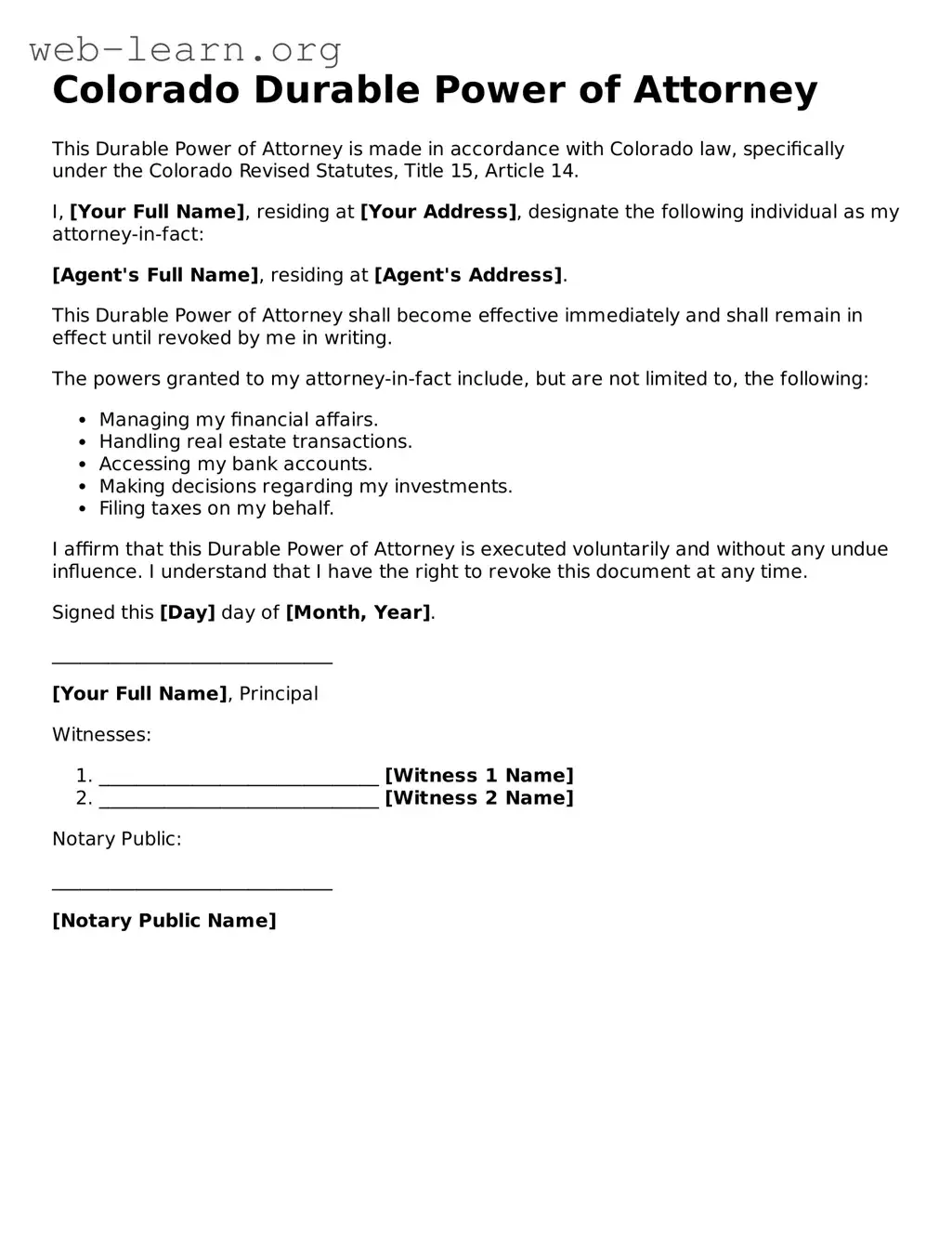
Colorado Durable Power of Attorney
This Durable Power of Attorney is made in accordance with Colorado law, specifically under the Colorado Revised Statutes, Title 15, Article 14.
I, [Your Full Name], residing at [Your Address], designate the following individual as my attorney-in-fact:
[Agent's Full Name], residing at [Agent's Address].
This Durable Power of Attorney shall become effective immediately and shall remain in effect until revoked by me in writing.
The powers granted to my attorney-in-fact include, but are not limited to, the following:
I affirm that this Durable Power of Attorney is executed voluntarily and without any undue influence. I understand that I have the right to revoke this document at any time.
Signed this [Day] day of [Month, Year].
______________________________
[Your Full Name], Principal
Witnesses:
Notary Public:
______________________________
[Notary Public Name]
| Fact Name | Description |
|---|---|
| Definition | A Colorado Durable Power of Attorney allows an individual (the principal) to designate another person (the agent) to make financial and legal decisions on their behalf, even if the principal becomes incapacitated. |
| Governing Law | This form is governed by the Colorado Revised Statutes, specifically Title 15, Article 14. |
| Durability | The term "durable" means that the power of attorney remains effective even if the principal becomes incapacitated. |
| Agent's Powers | The agent can be granted broad powers, including managing bank accounts, paying bills, and making investment decisions. |
| Revocation | The principal can revoke the Durable Power of Attorney at any time, as long as they are mentally competent. |
| Witness Requirements | In Colorado, the Durable Power of Attorney must be signed in the presence of a notary public or two witnesses to be valid. |
| Agent's Responsibilities | The agent has a fiduciary duty to act in the best interests of the principal and must keep accurate records of all transactions. |
| Common Uses | This form is often used for estate planning, managing finances during medical emergencies, or if the principal is traveling or living abroad. |
Completing the Colorado Durable Power of Attorney form is an important step in designating someone to make decisions on your behalf regarding financial and legal matters. It is essential to ensure that all sections are filled out accurately and completely to avoid any potential issues in the future.
A Durable Power of Attorney is a legal document that allows an individual (the principal) to designate another person (the agent) to make decisions on their behalf. This authority remains effective even if the principal becomes incapacitated. The DPOA can cover financial matters, healthcare decisions, or both, depending on how it is drafted.
In Colorado, any competent adult can serve as an agent. This includes family members, friends, or professionals. It is important to choose someone trustworthy, as they will have significant control over the principal’s affairs.
The primary difference lies in the "durable" aspect. A regular Power of Attorney becomes invalid if the principal becomes incapacitated, while a Durable Power of Attorney remains in effect under such circumstances. This feature is crucial for ensuring that decisions can still be made when the principal is unable to do so.
To create a Durable Power of Attorney in Colorado, the principal must complete a specific form that meets state requirements. The document must be signed by the principal in the presence of a notary public. It is recommended to consult with a legal professional to ensure that the form is filled out correctly and meets the principal’s needs.
Yes, a Durable Power of Attorney can be revoked at any time, as long as the principal is still competent. To revoke a DPOA, the principal should provide written notice to the agent and any third parties who may rely on the DPOA. It is advisable to create a formal revocation document for clarity.
If the appointed agent is unable or unwilling to fulfill their duties, the principal can designate an alternate agent in the DPOA document. If no alternate is named, or if both the agent and alternate cannot serve, a court may need to appoint a guardian or conservator to manage the principal's affairs.
Yes, the principal can specify limitations within the DPOA. For example, they may restrict the agent’s authority to certain financial transactions or healthcare decisions. It is essential to clearly outline any limitations in the document to avoid confusion or misuse of power.
While it is not legally required to have a lawyer to create a Durable Power of Attorney, consulting one is highly recommended. A legal professional can provide guidance on the implications of the document, ensure compliance with state laws, and help tailor the DPOA to meet specific needs.
The Durable Power of Attorney should be stored in a safe and accessible location. It is advisable to provide copies to the agent, family members, and any institutions that may need to reference it, such as banks or healthcare providers. Keeping the original document in a secure place ensures it is available when needed.
Filling out a Colorado Durable Power of Attorney (DPOA) form can be a straightforward process, but many individuals make common mistakes that can lead to complications. One frequent error is failing to specify the powers granted to the agent. While the form allows for broad powers, it is essential to clearly outline what decisions the agent can make on behalf of the principal. Without this clarity, the agent may face challenges when trying to act on the principal's behalf.
Another mistake involves not signing the document in front of a notary public. In Colorado, a DPOA must be notarized to be valid. If the principal neglects this step, the form may be deemed ineffective, leaving the agent without the authority to act. It is important to ensure that all signatures are properly witnessed and notarized to avoid any legal issues later on.
Individuals often overlook the importance of updating the DPOA when circumstances change. For example, if the principal’s health deteriorates or their relationship with the chosen agent changes, it may be necessary to revise the document. Failing to do so can result in the agent making decisions that no longer align with the principal's wishes.
Lastly, many people do not consider the implications of choosing the wrong agent. Selecting someone who may not be trustworthy or who lacks the ability to make sound decisions can lead to serious consequences. It is vital to choose an agent who understands the principal's values and can act in their best interest. This decision should not be taken lightly, as the agent will have significant authority over financial and healthcare matters.
When considering the Colorado Durable Power of Attorney (DPOA) form, it's essential to understand that it often works in conjunction with other important documents. These documents can help clarify your wishes and ensure your financial and medical decisions are respected. Here’s a brief overview of four commonly used forms that complement the DPOA.
In summary, these documents work together to provide a comprehensive plan for managing your health and finances. By preparing these forms, you empower your loved ones to act in your best interests, ensuring your wishes are honored even when you cannot voice them yourself.
A Durable Power of Attorney (DPOA) is an important legal document that allows someone to make decisions on behalf of another person, especially in situations where that person is unable to do so. Several other documents serve similar purposes, each with its own specific focus and application. Below are five documents that are similar to a Durable Power of Attorney:
Understanding these documents can help you make informed decisions about your legal and healthcare planning. Each serves a unique purpose, and knowing the differences can ensure that your wishes are honored in various situations.
When filling out the Colorado Durable Power of Attorney form, it's essential to approach the task with care. Here’s a list of things you should and shouldn’t do to ensure that the document is completed correctly.
Understanding the Colorado Durable Power of Attorney (DPOA) form is essential for effective estate planning. However, several misconceptions exist regarding this legal document. Here are six common misconceptions:
This is not true. Anyone can create a DPOA, regardless of age. It is a useful tool for anyone who wants to ensure their financial and medical decisions are handled according to their wishes in case they become incapacitated.
While a DPOA does grant significant authority, the powers can be limited to specific areas, such as financial or medical decisions. The principal can outline the extent of the agent's authority in the document.
This is incorrect. A DPOA can be effective immediately upon signing, or it can be set to activate only upon the principal's incapacitation, depending on how it is drafted.
A DPOA can be revoked at any time by the principal as long as they are mentally competent. This can be done through a written notice to the agent and any institutions that were relying on the DPOA.
A DPOA and a living will serve different purposes. A DPOA grants authority to someone to make decisions on your behalf, while a living will outlines your wishes regarding medical treatment in end-of-life situations.
Each state has its own laws and requirements regarding DPOA forms. It is crucial to use the Colorado-specific form to ensure compliance with local laws and regulations.
Filling out and using the Colorado Durable Power of Attorney form is an important step in planning for the future. Here are some key takeaways to consider:
Power of Attorney Michigan - A Durable Power of Attorney is a key component of comprehensive estate planning.
Power of Attorney Illinois - This document can be a vital part of a comprehensive estate plan.
Oregon Power of Attorney Form - It can help streamline the process of managing your affairs when you need assistance.