Homepage Blank Colorado Dr 6597 Form
Outline

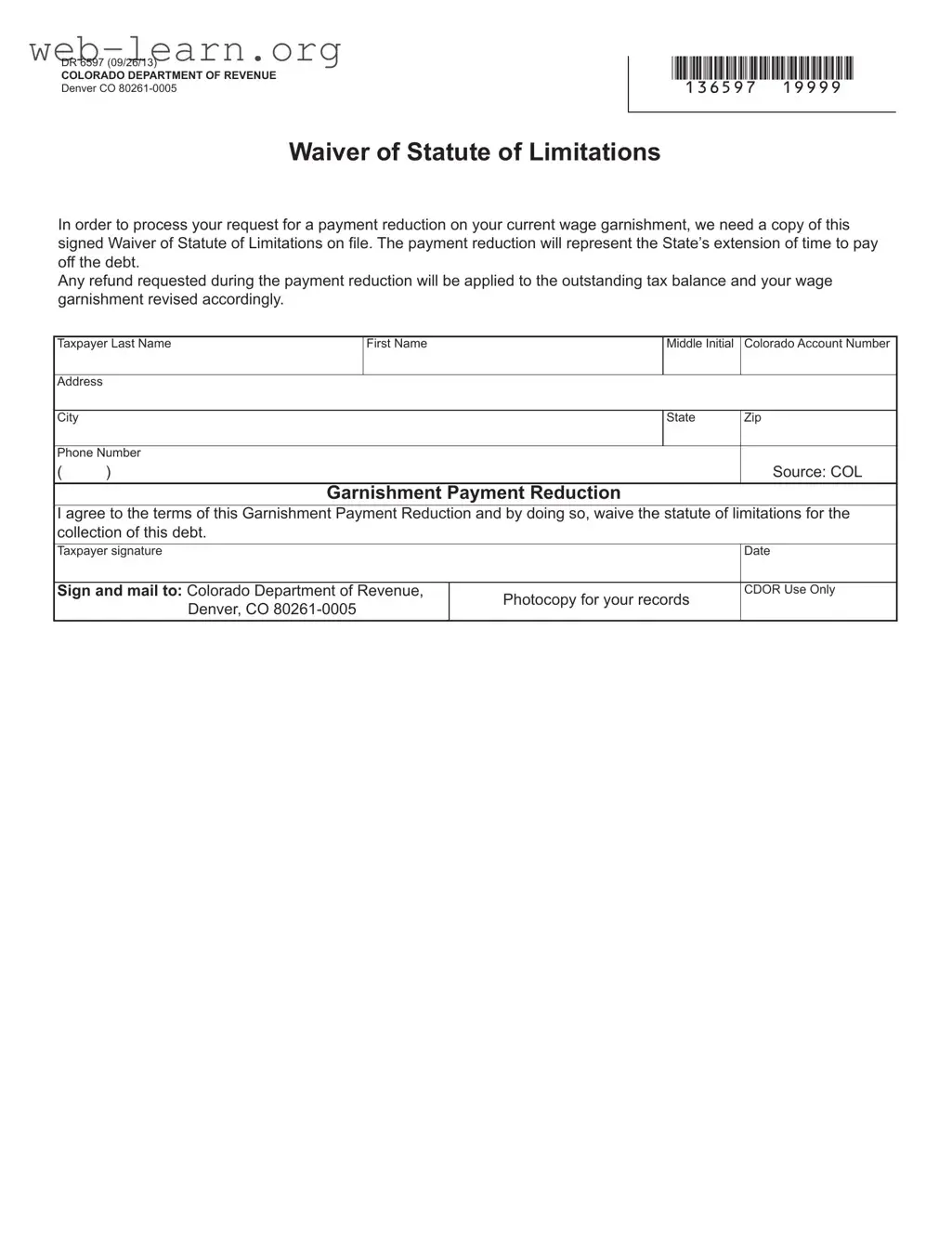
The Colorado DR 6597 form is an essential document for individuals facing wage garnishment in the state. This form serves as a Waiver of Statute of Limitations, allowing taxpayers to request a payment reduction on their current wage garnishment. By signing this form, individuals agree to extend the time they have to pay off their debt. It is important to note that any refund requested during this payment reduction period will be applied directly to the outstanding tax balance. This means that the amount owed may be adjusted, and the wage garnishment will be revised accordingly. To complete the form, taxpayers must provide their last name, first name, middle initial, Colorado account number, address, city, state, zip code, and phone number. The taxpayer’s signature and date are also required to finalize the request. Once completed, the form should be mailed to the Colorado Department of Revenue, ensuring that a photocopy is kept for personal records.

Sample - Colorado Dr 6597 Form

Taxpayer Last Name First Name Middle Initial Colorado Account Number
Address
City State Zip
Phone Number
Source: COL( )
Garnishment Payment Reduction
I agree to the terms of this Garnishment Payment Reduction and by doing so, waive the statute of limitations for the
collection of this debt.
Taxpayer signature Date
Sign and mail to: Colorado Department of Revenue,
Denver, CO 80261-0005
Photocopy for your records
CDOR Use Only
In order to process your request for a payment reduction on your current wage garnishment, we need a copy of this

off the debt.
Any refund requested during the payment reduction will be applied to the outstanding tax balance and your wage
garnishment revised accordingly.
Waiver of Statute of Limitations
*136597==19999*
DR 6597 (09/26/13)
COLORADO DEPARTMENT OF REVENUE
Denver CO 80261-0005

Form Information

Fact Name Details
Form Purpose The DR 6597 form is used to request a payment reduction on current wage garnishments in Colorado.
Governing Law This form is governed by Colorado Revised Statutes related to debt collection and wage garnishment.
Waiver of Statute By signing the form, taxpayers waive the statute of limitations for the collection of the debt.
Refund Application Any refund requested during the payment reduction process will be applied to the outstanding tax balance.
Submission Instructions The completed form must be mailed to the Colorado Department of Revenue for processing.

Detailed Guide for Filling Out Colorado Dr 6597

Filling out the Colorado DR 6597 form is a straightforward process that requires attention to detail. This form is essential for requesting a payment reduction on your wage garnishment. Once completed, it should be mailed to the Colorado Department of Revenue. Here are the steps to guide you through the process:

  1. Obtain the form: Download the Colorado DR 6597 form from the Colorado Department of Revenue website or request a physical copy.
  2. Fill in your personal information: Enter your last name, first name, and middle initial in the designated fields.
  3. Provide your Colorado account number: Locate your account number and write it down accurately.
  4. Enter your address: Fill in your complete address, including city, state, and zip code.
  5. Include your phone number: Write your phone number, ensuring it is correct for any follow-up communications.
  6. Read the waiver statement: Carefully review the statement regarding the waiver of the statute of limitations for the collection of your debt.
  7. Sign the form: Provide your signature in the designated area, confirming your agreement to the terms.
  8. Date the form: Write the date you are signing the form next to your signature.
  9. Make a copy: Photocopy the completed form for your records before mailing it.
  10. Mail the form: Send the signed form to the Colorado Department of Revenue at the address provided on the form.

After submitting the form, keep an eye on your mail for any communication from the Colorado Department of Revenue regarding your request. They will review your submission and inform you about the next steps in the process.

Obtain Answers on Colorado Dr 6597

  1. What is the purpose of the Colorado DR 6597 form?

    The Colorado DR 6597 form, also known as the Waiver of Statute of Limitations, is primarily used to request a payment reduction on an existing wage garnishment. By completing this form, you agree to extend the time allowed for the state to collect the debt. This extension can provide you with some financial relief by potentially lowering your monthly payments.

  2. Who should complete the DR 6597 form?

    This form should be completed by individuals who are currently facing wage garnishment due to unpaid taxes or other debts owed to the state of Colorado. If you wish to reduce your payment amount and are willing to waive the statute of limitations for the collection of your debt, this form is necessary.

  3. What information is required on the form?

    When filling out the DR 6597 form, you will need to provide the following information:

    • Your last name, first name, and middle initial
    • Your Colorado account number
    • Your address, including city, state, and zip code
    • Your phone number

    Additionally, you must sign and date the form to indicate your agreement to the terms outlined.

  4. How do I submit the DR 6597 form?

    Once you have completed and signed the DR 6597 form, it should be mailed to the Colorado Department of Revenue at the address provided on the form: Denver, CO 80261-0005. It is advisable to keep a photocopy of the signed form for your records before mailing it.

  5. What happens after I submit the form?

    After the Colorado Department of Revenue receives your completed DR 6597 form, they will process your request for a payment reduction. If approved, any refund you request during this payment reduction period will be applied to your outstanding tax balance, and your wage garnishment will be adjusted accordingly. Keep in mind that this process may take some time, so patience is essential.

Common mistakes

Filling out the Colorado DR 6597 form correctly is crucial for anyone seeking a payment reduction on their wage garnishment. However, many individuals make common mistakes that can delay their request or even result in denial. Understanding these pitfalls can help ensure a smoother process.

One frequent error is failing to provide complete personal information. The form requires essential details such as your last name, first name, middle initial, Colorado account number, and address. Omitting any of this information can lead to confusion or delays in processing your request. Double-checking that all fields are filled out accurately is vital.

Another mistake people often make is not signing the form. The signature is a critical component of the DR 6597 form. Without it, the Colorado Department of Revenue cannot process your request. Make sure to sign and date the form before mailing it. It may seem like a small detail, but it can significantly impact your application.

Additionally, individuals sometimes overlook the importance of keeping a copy of the form for their records. After sending the form to the Department of Revenue, having a photocopy can be invaluable. It serves as proof of your submission and can help resolve any disputes or questions that may arise later.

Finally, many people fail to read the terms of the payment reduction agreement carefully. By signing the form, you are agreeing to waive the statute of limitations for the collection of the debt. This means you are extending the time the state has to collect what you owe. Understanding this commitment is essential before signing, as it may have long-term implications for your financial situation.

By being aware of these common mistakes, you can take the necessary steps to fill out the Colorado DR 6597 form correctly. This will not only expedite your request but also help you avoid potential complications down the line.

Documents used along the form

When dealing with wage garnishments and tax issues in Colorado, several forms may accompany the Colorado DR 6597 form. Each document serves a unique purpose in the process, helping to clarify rights, responsibilities, and options available to taxpayers. Below is a list of commonly used forms that may be relevant.

  • Colorado DR 0400: This form is the "Income Tax Return" for individuals. It’s essential for filing state taxes and determining any potential refunds or liabilities that may impact wage garnishments.
  • Colorado DR 0158: Known as the "Individual Income Tax Payment Plan," this document allows taxpayers to propose a payment plan for outstanding tax debts. It can be beneficial when negotiating terms related to wage garnishments.
  • Colorado DR 0172: This is the "Request for Abatement" form. Taxpayers can use it to request a reduction or elimination of penalties and interest on unpaid taxes, which may help in resolving wage garnishments.
  • Colorado DR 0599: The "Wage Garnishment Exemption Claim" form allows individuals to claim exemptions from wage garnishment based on certain criteria, such as income level or family obligations.
  • Colorado DR 0704: This form is the "Request for Hearing." If a taxpayer disagrees with the garnishment, they can request a hearing to contest it, providing an opportunity to present their case.

Understanding these forms can help taxpayers navigate the complexities of wage garnishments and tax obligations in Colorado. Each document plays a vital role in ensuring that individuals can manage their financial responsibilities while protecting their rights.

Similar forms

The Colorado DR 6597 form is essential for those seeking a payment reduction on wage garnishments. It serves a specific purpose, but there are other documents that share similarities in terms of function and intent. Here are ten documents that are similar to the Colorado DR 6597 form:

  • IRS Form 12203: This form is used to request a collection due process hearing with the IRS. Like the DR 6597, it addresses issues related to tax debts and provides a way for taxpayers to negotiate terms regarding their obligations.
  • IRS Form 9465: This form allows taxpayers to request an installment agreement for paying off tax debts. Similar to the DR 6597, it requires consent to terms and conditions regarding debt repayment.
  • Colorado DR 1098: This document is a request for a payment plan for state tax liabilities. Both forms facilitate communication with tax authorities about managing debt payments.
  • IRS Form 433-A: This form collects financial information for individuals who owe taxes. Like the DR 6597, it is part of the negotiation process for debt resolution.
  • Colorado DR 0599: This is a request for a waiver of penalties for late tax payments. It shares the goal of alleviating financial burdens similar to the DR 6597.
  • IRS Form 1040X: This form is used to amend a previously filed tax return. It can impact tax liabilities and is often used in conjunction with other documents to address outstanding debts.
  • Colorado DR 0100: This is the Colorado Individual Income Tax Return form. It is necessary for reporting income and can influence tax obligations, similar to how the DR 6597 affects garnishment payments.
  • IRS Form 2848: This power of attorney form allows a representative to act on behalf of a taxpayer. It often accompanies other forms like the DR 6597 when dealing with tax matters.
  • Colorado DR 0102: This is the Colorado Corporate Income Tax Return form. It is relevant for businesses facing tax debts, mirroring the DR 6597's purpose for individuals.
  • IRS Form 13711: This form is used to request a reconsideration of an IRS decision. It serves a similar function of appealing decisions related to tax debts, akin to the DR 6597's negotiation process.

Understanding these documents can help individuals navigate their tax obligations more effectively. Each form plays a role in managing debts and negotiating terms with tax authorities.

Dos and Don'ts

When filling out the Colorado DR 6597 form, it is important to follow specific guidelines to ensure your application is processed smoothly. Here’s a list of what you should and shouldn’t do:

  • Do read the entire form carefully before starting to fill it out.
  • Do provide accurate information for all required fields, including your name and Colorado Account Number.
  • Do sign the form where indicated. An unsigned form may delay processing.
  • Do keep a photocopy of the completed form for your records.
  • Do mail the form to the correct address: Colorado Department of Revenue, Denver, CO 80261-0005.
  • Don’t leave any required fields blank; incomplete forms can be rejected.
  • Don’t use pencil or any erasable ink to fill out the form; always use a blue or black pen.
  • Don’t forget to check the deadline for submission to avoid any penalties.
  • Don’t submit the form without reviewing it for errors.
  • Don’t assume that a payment reduction will automatically happen without submitting this form.

Misconceptions

Understanding the Colorado DR 6597 form can be challenging. Here are some common misconceptions that people often have about this form:

  • The form is only for tax debts. Many believe that the DR 6597 form applies solely to tax-related wage garnishments. However, it can also be used for other debts that fall under the jurisdiction of the Colorado Department of Revenue.
  • Filling out the form guarantees a payment reduction. Some individuals think that submitting the DR 6597 form automatically results in a reduction of their wage garnishment. In reality, the request for a payment reduction is subject to review and approval by the state.
  • Once the form is submitted, the garnishment stops immediately. It is a common misconception that submitting the form halts wage garnishment right away. The garnishment will continue until the state processes the request and provides an official response.
  • The waiver of the statute of limitations is permanent. Many people misunderstand that signing the waiver means they will never be able to contest the debt. The waiver is specific to the period of time for collecting the debt and does not affect other rights or future disputes.
  • Only the taxpayer can sign the form. Some believe that only the individual named on the form can sign it. In fact, authorized representatives can also sign the form if they have the proper power of attorney.
  • Refunds will be issued immediately. A common misconception is that any refunds requested will be processed right away. Refunds are applied to the outstanding tax balance first and may take time to be processed.

Being informed about these misconceptions can help individuals navigate the process more effectively and understand their rights and responsibilities regarding wage garnishment in Colorado.

Key takeaways

Here are the key takeaways for filling out and using the Colorado DR 6597 form:

  • Purpose: The form is used to request a payment reduction on a current wage garnishment.
  • Waiver Requirement: Signing the form waives the statute of limitations for the collection of the debt.
  • Documentation: A signed copy of the form must be on file to process your request.
  • Refund Application: Any refund requested will be applied to your outstanding tax balance.
  • Revised Garnishment: Your wage garnishment will be revised according to the payment reduction.
  • Information Needed: Fill in your last name, first name, middle initial, Colorado account number, address, city, state, zip, and phone number.
  • Signature: Ensure you sign and date the form to validate your request.
  • Mailing Instructions: Send the completed form to the Colorado Department of Revenue at the specified address.
  • Keep a Copy: Photocopy the signed form for your records before mailing it.