Homepage Blank Colorado Dr 2922 Form
Outline

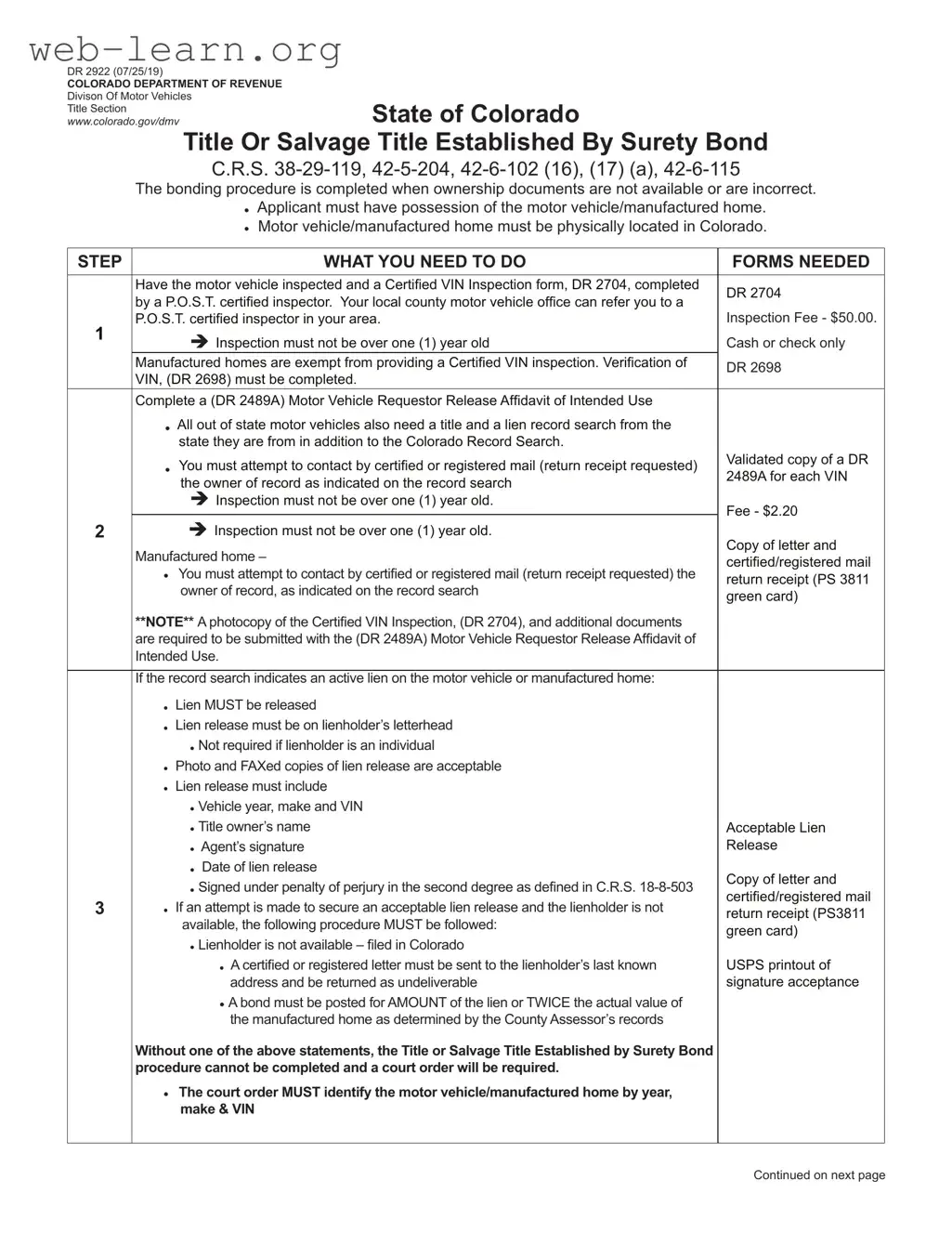
In the state of Colorado, navigating the complexities of vehicle ownership can sometimes be a daunting task, especially when it comes to the issuance of titles for motor vehicles or manufactured homes. The Colorado DR 2922 form is designed to facilitate this process when ownership documents are unavailable or incorrect. This form outlines the bonding procedure necessary for establishing a title or salvage title through a surety bond, as specified by Colorado Revised Statutes. To begin, applicants must physically possess the vehicle or manufactured home, which must be located within Colorado. A series of steps must be followed, including obtaining a Certified VIN Inspection from a P.O.S.T. certified inspector and completing various forms such as the DR 2489A Motor Vehicle Requestor Release Affidavit of Intended Use. The process also requires verification of any liens on the vehicle, contacting the previous owner of record, and potentially securing a bond for the amount of the lien or twice the vehicle's value. For manufactured homes, additional requirements include proof of ownership of the real property on which the home is located and evidence of property taxes paid. The DR 2922 form serves as a critical tool for ensuring that individuals can successfully navigate the intricacies of vehicle titling, providing a structured pathway to ownership in situations where traditional documentation may be lacking.


Sample - Colorado Dr 2922 Form

State of Colorado
Title Or Salvage Title Established By Surety Bond
C.R.S. 38-29-119, 42-5-204, 42-6-102 (16), (17) (a), 42-6-115
The bonding procedure is completed when ownership documents are not available or are incorrect.
Applicant must have possession of the motor vehicle/manufactured home.
Motor vehicle/manufactured home must be physically located in Colorado.
STEP WHAT YOU NEED TO DO FORMS NEEDED
1
Have the motor vehicle inspected and a Certied VIN Inspection form, DR 2704, completed
by a P.O.S.T. certied inspector. Your local county motor vehicle ofce can refer you to a
P.O.S.T. certied inspector in your area.
Inspection must not be over one (1) year old
DR 2704
Inspection Fee - $50.00.
Cash or check only
DR 2698
Manufactured homes are exempt from providing a Certied VIN inspection. Verication of
VIN, (DR 2698) must be completed.
2
Complete a (DR 2489A) Motor Vehicle Requestor Release Afdavit of Intended Use
All out of state motor vehicles also need a title and a lien record search from the
state they are from in addition to the Colorado Record Search.
You must attempt to contact by certied or registered mail (return receipt requested)
the owner of record as indicated on the record search
Inspection must not be over one (1) year old.
Validated copy of a DR
2489A for each VIN
Fee - $2.20
Copy of letter and
certied/registered mail
return receipt (PS 3811
green card)
Inspection must not be over one (1) year old.
Manufactured home –
You must attempt to contact by certied or registered mail (return receipt requested) the
owner of record, as indicated on the record search
**NOTE** A photocopy of the Certied VIN Inspection, (DR 2704), and additional documents
are required to be submitted with the (DR 2489A) Motor Vehicle Requestor Release Afdavit of
Intended Use.
3
If the record search indicates an active lien on the motor vehicle or manufactured home:
Lien MUST be released
Lien release must be on lienholder’s letterhead
Not required if lienholder is an individual
Photo and FAXed copies of lien release are acceptable
Lien release must include
Vehicle year, make and VIN
Title owner’s name
Agent’s signature
Date of lien release
Signed under penalty of perjury in the second degree as dened in C.R.S. 18-8-503
If an attempt is made to secure an acceptable lien release and the lienholder is not
available, the following procedure MUST be followed:
Lienholder is not available – led in Colorado
A certied or registered letter must be sent to the lienholder’s last known
address and be returned as undeliverable
A bond must be posted for AMOUNT of the lien or TWICE the actual value of
the manufactured home as determined by the County Assessor’s records
Without one of the above statements, the Title or Salvage Title Established by Surety Bond
procedure cannot be completed and a court order will be required.
The court order MUST identify the motor vehicle/manufactured home by year,
make & VIN
Acceptable Lien
Release
Copy of letter and
certied/registered mail
return receipt (PS3811
green card)
USPS printout of
signature acceptance
DR 2922 (07/25/19)
COLORADO DEPARTMENT OF REVENUE
Divison Of Motor Vehicles
Title Section
www.colorado.gov/dmv
Continued on next page
4
If the manufactured home is abandoned, the following information MUST be provided,
pursuant to C.R.S. 38-29-119:
Copy of the court order or judgment for possession obtained through a civil
proceeding
Court order or judgment must
Identify manufactured home by year, make and VIN
Proof of ownership of the real property on which the manufactured home is
located
Proof of property taxes paid
**NOTE** Step 4 only applies to manufactured homes. Step 4 does not apply to
motor vehicles
Copy of court order(s)
Copy of the real
property deed
Authentication of Paid
Ad Valorem Taxes, or
Certicate of Taxes Due
(obtained from the
County Treasurer),
pursuant to C.R.S. 38-
29-107.
Proof of taxes paid
is required on all
manufactured home
bond applications.
5
For the purpose of purchasing a surety bond or evidence of a savings account, deposit, or
certicate of deposit meeting the requirements of section 11-35-101, C.R.S. (see step 5),
establish the reasonable value of the vehicle determined by one of the following:
Price guide books
If the motor vehicle is newer than seven (7) years old
Computerized valuation services
Licensed Colorado automotive dealer
If not on dealer’s letterhead, must be notarized or signed under penalty of
perjury
MUST include Dealer’s license number
MUST be signed and dated
Dealership may perform its own appraisal when bonding for title in their
name
Certied appraisal
Appraisal must be
MUST be for the current condition of the motor vehicle at the time of titling
ALL motor vehicle
appraisals MUST
identify the vehicle, by
year, make and VIN
Manufactured home values MUST be established using the actual value determined by the
County Assessor’s records, pursuant to C.R.S. 38-29-119.
Records must identify manufactured home by year, make and VIN
Copy of County
Assessor’s records
6
Furnish evidence of a savings account, deposit, or certicate of deposit meeting the
requirements of section 11-35-101, C.R.S., or a good and sufcient bond with a corporate
surety not less than twice the reasonable value of the vehicle. The savings account, deposit,
certicate of deposit, or surety bond must indicate the year, make and VIN of the vehicle
Account Deposit
Certicate or signed
Bond. Indicate year,
make and VIN of
vehicle
7
Complete the Bond Statement Guide & In Lieu of Bond Afdavit, (DR 2394), providing the
following information:
Why bonding for ownership is required Account Deposit Certicate or signed Bond.
Indicate year, make and VIN of vehicle
What attempts were made to contact the owner of record to insure they have no
interest
From whom and when purchased and amount paid
Efforts to have the seller establish title
Motor vehicle’s/manufactured home’s year, make and VIN
Whether or not there are liens against the motor vehicle/manufactured home
Whether or not the vehicle is road worthy
Whether or not the manufactured home is on a permanent foundation
DR 2394
Continued on next page
DR 2922 (07/25/19)
8
Motor Vehicle has been or is now “salvage”
Have the motor vehicle inspected by a P.O.S.T. certied inspector and a Certied
VIN Inspection, (DR 2704) completed. Your local county motor vehicle ofce
can refer you to a P.O.S.T. certied inspector in your area.
Inspection must not be over one (1) year old
If the DR 2704 indicates that the motor vehicle is roadworthy, applicant will:
Apply for title by following the Title Established by Salvage Title Checklist, (DR 2415)
Complete the Salvage Title Statement of Fact, (DR 2424)
MUST state that
The motor vehicle was purchased without proper ownership document
No repairs were needed
Bond is required for title
If the (DR 2704) indicates that the motor vehicle is not roadworthy, applicant will:
Apply for salvage title using the Application for Salvage Title, (DR 2410) or
Apply for Title by repairing the motor vehicle
Follow the Title Established by Salvage Title checklist, (DR 2415)
Complete the Salvage Title Statement of Fact, (DR 2424)
MUST state
What repairs were completed to make the motor vehicle roadworthy
Obtain a new Certied VIN inspection, (DR 2704)
If the record search indicates the motor vehicle was “Previous Salvage” (Rebuilt from
Salvage), the applicant shall
Request a salvage history by
Submitting a Motor Vehicle Requestor Release Afdavit of Intended Use
(DR 2489A)
Include a photocopy of the (DR 2704)
Include a Statement of Fact, (DR 2444)
Indicate cause of salvage designation
Complete a Rebuilt from Salvage Disclosure, (DR 2710)
If the reason for salvage is indeterminate
Mark the “Other” box
State that the motor vehicle was “Purchased without proper ownership
documents through the bond process; unable to obtain a salvage history,
reason for salvage unknown.”
DR 2704
Inspection Fee - $50.00
Cash or check only
DR 2410
DR 2415
DR 2424
DR 2489A
DR 2704
DR 2710
Results of the “Salvage
Title History Search”
9
Apply for Title or Salvage Title at the county motor vehicle ofce in the county in which
you live.
Manufactured homes are title at the county motor vehicle ofce in the county in which the
manufacture home is located.
Secure and Veriable Identication is required to obtain a title and/or registration in the state
of Colorado. Please see (DR 2841) for acceptable identication documents.
**NOTE** The odometer must be disclosed on a secure form for motor vehicles with model
year of less than 10 years. The applicant taking title will disclose the mileage on the
(DR 2173) Motor Vehicle Bill of Sale. To obtain a (DR 2173), please contact Standard
Register at 1-800-877-0723.
Items listed above
Title fee - $7.20,
pursuant to C.R.S. 42-
6-137 (1)(a)
DR 2841
DR 2173
DR 2922 (07/25/19)

Form Information

Fact Name Description
Form Purpose The Colorado DR 2922 form is used to establish a title or salvage title for a motor vehicle or manufactured home when ownership documents are unavailable or incorrect.
Governing Laws This form is governed by Colorado Revised Statutes (C.R.S.) 38-29-119, 42-5-204, 42-6-102 (16), (17)(a), and 42-6-115.
Inspection Requirement A Certified VIN Inspection form (DR 2704) must be completed by a P.O.S.T. certified inspector, and the inspection must be no older than one year.
Fees Applicants must pay an inspection fee of $50.00, and a fee of $2.20 for lien record searches is also required.
Notification of Lienholders Applicants must attempt to contact the owner of record by certified or registered mail, return receipt requested, if a lien is indicated on the record search.
Bonding Procedure If a lienholder is unavailable, a bond must be posted for the amount of the lien or twice the actual value of the manufactured home as determined by the County Assessor’s records.

Detailed Guide for Filling Out Colorado Dr 2922

Filling out the Colorado DR 2922 form is an essential step when you need to establish ownership of a motor vehicle or manufactured home through a surety bond. This process involves several steps to ensure all necessary documentation is gathered and submitted correctly. Below are the steps you need to follow to complete the form accurately.

  1. Have the motor vehicle inspected by a P.O.S.T. certified inspector. Obtain a Certified VIN Inspection form (DR 2704). This inspection must be completed within the last year. The inspection fee is $50, payable by cash or check.
  2. If applicable, complete the DR 2698 VIN verification. Ensure you also fill out a Motor Vehicle Requestor Release Affidavit of Intended Use (DR 2489A). For out-of-state vehicles, obtain a title and lien record search from the originating state, along with the Colorado record search.
  3. Attempt to contact the owner of record via certified or registered mail, requesting a return receipt (PS 3811 green card). Keep a copy of this correspondence.
  4. If the record search reveals an active lien, ensure it is released on the lienholder's letterhead, including details like the vehicle year, make, VIN, and title owner's name. If the lienholder is unavailable, follow specific procedures to secure a lien release.
  5. For manufactured homes, gather necessary documents like a court order for possession if abandoned, proof of ownership of the real property, and evidence of paid Ad Valorem taxes.
  6. Establish the reasonable value of the vehicle using price guides or assessments from licensed dealers. Ensure all appraisals identify the vehicle by year, make, and VIN.
  7. Complete the Bond Statement Guide & In Lieu of Bond Affidavit (DR 2394). Include details about your attempts to contact the previous owner and the vehicle's history.
  8. If the vehicle has been salvaged, ensure the inspection confirms its roadworthiness. If it is not roadworthy, follow the salvage title application process.
  9. Gather all required documentation, including the completed forms and any necessary correspondence, and apply for the title or salvage title at your local county motor vehicle office.

Once you have completed these steps, you will be ready to submit your application along with the required documentation. Ensure that all forms are filled out accurately to avoid any delays in processing your request.

Obtain Answers on Colorado Dr 2922

  1. What is the purpose of the Colorado DR 2922 form?

    The Colorado DR 2922 form is used to establish ownership of a motor vehicle or manufactured home when the original ownership documents are missing or incorrect. This process involves securing a surety bond and following specific steps to verify ownership and resolve any outstanding liens.

  2. What steps must I take to complete the bonding procedure?

    To complete the bonding procedure, follow these steps:

    • Have the vehicle inspected by a P.O.S.T. certified inspector and obtain a Certified VIN Inspection form (DR 2704).
    • Complete a Motor Vehicle Requestor Release Affidavit of Intended Use (DR 2489A).
    • Contact the previous owner of record via certified or registered mail.
    • Gather any necessary lien release documents if there is an active lien on the vehicle.
    • Submit all required forms and documents to your local county motor vehicle office.
  3. What is a Certified VIN Inspection, and why is it needed?

    A Certified VIN Inspection is an assessment conducted by a certified inspector to verify the vehicle's identification number (VIN) and its roadworthiness. This inspection must be completed within one year of your application. It is a crucial step in the bonding process, ensuring that the vehicle is not stolen and is safe for use.

  4. Are there any fees associated with the DR 2922 process?

    Yes, there are several fees involved in the DR 2922 process:

    • The inspection fee for the Certified VIN Inspection (DR 2704) is $50.00.
    • A fee of $2.20 is required for the title and lien record search.
    • Additional fees may apply for processing your application at the county motor vehicle office.
  5. What if there is an active lien on the vehicle?

    If a lien is found during the record search, it must be released before you can proceed with the bonding process. The lien release must be on the lienholder's letterhead and include specific information such as the vehicle's year, make, and VIN. If the lienholder cannot be contacted, you may need to post a bond for the amount of the lien or twice the vehicle's value.

  6. What documents do I need to submit with the DR 2489A form?

    When submitting the DR 2489A form, you must include:

    • A photocopy of the Certified VIN Inspection (DR 2704).
    • Any lien release documents, if applicable.
    • Verification of the VIN (DR 2698).
    • Proof of contact attempts with the previous owner.
  7. What happens if the vehicle is determined to be “salvage”?

    If the vehicle is classified as salvage, you will need to follow additional steps. First, have the vehicle inspected to determine if it is roadworthy. If it is, you can apply for a title using the Title Established by Salvage Title Checklist (DR 2415). If it is not roadworthy, you will apply for a salvage title and provide documentation of repairs made to the vehicle.

Common mistakes

Filling out the Colorado DR 2922 form can be a straightforward process, but many individuals make common mistakes that can lead to delays or complications. One frequent error is failing to ensure that all required documents are included with the application. For instance, a photocopy of the Certified VIN Inspection (DR 2704) is necessary, along with additional documents. Omitting any of these can result in the application being rejected.

Another mistake often made is not verifying the age of the VIN inspection. The inspection must not be older than one year. If it is, applicants may find themselves needing to undergo another inspection, which can be time-consuming and frustrating. Ensuring that the inspection is current is a simple step that can save a lot of hassle.

Many applicants also neglect to contact the lienholder when there is an active lien on the vehicle. The form requires that the lienholder be contacted by certified or registered mail. If this step is skipped, the process can stall, as the necessary lien release must be obtained before proceeding with the application.

In addition, some individuals fail to provide adequate proof of ownership. This includes submitting the correct court orders or judgments, especially in cases involving abandoned manufactured homes. Without proper documentation, the application cannot be processed, leading to further delays.

Another common oversight is not properly completing the Bond Statement Guide & In Lieu of Bond Affidavit (DR 2394). This form requires detailed information about attempts made to contact the owner of record and other pertinent details. Incomplete or vague responses can result in complications, as the authorities need clear and comprehensive information to process the bond.

Additionally, applicants sometimes overlook the need for a signed lien release on the lienholder's letterhead. If the lienholder is an individual, this requirement is waived, but it is crucial to ensure that all other lien releases meet the specified criteria. Missing this detail can lead to unnecessary setbacks.

Some people also mistakenly assume that all motor vehicle appraisals are acceptable without proper verification. The appraisal must include specific details, such as the vehicle's year, make, and VIN. If these details are missing or incorrect, the appraisal may not be accepted, causing further delays in the application process.

Moreover, it is essential to remember that the application must be submitted in the correct county where the vehicle or manufactured home is located. Submitting the form to the wrong county office can lead to confusion and a prolonged waiting period for title issuance.

Lastly, many applicants fail to disclose the correct odometer reading. For vehicles less than ten years old, the mileage must be reported on a secure form. Neglecting to do so can lead to compliance issues and potential legal ramifications down the line. Ensuring that every detail is accurate and complete is vital for a smooth application process.

Documents used along the form

The Colorado DR 2922 form is often accompanied by several other important documents. Each of these forms serves a specific purpose in the process of establishing ownership for vehicles or manufactured homes. Here’s a brief overview of some of the key documents you may encounter.

  • DR 2704 - Certified VIN Inspection: This form is completed by a P.O.S.T. certified inspector to verify the vehicle's identification number (VIN). It is essential for the bonding procedure and must be less than one year old.
  • DR 2489A - Motor Vehicle Requestor Release Affidavit of Intended Use: This document is used to request information about the vehicle's ownership and any existing liens. It must be validated and accompanied by a certified mail receipt.
  • DR 2415 - Title Established by Salvage Title Checklist: This checklist guides applicants through the steps needed to establish a title for a salvage vehicle, ensuring all necessary actions are taken.
  • DR 2424 - Salvage Title Statement of Fact: This form provides details about the vehicle's history and any repairs made. It must state that the vehicle was purchased without proper ownership documents.
  • DR 2698 - VIN Verification: This form is used to verify the VIN for out-of-state vehicles. It is a crucial step in the title application process.
  • DR 2394 - Bond Statement Guide & In Lieu of Bond Affidavit: This affidavit outlines the reasons for needing a bond and the attempts made to contact the previous owner.
  • DR 2173 - Motor Vehicle Bill of Sale: This document is required to disclose the odometer reading for vehicles less than ten years old. It serves as proof of the sale transaction.
  • DR 2710 - Rebuilt from Salvage Disclosure: This form is necessary if the vehicle has a salvage history. It discloses the reasons for the salvage designation and any repairs completed.

Understanding these documents can simplify the process of securing a title or salvage title in Colorado. Each form plays a vital role in ensuring that all legal requirements are met and that ownership is properly established.

Similar forms

The Colorado DR 2922 form is similar to several other documents used in vehicle ownership and title processes. Here’s a breakdown of four documents that share similarities:

  • DR 2704 - Certified VIN Inspection: This form is required for verifying the vehicle's identity through a physical inspection. Like the DR 2922, it ensures that the vehicle is accurately represented and helps establish ownership when the title is not available.
  • DR 2489A - Motor Vehicle Requestor Release Affidavit of Intended Use: This document is used to request information about a vehicle's title history. Similar to the DR 2922, it requires the applicant to provide details about the vehicle and its ownership, helping to clarify title issues.
  • DR 2415 - Title Established by Salvage Title Checklist: This checklist is for applicants seeking a title for a vehicle previously deemed salvage. It parallels the DR 2922 in that both forms guide applicants through necessary steps to establish legal ownership and title status.
  • DR 2173 - Motor Vehicle Bill of Sale: This form is used to document the sale of a vehicle. Like the DR 2922, it plays a critical role in establishing ownership and provides necessary details about the vehicle, which is essential for title transfers.

Dos and Don'ts

When filling out the Colorado DR 2922 form, attention to detail is crucial. Here are some essential dos and don’ts to keep in mind:

  • Do ensure that all required inspections are completed within the last year. This includes the Certified VIN Inspection form (DR 2704).
  • Do gather all necessary documentation before submitting the form, including lien releases and affidavits.
  • Do provide accurate information about the vehicle, such as its year, make, and VIN, to avoid delays.
  • Do keep copies of all correspondence and documents submitted for your records.
  • Don’t attempt to submit the form without verifying that all fees have been paid, including inspection fees.
  • Don’t ignore the requirement for contacting the owner of record if there is an active lien; this step is essential.
  • Don’t submit incomplete documents. Double-check that all necessary forms are included.
  • Don’t forget to disclose the odometer reading on the required secure form for vehicles less than 10 years old.

Misconceptions

Understanding the Colorado DR 2922 form is crucial for anyone dealing with motor vehicle titles and ownership issues in the state. However, several misconceptions exist that can lead to confusion. Here are eight common misunderstandings about this form:

  • Misconception 1: The DR 2922 form is only for salvage titles.
  • This form is not limited to salvage titles. It is used for various title issues, including establishing ownership through a surety bond when ownership documents are missing or incorrect.

  • Misconception 2: You do not need to have the vehicle physically present in Colorado.
  • In fact, the vehicle must be physically located in Colorado for the bonding procedure to be completed. This requirement ensures that the vehicle can be inspected and verified.

  • Misconception 3: A VIN inspection is not necessary for manufactured homes.
  • While manufactured homes are exempt from providing a Certified VIN inspection, they still require verification of the VIN through the DR 2698 form.

  • Misconception 4: You can submit the DR 2922 form without attempting to contact the previous owner.
  • It is essential to attempt to contact the owner of record by certified or registered mail before proceeding with the bonding process. This step is crucial for establishing ownership.

  • Misconception 5: All liens must be released before applying for a title.
  • While an active lien must be addressed, a lien release is not required if the lienholder is an individual. In some cases, faxed copies of lien releases are acceptable.

  • Misconception 6: You can use any appraisal to establish the vehicle's value.
  • The appraisal must meet specific criteria, such as being performed by a licensed Colorado automotive dealer or using recognized price guide books. This ensures that the vehicle's value is accurately determined.

  • Misconception 7: The bonding process is quick and does not require much documentation.
  • The bonding process involves multiple steps and requires various forms and documents, including proof of ownership, lien releases, and appraisals. It is essential to be thorough and organized.

  • Misconception 8: Once you submit the DR 2922 form, you do not need to follow up.
  • After submission, it is important to follow up with the county motor vehicle office to ensure that all necessary steps are completed and that your application is being processed.

Key takeaways

Filling out and using the Colorado DR 2922 form involves several important steps. Here are key takeaways to keep in mind:

  • Ownership Documents: This form is primarily used when ownership documents for a vehicle or manufactured home are unavailable or incorrect.
  • Inspection Requirement: A Certified VIN Inspection (DR 2704) must be completed by a P.O.S.T. certified inspector, and this inspection cannot be older than one year.
  • Fees: An inspection fee of $50 is required, payable by cash or check only. Additional fees may apply for other necessary forms.
  • Contacting Previous Owners: You must attempt to contact the previous owner of record via certified or registered mail, ensuring you keep proof of this communication.
  • Lien Release: If there is an active lien on the vehicle or manufactured home, it must be released. A lien release must be on the lienholder’s letterhead, or a signed statement if the lienholder is an individual.
  • Abandoned Manufactured Homes: Special procedures apply if the manufactured home is abandoned, including obtaining a court order and proof of ownership of the real property.
  • Value Assessment: Establish the reasonable value of the vehicle through appraisal methods, ensuring that all appraisals are properly documented.
  • Secure Identification: To apply for a title or registration, you must provide secure and verifiable identification as outlined in the relevant documents.

Following these steps carefully will help ensure a smoother process when dealing with the Colorado DR 2922 form. Always keep copies of all documents submitted and received for your records.
