Homepage Blank Colorado Dr 2410 Form
Outline

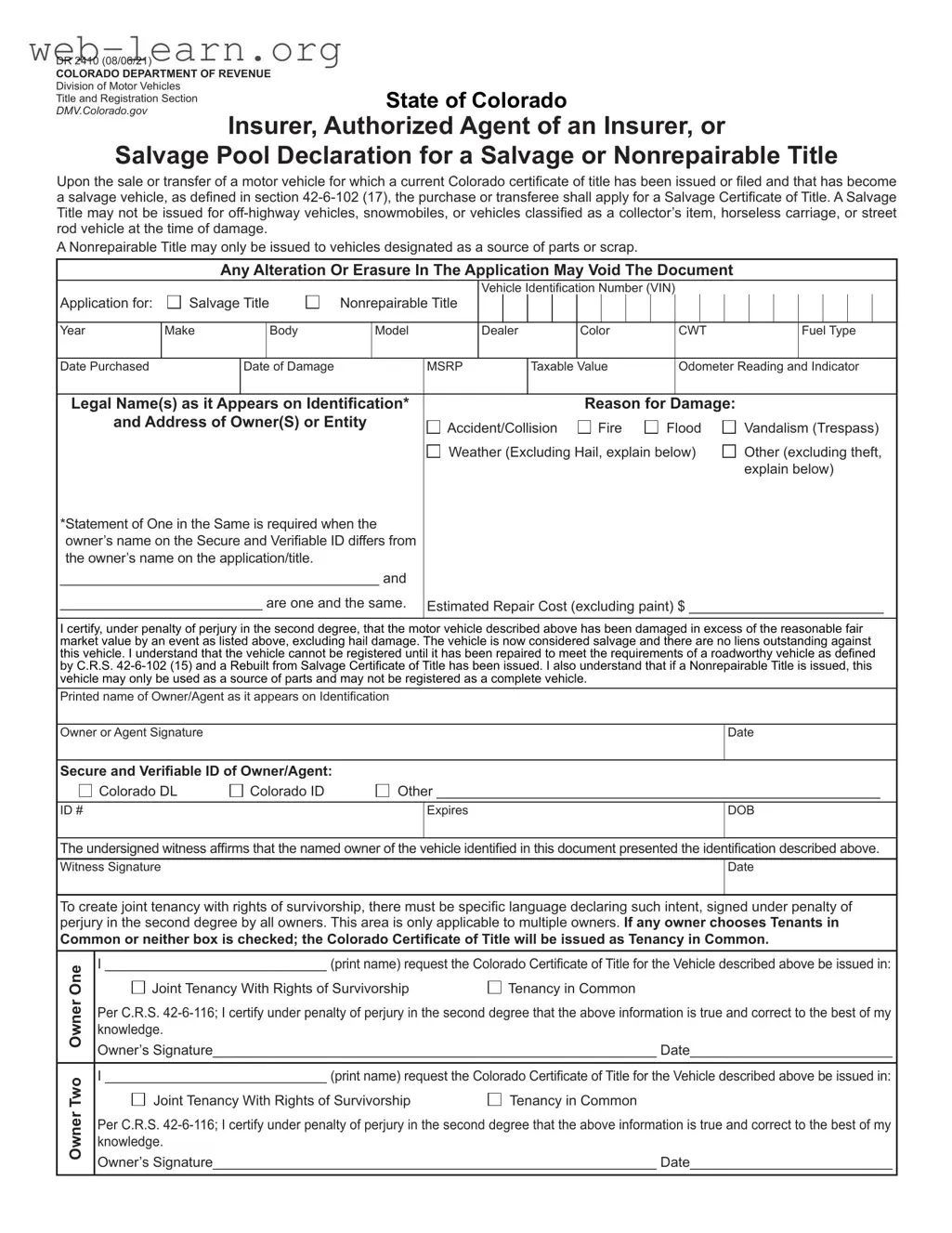
The Colorado DR 2410 form is a crucial document for individuals or entities looking to obtain a salvage title or a nonrepairable title for a motor vehicle that has suffered significant damage. When a vehicle is deemed a salvage vehicle, typically due to accidents, fires, floods, or other damaging events, the new owner must apply for this title through the Colorado Department of Revenue. It’s important to note that certain vehicles, such as off-highway vehicles, snowmobiles, and collector's items, are excluded from receiving a salvage title. Instead, a nonrepairable title may be issued for vehicles intended solely for parts or scrap. The form requires detailed information, including the vehicle identification number (VIN), make, model, year, and the reason for the damage. Additionally, the owner must certify that the vehicle's damage exceeds its fair market value and that no outstanding liens exist. Acknowledgment of the vehicle's status is essential, as it cannot be registered until repaired and issued a Rebuilt from Salvage Certificate of Title. Furthermore, if there are multiple owners, specific language must be included to establish joint tenancy with rights of survivorship or tenancy in common. Overall, the DR 2410 form serves as a formal application to navigate the complexities of salvage and nonrepairable vehicle titles in Colorado.


Sample - Colorado Dr 2410 Form

State of Colorado
Insurer, Authorized Agent of an Insurer, or
Salvage Pool Declaration for a Salvage or Nonrepairable Title
Upon the sale or transfer of a motor vehicle for which a current Colorado certicate of title has been issued or led and that has become
a salvage vehicle, as dened in section 42-6-102 (17), the purchase or transferee shall apply for a Salvage Certicate of Title. A Salvage
Title may not be issued for off-highway vehicles, snowmobiles, or vehicles classied as a collector’s item, horseless carriage, or street
rod vehicle at the time of damage.
A Nonrepairable Title may only be issued to vehicles designated as a source of parts or scrap.
Any Alteration Or Erasure In The Application May Void The Document
Application for: Salvage Title Nonrepairable Title
Vehicle Identication Number (VIN)
Year Make Body Model Dealer Color CWT Fuel Type
Date Purchased Date of Damage MSRP Taxable Value Odometer Reading and Indicator
Legal Name(s) as it Appears on Identication*
and Address of Owner(S) or Entity
* Statement of One in the Same is required when the
owner’s name on the Secure and Veriable ID differs from
the owner’s name on the application/title.
_________________________________________ and
__________________________ are one and the same.
Reason for Damage:
Accident/Collision Fire Flood Vandalism (Trespass)
Weather (Excluding Hail, explain below) Other (excluding theft,
explain below)
___________________________________________________________
___________________________________________________________
___________________________________________________________
___________________________________________________________
Estimated Repair Cost (excluding paint) $ _________________________
I certify, under penalty of perjury in the second degree, that the motor vehicle described above has been damaged in excess of the reasonable fair
market value by an event as listed above, excluding hail damage. The vehicle is now considered salvage and there are no liens outstanding against
this vehicle. I understand that the vehicle cannot be registered until it has been repaired to meet the requirements of a roadworthy vehicle as dened
by C.R.S. 42-6-102 (15) and a Rebuilt from Salvage Certicate of Title has been issued. I also understand that if a Nonrepairable Title is issued, this
vehicle may only be used as a source of parts and may not be registered as a complete vehicle.
Printed name of Owner/Agent as it appears on Identication
Owner or Agent Signature Date
Secure and Veriable ID of Owner/Agent:
Colorado DL Colorado ID Other _________________________________________________________
ID # Expires DOB
The undersigned witness afrms that the named owner of the vehicle identied in this document presented the identication described above.
Witness Signature Date
To create joint tenancy with rights of survivorship, there must be specic language declaring such intent, signed under penalty of
perjury in the second degree by all owners. This area is only applicable to multiple owners. If any owner chooses Tenants in
Common or neither box is checked; the Colorado Certicate of Title will be issued as Tenancy in Common.
Owner One
I _____________________________
(print name) request the Colorado Certicate of Title for the Vehicle described above be issued in:
Joint Tenancy With Rights of Survivorship Tenancy in Common
Per C.R.S. 42-6-116; I certify under penalty of perjury in the second degree that the above information is true and correct to the best of my
knowledge.
Owner’s Signature_________________________________________________________ Date__________________________
Owner Two
I _____________________________
(print name) request the Colorado Certicate of Title for the Vehicle described above be issued in:
Joint Tenancy With Rights of Survivorship Tenancy in Common
Per C.R.S. 42-6-116; I certify under penalty of perjury in the second degree that the above information is true and correct to the best of my
knowledge.
Owner’s Signature_________________________________________________________ Date__________________________
DR 2410 (08/06/21)
COLORADO DEPARTMENT OF REVENUE
Division of Motor Vehicles
Title and Registration Section
DMV.Colorado.gov
Insurer, Authorized Agent of an Insurer,
or Salvage Pool Declaration for a Salvage or Nonrepairable Title
This section is only required to be completed when an insurance company or salvage pool is applying for title without a properly
endorsed ownership document. The title fee for this type of transaction is $8.20.
Vehicle Description
Vehicle Identication Number (VIN)
Year Make Model Body Fuel
Odometer Reading & Indicator CWT Length Width
Applicant's Name
Address City State ZIP
Vehicle Acquired From Date of Settlement Acceptance:
Describe your attempts to contact the owner of record to obtain the properly endorsed certicate of ownership:
Notice Mailed To: Owner Lienholder Other _______________
Number of Written Attempts: Date(s) Mailed:
I certify, under penalty of perjury in the second degree, that the above statements are true and accurate to the best of my knowledge.
Applicant's Signature Date
DR 2410 (08/06/21)

Form Information

Fact Name Description
Form Purpose The DR 2410 form is used to apply for a Salvage Title or Nonrepairable Title for damaged motor vehicles in Colorado.
Applicable Vehicles Salvage Titles cannot be issued for off-highway vehicles, snowmobiles, or vehicles classified as collector’s items, horseless carriages, or street rods at the time of damage.
Legal Requirement According to C.R.S. 42-6-102 (15), a vehicle cannot be registered until it has been repaired to meet roadworthy standards and a Rebuilt from Salvage Certificate of Title has been issued.
Nonrepairable Title A Nonrepairable Title is only issued for vehicles designated as a source of parts or scrap and cannot be registered as a complete vehicle.
Owner Verification The form requires a Secure and Verifiable ID of the owner or agent to confirm identity and ownership before processing.

Detailed Guide for Filling Out Colorado Dr 2410

Filling out the Colorado DR 2410 form is an important step when applying for a salvage or nonrepairable title for a vehicle. This process requires accurate information to ensure the application is processed correctly. Follow these steps carefully to complete the form.

  1. Obtain the Colorado DR 2410 form from the Colorado Department of Revenue website or a local Division of Motor Vehicles office.
  2. Indicate whether you are applying for a Salvage Title or a Nonrepairable Title by checking the appropriate box.
  3. Fill in the Vehicle Identification Number (VIN), Year, Make, Body Model, Dealer Color, and Fuel Type.
  4. Provide the Date Purchased, MSRP, Taxable Value, and Odometer Reading and Indicator.
  5. Enter the Legal Name(s) as it appears on your identification and the Address of the owner(s) or entity.
  6. State the Reason for Damage by selecting one of the options provided and explaining if necessary.
  7. Estimate the Repair Cost and enter the amount in the designated space.
  8. Sign the certification statement, confirming the vehicle is damaged and has no outstanding liens.
  9. Print the name of the owner or agent as it appears on identification.
  10. Provide the Secure and Verifiable ID of the owner/agent, including the type of ID, ID number, expiration date, and date of birth.
  11. If applicable, have a witness sign to affirm the identification presented.
  12. If there are multiple owners, indicate the preferred form of ownership (Joint Tenancy or Tenancy in Common) and have all owners sign and date the form.

Obtain Answers on Colorado Dr 2410

  1. What is the Colorado DR 2410 form?

    The Colorado DR 2410 form is an application for a Salvage Title or Nonrepairable Title. It is used when a motor vehicle has been damaged and is considered a salvage vehicle. This form is required by the Colorado Department of Revenue's Division of Motor Vehicles.

  2. Who needs to fill out this form?

    Anyone who purchases or receives a motor vehicle that has been declared salvage must complete the DR 2410 form. This includes individuals and businesses. The form is also necessary for vehicles that are designated as nonrepairable, meaning they can only be used for parts or scrap.

  3. What information is required on the form?

    • Vehicle Identification Number (VIN)
    • Year, make, body model, and color of the vehicle
    • Legal name(s) and address of the owner(s)
    • Reason for damage (e.g., accident, fire, flood)
    • Estimated repair cost

    All of this information helps to establish the vehicle's status and assists in the title application process.

  4. What happens if I make a mistake on the form?

    Any alteration or erasure on the DR 2410 form may void the document. It is important to fill out the form carefully and accurately. If a mistake is made, it is advisable to complete a new form rather than trying to correct the original.

  5. Can I register a vehicle with a Nonrepairable Title?

    No, a vehicle with a Nonrepairable Title cannot be registered as a complete vehicle. It may only be used for parts or scrap. If you wish to register the vehicle, you will need to obtain a Rebuilt from Salvage Certificate of Title after the vehicle has been repaired to meet roadworthy standards.

  6. What is the penalty for providing false information on the form?

    Providing false information on the DR 2410 form is a serious matter. The form includes a certification statement that declares the information is true and correct. If found guilty, the individual may face penalties, including legal consequences for perjury.

Common mistakes

Filling out the Colorado DR 2410 form can be straightforward, but many people make mistakes that can lead to delays or complications. One common error is failing to provide the correct Vehicle Identification Number (VIN). The VIN is crucial for identifying the vehicle, and any mistakes can cause issues with the title application.

Another frequent mistake is not including the legal name of the owner as it appears on their identification. This information must match exactly. If it doesn’t, the application may be rejected. In cases where there is a difference, a statement of one in the same is required, which many people overlook.

People also often forget to explain the reason for damage adequately. Simply selecting "Accident/Collision" without further details can lead to confusion. Providing a thorough explanation helps the Department of Revenue understand the vehicle's condition better and can expedite the process.

Some applicants neglect to complete the estimated repair cost section. This information is essential for determining whether the vehicle qualifies for a salvage title. Leaving this blank can delay processing or result in denial of the application.

Additionally, signatures are sometimes missing. Both the owner and any agents must sign the form. A missing signature can lead to the application being deemed incomplete, causing further delays.

Another mistake involves misunderstanding the distinction between a salvage title and a nonrepairable title. Applicants may apply for the wrong title based on their vehicle's condition. It's important to understand the definitions and requirements for each type of title before submitting the application.

Some individuals fail to provide their Secure and Verifiable ID. This ID is necessary for verifying the identity of the owner or agent. Not including this information can result in the application being returned or rejected.

Lastly, people sometimes skip the witness signature section. If the application involves multiple owners, a witness signature is required to affirm the identification presented. Omitting this step can lead to further complications in the title issuance process.

Documents used along the form

The Colorado DR 2410 form is essential for applying for a salvage or nonrepairable title for a damaged vehicle. Several other forms and documents may accompany this application to ensure proper processing and compliance with state regulations. Below is a list of related documents that are often used in conjunction with the DR 2410 form.

  • Colorado Title Application (DR 2395) - This form is used to apply for a new title for a vehicle, including transfers, replacements, or changes in ownership.
  • Vehicle Identification Number (VIN) Inspection Form (DR 2704) - This document verifies the VIN of a vehicle, ensuring it matches the title and registration records.
  • Affidavit of Inheritance (DR 2420) - This form is used when a vehicle is inherited, providing proof of ownership transfer due to the death of the previous owner.
  • Bill of Sale - A bill of sale serves as a receipt for the transaction, documenting the sale of the vehicle from one party to another.
  • Secure and Verifiable Identification - This identification is required to confirm the identity of the vehicle owner or agent submitting the application.
  • Rebuilt from Salvage Title Application (DR 2411) - This form is used to apply for a rebuilt title after repairs have been made to a salvage vehicle, indicating it is roadworthy.
  • Notice of Lien (DR 2175) - This document notifies the state of any outstanding liens against the vehicle, which must be cleared before a title can be issued.
  • Power of Attorney (POA) - A POA allows another person to act on behalf of the vehicle owner in the title application process.
  • Odometer Disclosure Statement (DR 2173) - This form provides a record of the vehicle's mileage at the time of sale or transfer, which is necessary for title applications.
  • Application for Special Plates (DR 2000) - If the vehicle requires special license plates, this application is submitted along with the title application.

These documents facilitate the smooth processing of the DR 2410 form and ensure compliance with Colorado's vehicle title regulations. Having the correct forms ready can help avoid delays in obtaining a salvage or nonrepairable title.

Similar forms

The Colorado DR 2410 form is used to apply for a salvage title or nonrepairable title for a motor vehicle. It serves a specific purpose in the realm of vehicle ownership and title management. Several other documents share similarities with the DR 2410 form, primarily in their function and the information they require. Here are four such documents:

  • Application for Title (Form DR 2395): This form is used to apply for a new title for a vehicle that has not been previously titled in Colorado. Like the DR 2410, it collects information about the vehicle, including the Vehicle Identification Number (VIN), make, model, and owner details. Both forms require the applicant to provide proof of identity and ownership.
  • Bill of Sale: A bill of sale is a document that proves the transfer of ownership from one party to another. It includes details about the vehicle, such as the VIN, purchase price, and the names of the buyer and seller. Similar to the DR 2410, it is essential for establishing legal ownership, especially when applying for a new title.
  • Application for Rebuilt Title (Form DR 2411): This form is required when a vehicle that was previously declared salvage has been repaired and is being re-titled. It is akin to the DR 2410 in that it also requires information about the vehicle's condition and ownership, as well as proof that the vehicle has been restored to a roadworthy state.
  • Notice of Lien (Form DR 2175): This document is used to notify the state that a lien exists on a vehicle. It requires details about the vehicle, the owner, and the lienholder. Like the DR 2410, it plays a critical role in the vehicle title process, ensuring that all financial interests in the vehicle are documented and recognized.

Dos and Don'ts

When filling out the Colorado DR 2410 form, it’s crucial to follow certain guidelines to ensure a smooth application process. Here’s a list of things you should and shouldn’t do:

  • Do provide accurate information about the vehicle, including the Vehicle Identification Number (VIN), year, make, and model.
  • Do clearly state the reason for the vehicle's damage, selecting from the provided options.
  • Do ensure that the legal name(s) of the owner(s) match exactly as they appear on the identification.
  • Do sign and date the application where indicated to validate your submission.
  • Do include a statement of one in the same if the name on the ID differs from the application.
  • Don't make any alterations or erasures on the form, as this may void the document.
  • Don't forget to provide your Secure and Verifiable ID information.
  • Don't leave any required fields blank; incomplete applications may lead to delays.
  • Don't submit the application without ensuring that there are no outstanding liens against the vehicle.

By adhering to these guidelines, you can help expedite the process of obtaining a salvage or nonrepairable title for your vehicle. Ensure all details are correct and complete to avoid unnecessary complications.

Misconceptions

Understanding the Colorado DR 2410 form can be challenging. Here are eight common misconceptions about this important document:

  • A Salvage Title can be issued for any vehicle. This is not true. A Salvage Title is only issued for vehicles that meet specific criteria, excluding off-highway vehicles, snowmobiles, and collector's items.
  • Once a vehicle has a Salvage Title, it cannot be repaired. In fact, vehicles with a Salvage Title can be repaired and later receive a Rebuilt from Salvage Certificate of Title, allowing them to be registered again.
  • A Nonrepairable Title allows the vehicle to be used on the road. This is a misconception. A Nonrepairable Title means the vehicle can only be used for parts or scrap and cannot be registered as a complete vehicle.
  • Hail damage qualifies for a Salvage Title. This is incorrect. Hail damage is specifically excluded from the reasons that qualify a vehicle for a Salvage Title.
  • All owners must be present to sign the form. While it is ideal for all owners to sign, only one signature is required for the application, provided that the ownership is clearly established.
  • The form can be altered or erased if mistakes are made. Any alterations or erasures on the application may void the document, so it is crucial to fill it out carefully.
  • Only the owner can apply for a Salvage Title. An agent can also apply on behalf of the owner, as long as the agent's authority is clearly established.
  • There are no penalties for providing false information. This is a serious misconception. Certifying false information can lead to penalties, including perjury charges.

Being aware of these misconceptions can help ensure that you complete the Colorado DR 2410 form accurately and understand the implications of the titles involved.

Key takeaways

When dealing with the Colorado DR 2410 form, understanding the key points can make the process smoother. Here are some essential takeaways:

  • Purpose of the Form: This form is used to apply for a Salvage Title or a Nonrepairable Title for a vehicle that has been damaged beyond repair.
  • Eligibility: A Salvage Title cannot be issued for off-highway vehicles, snowmobiles, or vehicles classified as collector’s items at the time of damage.
  • Owner Identification: The legal name and address of the vehicle owner must match the identification presented. If there is a discrepancy, a Statement of One in the Same is required.
  • Repair Costs: You must provide an estimated repair cost. This figure helps establish that the vehicle is considered salvage.
  • Joint Ownership: If there are multiple owners, specific language must be included to establish joint tenancy with rights of survivorship; otherwise, the title will default to Tenancy in Common.

Filling out this form accurately is crucial, as any alterations or erasures may void the application. Ensure all information is complete and truthful to avoid delays in processing.